

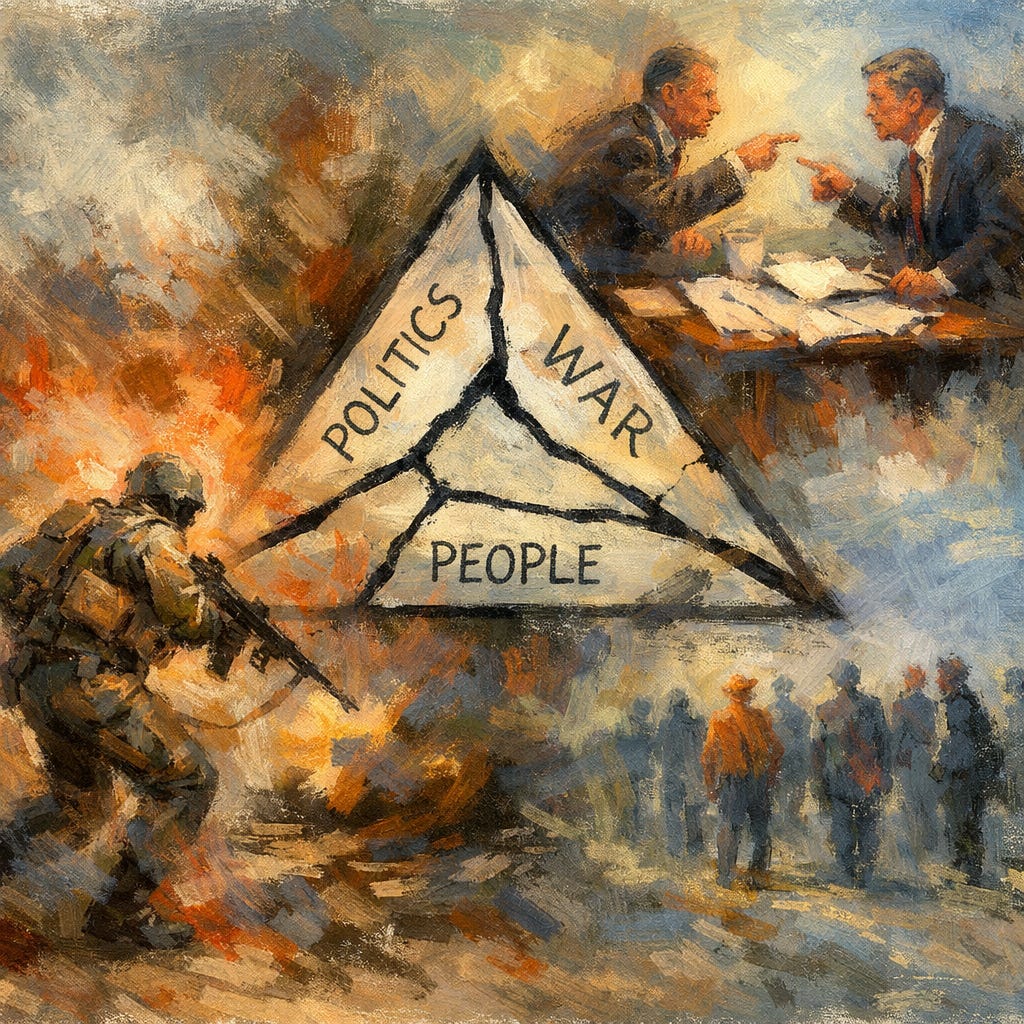
For more than two centuries, military strategists have turned to Carl von Clausewitz’s concept of the “remarkable trinity” to understand the nature of war.
Clausewitz argued that war emerges from the dynamic interaction of three forces: reason, passion, and probability—embodied in the state, the people, and the military.
In healthy political systems, these forces operate in tension but remain in balance. Political leadership defines the purpose of war, public sentiment supplies legitimacy and endurance, and the military profession manages the uncertainties of violence through disciplined application of force.
Yet the experience of the United States and its allies over the past two decades suggests that this triangular balance has eroded. The wars in Iraq and Afghanistan—particularly the strategic failures that followed the initial battlefield victories of 2001 and 2003—reveal a deeper structural problem: the gradual deformation of Clausewitz’s trinity in modern democratic societies.
The result is a troubling paradox. Western militaries have become historically unmatched in their capacity for operational and tactical excellence. But the political systems that authorize the use of that force have become increasingly short-term in their strategic orientation, while the societies that sustain those wars have grown progressively detached from the strategic purposes behind them.
The triangle is no longer equilateral.
Instead, it has become unbalanced—and in that imbalance lies the strategic dysfunction that has haunted Western military interventions in the twenty-first century.
The Strategic Blind Spot
Few episodes illustrate the deformation of Clausewitz’s trinity more clearly than the invasion of Iraq in 2003.
In the years that followed, the conventional explanation for the war’s strategic unraveling often centered on a simple claim: the United States failed to anticipate the long and difficult stabilization phase that would follow the collapse of Saddam Hussein’s regime.
But the historical record suggests a more troubling reality.
In December 2004, a U.S. Army historian and war planner involved in the campaign concluded that the invasion had proceeded without a comprehensive plan for stabilizing Iraq after the fall of Baghdad, a failure that continued to undermine the campaign long after the initial military victory. The problem was not the absence of operational preparation; the invasion itself had been meticulously planned and executed.
Rather, the deeper deficiency lay in the lack of a coherent political–military strategy for the postwar period.
The challenge of post-conflict stabilization—what the U.S. military calls “Phase IV operations”—was not an unknown concept within the professional military community. Military planners had long studied the political aftermath of war. From the reconstruction of Germany and Japan after World War II to the stabilization missions in Bosnia and Kosovo in the 1990s, historical precedent made clear that the collapse of a regime rarely constitutes the decisive strategic outcome of war. Removing a government simply creates a political vacuum that must be filled.
Indeed, many planners understood that regime collapse in Iraq could generate precisely the kinds of problems that later emerged: looting, institutional breakdown, and insurgency. Yet this understanding did not translate into a coherent political design for the postwar environment.
The reason lies not simply in bureaucratic oversight but in something deeper: the institutional compartmentalization of strategy itself.
Military planners recognized that the collapse of the Iraqi state would produce profound political consequences. But the professional culture of the armed forces encouraged a particular interpretation of civil–military relations. Political objectives belonged to civilian leadership; the military’s responsibility was execution. The armed forces would plan and conduct the invasion—the destruction of Saddam Hussein’s regime—but the broader political reconstruction of Iraq was treated as someone else’s problem.
This division reflected a widely accepted interpretation of Samuel Huntington’s model of objective civilian control, in which a politically neutral military confines itself to its professional sphere: the management of organized violence. Civilian leaders determine policy; the military carries it out.
In theory, this arrangement protects democratic governance.
In practice, however, the Iraq experience revealed its limitations. War is not a discrete technical activity that begins and ends with battlefield victory. It is a political process unfolding through violence. When the military treats the political consequences of war as external to its professional responsibility, strategic blind spots emerge precisely where the war’s decisive outcomes are determined.
The immediate aftermath of Baghdad’s fall illustrated this danger with striking clarity. The Iraqi state collapsed far more completely than anticipated. Ministries were looted, security institutions evaporated, and the administrative machinery of the state disintegrated almost overnight. Without sufficient forces to secure the country or a comprehensive plan for restoring governance, the political vacuum quickly filled with insurgent networks, sectarian militias, and criminal organizations.
What followed was not simply an insurgency but the unraveling of the strategic assumptions upon which the invasion had been built.
The blind spot, in other words, was not the absence of military competence. The invasion itself demonstrated overwhelming operational superiority. The blind spot lay in the failure to integrate military operations with a coherent political design for what would follow the collapse of the regime.
This failure exposes the deeper imbalance within Clausewitz’s trinity. Political leadership focused narrowly on regime removal. The military executed the operational plan with extraordinary efficiency. But the broader strategic relationship between political purpose, military action, and societal stability remained unresolved.
The result was a war that achieved decisive battlefield success while simultaneously losing control of the political conditions that define victory.
In Clausewitzian terms, the problem was not the destruction of the enemy’s forces. It was the absence of a viable political order capable of replacing the regime that had been destroyed.
Clausewitz, Misunderstood
Clausewitz’s conception of war was never politically sterile. His analysis rested on the fundamental proposition that war is a continuation of politics by other means. Military operations cannot be understood apart from the political objectives they are meant to achieve.
Yet in modern Western military culture, Clausewitz’s insight has often been overshadowed by a narrower interpretation of military professionalism that emphasizes operational competence while discouraging deep engagement with political questions.
This interpretation draws heavily from Samuel Huntington’s influential model of civil–military relations. In Huntington’s framework, a professional military preserves democratic governance by remaining politically neutral and focusing exclusively on its technical expertise: the management of violence.
But Huntington’s model was never intended to produce a politically ignorant military. And Clausewitz’s theory certainly did not support one.
Indeed, another influential scholar of civil–military relations offered a different interpretation of the military profession’s role in modern societies.
Writing in the 1960s, the sociologist Morris Janowitz argued that modern armed forces increasingly operate within a “constabulary” framework, in which military leaders remain deeply embedded in the political and societal purposes of the state.
In Janowitz’s vision, military professionalism does not require political detachment. Rather, it requires a deep understanding of the political contexts in which military force is employed.
Clausewitz’s own experience of war aligns far more closely with Janowitz’s model than with Huntington’s abstraction. For Clausewitz, war was inseparable from the political life of the society that fought it. Military leaders could not isolate themselves from political considerations because the entire purpose of military action was political.
When professional military education encourages officers to master the operational art of war-fighting while implicitly discouraging them from interrogating the political purposes of war itself, it inadvertently creates a profession extraordinarily skilled at applying force but hesitant to question the strategic logic guiding its use.
That is precisely the break in the trinity.
The Myopia of Politics
If the military dimension of the trinity has become overly professionalized, the political dimension has evolved in a different but equally troubling direction.
Modern democratic politics operates on increasingly compressed time horizons. Electoral cycles, media ecosystems, and public opinion pressures reward short-term political advantage far more reliably than long-term strategic design. In such an environment, decisions about the use of force are often shaped by immediate political incentives rather than sustained strategic deliberation.
Wars, however, unfold on entirely different timelines.
Military campaigns can last years. Stabilization and reconstruction efforts can last decades. Political careers, by contrast, are measured in election cycles.
This mismatch produces strategic incoherence. Military forces execute their missions with extraordinary competence, but the political objectives those missions are meant to achieve shift or dissolve under domestic political pressure.
The strategic equation no longer balances.
A Detached Citizenry
The third element of Clausewitz’s trinity—the people—has also changed dramatically in modern democratic societies.
The transition to an all-volunteer professional military has produced a force of exceptional capability. But it has also created a widening social distance between the military and the society it serves.
Wars continue, but most citizens experience them only indirectly.
This distance produces a form of strategic disengagement. Citizens assume that political and military leaders have developed coherent strategies for the wars they authorize. Yet those strategies are often poorly articulated, weakly debated, or only loosely connected to the sacrifices demanded of those who fight.
When public engagement with war becomes shallow, the legitimacy component of Clausewitz’s trinity weakens.
The Eisenhower Warning
The consequences of this imbalance were foreseen by one of the most experienced soldier–statesmen of the twentieth century.
In his farewell address in January 1961, President Dwight D. Eisenhower warned of the growing influence of what he called the military–industrial complex. His warning is often remembered as a critique of defense spending or bureaucratic power.
But Eisenhower’s deeper concern was about the health of the American Republic itself.
Eisenhower understood that democratic societies must remain vigilant about the relationship between military institutions, political leadership, and civic responsibility. His warning could only have come from someone who had inhabited all three roles simultaneously: soldier, strategist, and president.
When these spheres drift apart, the strategic judgment of the republic itself begins to erode.
The Real Dereliction
The strategic dysfunction of the past two decades cannot be attributed solely to political leadership, military institutions, or public disengagement. It arises from the interaction of all three.
The political system often pursues short-term objectives.
The military profession executes those objectives with extraordinary competence but remains culturally cautious about interrogating their strategic logic.
The public assumes coherence that often does not exist.
The result is a republic capable of fighting wars with unmatched operational excellence yet struggling to achieve durable political outcomes.
In such circumstances, the failure is not merely operational.
It is constitutional.
As Lt. Gen. Sir William Francis Butler centuries ago, societies that separate their thinkers from their warriors risk becoming places where thinking is done by cowards and fighting by fools.1
That danger is not theoretical. It is increasingly visible in the strategic contradictions of modern war.
Restoring the Balance
Rebalancing Clausewitz’s trinity will not be easy. But the path forward begins with a renewed understanding of the profession of arms.
Military officers must remain politically nonpartisan. But nonpartisanship does not require political ignorance. Clausewitz’s insight demands that officers understand the political purposes for which wars are fought and the strategic conditions required to achieve them.
Professional military education therefore has a critical role to play. Institutions such as the U.S. Army’s School of Advanced Military Studies were originally designed to cultivate officers who were not merely technicians of force but strategists steeped in history, politics, and philosophy.
Reinvigorating that tradition would strengthen—not weaken—civilian control of the military.
The goal is not a politicized military.
It is a strategically literate one.
The Republic at War
Ultimately, restoring balance within Clausewitz’s trinity is not simply a military problem. It is a civic one.
War is not merely an instrument of state policy. It is a test of the relationship between government, military institutions, and the societies that sustain them.
Clausewitz understood that war reflects the character of the political community that wages it.
If modern democracies wish to wage war wisely—or avoid it when possible—they must restore the equilibrium between reason, passion, and probability that once anchored the remarkable trinity.
Until they do, the pattern of operational success followed by strategic disappointment will likely continue.
Author Bio
Isaiah “Ike” Wilson III is a retired U.S. Army colonel and former senior civilian executive in the U.S. Department of Defense. He is a professor of practice at Arizona State University and founder of Wilson W.i.S.E. Consulting. He previously served as president of the Joint Special Operations University and is the author of Thinking Beyond War: Civil-Military Relations and Why America Fails to Win the Peace.
If you value this work, here are three ways you can step into the story with us:
📰 Subscriber (Free)
Stay informed. Receive every new essay, briefing, and analysis straight to your inbox. Join a growing community committed to civic resilience and national security.
🎧 Supporter (Paid Pledge)
Strengthen the signal. Your support sustains both Compound Security, Unlocked and our companion podcast The Civic Brief. Supporters ensure these conversations remain accessible to the wider public while elevating the quality, depth, and reach of the work.
🛡️ Sustainer (Patron Level)
Invest in the mission. Sustainers fuel new research, convenings, and storytelling that enlarge the civic frame of security. This is more than content — it’s a civic project. Your sponsorship helps preserve an independent voice committed to equipping citizens, leaders, and institutions for the compound challenges ahead.
All too often misattributed to the ancient Greece warrior-historian, Thucydides, rather than to its true originator, Sir Francis Butler.


