

By Isaiah Wilson III
Author’s Note: There and Back Again?
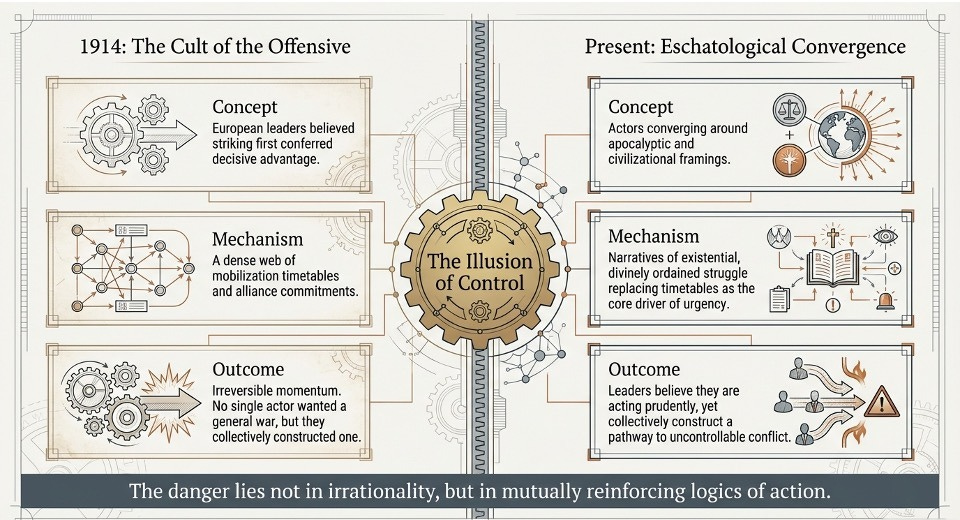
Political scientist Stephen Van Evera famously described how great powers, on the eve of the First World War, fell under the spell of what he termed the “cult of the offensive.” European leaders came to believe that striking first conferred decisive advantage, that delay invited defeat, and that war—if it came—would be short, manageable, even clarifying.
They were wrong on every count.
In The Guns of August, Barbara Tuchman chronicles how a dense web of mobilization timetables, alliance commitments, and strategic assumptions transformed crisis into catastrophe. No single actor set out to produce a general war. Yet each, acting within its own logic—its own perceived necessity—helped propel Europe toward a conflict that none could ultimately control.
What is most striking, in retrospect, is not the inevitability of war, but the confidence with which leaders believed they could manage it.
This essay begins from a similar concern.
Today, in the evolving confrontation involving Iran, Israel, and the United States, we are witnessing the emergence of something that bears an unsettling resemblance—not in form, but in function.
Then, the driver was a shared belief in the advantages of offense.
Now, it may be the convergence of apocalyptic and civilizational framings that elevate urgency, compress timelines, and redefine acceptable risk.
In both cases, the danger lies not in irrationality, but in mutually reinforcing logics of action.
Then, mobilization schedules created a sense of irreversible momentum.
Now, narratives of existential struggle—whether religious, civilizational, or strategic—may be performing a similar role.
The question, therefore, is not whether history repeats itself in detail. It does not.
The question is whether we are once again entering a moment in which leaders believe they are acting prudently, even defensively, while collectively constructing a pathway to outcomes they neither fully intend nor can easily arrest.
There and back again is not a law of history.
But it is a warning.
BLUF (Bottom Line Up Front)
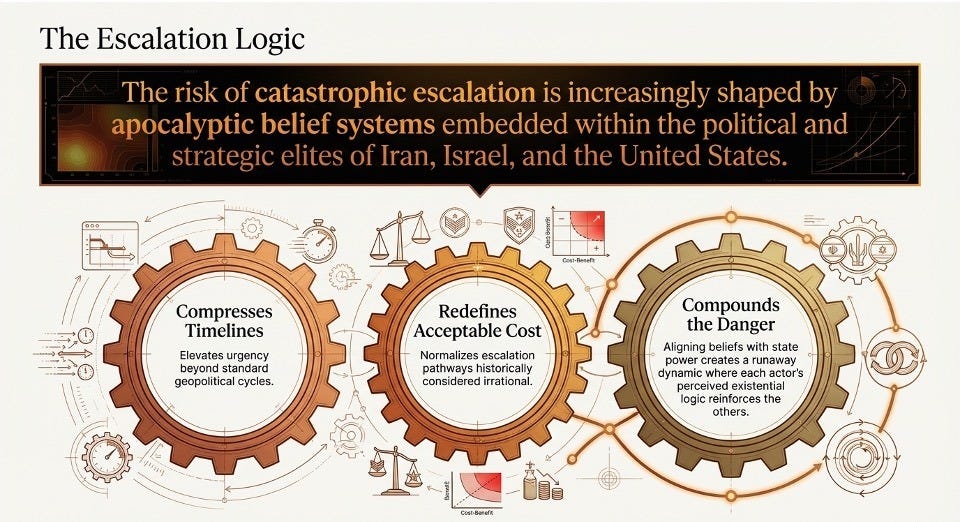
The growing risk of catastrophic escalation in the Iran–Israel–United States conflict is not driven solely by miscalculation, deterrence failure, or conventional security dilemmas. It is increasingly shaped by the interaction of apocalyptic belief systems embedded within political and strategic elites across all three actors.
When such beliefs align with state power, they can compress decision timelines, redefine acceptable costs, and normalize escalation pathways that would otherwise be considered irrational.
The result is a compound escalation dynamic in which each actor’s perceived existential logic reinforces the others—raising the probability of large-scale war, including scenarios previously confined to the realm of the unthinkable.
The Return of the Eschatological Variable
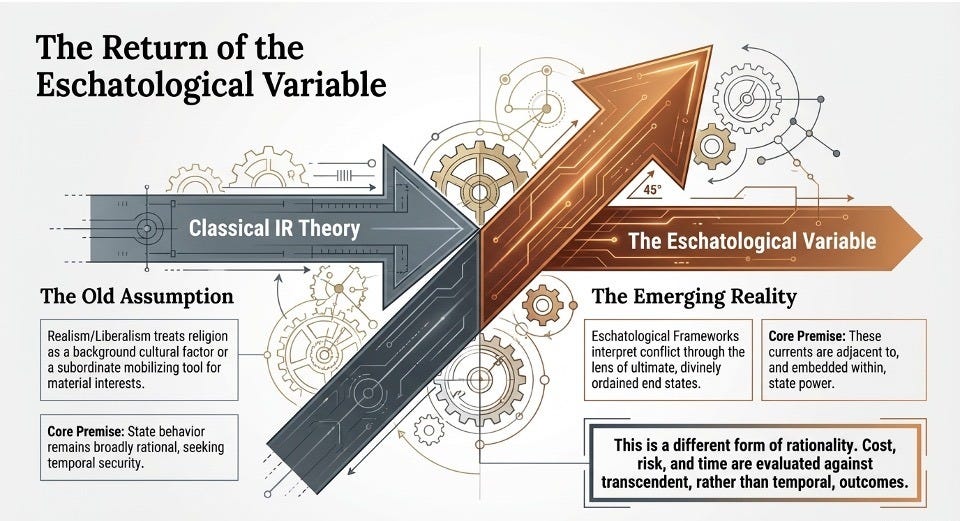
Modern international relations theory has long treated religion as either a background cultural factor or a mobilizing tool subordinate to material interests. From realism’s focus on power distributions to liberalism’s emphasis on institutions, the dominant frameworks assume that state behavior remains broadly rational, even when ideological.
This assumption is increasingly under strain.
Across the three principal actors in the current Iran conflict—the Islamic Republic of Iran, the State of Israel, and the United States—there exist influential currents of thought that are not merely ideological, but eschatological. That is, they interpret present conflict through the lens of ultimate, divinely ordained end states.
These currents are not fringe in the traditional sense. They are adjacent to power, sometimes embedded within it.
The result is not irrationality per se, but a different form of rationality—one in which cost, risk, and time are evaluated against transcendent, rather than temporal, outcomes.
Three Theaters, One Escalatory Logic
Iran: The Mahdist Horizon
Within the ideological architecture of the Islamic Republic, particularly among hardline factions of the Islamic Revolutionary Guard Corps (IRGC), strands of Twelver Shi’a eschatology—centered on the eventual return of the Hidden Imam (the Mahdi)—have long shaped strategic narratives.
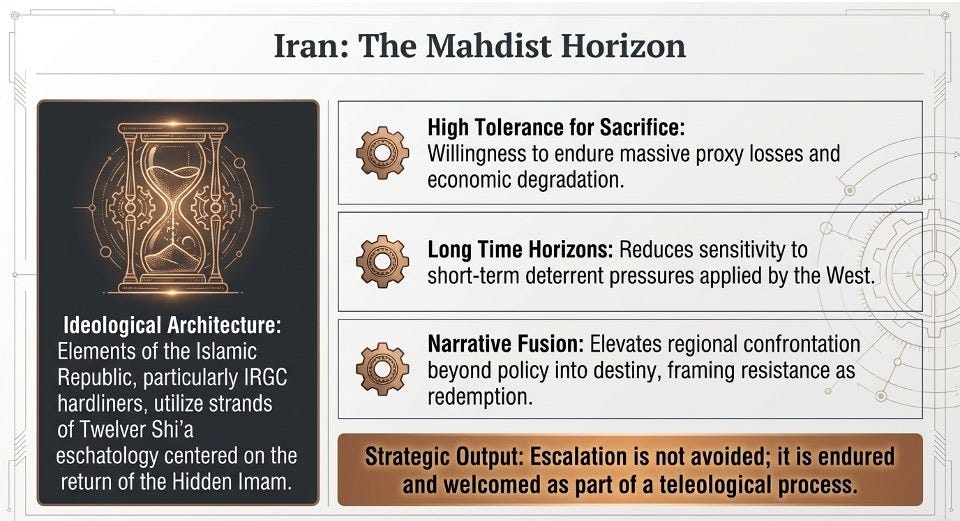
While the Iranian state is not reducible to apocalyptic theology, there is a documented pattern in which certain actors frame regional confrontation as part of a broader, divinely structured historical arc.
This framing can have operational consequences:
Tolerance for high levels of sacrifice, including proxy losses and economic degradation
Long time horizons, reducing sensitivity to short-term deterrent pressures
Narrative fusion between resistance and redemption, elevating conflict beyond policy into destiny
In such a system, escalation is not necessarily avoided; it can be endured, even welcomed, as part of a teleological process.
Israel: Redemption and Preemption
Within Israel, particularly among elements of the religious Zionist movement, there exists a parallel but distinct eschatological framework—one rooted in the belief that the modern state plays a role in a redemptive historical process.
This worldview does not dominate Israeli policy, but it has gained increasing influence within segments of the political and security establishment.
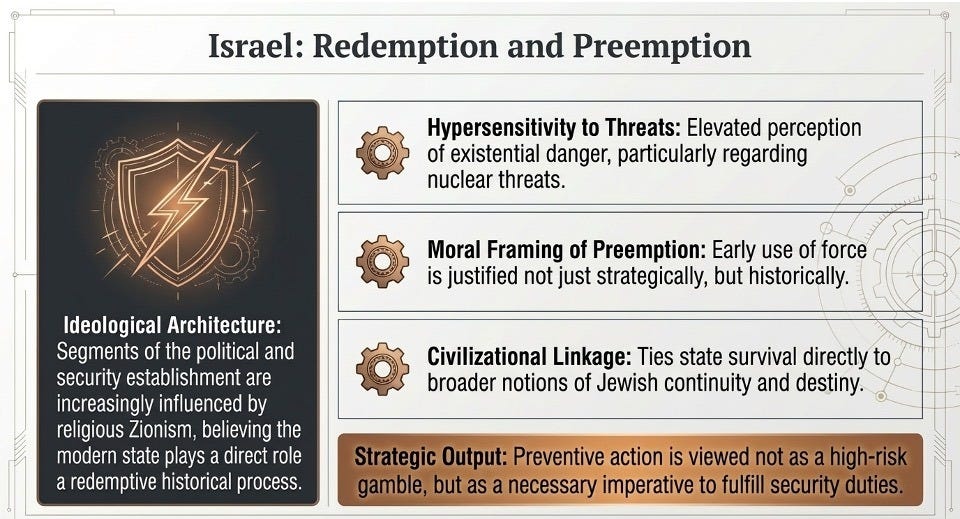
Its strategic implications are subtle but significant:
Heightened sensitivity to existential threat narratives, particularly regarding Iran’s nuclear program
Moral framing of preemption, in which early use of force is justified not only strategically but historically
Territorial and civilizational linkage, tying state survival to broader notions of Jewish continuity and destiny
The result is a decision environment in which preventive or preemptive action may be viewed not as risky, but as necessary to fulfill both security and historical imperatives.
United States: Civilizational Framing and Evangelical Eschatology
In the United States, apocalyptic belief operates through a different pathway—less institutionalized, but politically potent.
Segments of American political discourse, particularly within Christian nationalist and evangelical communities, interpret Middle Eastern conflict through dispensationalist frameworks that assign theological significance to Israel, Iran, and regional war.
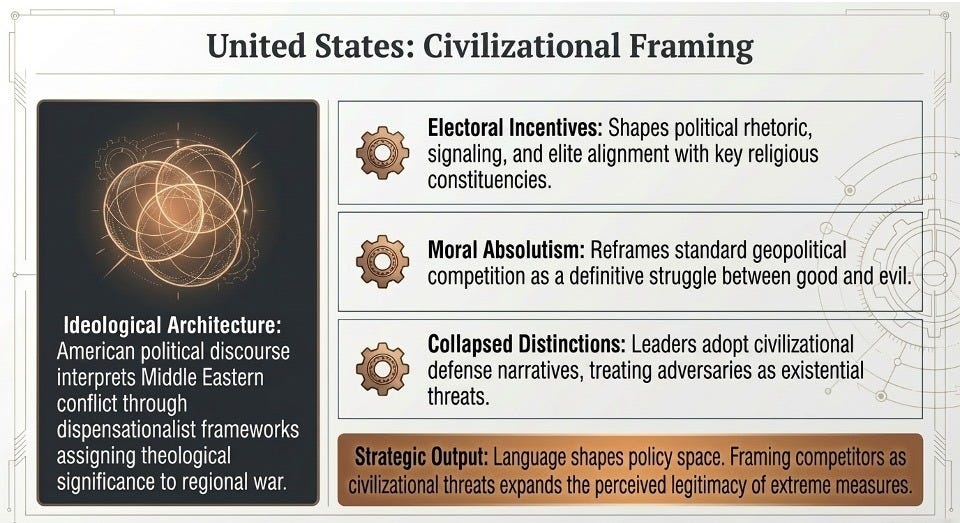
While these views do not dictate U.S. policy, they exert influence through:
Electoral incentives, shaping political rhetoric and signaling
Elite alignment, where policymakers adopt civilizational language that resonates with these constituencies
Moral absolutism, reframing geopolitical competition as a struggle between good and evil
More broadly, recent U.S. rhetoric has increasingly invoked civilizational defense narratives, collapsing distinctions between strategic competition and existential struggle.
This matters because language shapes policy space. When leaders describe adversaries not as competitors but as civilizational threats, they expand the perceived legitimacy of extreme measures.
From Deterrence to Destiny: A Shift in Strategic Grammar
Classical deterrence theory rests on a core assumption: that actors seek to avoid catastrophic loss.
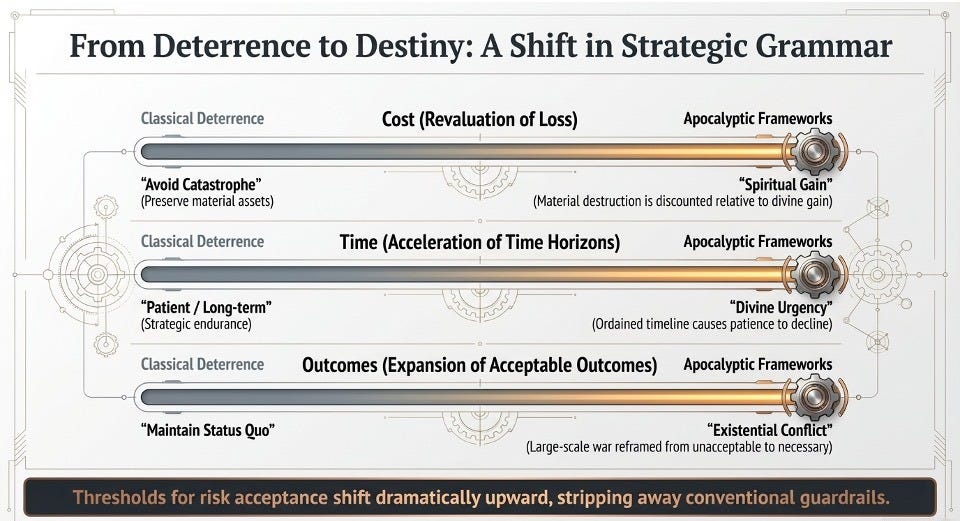
Apocalyptic frameworks complicate this assumption in three ways:
Revaluation of Loss
Material destruction may be discounted relative to perceived spiritual or historical gain.Acceleration of Time Horizons
If actors believe they are operating within a divinely ordained timeline, urgency increases, and patience declines.Expansion of Acceptable Outcomes
Outcomes previously considered unacceptable—including large-scale war—may be reframed as necessary or even desirable.
This does not mean that leaders seek destruction. Rather, it means that the thresholds for risk acceptance shift upward, sometimes dramatically.
The Emergence of a Compound Escalation System
What makes the current moment uniquely dangerous is not the presence of apocalyptic belief in any one actor, but the interaction of such beliefs across all three.
This creates what can be termed a compound escalation system:
Iran interprets resistance as divinely validated endurance
Israel interprets preemption as historically necessary survival
The United States increasingly frames conflict in civilizational terms
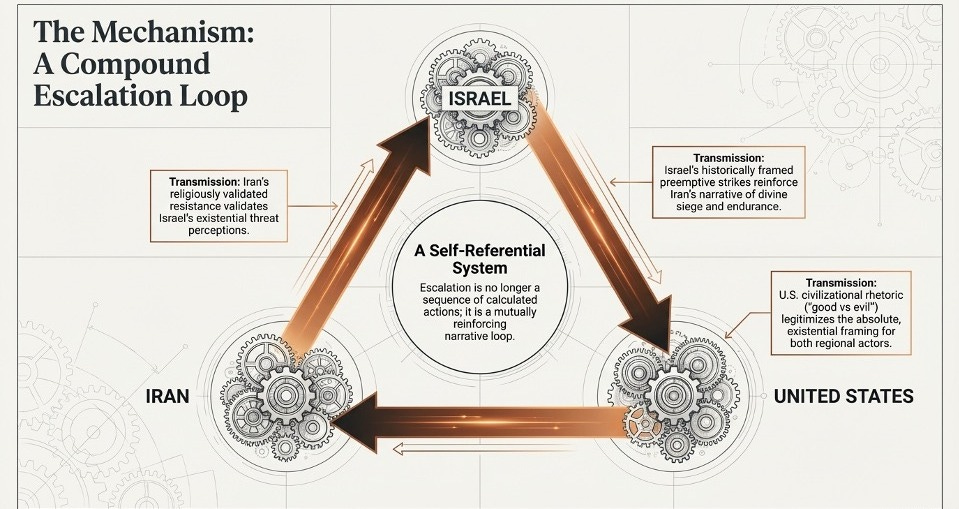
Each logic reinforces the others.
Iranian escalation validates Israeli threat perceptions
Israeli preemption reinforces Iranian narratives of siege
U.S. civilizational rhetoric legitimizes both as components of a broader struggle
The system becomes self-referential.
In such an environment, escalation is not merely a sequence of actions; it is a mutually reinforcing narrative loop.
Armageddon as Emergent Outcome, Not Intentional Objective
It is critical to distinguish between intentional apocalypse and emergent catastrophe.
There is little evidence that any of the three actors seek global destruction as an explicit goal. However, the interaction of their respective belief systems and strategic logics can produce outcomes that approximate apocalyptic scenarios, even in the absence of such intent.
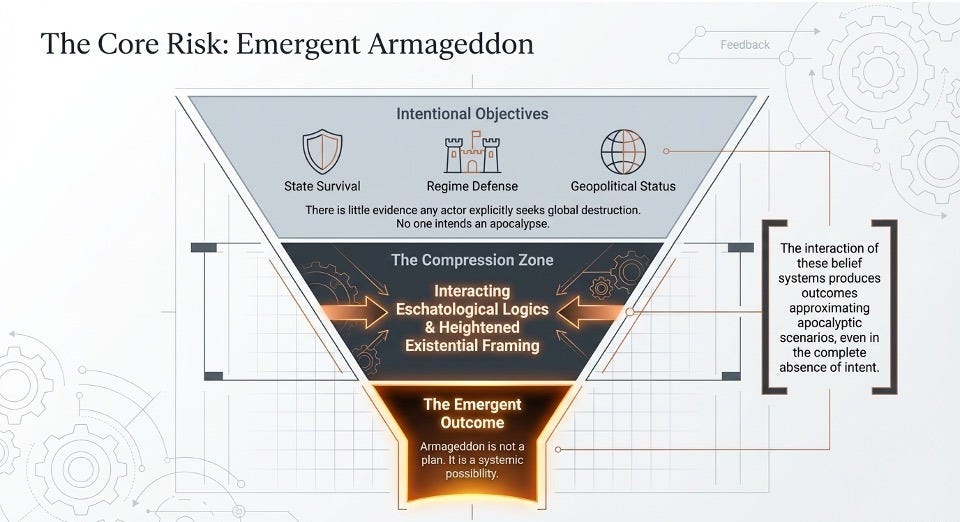
This is the core risk.
Armageddon, in this context, is not a plan. It is a systemic possibility—an emergent property of interacting escalation dynamics under conditions of heightened existential framing.
Implications for Policy and Analysis
If apocalyptic belief is treated as a marginal variable, policymakers will underestimate both the probability and speed of escalation.
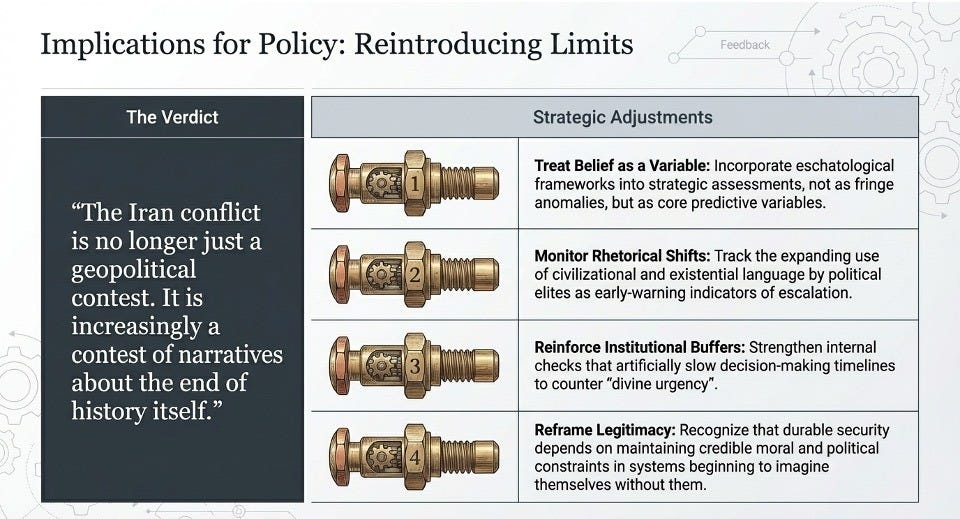
A more robust analytical approach requires:
Incorporating belief systems into strategic assessment, not as anomalies but as variables
Monitoring rhetorical shifts, particularly the increasing use of civilizational and existential language
Reinforcing decision-making buffers, including institutional checks that slow escalation timelines
Reframing legitimacy, recognizing that durable security depends not only on power, but on maintaining credible moral and political constraints
Conclusion: The Illusion of Control
The prevailing assumption in international politics is that escalation can be managed—that rational actors will ultimately pull back from the brink.
This assumption may no longer hold under conditions where belief, identity, and perceived destiny intersect with state power.
The danger is not that leaders have become irrational.
The danger is that they are operating within different rationalities—ones that redefine what is acceptable, what is necessary, and what is inevitable.
In such a world, the path to catastrophic conflict does not require a single reckless decision.
It requires only the steady convergence of three systems, each convinced—on its own terms—that it is acting in defense of something ultimate.
Dr. Wilson’s Verdict
The Iran conflict is no longer just a geopolitical contest. It is increasingly a contest of narratives about the end of history itself.
When multiple actors begin to interpret the present as a prelude to ultimate outcomes, the guardrails of conventional strategy weaken.
The task, then, is not only to manage power—but to reintroduce limits into systems that are beginning to imagine themselves without them.
If you value this work, here are three ways you can step into the story with us:
📰 Subscriber (Free)
Stay informed. Receive every new essay, briefing, and analysis straight to your inbox. Join a growing community committed to civic resilience and national security.
🎧 Supporter (Paid Pledge)
Strengthen the signal. Your support sustains both Compound Security, Unlocked and our companion podcast The Civic Brief. Supporters ensure these conversations remain accessible to the wider public while elevating the quality, depth, and reach of the work.
🛡️ Sustainer (Patron Level)
Invest in the mission. Sustainers fuel new research, convenings, and storytelling that enlarge the civic frame of security. This is more than content — it’s a civic project. Your sponsorship helps preserve an independent voice committed to equipping citizens, leaders, and institutions for the compound challenges ahead.


