
The War America Has Already Lost
Iran, the General Theory of Compound Security, and the End of Industrial-Age Victory.

by: Dr. Isaiah “Ike” Wilson III
For more than two centuries, the United States has measured victory largely by what it could see.
Enemy armies destroyed. Cities captured. Fleets sunk. Air superiority achieved. Precision strikes executed. Terrorist leaders eliminated. Missile sites cratered. Casualties inflicted at favorable ratios. Battle damage assessments painstakingly compiled into ever more sophisticated metrics of operational success.
American military professionalism has become synonymous with an extraordinary ability to convert overwhelming technological, organizational, and logistical superiority into battlefield dominance. It is, by nearly every historical measure, the most capable fighting force ever assembled.
Yet history has become increasingly unkind to nations that confuse battlefield success with strategic victory.
This is not a new observation.
The American experience in Vietnam, Iraq, and Afghanistan has already demonstrated that overwhelming military superiority does not necessarily produce enduring political success. But those cases have too often been explained away as failures of implementation, failures of political will, failures of post-conflict planning, or failures of nation-building.
Such explanations contain elements of truth, yet they leave untouched a more fundamental possibility—that the underlying theory by which America defines victory itself has become obsolete.
That possibility deserves far more serious consideration than it has received.
The central argument of this essay is straightforward but consequential. The United States may have already lost its broader strategic competition with Iran—not because Iran proved militarily superior, nor because American forces failed in combat, but because the United States continues to evaluate war through an industrial-age conception of victory while its adversaries increasingly compete according to the logic of the Compound Age.
If that proposition is correct, then recent military operations against Iran represent something historically significant: not simply another Middle Eastern campaign, but perhaps the first major demonstration that overwhelming tactical and operational success can coexist with—and even contribute to—strategic defeat.
Such a conclusion will undoubtedly strike many readers as counterintuitive, perhaps even provocative. After all, how can the world’s most powerful military lose to a regional power whose conventional capabilities remain vastly inferior? How can a nation that destroys more targets, fields more advanced technology, controls the air, projects power globally, and suffers comparatively fewer casualties be said to have lost?
The answer lies in asking a different question.
The relevant question is no longer, “Who won the battle?” Nor is it even, “Who imposed greater military costs?” Rather, the question that increasingly determines strategic success is this: Which competitor emerged from the conflict more capable of shaping the political, economic, technological, informational, diplomatic, commercial, and security environment that follows?
The distinction is profound.
War has always served political purposes. Carl von Clausewitz’s enduring insight—that war is the continuation of politics by other means—remains fundamentally sound.
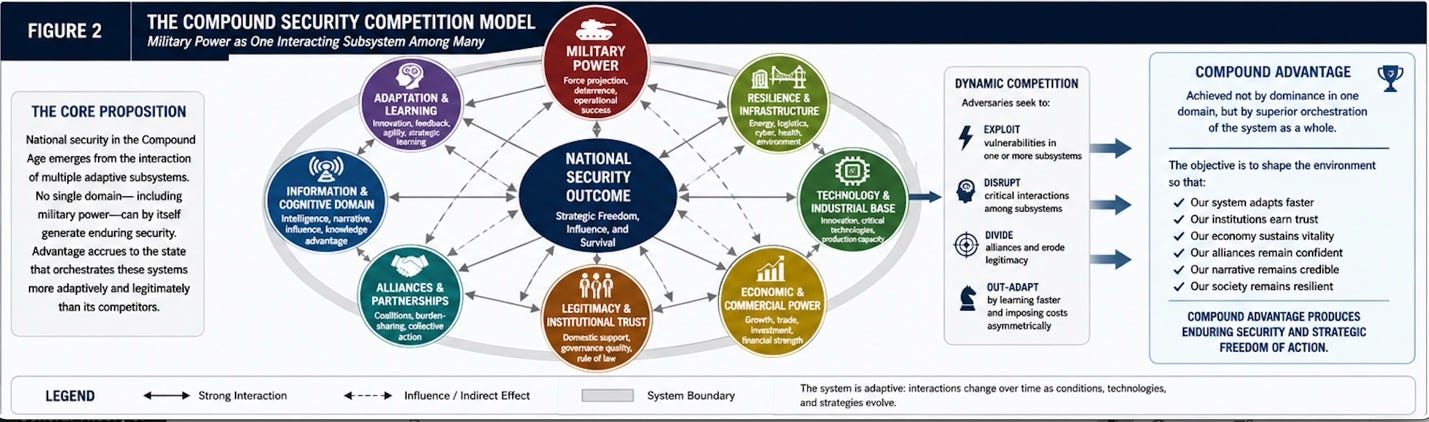
What has changed is not Clausewitz’s proposition but the architecture within which politics itself now operates. Political outcomes are no longer determined primarily by military interaction. They emerge from the interaction of multiple, deeply interconnected systems whose relationships are dynamic, adaptive, nonlinear, and increasingly global. Military force remains indispensable, but it no longer occupies the privileged position it once held as the principal determinant of strategic success. It has become one subsystem operating within a much larger competitive ecology.
This transformation defines what I have elsewhere described as the Compound Age.
The Compound Age is distinguished not simply by complexity, but by the convergence of multiple forms of interdependence. Economic networks, financial markets, commercial supply chains, cyber infrastructure, information ecosystems, energy flows, technological innovation, public legitimacy, institutional trust, demographic change, environmental pressures, and military power now interact continuously. Events within one domain rapidly cascade into others, producing second- and third-order consequences that frequently outweigh the immediate effects of military action itself. Security has become less about controlling individual domains than about managing the relationships among them.
Under such conditions, victory cannot be measured solely—or even primarily—through battlefield performance.
It must instead be assessed through the performance of the larger system under stress.
This represents more than a refinement of traditional strategic thought. It requires a fundamentally different ontology of war.
The unit of analysis is no longer the battlefield alone, nor even the campaign. It is the security system itself. States compete not merely through armies, navies, and air forces, but through the adaptive performance of entire societies. Political institutions, commercial resilience, alliance cohesion, technological innovation, economic endurance, informational credibility, public confidence, and the capacity for continuous adaptation become as strategically consequential as divisions maneuvering across terrain.
Victory therefore becomes an emergent property of systemic interaction rather than the cumulative result of tactical engagements.
Once viewed through this lens, many contemporary conflicts appear radically different. Military exchanges remain visible and dramatic, attracting headlines and dominating public discourse. Yet beneath those visible contests lies another competition, quieter but ultimately more decisive, in which states seek to shape incentives, preserve legitimacy, exploit interdependence, manipulate risk, redirect commercial flows, fracture coalitions, and impose opportunity costs upon their adversaries. Success in this larger competition often bears only partial correlation to success on the battlefield.
Indeed, military superiority can become strategically counterproductive if it induces a nation to invest ever greater resources into solving the wrong problem.
Superior capabilities may encourage leaders to seek military solutions to fundamentally systemic challenges, thereby reinforcing precisely the dynamics their adversaries seek to exploit. Tactical excellence becomes strategically self-limiting when it narrows rather than expands political choice.
It is against this backdrop that the American confrontation with Iran must be understood.
The conventional narrative describes the contest primarily in terms of military exchanges: missile strikes, air defenses, nuclear facilities, proxy militias, maritime operations, and deterrence signaling. Those events are undeniably important. They deserve careful military analysis.
But they do not constitute the war itself. They are manifestations of a much larger competition whose decisive terrain lies elsewhere.
Iran, unlike many previous American adversaries, has rarely attempted to match the United States symmetrically. It has not sought to become America’s military equal. Instead, Iran has systematically pursued a different theory of competition—one that assumes conventional inferiority while seeking advantage through persistence, asymmetry, institutional patience, regional influence, commercial disruption, proxy networks, ideological cohesion, and the exploitation of global interdependence.
The crucial question, therefore, is not whether Iran could defeat the United States militarily.
It is whether the United States understood the war Iran was actually fighting.
II. The Industrial Theory of Victory
The United States did not arrive at its contemporary understanding of victory by accident. It inherited a conception of war that was remarkably successful for nearly two centuries.
Indeed, it was so successful that Americans gradually ceased to distinguish between military success and strategic success, assuming that the former naturally produced the latter. That assumption became embedded not only within military doctrine, but within political culture, defense institutions, public expectations, congressional oversight, media reporting, and even academic strategic studies. It became less a theory than an article of faith.
The origins of that faith are understandable. The great interstate wars of the eighteenth, nineteenth, and much of the twentieth centuries generally rewarded industrial capacity, battlefield superiority, and the destruction of an opponent’s organized military power. Napoleon’s armies sought decisive battle. The American Civil War increasingly evolved toward the destruction of Confederate military capacity and the industrial foundations supporting it. The two World Wars became contests of mass mobilization in which industrial production, logistical endurance, technological innovation, and overwhelming military force ultimately determined political outcomes. Victory was visible because it culminated in surrender ceremonies, occupation governments, redrawn borders, and unmistakable regime collapse.
Even the Cold War, although fundamentally political, reinforced this worldview. Deterrence rested upon military capability. Military balance became the language through which political equilibrium was understood. The collapse of the Soviet Union seemed, to many observers, to confirm the superiority of Western military, economic, and political institutions operating together under American leadership. History appeared to validate the proposition that overwhelming power, properly organized and patiently sustained, would ultimately prevail.
The extraordinary success of Operation Desert Storm deepened this conviction.
In just over six weeks, the United States demonstrated a form of warfare that appeared almost revolutionary. Precision-guided munitions, stealth aircraft, satellite navigation, integrated command-and-control, and unprecedented joint operations dismantled one of the world’s largest conventional armies with astonishing speed and relatively limited coalition casualties. The campaign seemed to validate decades of American investment in technological superiority and operational art. It suggested that future wars might be won rapidly through information dominance, precision strike, and synchronized maneuver.
Yet Desert Storm also became something more dangerous. It became a mental model.
Military excellence became synonymous with strategic excellence.
Campaign effectiveness became confused with political effectiveness.
Operational mastery became mistaken for strategic mastery.
This distinction matters enormously because operational art, however sophisticated, exists to serve strategy—not to replace it. Operational success answers the question of how military force is employed. Strategy answers the question of why military force is employed and whether its employment produces the political conditions sought by the state. When the operational level becomes the principal measure of success, strategy itself gradually contracts until it becomes little more than the orchestration of military campaigns.
The United States did not simply become proficient at operational warfare. It became intellectually organized around it.
This evolution helps explain the recurring paradox that has defined American military experience since the end of the Cold War. In Iraq, Afghanistan, Libya, Syria, and elsewhere, American forces repeatedly demonstrated extraordinary tactical and operational competence. Individual units performed magnificently. Joint integration reached levels unprecedented in military history. Intelligence, surveillance, logistics, special operations, precision targeting, and command systems consistently outperformed those of America’s adversaries. Yet these remarkable operational achievements repeatedly failed to produce stable political outcomes.
The prevailing explanation has often been that the United States “won the war but lost the peace.” This familiar phrase contains an important insight, but it also perpetuates an increasingly misleading distinction. It assumes that war and peace remain sequential phases—that military victory occurs first, followed by a separate political challenge of stabilization, reconstruction, or governance.
The Compound Age dissolves that sequence.
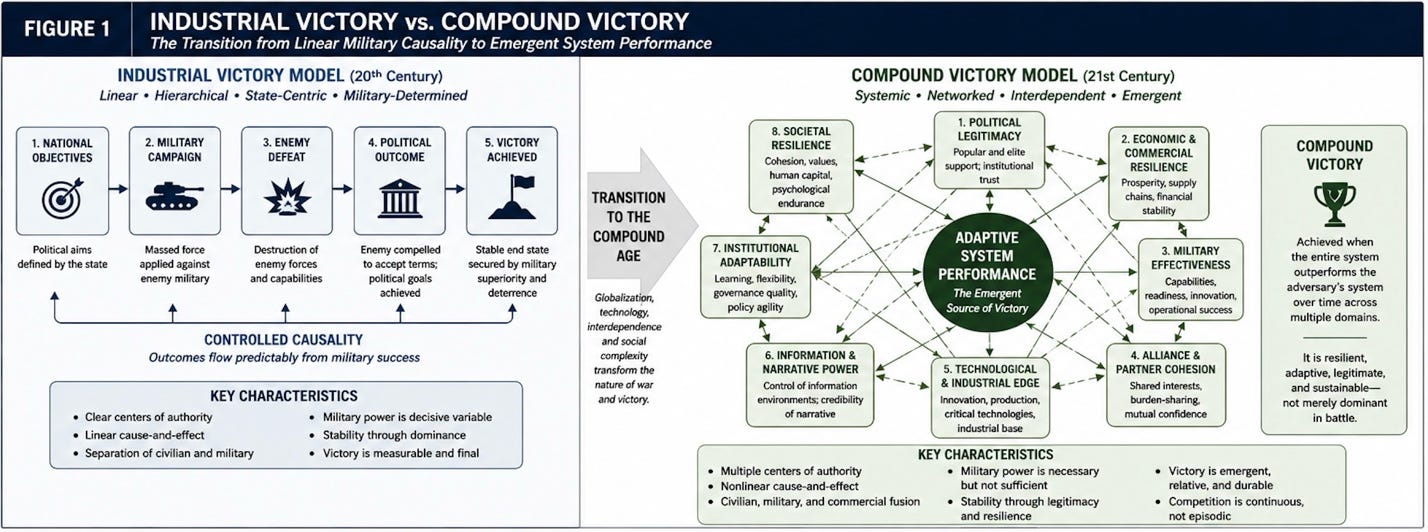
Political competition never pauses while military operations unfold. Commercial systems continue functioning. Financial markets react instantly. Social media shapes narratives in real time. Alliances strengthen or weaken with every decision. Public legitimacy rises or erodes continuously. Technological innovation accelerates. Cyber operations persist. Energy markets fluctuate. Domestic political coalitions shift. International institutions respond. Every military action simultaneously produces political, economic, informational, commercial, and diplomatic effects that begin influencing the strategic environment long before hostilities cease.
There is no longer a meaningful distinction between winning the war and winning the peace.
The peace is part of the war.
Indeed, in many contemporary conflicts, the political architecture that follows military action is already being constructed while the fighting continues. States are not competing merely to destroy one another’s capabilities. They are competing to define the conditions under which future competition itself will occur. Every strike, every sanction, every diplomatic initiative, every commercial disruption, every cyber intrusion, every narrative, and every alliance decision contributes to shaping that environment.
This is why battlefield dominance alone has become an increasingly unreliable predictor of strategic success.
Military power still matters enormously. No serious strategist should conclude otherwise. Force remains indispensable for deterrence, coercion, defense, and the protection of national interests. But military power has undergone a profound transformation in its strategic role. It no longer functions as the independent variable driving political outcomes. It has now unmistakingly become one interacting variable within a far larger adaptive system.
This observation lies at the heart of what I have elsewhere called the Paradox of the American Way of War. The paradox is not that American military power is inadequate. On the contrary, it is almost uniquely effective. The paradox is that America’s extraordinary proficiency at the military dimension of competition has, at times, obscured the reality that military force alone cannot govern the increasingly compound systems within which security is produced or lost.
The better America became at solving military problems, the more tempting it became to define strategic problems in military terms.
Every institution tends to optimize for the problems it knows how to solve.
The United States built the finest military instrument in human history.
Its principal competitors increasingly built strategies designed to make that instrument insufficient.
Iran understood this long before many American analysts did.
Tehran did not seek to defeat the United States where Washington was strongest. It sought to ensure that American military superiority would operate inside a competitive architecture where military superiority alone could never settle the larger contest. Rather than attempting to destroy American power, Iran sought to redirect it, absorb it, diffuse it, complicate it, and ultimately diminish its strategic return on investment.
This was not weakness masquerading as strategy.
It was strategy built around weakness.
And therein lies the defining insight of compound competition: the weaker competitor no longer seeks to equal the stronger competitor’s capabilities. Instead, it seeks to alter the relationship between capability and outcome.
That distinction marks the transition from the industrial age of warfare to the Compound Age. It is also the reason the American confrontation with Iran cannot be understood simply by counting destroyed facilities, intercepted missiles, eliminated commanders, or degraded military capabilities.
Those metrics remain relevant.
They are simply no longer decisive.
For Iran was never attempting to win America’s war.
It was attempting to redefine what winning itself would mean.
III. Iran Never Fought America’s War
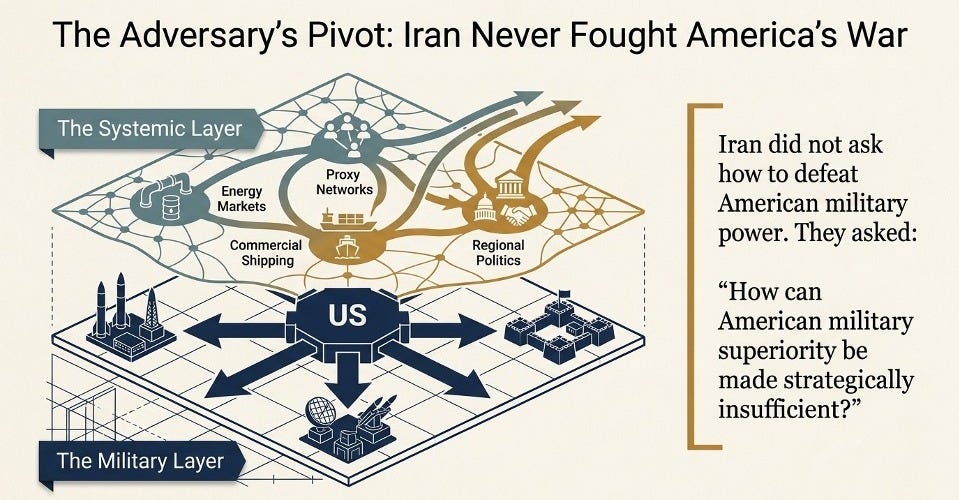
One of the oldest errors in strategic analysis is the assumption that adversaries define success in the same way. Analysts often project their own objectives onto their opponents, measuring progress according to metrics that make sense within their own strategic culture. The result is a profound form of analytical mirror-imaging. One side evaluates force ratios, target destruction, and operational tempo while the other evaluates political endurance, strategic distraction, economic disruption, coalition cohesion, and the gradual reshaping of the competitive environment. Both sides may be fighting the same conflict, yet they are not fighting the same war.
The United States and Iran exemplify this divergence.
From Washington’s perspective, the contest has generally been framed around deterrence, nuclear proliferation, regional military balance, freedom of navigation, and the degradation of Iranian military capabilities. American planning has naturally emphasized those dimensions in which the United States enjoys overwhelming comparative advantage. Intelligence collection identifies targets. Operational plans synchronize strikes. Precision weapons impose costs. Military readiness underwrites deterrence. Success is evaluated through measurable effects: facilities destroyed, missiles intercepted, commanders eliminated, proxy capabilities degraded, and the restoration of deterrent credibility.
Each of these objectives is rational.
None, however, necessarily addresses the competition Iran has been waging.
Iran has never operated under the illusion that it could defeat the United States in a conventional military contest. Its leaders have understood for decades that matching American expenditures, technology, or force projection would be economically impossible and strategically irrational. The Islamic Republic therefore developed something far more sophisticated than simple asymmetry. It developed an entirely different theory of strategic competition.
Rather than asking how to defeat American military power, Tehran asked a more consequential question:
How can American military superiority be made strategically insufficient?
That question fundamentally changes the nature of competition.
Instead of attempting to overcome America’s strengths, Iran sought to reposition those strengths within a larger system whose outcomes would be determined by variables that military dominance alone could not control. Time became more valuable than territory. Endurance became more valuable than decisive engagements. Adaptation became more valuable than parity. Persistence became more valuable than escalation. Influence became more valuable than occupation.
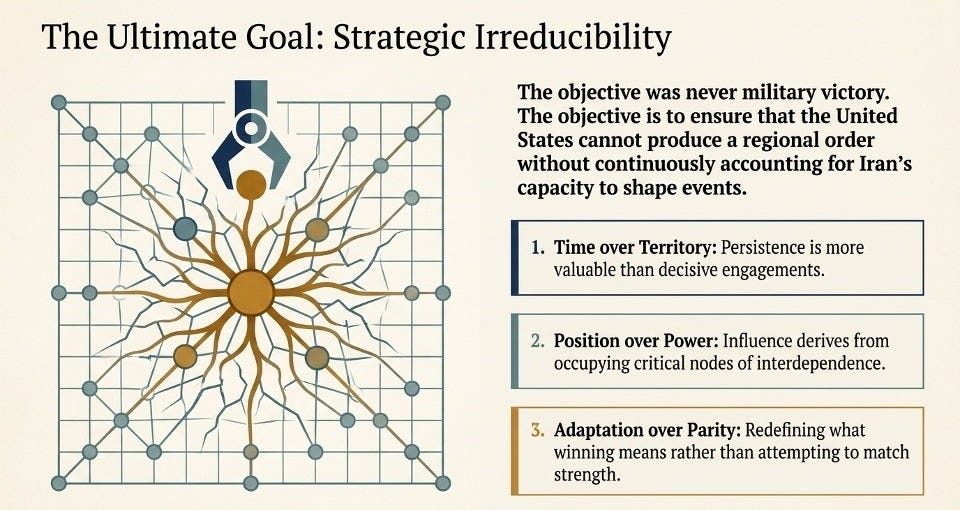
The objective was not military victory.
The objective was strategic irreducibility.
Iran sought to ensure that no matter how many facilities were destroyed, commanders eliminated, sanctions imposed, or proxy forces degraded, the Islamic Republic would remain an indispensable variable in every major calculation concerning the future of the Middle East. The regime did not have to become stronger than the United States. It merely had to ensure that the United States could not produce a regional order without continuously accounting for Iran’s capacity to shape events.
This represents a fundamentally different conception of power.
Power, in the industrial age, was often measured by accumulation: larger armies, larger economies, greater industrial production, superior technology. In compound competition, power increasingly derives from position within networks of interdependence. A comparatively weaker actor occupying a critical node can exercise influence disproportionate to its material capabilities. Control over chokepoints, proxy relationships, ideological movements, commercial flows, cyber infrastructure, financial vulnerabilities, and regional political alignments can produce strategic leverage that far exceeds conventional military strength.
Iran understood this.
The Strait of Hormuz illustrates the point.
Iran has never possessed the naval capability to defeat the United States Navy in open battle. Yet it has repeatedly demonstrated the ability to threaten one of the world’s most consequential maritime chokepoints, injecting uncertainty into global energy markets and forcing governments, corporations, insurers, and financial institutions around the world to incorporate Iranian behavior into their calculations. The resulting leverage is not measured by ships sunk. It is measured by systemic influence.
The same logic extends to Tehran’s cultivation of proxy networks across Lebanon, Iraq, Syria, Yemen, and beyond. Western analysts frequently describe these organizations as instruments of Iranian foreign policy, and they are. But from a compound perspective, they represent something more significant. They are adaptive extensions of Iranian strategic presence distributed across multiple political and geographic systems. They complicate attribution, diffuse retaliation, increase decision complexity, and expand Iran’s capacity to generate cascading effects across multiple domains simultaneously.
This is not simply proxy warfare.
It is distributed strategic architecture.
The distinction matters because distributed systems are inherently more resilient than centralized ones. They absorb shocks differently. They reconfigure more quickly. They substitute functions across nodes. They continue operating despite localized failures. Destroying one component rarely destroys the system itself. Instead, pressure often accelerates adaptation elsewhere.
Here we begin to encounter one of the central propositions of the General Theory of Compound Security.
Security is not synonymous with invulnerability.
No complex system is invulnerable.
Security is instead measured by the capacity of interconnected systems to continue performing their essential political and societal functions under conditions of sustained stress, disruption, and adaptation.
This represents a profound departure from traditional strategic analysis. Conventional military planning often treats resilience as a supporting consideration—a desirable characteristic that improves recovery after conflict. Compound competition reverses that logic. Resilience is not the aftermath of competition. It is one of its principal battlegrounds.
The competitor that adapts more rapidly than its opponent often gains strategic advantage even while absorbing greater material damage.
History repeatedly demonstrates this phenomenon.
Revolutionary movements, insurgencies, resistance networks, commercial innovators, terrorist organizations, and political reform movements have frequently survived not because they were stronger, but because they adapted faster than institutions organized around more rigid assumptions. Material superiority remained real, yet strategic advantage migrated toward the actor whose organizational learning outpaced that of its adversary.
Iran’s strategic culture increasingly reflects this adaptive logic.
American strategy, by contrast, has often remained oriented toward optimization rather than adaptation. Optimization seeks maximum efficiency under anticipated conditions. Adaptation seeks continued effectiveness under changing conditions. These are not identical objectives. Highly optimized systems often become extraordinarily capable within the environments for which they were designed yet simultaneously become more brittle when confronted by novel forms of competition.
The American military is arguably the most optimized fighting institution ever created.
The question is whether optimization for twentieth-century warfare has produced sufficient adaptiveness for twenty-first-century competition.
That question becomes even more consequential when viewed through the broader lens of Compound Security Competition.
Iran’s objective was never to destroy American military power. Its objective was to impose persistent strategic friction across multiple interconnected systems simultaneously—regional politics, energy markets, alliance cohesion, domestic American political debate, military resource allocation, commercial confidence, escalation management, and global perceptions of American influence. Each individual action mattered less than the cumulative effect of their interaction.
In systems language, Iran was not attempting to maximize tactical effects.
It was attempting to shape system behavior.
That distinction is decisive.
The United States frequently responded to individual manifestations of Iranian strategy—proxy attacks, maritime incidents, missile launches, nuclear advances, militia operations—as discrete security problems requiring discrete policy responses; and perhaps inviting of a unilateral muscular transactionalism. Yet from Tehran’s perspective, these were not isolated events. They were interacting components of a long-duration competitive campaign whose cumulative objective was to alter the strategic calculus of every actor operating within the region.
America often fought episodes.
Iran competed across trajectories.
America frequently optimized responses.
Iran continuously shaped relationships.
America measured military exchanges.
Iran measured strategic evolution.
It is precisely here that the vocabulary of “winning” and “losing” begins to lose its industrial-age meaning. Neither side sought unconditional surrender. Neither side expected decisive military annihilation. The competition instead revolved around whose theory of security would prove more durable under sustained systemic pressure.
That is not merely a different way of fighting.
It is a different definition of war itself.
And if that proposition is correct, then evaluating the American-Iranian competition requires a theory capable of measuring not simply military performance, but the performance of the larger security system within which military force now operates.
That is the task to which we now turn. For without such a framework, we remain trapped within precisely the industrial conception of victory that this essay argues has already expired.
IV. Toward a New Theory of Victory
If the United States and Iran have been competing according to fundamentally different conceptions of victory, then the natural question becomes how strategic success ought to be evaluated. It is insufficient simply to argue that traditional military metrics are no longer adequate. One must also offer an alternative framework capable of explaining why some states emerge from conflict strategically strengthened while others, despite overwhelming battlefield success, emerge strategically constrained. Without such a framework, criticism of existing strategic thought remains descriptive rather than explanatory.
‘The General Theory of Compound Security’ (GTOCS) was developed precisely to address this analytical gap.
Its starting point is deceptively simple. Security is not a condition. Nor is it merely the absence of threat. It is not synonymous with military superiority, deterrence, or territorial integrity, although each may contribute to it. Security is better understood as the sustained performance of an interconnected political community under conditions of persistent stress, disruption, adaptation, and competition.
This distinction fundamentally alters the object of strategic analysis.
Traditional security studies have tended to focus on actors. States compete. Armies fight. Governments negotiate. Institutions implement policy.
These actors remain important, but they are no longer sufficient units of analysis. The Compound Age requires that we shift our attention from actors alone to the systems within which those actors continuously interact. Modern societies are constituted by dense networks of political institutions, commercial markets, financial systems, energy infrastructures, technological platforms, information ecosystems, transportation networks, legal regimes, alliances, and civic relationships. None operates independently. Each both influences and is influenced by the others. The security of the whole emerges not from the strength of any single component but from the quality of their interaction.
This is the first great departure from the industrial conception of strategy.
Industrial-age warfare treated military power as the principal engine through which political outcomes were produced. Military superiority generated deterrence; deterrence preserved political order. Although economics, diplomacy, and domestic governance certainly mattered, they were generally treated as supporting functions orbiting around military capability.
The Compound Age reverses this relationship.
Military power remains indispensable, but it has become one adaptive subsystem among many. Its effectiveness increasingly depends upon the health, legitimacy, resilience, and adaptability of the larger system that generates and sustains it. Military force no longer stands above the system. It operates within it.
Accordingly, strategic analysis must also shift its attention.
The critical question is no longer, How effectively did military force destroy the adversary’s capabilities?
The critical question becomes, How did the interaction of military force with political institutions, commercial systems, alliance relationships, technological innovation, public legitimacy, and economic resilience alter the relative security of each competitor?
Victory thus becomes an emergent property rather than a cumulative statistic.
Emergence is one of the defining characteristics of complex adaptive systems. It describes outcomes that cannot be understood simply by examining individual components in isolation. A healthy economy cannot be explained solely through individual firms. Democratic legitimacy cannot be reduced merely to election results. Financial stability cannot be inferred only from individual banks. Likewise, strategic victory cannot be determined simply by tallying military exchanges.
It emerges from the interaction of multiple systems operating simultaneously.
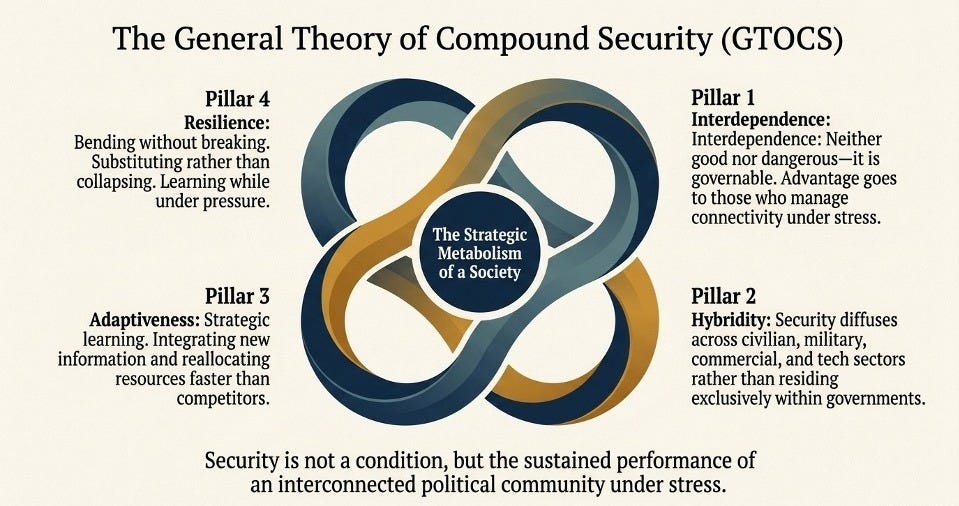
The General Theory of Compound Security identifies several interacting dimensions that increasingly determine strategic performance.
The first is interdependence.
For much of history, interdependence was viewed primarily as vulnerability. States sought self-sufficiency wherever possible because dependence created opportunities for coercion. Globalization altered that equation. Interdependence became both a source of prosperity and a source of strategic exposure. Supply chains, energy markets, digital infrastructure, semiconductor production, financial clearing systems, rare earth minerals, satellite networks, pharmaceuticals, and commercial shipping now bind states together in relationships that neither complete independence nor complete control can realistically eliminate.
Interdependence therefore becomes neither inherently good nor inherently dangerous.
It becomes governable.
The strategic question is no longer whether dependence exists. It is whether a state possesses sufficient redundancy, flexibility, and adaptive capacity to govern that dependence under conditions of stress. The more effectively a society manages interdependence, the more secure it becomes. The less effectively it manages those relationships, the more opportunities adversaries possess to convert connectivity into coercion.
Iran understood this intuitively. It could not outproduce the United States economically, but it could exploit critical nodes within globally interconnected systems. It could leverage maritime geography, proxy relationships, ideological networks, and energy markets to impose costs disproportionate to its own material power. Its influence derived less from absolute capability than from positional advantage within systems of interdependence.
The second dimension is hybridity.
The Compound Age has dissolved many of the boundaries that once organized strategic thought. Civilian and military sectors increasingly overlap. Public institutions collaborate with private corporations. Artificial intelligence developed for commercial purposes rapidly acquires military applications. Financial sanctions become instruments of coercion. Cyber intrusions produce physical consequences. Information campaigns alter electoral outcomes. Commercial technologies reshape intelligence collection. Universities become strategic assets. Corporations become geopolitical actors.
Security therefore no longer resides exclusively within governments.
It is distributed across society.
This diffusion fundamentally changes both vulnerability and resilience. Adversaries need not defeat armed forces if they can instead manipulate commercial logistics, public confidence, technological innovation, legal institutions, or information ecosystems. Likewise, societies possessing broad adaptive capacity across public and private sectors often recover more effectively from disruption than societies whose capabilities remain concentrated within governmental hierarchies alone.
The third dimension is adaptiveness.
Industrial-age institutions sought optimization. Compound-age institutions require continuous learning.
Optimization assumes relatively stable environments. Adaptation assumes continuous change.
This distinction cannot be overstated.
The military organizations that perform most effectively under known conditions are not necessarily those that perform most effectively under changing conditions. The same principle applies to governments, corporations, alliances, and societies themselves. Strategic advantage increasingly accrues not to those who possess the greatest resources, but to those capable of integrating new information, revising assumptions, reallocating resources, and reorganizing relationships more rapidly than their competitors.
Adaptation is therefore not simply resilience.
It is strategic learning.
Finally comes resilience.
Resilience is perhaps the most misunderstood concept in contemporary security discourse. Too often it is interpreted merely as recovery following disruption. The General Theory of Compound Security understands resilience differently. True resilience is the capacity of a system not merely to recover, but to continue performing its essential functions while adapting during disruption itself.
Resilient systems bend without breaking.
They substitute rather than collapse.
They reorganize rather than freeze.
They learn while under pressure.
They emerge from stress different—sometimes stronger—than they entered it.
That characteristic ultimately separates secure societies from merely powerful ones.
For power may destroy an adversary.
Only resilience determines whether one survives one’s own success.
These four dimensions—interdependence, hybridity, adaptiveness, and resilience—do not operate independently. They reinforce and constrain one another continuously. Their interaction produces what might be called the strategic metabolism of a society: its capacity to absorb shocks, learn from disruption, preserve legitimacy, sustain economic vitality, maintain alliance confidence, and continue shaping its environment despite persistent competition.
It is here that the American-Iranian case assumes significance far beyond the Middle East.
If these dimensions increasingly define strategic success, then military superiority becomes only one contributor to security rather than its defining measure. A nation may dominate the battlefield while simultaneously exhausting political capital, weakening alliance cohesion, increasing commercial uncertainty, accelerating adversary adaptation, diverting strategic attention, and reinforcing the very patterns of competition its opponent seeks to perpetuate.
When that occurs, battlefield victory and strategic defeat cease to be contradictory.
They become causally connected.
The tragedy is not that military power failed.
The tragedy is that military success, evaluated through an obsolete theory of victory, may itself become the mechanism through which larger strategic failure emerges.
V. The Paradox of American Power
If the General Theory of Compound Security provides the conceptual framework through which strategic success should now be evaluated, then the American experience over the past three decades provides perhaps its most compelling empirical demonstration.
The paradox is not that the United States has become militarily weaker. Quite the opposite. Never in recorded history has a nation possessed greater capacity to project force globally, integrate operations across domains, exploit advanced technology, or destroy military targets with such speed, precision, and discrimination. The United States remains, by every conventional measure, the preeminent military power of the modern era.
Yet history increasingly presents a disquieting pattern.
The very nation that has achieved unprecedented operational excellence has struggled with growing frequency to convert that excellence into durable strategic advantage. This recurring pattern cannot reasonably be dismissed as coincidence. Nor can it be explained solely through poor execution, flawed political leadership, inadequate post-conflict planning, or shifting domestic priorities. Those factors undoubtedly matter. But they remain incomplete explanations because they fail to account for the remarkable consistency with which American military success has been accompanied by strategic ambiguity.
The pattern itself demands explanation.
It is this recurring contradiction that I first sought to understand in Thinking Beyond War: Civil-Military Relations and Why America Fails to Win the Peace. At the time, the paradox appeared primarily within the relationship between battlefield dominance and political outcomes. The United States repeatedly demonstrated that it could dismantle opposing military organizations with extraordinary efficiency. Yet the political environments that followed rarely reflected the clarity or permanence suggested by military victory. Tactical brilliance repeatedly encountered strategic frustration.
The Compound Age has not eliminated that paradox.
It has enlarged it.
The paradox now extends beyond the relationship between military campaigns and political settlements into the interaction of entire systems. Military force increasingly succeeds exactly as intended while simultaneously generating dynamics that diminish the overall strategic position of the state employing it. What once appeared as a post-conflict governance problem now reveals itself as something much deeper: a systemic disconnect between the instruments through which America exercises power and the environments within which power now produces security.
The distinction I have increasingly drawn is therefore between superforce and superpower.
A superforce possesses overwhelming military capability. It can project force globally, dominate battlespaces, destroy opposing forces, and impose immediate costs upon adversaries. The United States unquestionably remains the world’s foremost superforce.
A superpower, however, accomplishes something more demanding. It shapes the behavior of interconnected systems. It aligns military, political, diplomatic, commercial, technological, informational, and societal instruments toward coherent strategic ends. It creates environments within which other actors voluntarily adjust their behavior because the incentives embedded within those systems favor cooperation over resistance. A superpower governs relationships, not merely battlefields.
The distinction is subtle but decisive.
Force destroys.
Power organizes.
Force compels.
Power shapes.
Force imposes costs.
Power structures choices.
History’s greatest empires rarely endured because they won every battle. They endured because they built systems within which military victory became progressively less necessary. Their influence rested upon institutions, commercial networks, legal regimes, cultural attraction, political legitimacy, and shared expectations as much as upon military superiority.
The Roman Empire, the British Empire, and the post-1945 American-led international order each illustrate, in different ways, that enduring strategic success depends less upon repeated demonstrations of force than upon the construction of systems whose participants perceive continued participation as preferable to resistance.
The United States itself understood this after the Second World War.
The Marshall Plan was not simply economic assistance. It was strategic architecture.
The Bretton Woods institutions were not merely financial mechanisms. They constituted an international operating system.
NATO was not simply a military alliance. It institutionalized shared political expectations.
The General Agreement on Tariffs and Trade, later the World Trade Organization, facilitated not merely commerce but strategic interdependence.
The dollar’s reserve status became not only an economic advantage but a source of geopolitical influence.
Taken together, these institutions reflected an extraordinary act of orchestration. Military power underwrote the system, but the system itself generated legitimacy, prosperity, predictability, and voluntary participation on a scale unprecedented in modern history. American influence became durable precisely because it extended far beyond coercion.
This distinction between synchronization and orchestration has become increasingly central to strategic thought in the Compound Age.
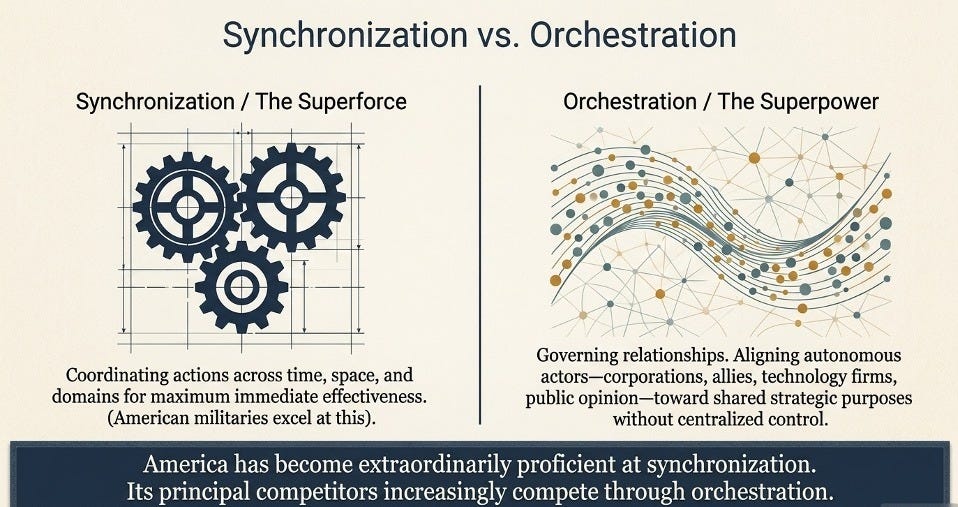
Synchronization is fundamentally an operational activity. It coordinates actions across time, space, domains, organizations, and capabilities to maximize immediate effectiveness. Modern militaries excel at synchronization. They integrate intelligence, fires, maneuver, logistics, cyber operations, and command relationships with remarkable precision. American joint doctrine represents perhaps the world’s most sophisticated expression of synchronized operations.
Orchestration is something altogether different.
Orchestration concerns not the coordination of activities but the governance of relationships. It aligns autonomous actors possessing different interests, authorities, incentives, cultures, and time horizons toward broadly shared strategic purposes without requiring centralized control. It recognizes that governments no longer command many of the systems upon which national security depends. Commercial firms, financial institutions, technology companies, universities, state and local governments, allied nations, international organizations, nongovernmental organizations, and civil society all possess independent agency. None can simply be ordered into compliance.
They must instead be influenced, aligned, persuaded, incentivized, and continually adapted together.
This is the strategic task of the Compound Age.
It is also where the United States increasingly confronts its greatest challenge.
America has become extraordinarily proficient at synchronization.
Its principal competitors increasingly compete through orchestration.
Iran offers an instructive example.
Tehran possesses no equivalent to American joint doctrine. It cannot synchronize global military operations with anything approaching American sophistication. Yet it has demonstrated a remarkable ability to orchestrate relationships among state institutions, proxy organizations, religious networks, commercial actors, regional political movements, information campaigns, and external partners into a competitive system that repeatedly complicates American decision-making. The individual components of this system often appear weak when examined independently. Their collective interaction, however, produces strategic influence far exceeding the sum of their parts.
This observation should not be mistaken for admiration.
It is diagnosis.
Strategists are obligated to understand why certain competitive models produce durable effects regardless of whether they approve of the political purposes they serve.
The larger lesson extends well beyond Iran.
China’s Belt and Road Initiative represents an orchestration strategy more than an infrastructure program. Russia’s integration of cyber operations, energy dependence, political influence, private military organizations, and information campaigns similarly reflects orchestration rather than mere synchronization. Even multinational corporations increasingly compete through orchestrating ecosystems rather than controlling vertically integrated enterprises. The logic is becoming ubiquitous across security, commerce, and technology alike.
The United States remains overwhelmingly superior within many individual domains.
The emerging competition is increasingly decided by the relationships among those domains.
This is precisely where the General Theory of Compound Security intersects with Theater-Strategic Art.
Theater strategy can no longer be understood simply as the integration of military campaigns across geographic space. It must instead become the orchestration of adaptive political, commercial, diplomatic, informational, technological, and military systems whose interactions shape strategic outcomes over time. Campaigns remain necessary, but they become components of larger systemic designs rather than ends in themselves.
This realization also reveals why deterrence itself must evolve.
Industrial deterrence sought to prevent specific military actions through the threat of unacceptable punishment.
Compound deterrence seeks something broader.
It seeks to preserve the adaptive integrity of the entire security system while shaping the incentives of competitors across every domain through which strategic behavior emerges.
In this sense, the central problem confronting the United States is not inadequate military capability.
It is conceptual inertia.
The institutions that produced extraordinary success during the industrial age continue to optimize for problems increasingly defined by the assumptions of that era. They remain exceptionally effective at fighting wars whose decisive terrain is military.
The difficulty is that the decisive terrain itself has shifted.
Iran did not expose weaknesses in American military power.
It exposed the growing mismatch between an industrial theory of victory and a compound reality of competition.
That mismatch—not the balance of missiles, aircraft, or brigades—may ultimately prove to be the defining strategic lesson of the conflict.
For once the criterion of victory changes, every previous measure of success must be reconsidered.
And it is to that reconsideration that we now turn. For if victory in the Compound Age is measured by the adaptive performance of entire security systems, then the empirical question is no longer whether the United States won more engagements than Iran.
The question is far more consequential.
Which competitor emerged from the confrontation better positioned to shape the strategic environment that follows?
VI. ‘Winning’ the Wrong War
If the preceding argument is correct, then the central question is no longer whether the United States demonstrated military superiority over Iran. It unquestionably did. Nor is the question whether Iranian military capabilities suffered significant degradation. They did. The destruction of infrastructure, the elimination of senior military leaders, the disruption of command-and-control networks, and the attrition of proxy capabilities are all genuine operational achievements. To deny them would be analytically dishonest.
The more difficult question is whether those achievements altered the strategic trajectory of the larger competition in America’s favor.
That is a fundamentally different inquiry.
It requires abandoning the familiar habit of treating military performance as the independent variable from which all other political outcomes naturally follow. Instead, military action must itself be evaluated as one contributor among many to the adaptive performance of the larger security system. Operational effectiveness becomes one metric within a much broader strategic ledger.
This distinction exposes a recurring analytical mistake that has characterized much of the public debate surrounding the American-Iranian confrontation. Commentators have frequently asked whether American strikes restored deterrence, weakened Iran’s military, delayed its nuclear ambitions, or demonstrated American resolve. Each is a legitimate question. Yet each remains incomplete because each examines one subsystem in relative isolation.
Compound competition demands that we ask a different set of questions.
· Did the conflict increase or diminish America’s strategic freedom of action?
· Did it strengthen or weaken alliance cohesion?
· Did it improve or complicate regional political stability?
· Did it expand or constrain American diplomatic options?
· Did it reinforce or erode the legitimacy of the broader international order upon which American influence depends?
· Did it enhance or diminish commercial confidence?
· Did it preserve scarce strategic attention for emerging challenges elsewhere?
· Did it leave the United States more adaptive, more resilient, and better positioned to shape future competition?
These are not secondary considerations.
They are the strategic outcome.
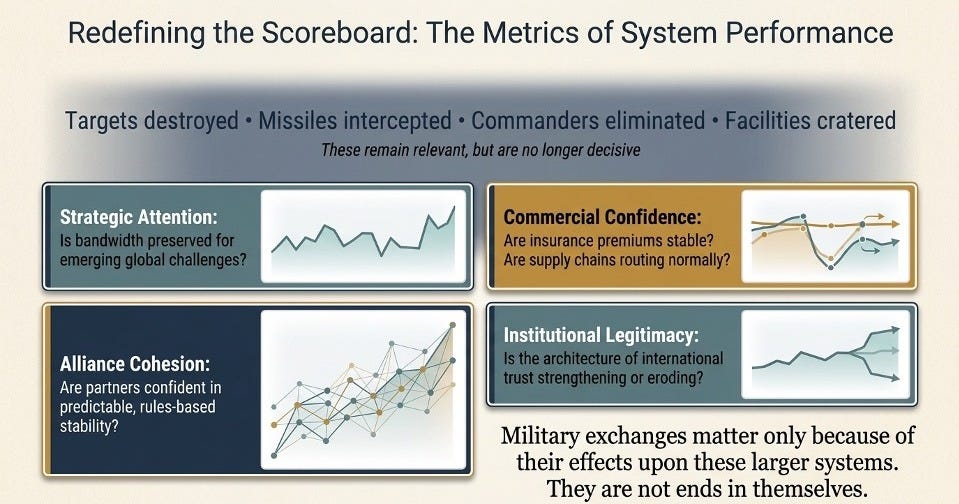
Military exchanges matter because of their effects upon these larger systems. They are not ends in themselves.
Viewed through this lens, the American-Iranian competition begins to appear considerably more ambiguous than conventional military analysis suggests.
Consider strategic attention.
One of the scarcest resources possessed by any great power is not military capability but cognitive bandwidth. Governments possess finite decision-making capacity. Senior leaders possess finite political capital. Military organizations possess finite readiness. Industrial bases possess finite production capacity. Every additional commitment necessarily competes with others for resources, planning, and sustained attention.
One of Iran’s most enduring strategic accomplishments has been its ability to command disproportionate American attention despite possessing only a fraction of America’s material capabilities.
That attention itself constitutes strategic leverage.
Every aircraft carrier deployed to the Gulf is unavailable elsewhere. Every intelligence platform redirected toward Iranian activities is unavailable for another theater. Every diplomatic initiative devoted to crisis management in the Middle East consumes energy that might otherwise be invested in Indo-Pacific competition, technological innovation, alliance modernization, or domestic renewal.
In compound competition, forcing one’s adversary to allocate scarce strategic attention inefficiently is itself a form of victory.
The same logic applies to commercial systems.
The United States has long understood freedom of navigation as a military mission. The Compound Age reveals it to be something broader. Maritime security is simultaneously an economic function, an insurance function, an energy function, a financial function, and a political function. Disruptions in one dimension rapidly cascade across the others.
Iran has repeatedly demonstrated that it need not close the Strait of Hormuz permanently to exercise influence. It need only introduce sufficient uncertainty to alter commercial calculations. Shipping companies reroute. Insurance premiums rise. Energy prices fluctuate. Financial markets react. Governments reconsider risk. Commercial actors adjust behavior long before physical disruption reaches catastrophic levels.
This is not merely economic coercion.
It is systemic competition.
Military superiority cannot by itself eliminate such dynamics because the competition is no longer occurring solely at the point of physical confrontation. It is occurring throughout the interconnected systems whose behavior determines commercial confidence and political stability.
Alliance dynamics present a similar picture.
The post-1945 international order has rested less upon American military supremacy than upon confidence that American leadership contributes to predictable, rules-based stability. Alliances function because members perceive participation as enhancing their long-term security and prosperity.
Every prolonged regional crisis tests that confidence.
Partners begin asking increasingly difficult questions. How sustainable is American strategy? What risks accompany alignment? What economic costs are acceptable? How should scarce defense resources be allocated? Which regional commitments deserve priority? Such debates are entirely normal. Yet collectively they influence the adaptive performance of the alliance itself.
Again, the relevant metric is not simply whether allies supported particular military operations.
It is whether the larger architecture of confidence became stronger or weaker.
Legitimacy operates according to the same logic.
Throughout history, legitimacy has often been treated as an ethical or normative concern distinct from strategy. Compound competition dissolves that distinction. Legitimacy functions as strategic capital. It influences coalition formation, diplomatic flexibility, institutional trust, commercial investment, domestic resilience, and international cooperation. It shapes the willingness of others to bear costs voluntarily rather than through coercion.
Military operations that achieve immediate operational success while gradually eroding broader legitimacy may therefore generate diminishing strategic returns over time.
The point is not that military force should never be employed.
The point is that force must now be evaluated according to its interaction with legitimacy rather than independently from it.
Perhaps the most consequential dimension, however, concerns adaptation itself.
Wars have always produced learning.
The Compound Age accelerates that process dramatically.
Every military campaign becomes a laboratory observed not only by participants but by allies, competitors, corporations, financial institutions, technology firms, intelligence services, universities, and non-state actors across the globe. Lessons diffuse almost instantaneously. Tactics evolve. Technologies proliferate. Institutional innovations spread.
The strategic question therefore becomes not merely who learned more during the conflict.
It becomes who adapted more effectively afterward.
This is where America’s traditional metrics become particularly problematic.
The United States often measures adaptation primarily within military organizations. New doctrine emerges. Technologies improve. Force structures evolve. These developments are important, but they remain institutionally bounded.
Compound adaptation is societal.
It encompasses commercial innovation, industrial policy, educational systems, political institutions, technological ecosystems, alliance governance, public trust, and strategic culture simultaneously.
Iran’s comparative advantage has rarely been innovation in individual technologies.
Its comparative advantage has been institutional patience.
It has repeatedly demonstrated a willingness to learn incrementally, absorb punishment, preserve strategic continuity, and continue competing across decades rather than campaigns.
Time itself becomes an ally.
This observation brings us to what may be the most uncomfortable implication of the entire analysis.
If victory in the Compound Age is measured by the adaptive performance of entire security systems rather than by battlefield dominance alone, then military superiority no longer guarantees strategic success.
Indeed, under certain conditions, military superiority may unintentionally reinforce the very patterns through which weaker competitors seek advantage. A state capable of solving virtually every immediate military problem may become progressively less inclined to recognize that the decisive problems are no longer primarily military.
This is the danger of success.
The United States did not fail because it lacked capability.
It may have failed because capability became its principal lens for understanding strategy.
Iran, by contrast, understood that the objective was never to outperform America militarily.
It was to ensure that America’s extraordinary military performance remained insufficient to determine the larger outcome.
If that assessment is correct, then the American-Iranian confrontation should not be remembered principally as a contest of missiles, aircraft, proxies, or nuclear facilities.
It should be remembered as the moment when the industrial definition of victory finally ceased to describe the reality of strategic competition.
The United States won the military campaign.
The more consequential question is whether it simultaneously lost the strategic system within which that campaign occurred.
If so, then history may judge this not as a military defeat, but as something far more significant.
It may judge it as the first great strategic defeat of the Compound Age.
VII. The First Great Compound War
Every age of strategy eventually reaches a moment when its inherited vocabulary becomes insufficient to describe the realities before it.
The concepts remain familiar. The institutions endure. The doctrines continue to be taught. Yet the relationship between those concepts and the world they seek to explain gradually weakens until the language of one era begins obscuring rather than illuminating the problems of the next.
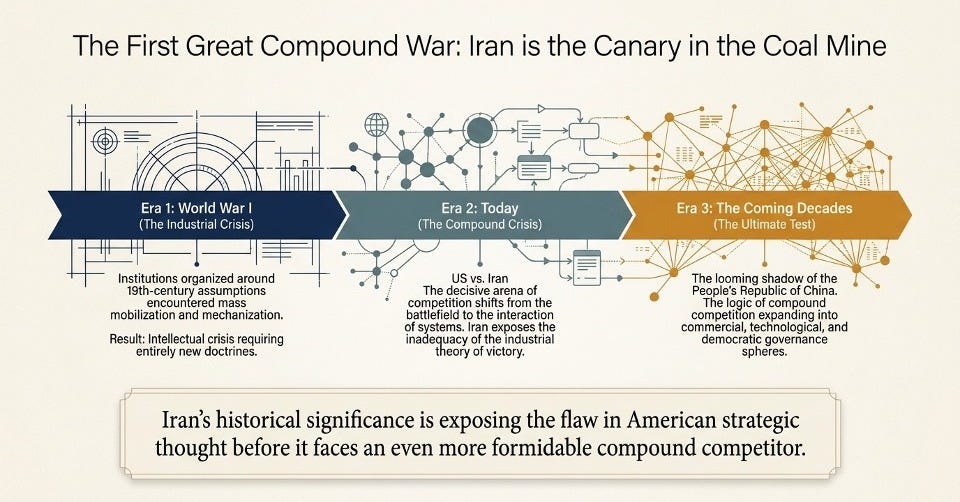
The Industrial Age experienced such a transformation during the First World War. Military institutions organized around the assumptions of the nineteenth century encountered technologies and social mobilization that fundamentally altered the character of conflict. The result was not merely tactical surprise but intellectual crisis. Entire generations of military thought had to be reconsidered before operational art, mechanized warfare, strategic bombing, amphibious operations, logistics, and combined arms doctrine eventually emerged to explain a world that previous theories could no longer adequately describe.
I believe we are living through a comparable transition today.
The American-Iranian confrontation should not be understood simply as another chapter in the long history of Middle Eastern conflict. Nor should it be remembered merely as a dispute over nuclear enrichment, proxy militias, maritime security, or regional deterrence. Those issues remain important, but they are manifestations of a much larger transformation already underway.
History may ultimately remember this confrontation as the first great compound war—not because it introduced entirely new instruments of conflict, but because it revealed that the decisive arena of strategic competition had shifted from the battlefield to the interaction of systems.
That distinction carries profound implications for military institutions, governments, businesses, universities, and societies alike.
The first implication is that strategy itself must be redefined.
For more than a century, strategic planning has generally proceeded by identifying objectives, allocating resources, sequencing military operations, and synchronizing instruments of national power. That approach remains necessary, but it is no longer sufficient. Strategy in the Compound Age becomes less about directing individual instruments than about governing relationships among adaptive systems that no single authority fully controls.
Governments no longer monopolize strategic capability.
Technology firms possess capabilities once reserved for nation-states. Commercial shipping companies influence geopolitical resilience. Financial institutions shape sanctions and capital flows. Universities accelerate innovation. Social media platforms alter public perception in real time. Artificial intelligence diffuses simultaneously across civilian and military applications. Critical infrastructure is owned as often by private firms as by governments. Supply chains stretch across continents. Alliances increasingly depend upon commercial integration as much as military commitments.
No ministry of defense commands these relationships.
They must be orchestrated.
This is why I have argued elsewhere that the next evolution of strategic thought lies not in improving synchronization but in mastering orchestration. Synchronization remains indispensable for military operations. Orchestration becomes indispensable for governing the larger ecosystem within which military operations now derive their strategic meaning.
The second implication concerns deterrence.
Throughout the nuclear era, deterrence rested principally upon the credible threat of unacceptable military punishment. That logic continues to apply in certain contexts. Nuclear deterrence remains essential. Conventional deterrence remains indispensable. Yet compound competitors increasingly seek objectives that military punishment alone cannot reliably prevent.
Commercial coercion.
Cyber disruption.
Supply-chain manipulation.
Financial warfare.
Political polarization.
Technological dependence.
Institutional erosion.
Information operations.
None is adequately deterred by military superiority alone.
The challenge therefore is not to abandon deterrence but to expand it.
Compound deterrence must seek to preserve the adaptive integrity of the larger security system itself. Its objective is not simply preventing attacks but reducing opportunities for adversaries to convert interdependence into coercion. It emphasizes redundancy alongside efficiency, legitimacy alongside coercion, resilience alongside readiness, adaptation alongside optimization. Military capability remains foundational, but it functions increasingly as one pillar supporting a much broader architecture of national security.
The third implication extends beyond governments altogether.
The logic of compound competition is no longer confined to international politics. Increasingly it characterizes commercial competition, technological innovation, public health, environmental resilience, financial stability, and democratic governance. Businesses compete through ecosystems rather than products. Technologies evolve through networks rather than isolated inventions. Political legitimacy emerges from interactions among institutions rather than from constitutional design alone.
The grammar of compound competition is becoming the grammar of modern society itself.
This realization explains why the American-Iranian case matters far beyond the Middle East.
China is studying these dynamics.
Russia is practicing them.
Transnational criminal organizations exploit them.
Violent extremist movements adapt through them.
Global corporations increasingly organize around them.
Artificial intelligence accelerates them.
The competition of the coming decades will not be decided primarily by whose military is strongest, although military strength will remain indispensable. It will be decided by which societies prove most capable of continuously adapting the relationships among their political, commercial, technological, informational, and military systems while preserving legitimacy, trust, resilience, and strategic freedom of action.
That is a far more demanding standard than military superiority alone.
It also suggests that many of the institutions inherited from the twentieth century require reconsideration—not because they failed, but because they succeeded so completely within one strategic environment that they now risk becoming prisoners of their own assumptions. Institutions optimize for the world that created them. They rarely evolve naturally into the institutions required by the world that follows.
The United States therefore confronts a choice more profound than whether to modernize its weapons, increase defense spending, or revise operational doctrine.
It must decide whether it is willing to modernize its theory of victory.
That is ultimately the larger significance of Iran.
Iran is not the principal strategic challenge confronting the United States. Nor is it the strongest competitor America will face during the twenty-first century. The People’s Republic of China will almost certainly occupy that distinction. Yet Iran may prove historically more significant for another reason.
It exposed the inadequacy of an industrial theory of victory before America encountered an even more formidable compound competitor.
Whether that warning is recognized may shape the strategic history of the century ahead.
The question, therefore, is not whether American military power remains unequaled.
It does.
The question is whether unequaled military power remains sufficient to determine strategic success.
I believe the evidence increasingly suggests that it does not.
The first great lesson of the Compound Age is that security no longer emerges principally from dominance within individual domains. It emerges from the adaptive performance of interconnected systems under conditions of persistent competition. Military force remains essential, but it no longer defines victory. Political legitimacy, commercial resilience, technological innovation, alliance cohesion, institutional trust, economic adaptability, and societal learning have become coequal determinants of strategic success.
Nations that continue to measure victory by the destruction they inflict will increasingly discover that they have misunderstood the competition itself.
They will optimize for battles while their adversaries optimize for systems.
They will synchronize campaigns while their competitors orchestrate environments.
They will perfect the employment of force while neglecting the governance of relationships through which enduring security is ultimately produced.
That is not simply a new way of fighting.
It is a new way of winning.
Or losing.
And that may be the defining strategic reality of the twenty-first century.
If you value this work, here are three ways you can step into the story with us:
📰 Subscriber (Free)
Stay informed. Receive every new essay, briefing, and analysis straight to your inbox. Join a growing community committed to civic resilience and national security.
🎧 Supporter (Paid Pledge)
Strengthen the signal. Your support sustains both Compound Security, Unlocked and our companion podcast The Civic Brief. Supporters ensure these conversations remain accessible to the wider public while elevating the quality, depth, and reach of the work.
🛡️ Sustainer (Patron Level)
Invest in the mission. Sustainers fuel new research, convenings, and storytelling that enlarge the civic frame of security. This is more than content — it’s a civic project. Your sponsorship helps preserve an independent voice committed to equipping citizens, leaders, and institutions for the compound challenges ahead.
"This is why battlefield dominance alone has become an increasingly unreliable predictor of strategic success."
Meanwhile we just DOGE'd USAID out of existance. Yah that makes perfect sense. A USMA grad exchange cadet from 93 is number 2 at the Thai Neighboring Countries Economic Development Cooperation Agency NEDA. There is a vacuum after USAID and China is happy to fill it in their style of development.
One of many examples is the new highway in Cambodia. Cambodia only has one higway in the entire country.....just one.......newly built with Chinese money. Even with the Khmer Prime MInister being a 99 USMA grad, anything USAID was doing in Cambodia seems a fart in the wind compared to what the Chinese built.
Provocative piece Ike. Great points and even greater visual aids. The Synchronization v. Orchestration was a great slide to support your narrative.
A “blemish” in one theater does not equate to systemic decline though. History shows superpowers can absorb setbacks while retaining their status (e.g. Vietnam). Resiliency and adaptation capacity is still superior in America. The US retains unmatched global military projection, alliances, economic/financial US dollar dominance and the innovation edge.
I feel Iran’s proxy networks have all been degraded and they are weaker today than they were 5 years or even 6 months ago. Their Nuisance Meter remains pegged with Hormuz, but I do not see them strategically ascending in any realm.
When I look for a failed modern conflict, where the aggressor misreads the compound security problem and comes out far worse off than they were at the start, I can only point to Moscow. Failed strategic objectives of regime change and territory control, coupled with massive losses of personnel and equipment. Ukraine has used your orchestration model to pick up allied support and gains in military/political will.
Overall a thought provoking piece and we will have to continue to rethink what victory looks like in the Compound Age.