
Beyond “Degrade and Destroy”
Reframing the Systemic War Against ISIL—and the strategic record of Operation Inherent Resolve.

By Dr. Isaiah (Ike) Wilson III
Author Bio
Dr. Isaiah (Ike) Wilson III is a civic strategist, a national and global affairs security expert, and ‘professor without portfolio’. A retired U.S. Army colonel and former senior civilian executive with the Department of Defense, he served as Deputy Chief of the Commander’s Action Group and Chief of the Commander’s Initiatives Group at U.S. Central Command during General Lloyd J. Austin III’s command tenure (2013–2016).
He is the founder and CEO of Wilson W.i.S.E. Consulting and a Professor of Practice at Arizona State University.
Prologue: On Record, Responsibility, and the War We Thought We Knew
I did not set out to write this piece.
Like many who have had the privilege—and burden—of serving at the intersection of war and policy, I have long believed that the work itself should speak through the record. That history, when carefully assembled and honestly rendered, has a way of revealing its own truths.
But over time, I began to recognize something more troubling.
The record of the war against the Islamic State—what became Operation Inherent Resolve—was beginning to settle into a narrative that did not fully reflect the reality we experienced, the judgments we made, or the conditions under which we operated.
It was not that the story being told was entirely wrong. It was that it was incomplete—flattened in ways that stripped it of its most important features.
Complexity gave way to simplicity.
Context gave way to chronology.
And, at times, strategy gave way to storyline.
In some accounts, the campaign is framed as a delayed response to an emerging threat—one marked by uncertainty, fragmentation, and eventual correction. In others, it is recast more sharply, shaped by political currents that came later, and presented as a problem inadequately handled until it was not.
Both versions miss something essential.
They miss the fact that the war we were engaged in was not, in its nature, a conventional war—or even a traditional counterterrorism campaign. It was something more difficult to see, harder to explain, and more uncomfortable to confront.
It was a war fought within a system that was itself coming apart.
I came to understand this not as an outside observer, but from inside the command—serving General Lloyd Austin at U.S. Central Command as Deputy Chief of the Commander’s Action Group and Chief of the Commander’s Initiatives Group. These roles placed me at a unique vantage point: close enough to decision-making to see how judgments were formed, and far enough across the system to understand how those decisions interacted with forces well beyond any single headquarters.
From that vantage point, one insight became increasingly clear:
We were not simply confronting an enemy.
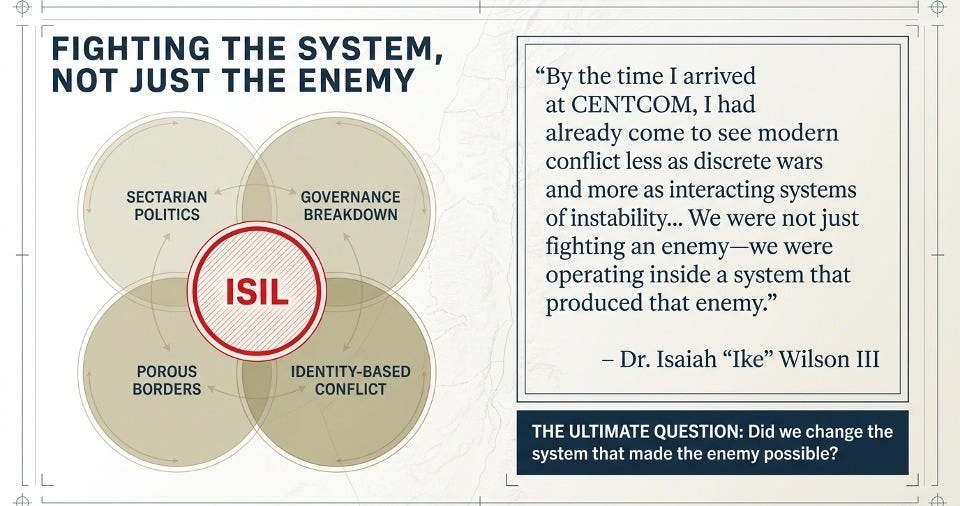
We were operating within a set of conditions—political, social, regional—that were producing that enemy.
And that distinction shaped ... everything.
It shaped how we understood ISIL—not just as a terrorist organization, but as a compound actor embedded in a broader system of instability. It shaped how we understood Iraq and Syria—not as separate theaters, but as a single, interconnected battlespace. And it shaped how we approached the use of force—not as a solution in itself, but as one instrument within a larger and often incomplete strategy.
These were not abstract considerations. They were present in the assessments we made, the options we developed, and the risks we weighed.
Yet they are often absent—or only faintly visible—in the accounts that have followed.
This essay is an effort to restore some of that missing context.
Not to settle scores.
Not to relitigate decisions.
And not to claim that we got everything right.
We did not.
But the record should reflect not only what happened, but how the problem was understood—and why certain choices were made within the constraints that existed.
Because the stakes of getting this right extend beyond history.
They reach into how we prepare for the next conflict, how we educate those who will lead it, and how we think about the relationship between military power and the systems within which it is applied.
If this piece does anything, I hope it does this:
It encourages a more honest reckoning with the kind of war we fought—and the kind we are likely to face again.
Because the next time, the system may be even more complex. And that ‘next time’ is already upon us.
If there is a throughline between Operation Inherent Resolve and the current war with Iran, it is this: we demonstrated an ability to disrupt a threat without fully addressing the system that produced it—and then carried forward that same habit of mind into a far more escalatory context.
What were lessons observed but never fully internalized in OIR—the limits of kinetic success, the primacy of political conditions, and the risks of operating within fractured regional systems—now reappear with sharper consequence in Operation Epic Fury, where the scale, stakes, and second-order effects are already proving more difficult to bound.
The danger is not that we failed to learn from OIR, but that we learned selectively—retaining confidence in operational tools while underweighting the systemic conditions that constrain their effectiveness.
In Epic Fury, that imbalance is magnified: a campaign designed for rapid, decisive effect is unfolding within a regional system that, once again, cannot be reshaped by force alone.
And the margin for misunderstanding even smaller.
Introduction: A Record in Need of Correction
The war against the Islamic State—what became Operation Inherent Resolve (OIR)—has already begun to harden into history. Books, official summaries, and retrospective accounts have constructed a narrative that is, at best, incomplete and, at worst, misleading.
Much of that narrative reduces the campaign to a familiar frame:
a counterterrorism effort,
a delayed response,
a fragmented command structure,
and a gradual march toward eventual success.
In some accounts—particularly those shaped during and after the Trump administration—the story is recast through a more overtly political lens: one of inherited failure corrected through belated decisiveness.
Both versions miss something essential.
They misunderstand not just what the United States did, but what kind of war it was fighting.
Because Operation Inherent Resolve was never simply a counterterrorism campaign.
It was a ‘systemic war’—fought not against a single enemy, but within a collapsing regional order that produced that enemy.
And unless that is understood clearly, the historical record will remain fundamentally distorted.
The War We Thought We Were Fighting
In public discourse, ISIL was framed as a terrorist organization that had metastasized into a quasi-state. That description, while not wrong, was incomplete.
Inside CENTCOM, the assessment was more precise—and more unsettling.
ISIL was understood as a compound threat:
insurgent
terrorist
proto-state
transregional network
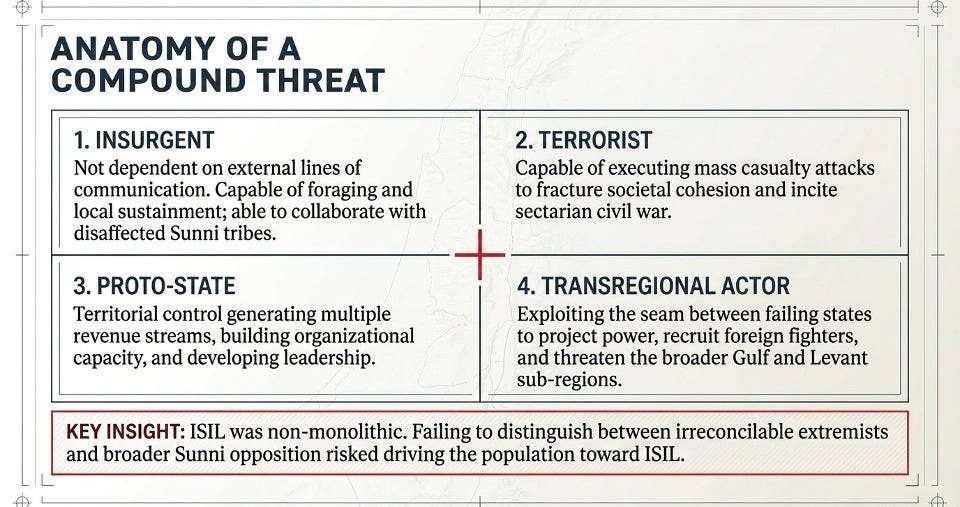
It was not static. It did not depend on traditional lines of communication. It could sustain itself locally, drawing on population, resources, and grievance.
More importantly, it was embedded within a broader system:
a Syria in insurgency and civil war, ... a ‘compound, contagion war’
an Iraq suffering from deep political fracture,
and a region increasingly defined by sectarian polarization and state weakness.
ISIL did not simply exploit that system.
It was a product of it.
This distinction—between enemy and environment—was not academic. It shaped how the command understood risk, opportunity, and the limits of military power.
The Systemic War: Iraq, Syria, and the Nexus Between
One of the most persistent errors in the public record is the treatment of Iraq and Syria as separate theaters.
They were not.
They formed a single operational and strategic system, with the Iraq–Syria border functioning less as a boundary than as a seam—one that ISIL used to move fighters, resources, and influence.
Syria, in particular, played a far more central role than many accounts acknowledge.
By 2013:
governance had collapsed across large portions of the country,
multiple armed actors competed for control,
and external flows—fighters, money, weapons—were accelerating.
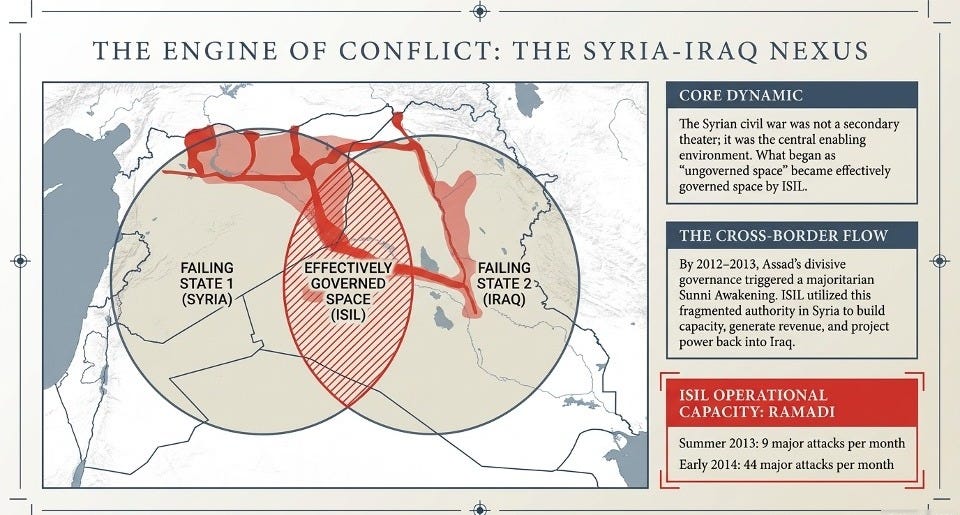
What had once been described as “ungoverned space” became something more dangerous:
… space governed by non-state actors with increasing sophistication and reach.
ISIL used Syria not simply as sanctuary, but as an incubator:
building organizational capacity,
establishing revenue streams,
and developing the operational depth that would later enable its expansion into Iraq.
To treat Syria as secondary—or as an adjunct to the Iraq fight—is to misunderstand the war.
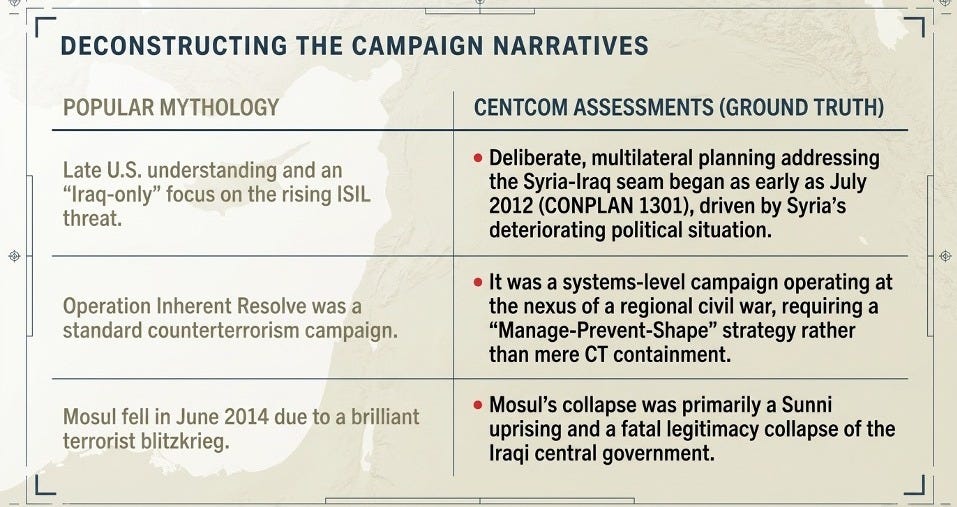
Mosul: Collapse, Not Surprise
The fall of Mosul in June 2014 is often portrayed as a shocking intelligence failure or a sudden battlefield collapse.
In reality, it was something more systemic—and more predictable.
Mosul fell not simply because ISIL attacked.
It fell because:
Iraqi Security Forces were unwilling to fight for a government they did not trust,
local populations were alienated from Baghdad,
and a range of anti-government actors—tribal, nationalist, and extremist—aligned, if only temporarily, against the state.
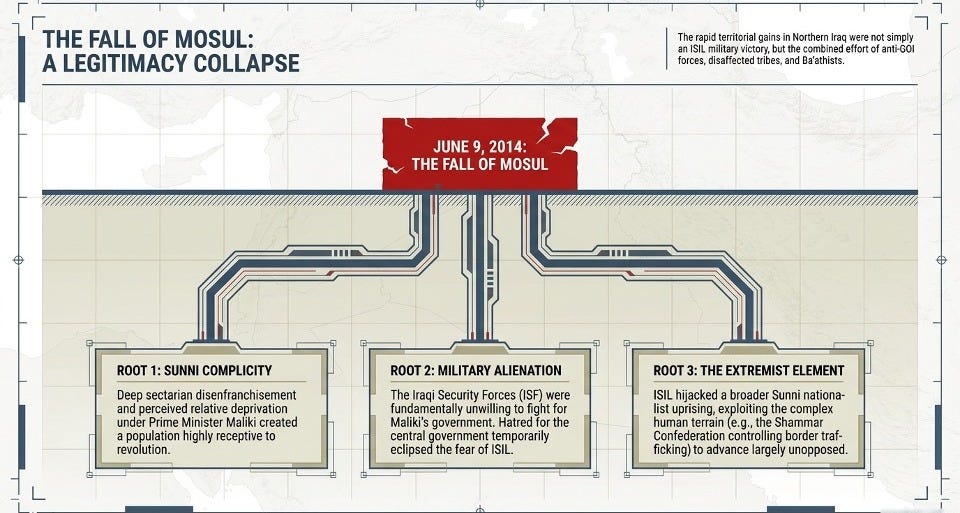
What unfolded looked less like a terrorist seizure of territory and more like:
… a Sunni uprising with an extremist vanguard.
This interpretation mattered. It suggested that the problem was not simply the presence of ISIL, but the absence of legitimacy.
And that, in turn, placed limits on what military force could achieve.
Inside CENTCOM: Roles, Functions, and Strategic Work
During this period, I served in dual roles:
Deputy Chief of the Commander’s Action Group (CAG)
Chief of the Commander’s Initiatives Group (CIG)
These positions sat at the intersection of:
strategy,
operations,
and advisory to senior decision-making.
The CAG functioned as the commander’s immediate-term advisory to the strategic leader – CDRUSCENTCOM, and his joint-directorate staff and subordinate subcomponent commands, responsible for:
synthesizing information across the command,
preparing decision briefs,
framing options for senior leaders,
and ensuring alignment between operational activity and strategic intent.
The Initiatives Group, by contrast, was forward-looking.
It focused on:
developing new concepts,
integrating cross-functional efforts,
and anticipating emerging challenges that did not yet fit neatly into existing plans.
Together, these roles required operating across:
policy guidance from Washington,
operational realities in theater,
and coalition dynamics that often introduced competing priorities.
It was, in effect, a position inside the system—tasked with helping the commander see the system clearly and act within its constraints.
General Austin’s Command: Discipline Under Constraint
General Lloyd Austin’s leadership during this period is often described in understated terms—deliberate, measured, cautious.
Those descriptions are accurate, but incomplete.
His command style reflected a deeper understanding:
That in a system as fragile as Iraq and Syria, the misapplication of force could accelerate the very dynamics we were trying to contain.
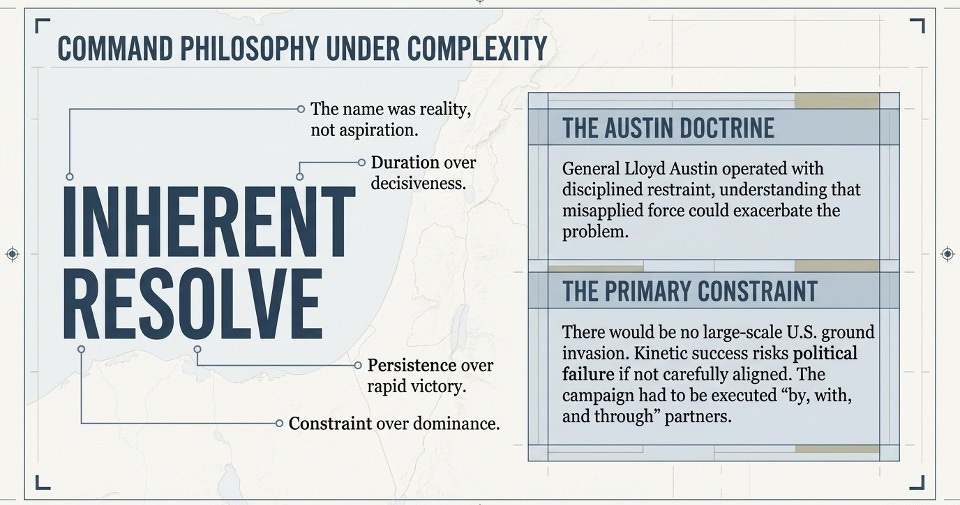
He was acutely aware of:
sectarian sensitivities,
the fragility of Iraqi political institutions,
and the risks of actions that could be perceived as taking sides in a broader civil conflict.
His approach emphasized:
coalition alignment,
controlled escalation,
and the careful sequencing of military effects.
This was not hesitation.
It was strategic discipline under conditions of uncertainty.
Operation Inherent Resolve: Strategy Under Constraint
The strategy that emerged—often described as “by, with, and through”—was less a doctrinal innovation than a practical necessity.
The United States faced constraints:
limited domestic appetite for large-scale intervention,
a need for regional legitimacy,
and the absence of reliable, unified partners on the ground.
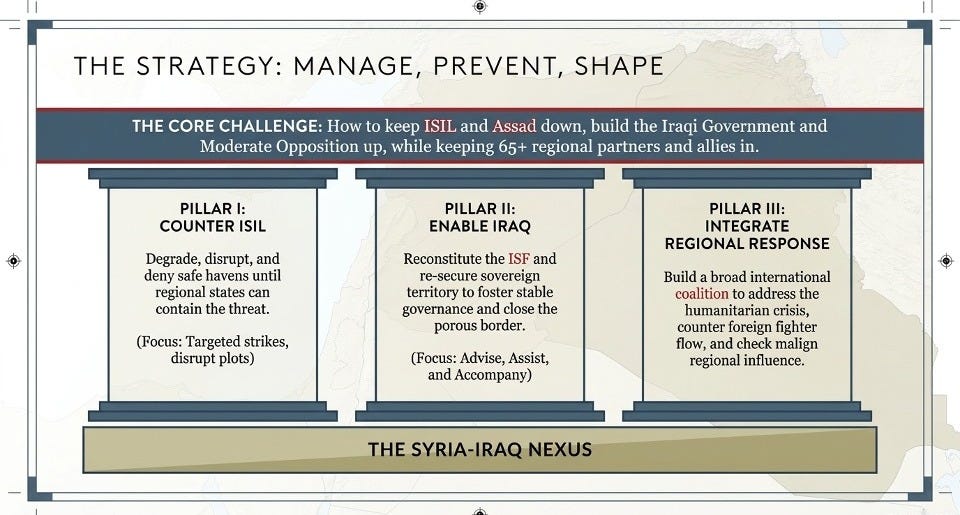
The result was a campaign built around:
coalition action,
partner force development,
targeted airpower,
and incremental expansion of advisory roles.
Its logic was not rapid victory.
It was:
… persistence over time, applied within a complex system that could not be controlled outright.
From Concept to Campaign: A Blueprint for How the War Could Work
Lost in many retrospective accounts is the fact that the campaign against ISIL was not conceived as open-ended or reactive. By late 2014 and early 2015, there was already a clear—if imperfect—effort inside CENTCOM to translate diagnosis into a time-bound, outcomes-oriented campaign design.
The logic was straightforward, even if the execution would prove difficult.
The problem was not simply to “fight ISIS,” but to sequence actions in a way that moved the system itself toward stability. That required thinking in phases, not episodes—and in effects, not just activities.
The emerging framework envisioned a roughly 36-month campaign, organized around three cumulative objectives:
Disrupt the organization’s momentum and ability to expand
Degrade its operational capacity and territorial control
Dismantle its networks, leadership, and governing structures
Each phase was not discrete but overlapping—designed to reinforce one another over time.
In the early period, the focus was on disruption: slowing ISIL’s advance, breaking its tempo, and introducing what we often referred to as “circuit breakers.” These included targeted strikes, expanded intelligence collection, and limited advisory efforts aimed at stabilizing key areas and buying time.
The next phase—degradation—required more than continued pressure. It required enabling partner forces to retake and hold terrain, while systematically reducing ISIL’s ability to generate resources, move fighters, and coordinate operations across the Iraq–Syria seam.
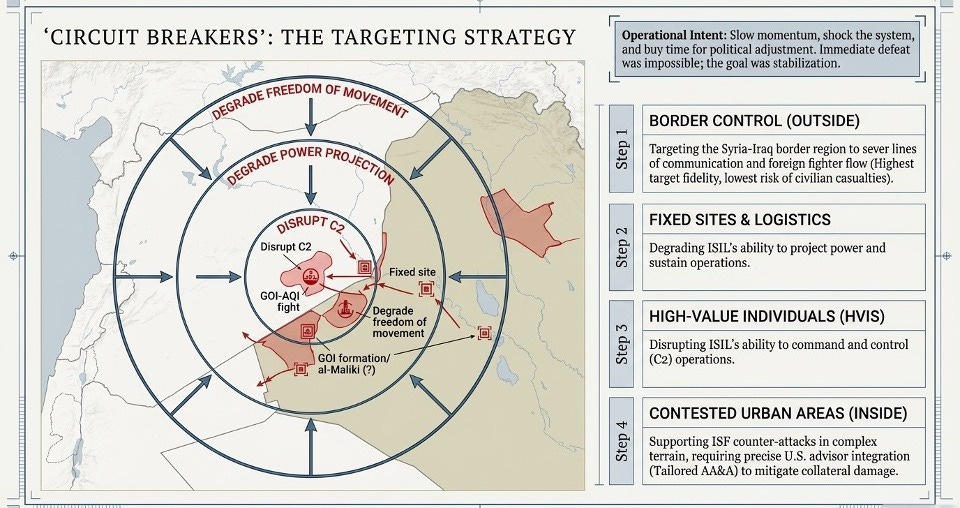
But it was the final phase—dismantlement—that most clearly revealed the limits of a purely military approach.
Because “dismantling ISIL” in any meaningful sense meant more than destroying its fighters or recapturing its territory. It meant:
breaking its ties to local populations,
undercutting the grievances that sustained it,
and restoring forms of governance that could compete for legitimacy.
In other words, it required political outcomes, not just military ones.
From the outset, there was an understanding—sometimes stated plainly, often implied—that what we loosely called “defeat” could not be achieved by the United States alone, or by military means alone.
It would require:
whole-of-government approaches, across multiple states,
coalition alignment beyond the military domain,
and, most critically, political will and resilience within Iraq, and eventually Syria.
The campaign, then, was never simply, merely, about defeating ISIL as an organization.
It was about creating the conditions under which ISIL could no longer re-emerge as a viable system actor.
That distinction—between destruction and durable defeat—was understood early.
What proved far more difficult was sustaining the alignment, patience, and political cohesion required to carry that logic through to its conclusion.
The Limits of Military Power
The campaign ultimately succeeded in degrading and territorially defeating ISIL.
But it did not resolve the underlying conditions that gave rise to it.
This outcome was not a failure of execution.
It reflected a deeper truth:
Military force can disrupt violent systems. It rarely transforms the political conditions that sustain them.
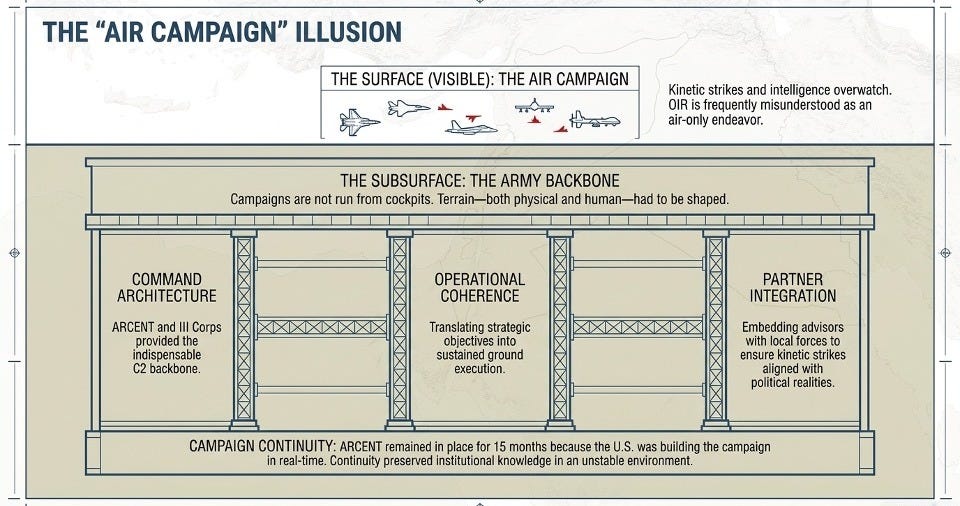
This is where many retrospective accounts fall short.
They measure success in terms of:
territory retaken,
enemies killed,
or timelines accelerated.
But they overlook the more fundamental question:
Did the system change?
Narrative Drift and Political Reframing
In the years since, the narrative of OIR has drifted.
Some accounts emphasize fragmentation and delay, obscuring the complexity of the environment.
Others—particularly those shaped by later political narratives—suggest that decisive action was delayed until new leadership imposed it.
Both interpretations flatten the reality.
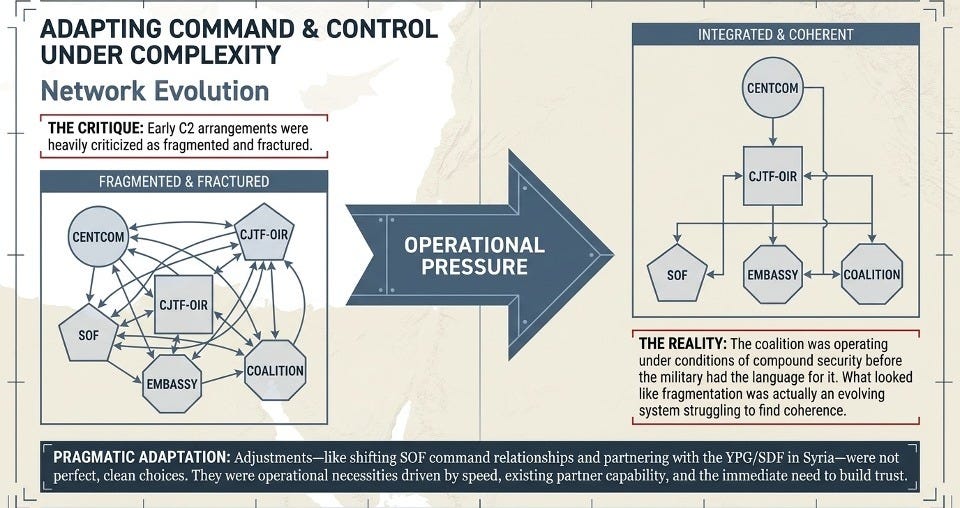
They ignore:
the systemic nature of the conflict,
the constraints under which decisions were made,
and the strategic logic guiding those decisions.
In doing so, they risk replacing history with simplification—and, at times, politicization.
Conclusion: Restoring the Record
Operation Inherent Resolve was not a conventional war, nor was it a simple counterterrorism campaign.
It was:
… a systemic war fought within a failing regional order against a compound threat that both exploited and emerged from that order.
Understanding it requires more than recounting events.
It requires recognizing:
the nature of the system,
the limits of force,
and the complexity of operating within both.
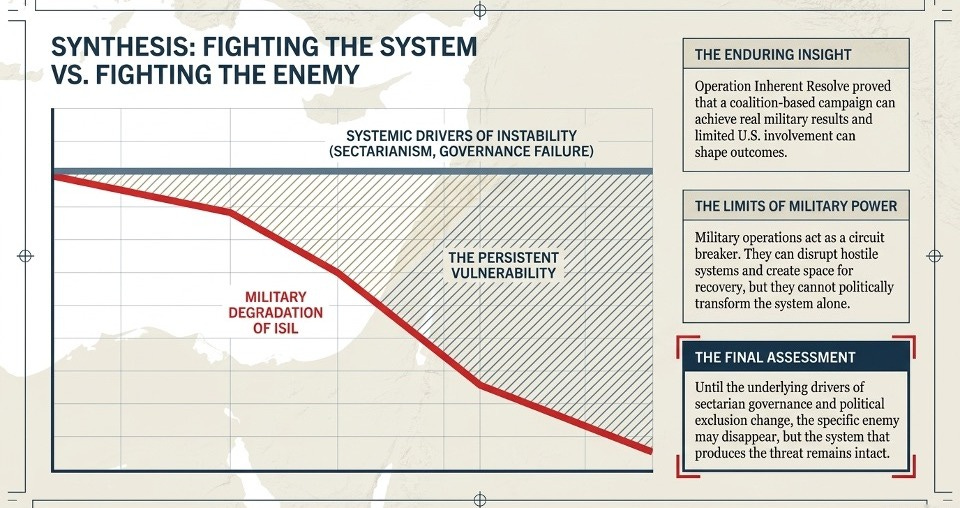
If the historical record is to be accurate—and useful—it must reflect that reality.
Because the next conflict will not look simpler.
It will look more like this one.
It already does ...
If you value this work, here are three ways you can step into the story with us:
📰 Subscriber (Free)
Stay informed. Receive every new essay, briefing, and analysis straight to your inbox. Join a growing community committed to civic resilience and national security.
🎧 Supporter (Paid Pledge)
Strengthen the signal. Your support sustains both Compound Security, Unlocked and our companion podcast The Civic Brief. Supporters ensure these conversations remain accessible to the wider public while elevating the quality, depth, and reach of the work.
🛡️ Sustainer (Patron Level)
Invest in the mission. Sustainers fuel new research, convenings, and storytelling that enlarge the civic frame of security. This is more than content — it’s a civic project. Your sponsorship helps preserve an independent voice committed to equipping citizens, leaders, and institutions for the compound challenges ahead.
This is an interesting piece. On one hand the command team needs to develop a sound strategy to combat ISIL and on the other hand it needs to communicate effectiveness to DC and the world. The problem.... you can't tip your hand to the enemy.
The transparency needed to satisfy the world and the American public would tip the hand majorly giving ISIL the ability to directly counter the strategy. On the other hand, not informing them creates the challenges you laid out.
If not already, the war colleges need to have this as a course. Senior officers need to be able to identify these things well before they run into them. Though... military officers knowing this is only one side of the coin.
Presidential appointees and the diplomatic corp are the other two legs of this three legged stool. If they're not on the same page (especially the presidential appointees) then the chair falls. So that leaves the diplomatic corp and military officers to effectively communicate what the reality is and the strategy needed to the appointees, but as we've seen... egos can get in the way of that.
So that leads to the next question.... how does the system balance an appointee that may have zero true knowledge on a topic and the reality on the ground with.... an appointee who is trying to stir up other thoughts i.e. forcing the diplomatic corps and the military to think outside of their normal box?