
Will the Democratic Party Become the Party of Democratic Socialism?
Perhaps. But America Has Another Name for It: ‘The Democratic Party’ (!)

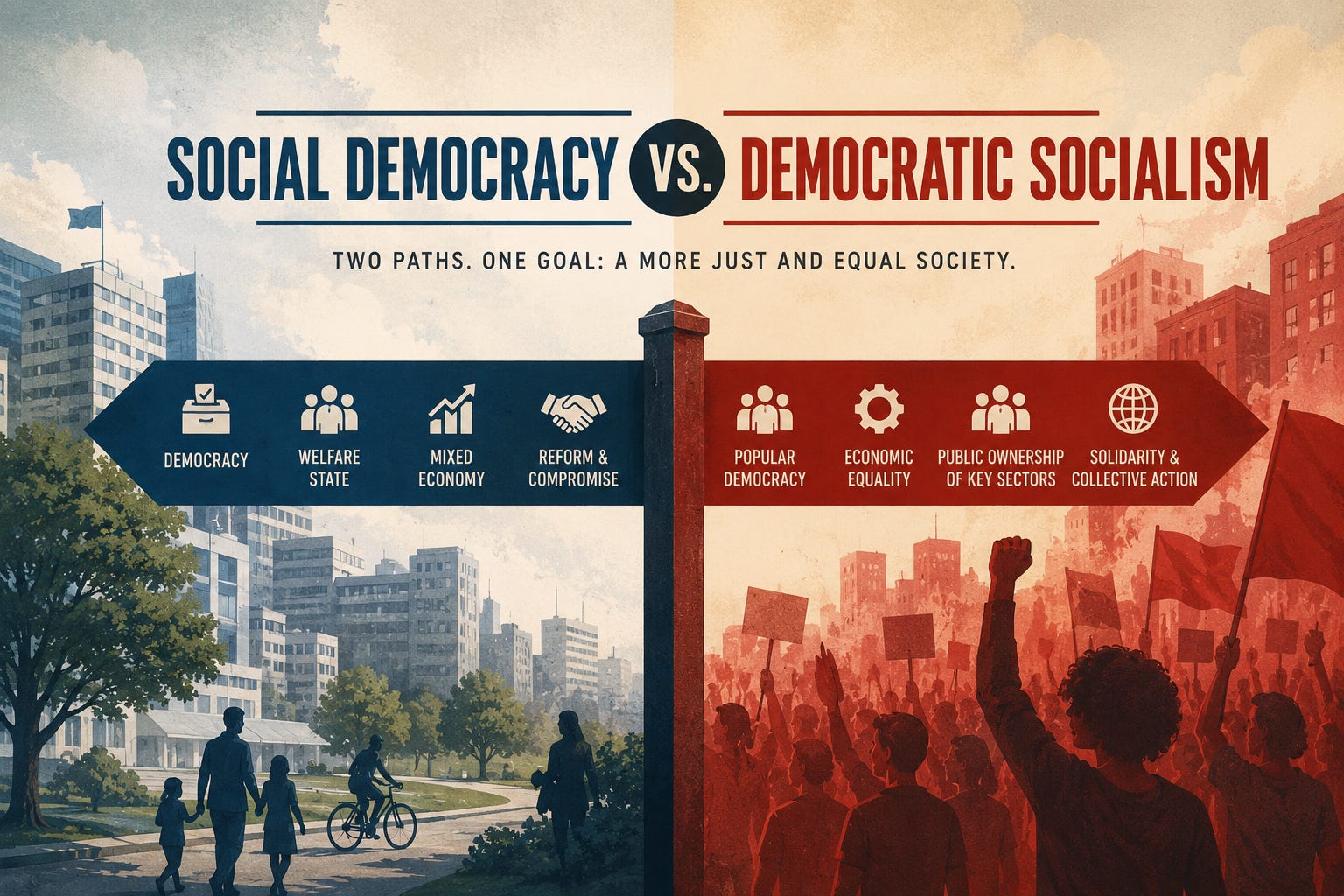
Michael Smerconish posed a deceptively simple question this past weekend (08 Aug 26): Will the Democratic Party become the party of democratic socialism? It is precisely the sort of question that our contemporary politics encourages us to answer immediately—yes or no, left or center, Mamdani or Clinton, socialist or capitalist.
But viewed through the longer lens of American Political Development, the question looks considerably different.
The more historically revealing question may be whether the Democratic Party is approaching another of those recurrent moments in American political development when an aging political order can no longer adequately govern the conditions it helped create, and a party must reconstruct itself around a new understanding of what government is for.
If that is what is happening, then my answer to Smerconish’s question is a qualified yes. The Democratic Party may indeed become more recognizably social democratic.
But that does not necessarily mean becoming socialist in the conventional American understanding of the word, much less becoming the institutional expression of the Democratic Socialists of America. The distinction matters enormously.
Democratic socialism traditionally raises fundamental questions about the ownership of capital and the organization of economic production.
Social democracy begins somewhere else. It accepts markets, private property, entrepreneurship, investment, competition, and capitalism itself, while insisting that markets remain embedded within democratic institutions and subordinated, at critical points, to the requirements of citizenship, social stability, opportunity, and the common good.
Put more plainly, social democracy does not ask government to replace capitalism. It asks democratic government to make capitalism governable—and to make the prosperity capitalism produces sufficiently broadly shared that citizens continue to regard both the economic system and the political system as legitimate.
That proposition is hardly foreign to American political development. In important respects, it is one of its central stories.
The United States has repeatedly responded to periods of profound economic, technological, and social transformation not by abolishing markets but by rebuilding the institutional architecture surrounding them.
The Progressive Era responded to industrial concentration with regulation, antitrust, professional government, and democratic reform. The New Deal responded to the collapse of industrial capitalism by constructing Social Security, labor protections, financial regulation, unemployment insurance, public investment, and a vastly enlarged conception of national responsibility. The Great Society extended that settlement through Medicare, Medicaid, civil-rights enforcement, education, and an expanded social citizenship. None abolished American capitalism. Each arguably helped save it from its own destabilizing tendencies.
This is where American Political Development becomes especially useful. APD teaches us not to understand American politics simply as a succession of elections or ideological swings. Political orders accumulate institutions, commitments, constituencies, veto points, and governing assumptions over time. Those arrangements eventually encounter changing conditions for which they were not designed. Institutions created to solve yesterday’s problems become incapable of solving tomorrow’s. Old coalitions fracture. New constituencies emerge. Ideas once regarded as politically impossible migrate toward the center of political debate. Periods of apparent political disorder can therefore be symptoms of something larger: regime exhaustion and reconstruction.
The Democratic Party has undergone precisely these transformations before. The party of Andrew Jackson was not the party of Franklin Roosevelt. Roosevelt’s Democratic Party was not Lyndon Johnson’s coalition after the incorporation of civil rights into the national Democratic project. And the Democratic Party that emerged from the Reagan era—particularly through the New Democrat and Third Way accommodations of the 1980s and 1990s—was itself an adaptation to a political order whose governing vocabulary had shifted dramatically toward markets, deregulation, globalization, fiscal restraint, and skepticism toward government.
Those adaptations were not necessarily irrational. Political parties are historical organisms. They adjust to survive. But accommodations can eventually become constraints.
Theodore J. Lowi offers another way of understanding this developmental problem. Lowi’s enduring insight—that policies create their own politics—reminds us that political orders do not merely respond to social conditions; over time, they reorganize interests, expectations, institutions, and ultimately the very terrain upon which subsequent political struggles occur. The regulatory and redistributive state constructed during the Progressive Era, New Deal, and Great Society created one kind of American political economy. The deregulatory, financialized, increasingly privatized order that followed created another. Each produced constituencies that benefited from it, interests organized to defend it, and path dependencies that made subsequent change difficult. But each also produced consequences that eventually challenged its own legitimacy.
Seen through Lowi’s lens, today’s demand for a more social-democratic politics need not be understood principally as an ideological conversion of the American electorate. It may instead represent politics responding to the accumulated consequences of the policies—and non-policies—of the preceding political order. The politics are changing because the political economy changed first.
The question confronting Democrats in the 2020s and approaching the 2030s is whether the political-economic environment to which the party adapted during the late twentieth century still exists.
Increasingly, it does not.
Americans now inhabit an economy characterized simultaneously by extraordinary aggregate wealth and profound household insecurity; remarkable technological capability and widespread anxiety about displacement; global abundance and fragile supply chains; enormous corporate productivity and declining confidence that work reliably produces economic security. Housing, health care, higher education, childcare, elder care, and retirement have become sources of economic precarity for millions of households. Artificial intelligence threatens to transform the relationship between labor and capital faster than twentieth-century social institutions can adapt. Climate shocks, pandemics, migration, demographic aging, geopolitical competition, energy transitions, fiscal pressure, and technological disruption increasingly interact rather than arrive separately.
These are not merely progressive concerns. They are systems problems.
They are problems of the Compound Age.
And this is precisely why social democracy may be returning—not primarily as ideology, but as institutional necessity.
The political economy constructed for an earlier age assumed that many risks could remain individualized. Lose employment, retrain. Need health insurance, obtain it through employment. Need retirement security, save and invest. Need housing, enter the market. Need education, borrow against future earnings. Need childcare, purchase it privately.
The underlying assumption was that sufficiently dynamic markets, supplemented by targeted public assistance, could distribute both opportunity and risk tolerably well.
Karl Polanyi described a related dynamic as the “double movement”: the recurring tension between efforts to expand the reach of self-regulating markets and society’s countermovement to protect itself from the social dislocations those markets can produce. Polanyi’s point was not that markets are inherently destructive, but that markets cannot remain permanently disembedded from the societies in which human beings actually live. When labor, housing, land, health, family life, and community become treated too completely as commodities, pressures eventually arise for political protection and institutional re-embedding.
That insight is particularly useful for understanding the present moment. The renewed appeal of unions, industrial policy, antitrust, public investment, health-care guarantees, family supports, and other ostensibly “social-democratic” measures may represent less a rejection of capitalism than another American countermovement against the accumulated insecurities of a political economy that placed increasingly large categories of risk upon individuals and households.
The challenge, as Polanyi’s own century demonstrated, is ensuring that the countermovement remains democratic, pluralistic, and liberal rather than becoming authoritarian, exclusionary, or economically suffocating.
Compound systems behave differently.
Risks cascade. A health crisis becomes an employment crisis; an employment crisis becomes a housing crisis; a housing crisis becomes an educational crisis for children; technological displacement becomes regional economic decline; regional decline becomes political alienation; political alienation becomes institutional distrust; institutional distrust becomes democratic instability.
What appears in conventional policy analysis as six separate policy problems may actually constitute one interconnected system failure.
The governing question therefore changes. It is no longer simply: How much government should we have? It becomes: What capacities must democratic society possess to remain resilient under compound stress?
That question potentially opens an enormous political space for Democrats.
But only if ... they resist confusing social democracy with ideological purification.
The historical strength of the Democratic Party has rarely rested upon ideological uniformity. Quite the opposite. The Democratic Party has usually been strongest when it functioned as an extraordinarily broad—and frequently uncomfortable—coalition of constituencies whose interests intersected without becoming identical. Workers and intellectuals. Urban immigrants and rural farmers. Organized labor and entrepreneurs. African Americans and white ethnics. Southern populists and Northern liberals. Later, environmentalists, professionals, minorities, women, suburbanites, young people, and elements of corporate America. The coalition has repeatedly contained contradictions, some morally indefensible and eventually unsustainable. But institutionally its defining characteristic was breadth.
That is what “big tent” once actually meant.
E. E. Schattschneider helps explain why recovering that big tent requires more than assembling demographic constituencies. “The definition of the alternatives,” he famously argued, “is the supreme instrument of power.” Political parties succeed not simply by taking positions on existing conflicts but by determining which conflicts become politically salient and how the alternatives are organized.
That insight should matter enormously to Democrats. If the party allows the emerging argument to be defined as “capitalism versus socialism,” it enters a political battlefield largely constructed by its opponents and inherited from the Cold War.
But if the conflict is instead organized around concentrated versus broadly distributed economic power, insecurity versus security, monopoly versus competition, private vulnerability versus public resilience, and an economy that serves democratic citizenship versus one that progressively destabilizes it, ... the coalition potentially changes.
Schattschneider’s lesson is therefore not semantic cleverness. It is coalition politics at its most fundamental: whoever successfully defines what the political conflict is about goes a long way toward determining who can be assembled on either side of it.
American social democracy could become the organizing principle of a new Democratic big tent precisely because it enlarges rather than narrows the scope of that coalition.
A twenty-first-century social democracy could potentially reconstruct that coalition around material citizenship rather than ideological identity. The organizing proposition would be strikingly simple: whatever else Americans disagree about, citizenship in the wealthiest democratic republic in human history should carry certain practical guarantees.
Work should provide dignity. Illness should not produce bankruptcy. Raising children should not require economic ruin. Education should create mobility rather than permanent indebtedness. Retirement after a lifetime of work should be secure. Markets should remain competitive rather than captured by monopolies. Workers should possess meaningful bargaining power. Entrepreneurs should be able to challenge incumbent concentrations of wealth. Communities should possess functioning infrastructure. And government should be capable of delivering public goods competently enough to earn the trust required for democratic self-government.
That agenda need not require hostility toward capitalism. Indeed, historically its strongest American argument may be precisely the opposite: social democracy can be understood as the political infrastructure of sustainable capitalism.
Franklin Roosevelt understood something about this that subsequent generations sometimes forget. The New Deal was radical relative to the institutional arrangements it displaced, but conservative in another, deeper sense. It preserved a market democracy by reforming a political economy whose failures threatened the legitimacy of both markets and democracy. Social Security did not collectivize American industry. Deposit insurance did not abolish banks. The Wagner Act did not eliminate corporations. Securities regulation did not close Wall Street. These interventions changed the rules within which capitalism operated because the previous rules had produced politically intolerable outcomes.
That distinction is critical today.
The Democratic Party therefore faces a choice larger than whether it moves “left” or “center.” Those spatial metaphors may themselves obscure what is happening. The more consequential choice is whether Democrats understand the present moment as another developmental hinge—one in which the institutional settlement inherited from the late twentieth century is increasingly mismatched to twenty-first-century conditions.
Seen that way, the emerging attraction of social-democratic policies among younger Americans becomes less mysterious. They have come of age under institutional conditions very different from those experienced by the generations that built the postwar political order. For many younger citizens, the formative experiences have been the financial crisis, crushing housing costs, student debt, precarious employment, pandemic disruption, climate anxiety, technological displacement, and extraordinary concentrations of wealth. Telling such voters that policies their grandparents experienced as ordinary features of the New Deal order constitute dangerous departures from American capitalism is unlikely to settle the argument.
But neither should Democrats conclude that this generational opening constitutes a mandate for doctrinal democratic socialism.
That would repeat another recurring mistake of political development: confusing the constituency that first articulates an emerging problem with the coalition ultimately capable of governing it.
The potentially transformative Democratic coalition is considerably larger than the socialist left. It could encompass union households and technology workers; Black and Latino working-class voters and college-educated suburbanites; young renters and elderly Social Security recipients; climate activists and domestic manufacturers; small-business owners threatened by monopoly concentration and workers threatened by corporate monopsony; rural communities losing hospitals and urban families unable to afford childcare, ... Independents, ... true, genuine, ‘conservatives’. Their ideological identities may differ dramatically. Their experience of insecurity increasingly does not.
I spoke to the “horseshoe theory” of this now nearly a decade ago ...
The connective tissue is not socialism.
It is security.
Economic security. Health security. Housing security. Retirement security. Community security. Democratic security. And increasingly, security against the systemic shocks of the Compound Age.
This is where social democracy potentially becomes something larger than a factional program. It can become a coalition architecture.
The Democratic Party’s developmental opportunity, therefore, may not lie in becoming the party of democratic socialism. It may lie in recovering an older American proposition and translating it for radically new conditions: democracy requires a political economy capable of producing citizens secure enough to remain democratic.
That proposition can accommodate Alexandria Ocasio-Cortez and Abigail Spanberger. It can encompass Bernie Sanders voters and traditional labor Democrats, pragmatic governors, small-business owners, racial minorities, suburban professionals, younger voters skeptical of capitalism, and older voters who would never dream of describing Medicare or Social Security as socialism even while fiercely defending both. A genuine big tent does not require these constituencies to agree about the ultimate theory of capitalism. It requires them to agree about the minimum conditions of democratic citizenship.
This is why the semantic distinction matters so much. Calling the emerging project “democratic socialism” invites Americans into an ideological argument inherited largely from the twentieth century. Calling it American social democracy locates the argument where it belongs: inside the long historical development of the American republic itself.
The central political question of the Compound Age is not whether America will become socialist or remain capitalist. America will almost certainly remain a predominantly capitalist society. The deeper question is what kind of capitalism can coexist sustainably with republican democracy under conditions of extraordinary technological change, concentrated wealth, demographic transformation, geopolitical competition, ecological stress, and cascading systemic risk.
The ‘Second Gilded Age’ and the Search for a Second Progressive Settlement
There is another historical rhythm worth considering. American political development has never moved neatly forward. It has moved through periods of institutional construction, consolidation, exhaustion, disruption, and reconstruction. The first Progressive Era did not simply appear because Americans suddenly became more progressive. It arose as a political response to the pathologies produced by the Gilded Age: extraordinary concentrations of wealth and corporate power, monopoly and political corruption, dangerous working conditions, rapid technological disruption, mass immigration and urbanization, spectacular fortunes alongside profound insecurity, and a growing sense that institutions designed for an earlier republic were no longer capable of governing an industrial continental power.
Progressivism was, in this sense, less an ideology imposed upon American development than an institutional immune response generated by it.
The resemblance to our own moment is difficult to ignore. For decades, scholars and commentators have described the contemporary United States as entering a “second Gilded Age,” marked again by extraordinary concentrations of wealth, weakened organized labor, monopoly and oligopoly, financialization, technological fortunes of unprecedented scale, declining confidence in public institutions, and growing distance between formal democratic equality and the actual distribution of economic and political power. The Trump I and Trump II periods have intensified rather than invented many of these conditions. They have also added another dimension to the developmental crisis: a more explicit contest over the administrative state, constitutional norms, executive power, institutional independence, and even the meaning and boundaries of membership in the American political community.
From an APD perspective, therefore, the emergence of another progressive impulse should hardly surprise us. If the first Progressive Era emerged partly as a corrective to the first Gilded Age, then conditions resembling a second Gilded Age should generate pressures toward something resembling a second Progressive Era. History does not repeat mechanically, and institutional development is never cyclical in any simple sense. Path dependence ensures that the next settlement will be constructed upon the accumulated architecture of everything that came before it. But political systems do exhibit recurrent corrective dynamics. Concentrations of power produce countervailing demands. Institutional failures generate demands for institutional reconstruction. Periods in which markets substantially outrun governing capacity eventually create political constituencies demanding that governing capacity catch up.
This is where the analogy becomes both useful and dangerous. A corrective movement is not inherently a correct movement. Medicine can be badly prescribed. Dosage matters.
The challenge for a second Progressive Era, therefore, is not simply to administer more government to compensate for too much market, or more equality to compensate for too much concentration. It is to ‘get the cocktail right’: to identify which institutional medicines are necessary, in what combinations, at what dosage, for which pathologies, and with what safeguards against their own adverse effects.
Antitrust can restore competition without becoming hostility toward successful enterprise. Industrial policy can rebuild national capacity without degenerating into permanent corporate subsidy. Labor power can provide necessary counterweight to concentrated capital without freezing economic adaptation. Social insurance can create security without eliminating agency or mobility. Regulation can discipline markets without suffocating innovation. Public investment can expand common capacity without making government the proprietor of economic life. And executive capacity can be strengthened without strengthening executive domination.
That last distinction may be the most important of all. The purpose of a second Progressive Era cannot simply be to construct a stronger state. It must construct a more capable democratic state constrained by republican institutions. The dangers arising from concentrated private power do not disappear when power is transferred to public institutions; concentration itself remains the problem. A social-democratic correction that weakens pluralism, constitutional restraint, local autonomy, entrepreneurship, civil society, or individual liberty could eventually become as dangerous to the American polity as the conditions it was intended to cure. The history of the twentieth century offers ample warning that countermovements against market dislocation can travel in democratic as well as profoundly undemocratic directions.
The governing task is consequently neither laissez-faire nor statism. It is balance: markets capable of producing abundance; government capable of producing public goods; workers possessing sufficient power to bargain; capital possessing sufficient freedom to innovate; communities possessing sufficient resilience to absorb disruption; and constitutional institutions sufficiently strong to prevent any one of these forces from overwhelming the others.
That is also where Lowi, Polanyi, and Schattschneider converge. Lowi reminds us that the institutional remedies we choose will themselves create new politics. Polanyi reminds us that societies will eventually protect themselves when markets become too disembedded from human needs, while history warns that such countermovements are not guaranteed to remain liberal or democratic. Schattschneider reminds us that the political struggle will ultimately turn upon how the conflict itself is defined and which constituencies that definition brings into the arena.
The task for Democrats, then, is not to recreate the Progressive Era, the New Deal, or the Great Society. Historical reconstruction cannot mean historical reenactment. The task is to do what those earlier generations did: diagnose the specific institutional failures of their own age and construct a governing settlement appropriate to them.
That is why the distinction between democratic socialism and social democracy matters so much. The former can too easily become an argument about ideological destination. The latter can be understood as a method of democratic correction—an effort to rebalance capitalism and democracy when accumulated concentrations of economic power, social insecurity, and institutional incapacity threaten the legitimacy of both.
If the United States has indeed entered a second Gilded Age, then a second Progressive Era may already be forming in response. The question is not whether the correction will come. The accumulated pressures of the Compound Age make some form of correction increasingly likely. The question is whether American political leadership can formulate the right prescription: strong enough to treat the disease, carefully balanced enough not to become another disease itself, and sufficiently democratic that the patient remains recognizably the American republic when the treatment is complete.
American Political Development suggests that political orders endure not by refusing adaptation but through it. The Progressive settlement modified the Gilded Age. The New Deal reconstructed industrial capitalism. The Great Society reconstructed the boundaries of American citizenship. Each transformation incorporated ideas that had previously existed outside the political mainstream. Each produced conflict. Each generated institutional excesses and unintended consequences alongside enduring achievements. And each altered what Americans subsequently regarded as normal.
We may be approaching another such hinge.
If so, the most consequential development would not be the Democratic Party becoming “the socialist party.” It would be the Democratic Party rediscovering its historical function as the principal institutional vehicle through which American capitalism periodically renegotiates its social contract with American democracy.
That would be something simultaneously old and new: Rooseveltian in instinct, post-neoliberal in political economy, pluralist in coalition, entrepreneurial in its continued commitment to markets, and profoundly modern in its recognition that security in the Compound Age is increasingly produced collectively.
And perhaps that is the answer to Smerconish’s prescient question.
Will the Democratic Party become the party of democratic socialism?
Perhaps—but only if we use the term loosely enough that it ceases to tell us very much.
The more historically meaningful possibility is that Democrats become the party of American social democracy: not a smaller ideological party moving leftward, but a larger coalition moving outward; not a party committed to abolishing capitalism, but one committed to making capitalism compatible again with democratic citizenship; not a retreat from America’s political tradition, but another reconstruction within it.
The irony would be considerable.
What Americans are beginning to call socialism may turn out to be something far more familiar.
It may simply be the next developmental iteration of the New Deal’s oldest bargain: capitalism for prosperity, democracy for legitimacy, and a capable republic strong enough to keep the two from destroying one another.
In the Compound Age, that may prove less a radical proposition than a prerequisite for keeping the American big tent standing.

If you value this work, here are three ways you can step into the story with us:
📰 Subscriber (Free)
Stay informed. Receive every new essay, briefing, and analysis straight to your inbox. Join a growing community committed to civic resilience and national security.
🎧 Supporter (Paid Pledge)
Strengthen the signal. Your support sustains both Compound Security, Unlocked and our companion podcast The Civic Brief. Supporters ensure these conversations remain accessible to the wider public while elevating the quality, depth, and reach of the work.
🛡️ Sustainer (Patron Level)
Invest in the mission. Sustainers fuel new research, convenings, and storytelling that enlarge the civic frame of security. This is more than content — it’s a civic project. Your sponsorship helps preserve an independent voice committed to equipping citizens, leaders, and institutions for the compound challenges ahead.