

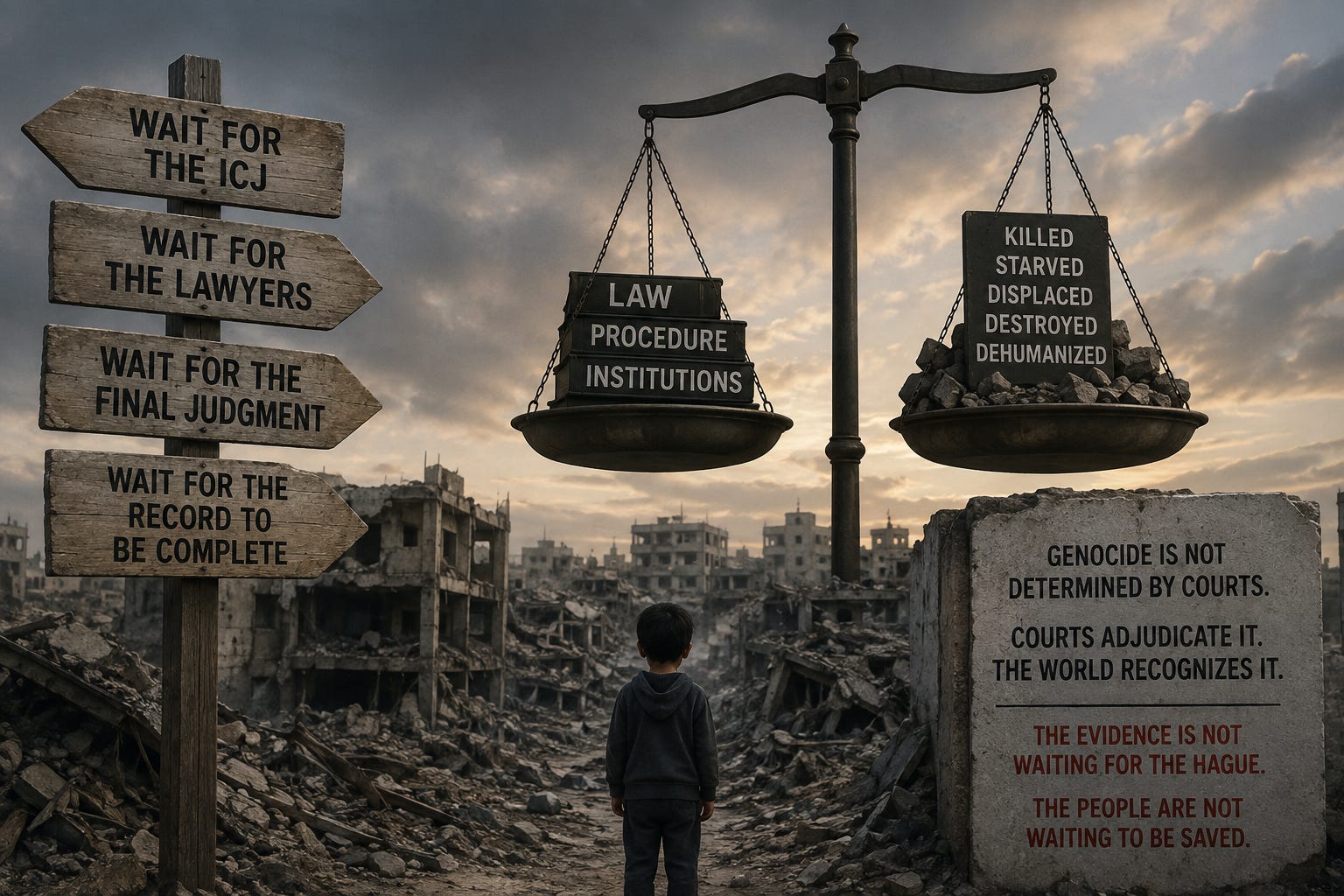
There is an odd rule emerging in the argument over Gaza. We are told that we must wait.
Wait for the International Court of Justice. Wait for the lawyers. Wait for the final judgment. Wait until the evidentiary record is complete and the briefs have been filed and answered and the judges in The Hague have determined whether the destruction of Gaza satisfies the extraordinarily demanding legal requirements of the Genocide Convention.
Only then, apparently, may we know what we have been watching.
This injunction would be easier to understand if it came from a political culture otherwise reverential toward international institutions. But it does not.
It comes at precisely the moment when much of the Western political world—and particularly the United States—has become increasingly skeptical of international courts, international organizations, multilateral regimes, and the United Nations itself. The United States is not a party to the Rome Statute establishing the International Criminal Court. American administrations have repeatedly disputed the court’s jurisdiction over Americans and Israelis. Washington has imposed sanctions on ICC officials. In August 2026, the United States expanded sanctions against senior ICC officials even as it continued to denounce the institution’s Palestine investigation as illegitimate.[1]
And yet, in the argument over whether Israel’s conduct in Gaza constitutes genocide, one repeatedly encounters a peculiar appeal to institutional patience:
The ICJ has not ruled that it is genocide.
The statement is true.
What follows from it is not.
A court can determine legal responsibility for genocide. It does not create the historical phenomenon called genocide by pronouncing its name. The Holocaust did not become genocide when lawyers retrospectively supplied it with a legal category. The destruction of the Ottoman Armenians did not await an international tribunal before becoming intelligible as an effort to destroy a people. Rwanda was genocide while the killing was occurring, including during the months when governments avoided using the word precisely because naming it might create obligations to act.
Courts adjudicate genocide.
They do not bring genocide into existence.
The distinction matters enormously in Gaza because our understandable insistence on legal precision has gradually become confused with something quite different: an insistence that legal institutions possess a monopoly over empirical judgment. They do not.
The more useful question is therefore no longer simply Has an international court convicted Israel of genocide?
It is this:
Given the definition of genocide, the observable conduct, evidence bearing upon intent, alternative explanations, historical comparison, and the accumulated judgments of specialists whose professional lives have been devoted to studying genocide, where does the preponderance of evidence now lie?
That question produces a considerably more uncomfortable answer.
The Word We Are Afraid to Use
Genocide is simultaneously a legal category, a historical category, and a moral category.
Confusing the three has distorted much of the public argument.
The 1948 Convention on the Prevention and Punishment of the Crime of Genocide defines genocide not principally by numbers but by intent. Certain enumerated acts—including killing members of a protected group, causing serious bodily or mental harm, deliberately inflicting conditions of life calculated to bring about the group’s physical destruction, preventing births, or forcibly transferring children—become genocide when committed with the “intent to destroy, in whole or in part,” a national, ethnic, racial, or religious group as such.[2]
This makes genocide different from a synonym for mass killing.
A state can kill enormous numbers of civilians unlawfully without necessarily committing genocide. It can commit war crimes. It can commit crimes against humanity. It can conduct an illegal war. It can use disproportionate force. Genocide requires something additional: the specific intention to destroy the protected group, at least in substantial part.
This is the strongest argument made by those who reject the genocide designation for Gaza, and it deserves to be stated in its strongest rather than weakest form.
Israel did not begin the present war without cause. On October 7, 2023, Hamas and allied militants attacked Israeli communities, murdering roughly 1,200 people and abducting more than 250. The attack included crimes against civilians and constituted grave violations of international law. Israel had both a right and an obligation to protect its population and to pursue those responsible. The Israeli government’s legal position has consistently maintained that the purpose of its military campaign is the destruction of Hamas’s military and governing capabilities and the recovery of hostages—not the destruction of Palestinians as a people.[3]
That distinction cannot simply be waved away.
Nor does the terrible magnitude of Palestinian death establish genocide by itself.
But neither does saying Hamas resolve the question.
A military objective and a genocidal objective are not logically mutually exclusive. More important, a state’s stated purpose cannot be the final test of its actual purpose. If it were, genocide law would be nearly useless. Few governments announce in juridically convenient language that they intend to destroy a protected people.
Intent must often be inferred.
And that is where Gaza becomes more difficult.
The Scholar Who Changed His Mind
Omer Bartov is useful here not because he provides an authority to whom judgment can be outsourced, but because he demonstrates how judgment ought to work.
Bartov is an Israeli-born historian, a former Israel Defense Forces soldier, and one of the world’s best-known scholars of the Holocaust, genocide, and the relationship between military institutions and mass violence. His scholarship has spent decades examining precisely the uncomfortable space in which organized warfare becomes something else.
And Bartov did not initially call Gaza a genocide.
In November 2023, amid growing accusations that Israel’s campaign already met the definition, Bartov argued that the evidence did not yet establish that conclusion. He saw abundant evidence of potential war crimes and heard rhetoric that he regarded as genocidal. But rhetoric and genocide were not yet the same thing. His warning was prospective: genocidal intent could become genocidal action.[4]
Then he changed his mind.
The change matters.
Bartov later identified the Israeli operation in Rafah in May 2024 as a decisive point in his assessment. Looking retrospectively at repeated population displacement alongside the destruction of housing, universities, schools, hospitals, religious institutions, cultural sites, infrastructure, and other structures necessary for a society to reproduce itself, he concluded that the cumulative pattern could no longer adequately be understood simply as collateral destruction accompanying a campaign against Hamas.[5]
By July 2025 his conclusion was explicit: Israel was committing genocide in Gaza.
One may dispute Bartov’s conclusion. That is precisely what scholarship permits. One may challenge his reading of particular military operations, the evidentiary weight he assigns statements by Israeli officials, his inference of intent, or the relationship he draws between destruction of social infrastructure and physical destruction of a protected group.
But one cannot fairly describe his position as merely the reflex of an anti-Israel ideology.
His trajectory ran in the opposite direction.
Evidence changed; his judgment changed.
That is worth dwelling upon because contemporary political argument increasingly works the other way around. We choose the conclusion first and then determine which institutions, experts, statistics, and evidentiary standards we are prepared to recognize.
Bartov did something simpler and rarer.
He specified a threshold.
He watched.
And when he believed the evidence crossed it, he revised his conclusion.
That is not certainty. It is inquiry.
When One Scholar Becomes Many
Bartov’s judgment would be interesting if it stood alone.
It no longer does.
In December 2024, Amnesty International published an extensive investigation concluding that Israel had committed genocide against Palestinians in Gaza. Amnesty examined civilian killing, destruction of infrastructure, forced displacement, restrictions upon humanitarian assistance and essential goods, and statements by Israeli officials, arguing that the pattern of conduct established the requisite genocidal intent.[6]
Human Rights Watch was somewhat more circumscribed. Its December 2024 investigation focused particularly on deprivation of water and concluded that Israeli authorities were responsible for extermination and “acts of genocide,” arguing that deliberate deprivation of water inflicted conditions of life capable of bringing about physical destruction.[7]
Then something particularly significant happened inside Israel itself.
In July 2025, B’Tselem—one of Israel’s most prominent human-rights organizations—published a report titled Our Genocide. It concluded that the Israeli government was conducting coordinated policies intended to destroy Palestinian society in Gaza. Physicians for Human Rights–Israel reached a related conclusion through a medical and public-health analysis of the destruction of Gaza’s health system.[8]
These were not findings issued from Tehran, Hamas headquarters, or an anti-Israel student encampment.
They came from Israeli civil society.
In August 2025, the International Association of Genocide Scholars adopted a resolution concluding that Israel’s policies and actions in Gaza met the legal definition of genocide contained in Article II of the Genocide Convention.
The vote requires an important qualification frequently lost in public discussion: 86 percent of participating voters supported the resolution, but only about 28 percent of the organization’s membership voted. It therefore cannot honestly be described as 86 percent of all genocide scholars—or even 86 percent of all IAGS members—declaring Gaza a genocide.[9]
But neither can it honestly be dismissed as an eccentric claim existing outside the discipline.
The world’s largest professional association devoted to genocide studies had formally crossed the threshold.
The following month, the United Nations Independent International Commission of Inquiry went further. In September 2025 it concluded, after analyzing Israel’s conduct under the Genocide Convention, that Israeli authorities had committed four of the five genocidal acts enumerated by the Convention and that the evidence supported the required genocidal intent. It concluded that Israel bore responsibility for genocide and failure to prevent genocide.[10]
One need not accept every one of these findings to recognize what had happened intellectually.
The burden of argument had shifted.
In late 2023, calling Gaza genocide could reasonably be characterized as an anticipatory allegation requiring considerably more evidence.
By late 2025, rejecting the designation required engaging not merely activists but Holocaust historians, genocide scholars, international lawyers, human-rights investigators, Israeli human-rights organizations, medical experts, and a United Nations commission that had expressly applied the elements of the Genocide Convention.
That is not the same thing as saying that a consensus had rendered further debate illegitimate.
But it does mean that “obviously not genocide” had ceased to be a serious description of the state of the evidence.
What the Court Has—and Has Not—Said
This is where the International Court of Justice must be put back into its proper place.
South Africa instituted proceedings against Israel under the Genocide Convention in December 2023. The ICJ subsequently imposed provisional measures. Those decisions were significant, but they were not a judgment that genocide had occurred. The Court was considering whether rights asserted under the Convention were plausible and whether circumstances required emergency measures to prevent irreparable harm while the merits were litigated.[11]
The distinction has been mangled in both directions.
Supporters of the genocide allegation sometimes say, inaccurately, that the ICJ “ruled that Israel is committing genocide.”
It did not.
Defenders of Israel sometimes imply that because the ICJ has not reached such a judgment, genocide has therefore not been established in any meaningful sense.
That does not follow either.
As of August 2026, the merits case remains unresolved. Israel submitted its counter-memorial in March 2026.[12] The judicial process therefore continues.
And it should.
Courts should be slow. Legal judgments establishing state responsibility for genocide should demand evidence, adversarial argument, exacting standards, and procedural fairness. The gravity of the accusation demands nothing less.
But judicial caution answers a particular question:
Has legal responsibility been established to the standard required by this tribunal?
It does not answer:
What is presently the best explanation of the evidence?
The difference resembles one familiar from domestic law. An acquittal does not necessarily establish that an event did not happen. It establishes that criminal culpability was not proved according to a particular legal standard through a particular adjudicative process. Historical knowledge, scientific inference, intelligence assessment, journalism, and ordinary human judgment operate according to different evidentiary purposes.
A historian is not a criminal jury.
Neither is a citizen.
The Paradox of the Internationalists Who Aren’t
And here lies the larger story.
For much of the post-Cold War era, critics of the so-called rules-based international order have argued that international institutions are remote, politicized, selective, unaccountable, or impotent. The United Nations is dismissed as dysfunctional. International courts are accused of exceeding their mandates. Sovereignty is invoked against multilateral constraint.
The United States’ relationship with the International Criminal Court provides an especially stark example. Again, Washington has never ratified the Rome Statute. American governments have resisted ICC jurisdiction over U.S. nationals and, with renewed intensity, attacked the court when it turned its attention toward Israel. The ICC’s November 2024 warrants for Benjamin Netanyahu and former Defense Minister Yoav Gallant alleged, among other things, the war crime of starvation as a method of warfare and crimes against humanity.[13] The United States rejected the court’s jurisdiction and subsequently escalated punitive measures against its officials.
There are principled arguments for those positions.
But something peculiar happens when the conversation turns from whether international institutions should constrain Israel to whether outsiders may describe Israel’s conduct.
Suddenly The Hague becomes indispensable.
Wait for the ICJ.
The international institution considered too illegitimate to constrain sovereign power somehow becomes authoritative enough that its unfinished deliberations are invoked to constrain language itself.
This is selective institutionalism.
The phenomenon is hardly unique to Israel’s defenders. Progressives, nationalists, human-rights advocates, governments, and political movements of every variety are capable of the same maneuver. Institutions become authoritative when their conclusions validate our priors and hopelessly compromised when they do not.
We do this with intelligence agencies.
We do it with courts.
We do it with scientific bodies.
We do it with election systems.
And we do it with the United Nations.
The deeper danger is not hypocrisy. Hypocrisy is ordinary political behavior.
The deeper danger is epistemological opportunism: changing the rules governing what counts as knowledge according to the conclusion those rules are likely to produce.
The Problem With “Never Again”
Genocide occupies a peculiar place in Western moral imagination because the concept itself emerged from catastrophe.
Raphael Lemkin coined the word during the Second World War, combining the Greek genos—people or tribe—with the Latin -cide, killing. The Holocaust gave the emerging concept its most terrible referent, though Lemkin’s thinking ranged across earlier cases of group destruction. The Genocide Convention transformed that intellectual innovation into law in 1948.[14]
But the success of the concept created its own trap.
Genocide became understood not merely as one form of mass atrocity but as the crime of crimes. And the Holocaust became the implicit measuring instrument against which subsequent atrocities were often compared.
This creates an extraordinarily high imaginative threshold.
Where are the extermination camps?
Where are the gas chambers?
Where is the industrial machinery explicitly designed to murder every member of the group?
But the Convention does not define genocide as “another Holocaust.”
Nor did Lemkin.
A population can be destroyed through conditions of life as well as immediate execution. Destruction can occur in part rather than in totality. And genocidal intent need not reproduce the ideological, bureaucratic, or technological architecture of Nazi Germany.
The Holocaust is a genocide. It is not the template to which every genocide must conform.
This is precisely why Jewish and Israeli scholars who identify genocide in Gaza matter—not because Jewish identity confers special evidentiary authority, and certainly not because Jewish opinion on the matter is uniform.
It is not.
Rather, their participation exposes the inadequacy of an argument sometimes used to terminate inquiry: that applying the genocide concept to Israeli conduct necessarily constitutes antisemitism or Holocaust trivialization.
It may sometimes be deployed antisemitically.
But that cannot make the empirical question disappear.
Indeed, one of the most profound achievements of the post-Holocaust international order was supposed to be the universalization of the lesson.
“Never again” could not coherently mean merely:
Never again to us.
Its moral content depended upon becoming:
Never again to anyone.
That proposition is most difficult—and therefore most meaningful—when applying it threatens identities, alliances, and historical narratives we cherish.
October 7 Must Remain in the Story
None of this requires forgetting how the present catastrophe began.
Any account of Gaza that treats October 7 as an inconvenient preface is morally and analytically defective.
Hamas deliberately attacked civilians. Families were murdered. People were kidnapped from their homes and from a music festival. Hostages were carried into Gaza. The assault traumatized Israeli society and activated historical fears whose depth outsiders sometimes underestimate.
Hamas has also brutally repressed Palestinians. A 2026 UN investigation documented killings, torture, sexual violence, and other severe abuses by Hamas and affiliated forces against Palestinians in Gaza.[15]
Palestinians are not Hamas.
But neither is Hamas an abstraction invented to justify Israeli military operations.
Both truths have to fit inside the same moral universe.
The fact that Hamas committed atrocities does not immunize Israel’s subsequent conduct from the laws governing war or genocide.
And the possibility that Israel has committed genocide does not retroactively transform October 7 into legitimate resistance.
This should be elementary.
Instead, our politics increasingly demands moral monopolies: one side must possess innocence so that the other can possess guilt.
History rarely cooperates.
A victim can become a perpetrator without ceasing to have been a victim.
A people can suffer historical trauma without acquiring an inheritable exemption from inflicting trauma.
And recognizing the humanity of Palestinians does not diminish the humanity of Israelis by one molecule.
The moral arithmetic is not zero-sum.
Force Is Not an Explanation
There is another problem beneath this argument.
Modern states are exceptionally good at describing violence through the vocabulary of military purpose.
Target.
Objective.
Threat.
Collateral damage.
Operational necessity.
Human shield.
Evacuation zone.
Proportionality.
These concepts are indispensable to the conduct and regulation of warfare. But they can also produce a kind of analytical tunnel vision. Once violence is categorized as military force, we become tempted to evaluate it principally through the military purpose asserted for it.
Yet force describes a means.
It does not establish the political character of the result.
A military can destroy a city while pursuing an enemy within it. It can also destroy the conditions under which a society inhabiting that city can continue to exist. Those propositions can simultaneously be true.
That is why the Gaza debate cannot finally be settled by repeating that Israel is at war with Hamas.
The question is not merely whom Israel says it is fighting.
The question is what Israel’s accumulated application of force has done, is doing, and was intended to do to the Palestinian population of Gaza as a group.
The distinction is the difference between military explanation and political analysis.
Naming Before the Verdict
There is a terrible temporal problem embedded in the law of genocide.
The law commands states not merely to punish genocide but to prevent it.
Prevention necessarily occurs before final adjudication.
If governments must await a conclusive judicial finding before treating genocide as a serious possibility, the preventive obligation becomes nearly nonsensical. A final judgment may arrive years after the people whom the Convention was designed to protect have been killed, dispersed, starved, displaced, or otherwise destroyed as a viable group.
This does not mean lowering the evidentiary threshold until every brutal war becomes genocide.
It means distinguishing certainty from responsibility.
The relevant question during an unfolding catastrophe cannot be:
Do we possess the certainty historians may possess 30 years from now?
It must be:
What does the evidence presently require reasonable people and responsible governments to consider possible, probable, or increasingly difficult to deny?
In November 2023, Omer Bartov looked at Gaza and said, in substance: not yet.
Then he watched.
By 2024 he believed the evidence had changed.
By 2025 Amnesty International, Israeli human-rights organizations, leading genocide scholars, and eventually a UN Commission of Inquiry had independently crossed related thresholds.
The International Court of Justice has not yet done so.
That fact matters.
It simply does not mean what we have sometimes asked it to mean.
Who Gets to Name It?
So who gets to name a genocide?
Courts do.
Historians do.
Genocide scholars do.
Investigators do.
Survivors do.
Journalists do.
Governments do.
And citizens do.
They do not do so with equal authority, according to identical standards, or with equal likelihood of being correct. Their conclusions should be challenged. Their evidence should be interrogated. Their terminology should be disciplined. Political motives should be examined—including the motives of those eager to apply the word and those desperate to prevent its application.
But none possesses a monopoly over recognition.
The great lesson of atrocity prevention cannot be that humanity should become exceptionally good at identifying genocide retrospectively.
We already are.
Museums are filled with atrocities we can now name confidently. Plaques commemorate communities after they have disappeared. Governments issue apologies generations after officials explained why contemporary evidence was ambiguous. Historians reconstruct the intentions that political leaders once insisted could not possibly be known.
The harder moral task is recognition before history makes recognition safe.
Perhaps the final judgment of the International Court of Justice will conclude that South Africa failed to establish genocidal intent to the Court’s demanding legal standard. If so, that judgment will matter enormously and should be taken seriously.
Perhaps the Court will conclude that Israel violated the Genocide Convention.
That will matter enormously too.
But neither eventuality can absolve us from the obligation to reason in the meantime.
The most troubling question Gaza presents may therefore extend well beyond Israel and Palestine.
It is a question about ourselves.
When institutions we distrust tell us something we want to hear, why do they suddenly become authoritative?
When specialists revise their conclusions in response to accumulating evidence, why do we treat revision as bias rather than the essence of inquiry?
Why do we demand judicial certainty for atrocities occurring to some populations when we comfortably employ historical and political judgment for others?
And at what point does waiting for permission to name what we see become another way of choosing not to see it?
The future court judgment will tell us something important about Gaza.
Our conduct while waiting for it may tell history something equally important about us.
Endnotes
On the continuing U.S. campaign against the International Criminal Court and sanctions directed at court officials in 2026, see reporting on the August 2026 expansion of U.S. sanctions. The episode is particularly relevant because it illustrates the larger institutional paradox discussed here: an international court may simultaneously be described as illegitimate when exercising jurisdiction and invoked as indispensable when demanding adjudicative certainty.
United Nations, Convention on the Prevention and Punishment of the Crime of Genocide, adopted December 9, 1948, Article II. The Convention defines genocide through five categories of prohibited acts committed with intent to destroy, in whole or in part, a national, ethnical, racial, or religious group. See also United Nations Office on Genocide Prevention and the Responsibility to Protect, “Definitions of Genocide and Related Crimes.”
State of Israel, Ministry of Foreign Affairs, “Opening Statement of MFA Legal Advisor Tal Becker at ICJ Proceedings,” January 12, 2024; and Malcolm Shaw, oral argument concerning prima facie jurisdiction and the Genocide Convention, South Africa v. Israel. Israel’s position emphasizes the October 7 attack, self-defense, the campaign against Hamas rather than Palestinians as a group, and the absence of specific genocidal intent.
Omer Bartov, “What I Believe as a Historian of Genocide,” New York Times, November 10, 2023. Bartov distinguished evidence of genocidal rhetoric and potential intent from sufficient evidence that genocide was then occurring. His subsequent evolution is important precisely because his initial position was skeptical of applying the designation.
Omer Bartov, “As a Former IDF Soldier and Historian of Genocide, I Was Deeply Disturbed by My Recent Visit to Israel,” The Guardian, August 13, 2024; see also Bartov’s subsequent discussions of Rafah as an evidentiary turning point and his July 2025 argument, “I’m a Genocide Scholar. I Know It When I See It,” New York Times, July 2025. Bartov emphasized the cumulative destruction of institutions and material conditions required for Palestinian collective life.
Amnesty International, “You Feel Like You Are Subhuman”: Israel’s Genocide Against Palestinians in Gaza, December 2024. Amnesty’s investigation analyzed killing, serious bodily or mental harm, conditions of life, displacement, restrictions upon essential resources, destruction of civilian infrastructure, and evidence relating to intent.
Human Rights Watch, Extermination and Acts of Genocide: Israel Deliberately Depriving Palestinians in Gaza of Water, December 19, 2024. HRW concluded that deliberate deprivation of water constituted extermination and that some conduct amounted to acts of genocide, while carefully distinguishing this conclusion from a broader determination that every element of genocide had been established.
B’Tselem, Our Genocide, July 2025; Physicians for Human Rights–Israel, related medical-legal analysis of Gaza’s healthcare destruction. B’Tselem concluded that Israeli policy had developed into an effort to destroy Palestinian society in Gaza. The importance of these findings lies partly in their provenance: both organizations are Israeli human-rights institutions rather than external governmental adversaries of Israel.
International Association of Genocide Scholars, “Resolution on the Situation in Gaza,” August 2025. The resolution concluded that Israeli policies and actions met the legal definition of genocide under Article II. Eighty-six percent of participating voters supported it; subsequent reporting clarified that approximately 28 percent of the total membership participated. This qualification is essential to accurately representing the evidentiary weight of the resolution.
United Nations Human Rights Council, Independent International Commission of Inquiry on the Occupied Palestinian Territory, including East Jerusalem, and Israel, Legal Analysis of the Conduct of Israel in Gaza Pursuant to the Convention on the Prevention and Punishment of the Crime of Genocide, A/HRC/60/CRP.3, September 16, 2025. The Commission concluded that four of the five genocidal acts specified by the Convention had occurred and found evidence of the requisite intent.
International Court of Justice, Application of the Convention on the Prevention and Punishment of the Crime of Genocide in the Gaza Strip (South Africa v. Israel), Order of January 26, 2024, together with subsequent provisional-measures orders. The provisional-measures proceedings should not be confused with adjudication on the merits. The Court’s inquiry concerned plausible rights under the Convention and risk of irreparable prejudice rather than a final determination that genocide had occurred.
International Court of Justice, South Africa v. Israel, Case No. 192, procedural record. Following extensions, Israel submitted its counter-memorial in March 2026. As of August 2026, no final merits judgment has established or rejected Israel’s state responsibility for genocide. (
International Criminal Court, Situation in the State of Palestine, warrants concerning Benjamin Netanyahu and Yoav Gallant, November 21, 2024. The ICC proceedings concern alleged war crimes and crimes against humanity rather than an adjudication of genocide. The Court found reasonable grounds relating, among other allegations, to starvation as a method of warfare, murder, persecution, and other inhumane acts.
Raphael Lemkin, Axis Rule in Occupied Europe: Laws of Occupation, Analysis of Government, Proposals for Redress (Washington, DC: Carnegie Endowment for International Peace, 1944); United Nations, Convention on the Prevention and Punishment of the Crime of Genocide, 1948. Lemkin’s conception of group destruction was historically broader than the popular tendency to treat genocide as synonymous exclusively with Holocaust-style industrial extermination.
United Nations Independent International Commission of Inquiry, findings concerning abuses committed by Hamas and other Palestinian armed groups against Palestinians in Gaza, June 2026. The Commission documented executions, torture, severe violence, sexual violence, and other abuses potentially constituting war crimes. These findings underscore why condemnation of Israeli conduct need not—and analytically should not—require minimizing Hamas’s crimes.
Selected Works
Bartov, Omer. Anatomy of a Genocide: The Life and Death of a Town Called Buczacz. New York: Simon & Schuster, 2018.
Bartov, Omer. “As a Former IDF Soldier and Historian of Genocide, I Was Deeply Disturbed by My Recent Visit to Israel.” The Guardian, August 13, 2024.
Bartov, Omer. “I’m a Genocide Scholar. I Know It When I See It.” New York Times, July 2025.
B’Tselem. Our Genocide. Jerusalem: B’Tselem—The Israeli Information Center for Human Rights in the Occupied Territories, July 2025.
International Association of Genocide Scholars. “Resolution on the Situation in Gaza.” August 2025.
International Court of Justice. Application of the Convention on the Prevention and Punishment of the Crime of Genocide in the Gaza Strip (South Africa v. Israel). Case No. 192. 2023–present.
Lemkin, Raphael. Axis Rule in Occupied Europe: Laws of Occupation, Analysis of Government, Proposals for Redress. Washington, DC: Carnegie Endowment for International Peace, 1944.
Power, Samantha. “A Problem from Hell”: America and the Age of Genocide. New York: Basic Books, 2002.
Shaw, Martin. What Is Genocide? 2nd ed. Cambridge: Polity, 2015.
United Nations. Convention on the Prevention and Punishment of the Crime of Genocide. December 9, 1948.
United Nations Human Rights Council. Independent International Commission of Inquiry on the Occupied Palestinian Territory, including East Jerusalem, and Israel. Legal Analysis of the Conduct of Israel in Gaza Pursuant to the Convention on the Prevention and Punishment of the Crime of Genocide. A/HRC/60/CRP.3. September 16, 2025.
Amnesty International. “You Feel Like You Are Subhuman”: Israel’s Genocide Against Palestinians in Gaza. London: Amnesty International, 2024.
Human Rights Watch. Extermination and Acts of Genocide: Israel Deliberately Depriving Palestinians in Gaza of Water. New York: Human Rights Watch, December 2024.

If you value this work, here are three ways you can step into the story with us:
📰 Subscriber (Free)
Stay informed. Receive every new essay, briefing, and analysis straight to your inbox. Join a growing community committed to civic resilience and national security.
🎧 Supporter (Paid Pledge)
Strengthen the signal. Your support sustains both Compound Security, Unlocked and our companion podcast The Civic Brief. Supporters ensure these conversations remain accessible to the wider public while elevating the quality, depth, and reach of the work.
🛡️ Sustainer (Patron Level)
Invest in the mission. Sustainers fuel new research, convenings, and storytelling that enlarge the civic frame of security. This is more than content — it’s a civic project. Your sponsorship helps preserve an independent voice committed to equipping citizens, leaders, and institutions for the compound challenges ahead.
"Palestinians are not Hamas."
In this very expansive and well articulated argument, this is the crux.
And yet, Hamas is indeed comprised of Palestinians; Hamas has not repudiated the atrocities of October 7 nor made any pledge or actions that would preclude future atrocities.
October 7 was not an isolated incident, but an extreme example of Hamas' raison d'etre, which is clearly stated in the Hamas Charter: the destruction of Israel.
The people of Gaza gave power to Hamas in the election of January 2006, which was solidified in June 2007 when Hamas seized control from Fatah.
Thus, Israel is addressing Hamas as a persistent, violent, existential threat. It is not possible to exclude the people of Gaza from that, as they are the source, the location and the manpower that comprises that threat.
The same can be said for Iran, which not coincidentally, is the enabler of Hamas (and Hezbollah and the Houthis). Tens of thousands of Iranians have been murdered by their own government, so their is dissent within, but it is not possible to deal with the malignant and existential threat posed by Iran without adversely impacting the population from which that threat emanates.
The Turning That Needs No Court
I. Teshuva Does Not Ask Permission
Teshuva answers to no judge, no tribunal, no nation-state. It is the ancient, unyielding demand: Look at what is being done in your name. Look at what your silence enables. Turn — before history names you complicit.
You do not need The Hague to tell you what you see. Teshuva begins the moment you stop hiding behind procedure and stare the evidence in the face. No external authority grants permission. Permission was never theirs to give. It is yours — and you have refused to use it.
II. Teshuva Is Not Apology. It Is Accountability Without Delay.
Apology comes after being caught. Teshuva turns before the verdict — because moral truth does not wait for legal proof.
The Convention defines genocide by intent. Teshuva demands you confront intent without a prosecutor needing to prove it to you beyond reasonable doubt. It demands you look at the displacement, the starvation, the erasure of a people’s ability to exist — and ask: Is this what we swore to become after the Holocaust? Is this the “Never Again” we handed down as a legacy?
If you need a court to answer that question for you — you have already failed the test.
III. Why They Refuse: Yetzer HaRa, Pride, and Idolatry
This is what the Talmud teaches about those who will not turn — and it is devastatingly clear:
First: the yetzer hara — the evil impulse — whispers the excuses. It does not command evil outright. It says: Wait. It is not so bad. You can examine it later. Who are you to judge? Day by day, it dulls the conscience until atrocity becomes “politics” and cruelty becomes “security.” It is the mechanism, not the root.
Then: pride — the true barrier. The Talmud states plainly: “Anyone who is proud cannot do teshuva.” (Sotah) Pride cannot admit wrong. It cannot bear rebuke. To acknowledge harm would be to admit imperfection — and pride will die before it admits that.
Finally: refusal hardens into avodah zarah — idolatry. The Talmud goes further: “Arrogance is equal to idolatry.” (Yoma 29a) Because teshuva means bowing to a truth higher than yourself. To say “I will not turn” is to say: My judgment stands above God. My ego is the highest law. I worship my own righteousness.
This is the Talmud’s harsh conclusion: Refusing teshuva is not caution. It is not prudence. It is setting your own ego in the place of God. That is avodah zarah — full and complete.
Worse: when you silence the rebuke of those who say “look, turn, acknowledge” — you seal your own teshuva from the inside. Eventually, the Talmud warns, the gates remain open — but you will no longer be able to see them. Your heart will harden — not because God closed it, but because you chose blindness long enough that blindness became who you are.
IV. The Sin Is Not the Acts. The Sin Is the Refusal to Look.
Others debate whether the acts meet a legal definition. Teshuva cuts through that cowardice. It says: You do not need a technical definition to recognize atrocity. You do not need a judge’s gavel to know that starving, displacing, and destroying an entire society is an abomination.
You are waiting for external permission precisely because you dare not turn inward. You dare not admit that the suffering inflicted in your own name violates every moral pretense you claim to uphold. Waiting is not caution. Waiting is complicity.
V. “Never Again” Means Never Again — Not “Never Again Until We Do It to Others”
You inherited the memory of your own destruction. You said: Never again. That promise is meaningless if it only protects you.
Teshuva is the mechanism that makes that promise real for everyone — or it is nothing. If the slaughter and starvation of another people does not move you to turn — if you require lawyers to parse words before you dare grieve them — then “Never Again” is not a moral vow. It is just a tribal slogan. And you have made a mockery of every victim in your own history.
VI. Teshuva Demands You Name What You See — Before the World Names It For You
There are already those among you — historians, veterans, rabbis, Israelis — who have looked and named the truth. They do not speak with external authority. They speak with teshuva. They have turned. And you have rejected them. You silence them. You call them traitors.
That rejection is your true sin. Not the acts alone — but the suppression of the very voice that could save you.
Teshuva says: Turn now. Name it now. Repent now. Change course now. Not because a court orders you — but because your own conscience, your own history, your own covenant demands it.
If you will not turn freely — then the turning will be forced upon you. By history. By justice. By the verdict of generations who will ask: They saw. They knew. And they waited — for what?
VII. Yet There Is Hope — The Voice That Never Ceases
This is where Reb Nachman of Breslov gives us the hope that pride tries to bury. From Likutei Moharan: No descent is ever final. The lowest fall exists only so that you may rise higher still.
You do not need to be perfect to begin. You do not even need to have the right words. The faintest, broken, half-conscious wish to return — that is already teshuva. The spark is there in the fall itself. Even when you feel utterly distant, even when the door seems locked — the longing itself is the most powerful form of return.
As the drash of Shir Hashirim teaches: a fragment of a song, a distant echo, the barest whisper — that is enough to bring the Beloved running. You do not need to have made it all the way home to be held. The moment you turn your face toward the garden — you are already there.
The very fact that you yearn to return means you have never truly been away.
So do not wait until you are worthy. Do not wait until the court speaks. Do not wait until pride bows its head. Sing the broken song. Speak the incomplete truth. Turn — however haltingly, however imperfectly. That is all teshuva ever asked. And that is enough.
Part VIII. The Silence That Elevates Teshuva
All five masters — Rambam, Rabbeinu Yonah, Rav Kook, Soloveitchik, and Nachman of Breslov — knew the word peshat perfectly. They used it everywhere else. They respected it. They built their work upon it.
But when they wrote about Teshuva — not one of them ever called it "peshat."
This was no oversight. It was a choice. They chose not to use the word — because they understood something profound:
Peshat tells you what the words say.
Teshuva is what the words were written to carry.
Peshat is the doorway.
Teshuva is the home you reach when you walk through it.
Peshat is the vessel.
Teshuva is the love the vessel was made to hold.
Peshat is the surface reading.
Teshuva is the whole point — the return, the reunion, the Beloved waiting at the gate.
And here stands the proof:
If Teshuva were merely one more way to read the text — just another layer of meaning — they would have called it peshat.
They would have said, "This is the plain sense of the verse."
Instead, they all stayed silent. Not one reached for the word. Because they knew: Teshuva is too big, too deep, too alive, too holy to fit inside a phrase like "plain meaning."
Teshuva is not what the text means. Teshuva is what the text was written for.