
When Smoke Becomes Strategy
Climate Change, Compound Security Competition and the Return of Transactional Geopolitics.

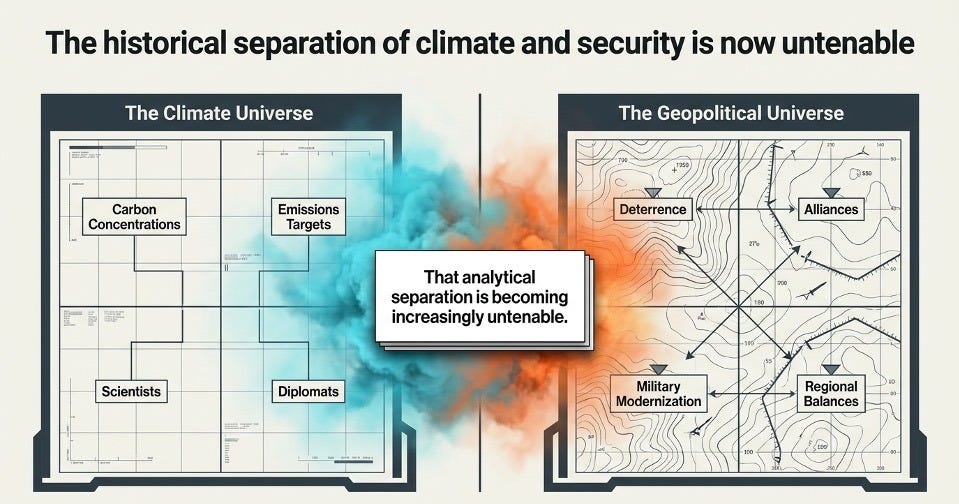
For much of the post-Cold War era, climate change and geopolitics occupied largely separate intellectual and policy universes. Climate scientists measured atmospheric carbon concentrations while diplomats negotiated emissions targets. National security practitioners, meanwhile, focused on deterrence, alliances, military modernization and regional balances of power.
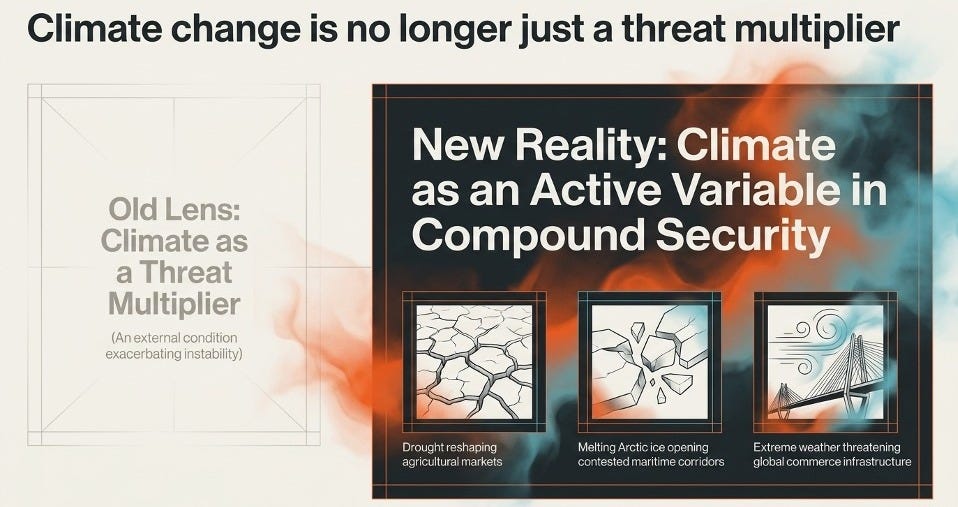
Environmental degradation certainly appeared on defense agendas, but it was generally understood as a “threat multiplier”—a condition that exacerbated instability rather than one that fundamentally altered the nature of interstate competition itself.
That analytical separation is becoming increasingly untenable.
The emerging international system is no longer defined simply by renewed great-power rivalry, nor merely by accelerating climate disruption. It is characterized instead by the convergence of multiple systemic transformations whose interactions generate strategic effects that none would produce independently.
Climate change, geopolitical competition, geoeconomic fragmentation, technological disruption, demographic shifts, information warfare and domestic political polarization increasingly operate not as parallel phenomena but as mutually reinforcing dynamics.
Their intersection produces what might best be understood as a new category of strategic environment: the Compound Age.
Within such an environment, environmental crises cease to be merely environmental. They become political. Economic. Informational. Strategic. They become instruments through which states reinterpret interests, redefine threats and renegotiate the boundaries of sovereignty itself.
The recurring Canadian wildfire seasons offer a revealing illustration. The smoke that drifts across the United States is not simply an ecological consequence of hotter, drier conditions. It is simultaneously a public health emergency, an economic disruption, an information challenge, a test of governmental competence and, increasingly, a transboundary political issue.
The strategic significance lies not in the smoke itself, but in the narratives that emerge around it. In an era marked by renewed neo-mercantilism, muscular transactionalism and intensifying competition among states, even atmospheric pollution can become subject to securitization.
This possibility reflects a broader transformation in the character of international politics. The liberal international order that emerged after 1945 rested upon assumptions of expanding institutional cooperation, mutually beneficial interdependence and progressively thicker norms governing state behavior. While these assumptions were always imperfectly realized, they nevertheless shaped expectations about how states would respond to transnational challenges. Climate change, accordingly, was framed principally as a collective-action problem requiring multilateral governance.
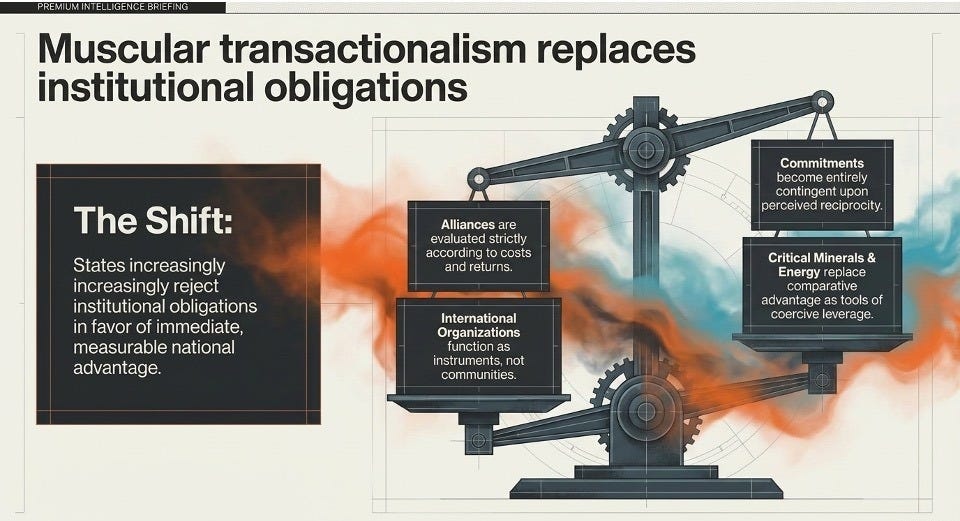
Today’s strategic environment points in a different direction. Across much of the world, governments increasingly evaluate relationships through the language of reciprocity, leverage, burden sharing and national advantage. Critical minerals replace comparative advantage. Supply chains become instruments of statecraft. Energy becomes coercive leverage. Technology standards become arenas of geopolitical competition. Economic interdependence is no longer assumed to generate peace; instead, it is increasingly viewed as a potential source of vulnerability.
This return toward neo-mercantilist thinking represents less a restoration of seventeenth-century mercantilism than its twenty-first-century adaptation. States remain deeply interconnected, yet they increasingly seek asymmetric advantages within those interdependencies. The objective is not autarky but selective dependence—ensuring that others require access to one’s markets, technologies, resources or infrastructure while reducing one’s own exposure to reciprocal pressure.
Climate change enters this emerging system not as an external variable but as an amplifier of every existing strategic competition. Drought reshapes agricultural markets. Melting Arctic ice opens new maritime corridors while intensifying competition over resources. Extreme weather threatens infrastructure supporting global commerce. Population displacement alters migration patterns. Insurance markets retreat from increasingly hazardous regions. Environmental shocks cascade through financial systems, political institutions and alliance relationships alike.
In the Compound Age, therefore, climate change cannot be understood merely as a threat multiplier. It has become an active variable within compound security competition.
This distinction matters.
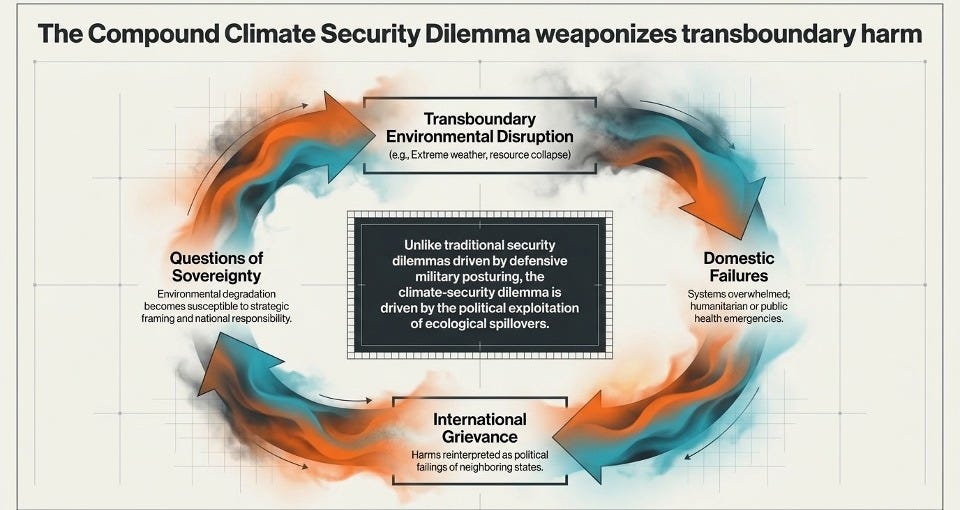
Traditional security dilemmas emerged when defensive measures undertaken by one state appeared offensive to another, producing spirals of mutual insecurity. The emerging climate-security dilemma differs fundamentally. Here, environmental disruptions create transboundary harms that encourage political reinterpretation. Domestic failures become international grievances. Humanitarian emergencies become questions of sovereignty. Public health challenges become arguments about national responsibility. Environmental degradation becomes susceptible to strategic framing.
Canada illustrates this emerging dilemma with unusual clarity because of its unique geopolitical position. It is simultaneously America’s closest ally, largest trading partner, Arctic partner, energy supplier, critical minerals source and one of the world’s most environmentally significant countries. Few bilateral relationships exhibit greater economic integration, deeper military cooperation or stronger institutional trust.
Yet precisely because of that intimacy, Canada also demonstrates how environmental interdependence increasingly carries strategic consequences. Massive wildfire seasons do not respect international borders. Smoke drifts across thousands of miles, degrading air quality throughout major American metropolitan areas. Public health systems absorb additional burdens. Commercial aviation experiences disruption. Outdoor economic activity declines. Emergency management systems face sustained pressures.
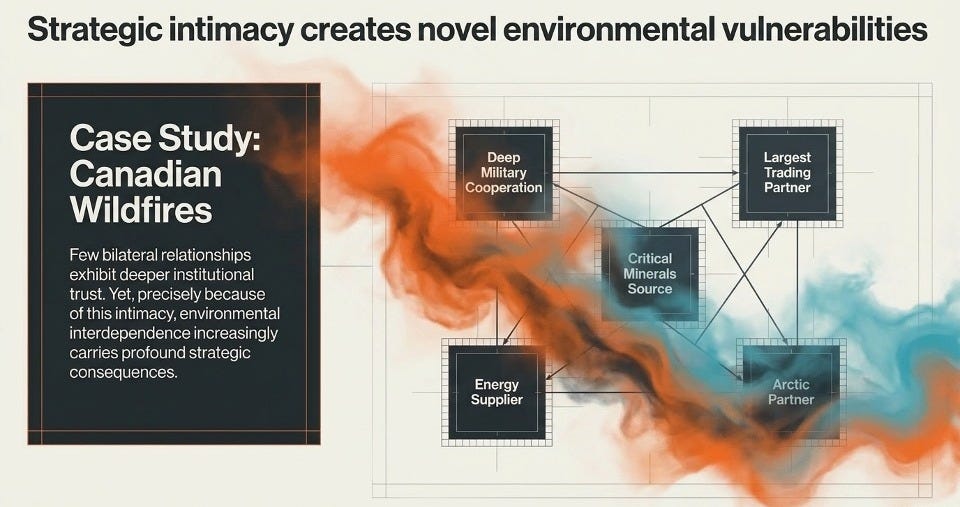
None of these effects constitutes aggression. None reflects deliberate policy. Yet all produce measurable consequences inside another sovereign state.
Historically, such events would have remained primarily matters of disaster management and bilateral cooperation. In the contemporary political environment, however, they may increasingly become incorporated into broader narratives concerning governmental competence, border security, economic costs and national resilience.
The danger does not arise because climate change inevitably produces interstate conflict. Rather, it arises because political actors increasingly possess incentives to reinterpret transboundary environmental harms through the language of security and sovereignty, and increasingly in hyper-partisan politicized context.
This evolving logic intersects with another important transformation: the rise of muscular transactionalism as a governing philosophy.
Transactional diplomacy has always existed. States have always negotiated interests. What distinguishes contemporary transactionalism is its increasingly explicit rejection of institutional obligations in favor of immediate, measurable national advantage. Alliances become evaluated according to costs and returns. International organizations become instruments rather than communities. Commitments become contingent upon perceived reciprocity.
Within this framework, questions once considered politically unthinkable can gradually enter mainstream discourse. If another country’s domestic failures generate recurring costs for one’s own population, does that create obligations beyond traditional diplomatic cooperation? Should states demand compensation? Joint management? Enhanced oversight? New authorities governing shared ecosystems?
These questions need not imply territorial ambitions to reshape understandings of sovereignty. They instead illustrate how repeated transboundary harms can gradually expand the range of policies regarded as politically legitimate.
Recent rhetoric surrounding Canadian sovereignty—including suggestions that Canada could become the “51st state”—should be understood primarily through this analytical lens.
Regardless of whether such statements are intended as negotiating tactics, political theater or genuine strategic signaling, they alter the discursive boundaries of international politics. They demonstrate how alliance relationships themselves may become rhetorically reframed within a transactional paradigm that evaluates neighboring states less as permanent partners than as assets, liabilities or bargaining positions.
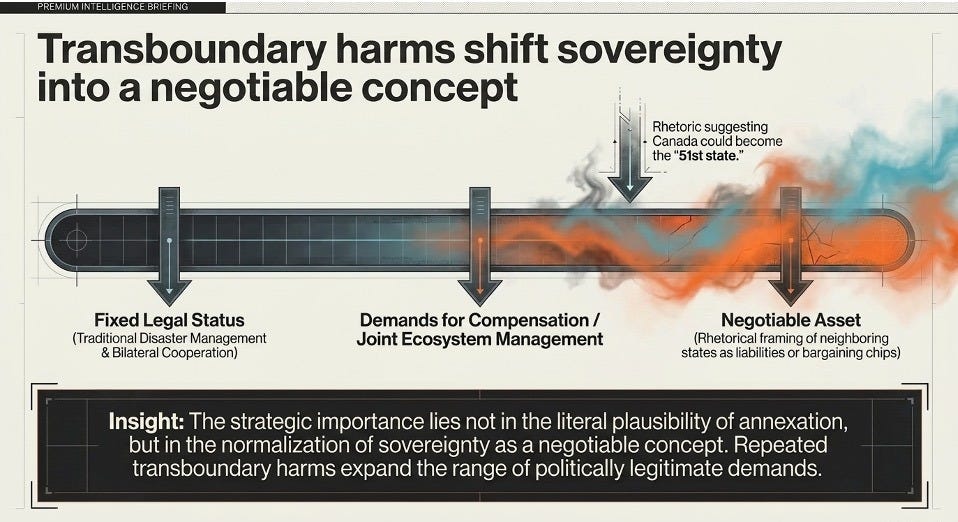
The strategic importance lies not in the literal plausibility of annexation but in the normalization of sovereignty as a negotiable concept.
Such rhetorical evolution carries implications extending far beyond North America. Throughout history, political communities have frequently justified extraordinary measures by redefining what constitutes legitimate self-defense. In the Compound Age, transboundary environmental harms may increasingly contribute to such redefinitions. Not because wildfire smoke itself constitutes an armed attack, but because cumulative environmental disruptions become embedded within broader narratives concerning national survival, economic resilience and governmental responsibility.
Herein lies what may be termed the Compound Climate Security Dilemma.
Unlike traditional environmental security frameworks, this dilemma recognizes that climate disruption interacts simultaneously with geopolitical rivalry, economic coercion, domestic polarization, technological competition and information warfare. Each dimension amplifies every other. Climate stress accelerates migration. Migration intensifies domestic political contestation. Political polarization reshapes alliance commitments. Economic fragmentation encourages protectionism. Information operations exploit public anxieties.
Together they produce strategic outcomes qualitatively different from the sum of their individual components.
Security competition thus becomes increasingly compound rather than merely complex.
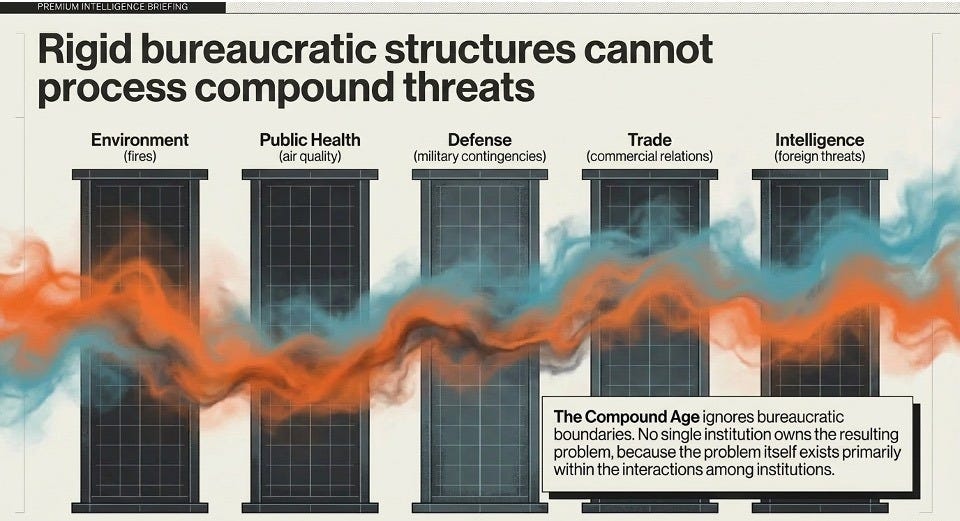
The implications for policymakers are profound. Conventional institutions remain organized according to functional specialization. Environmental agencies manage fires. Public health authorities monitor air quality. Defense establishments prepare for military contingencies. Trade ministries oversee commercial relations. Intelligence organizations assess foreign threats.
The Compound Age increasingly ignores these bureaucratic boundaries.
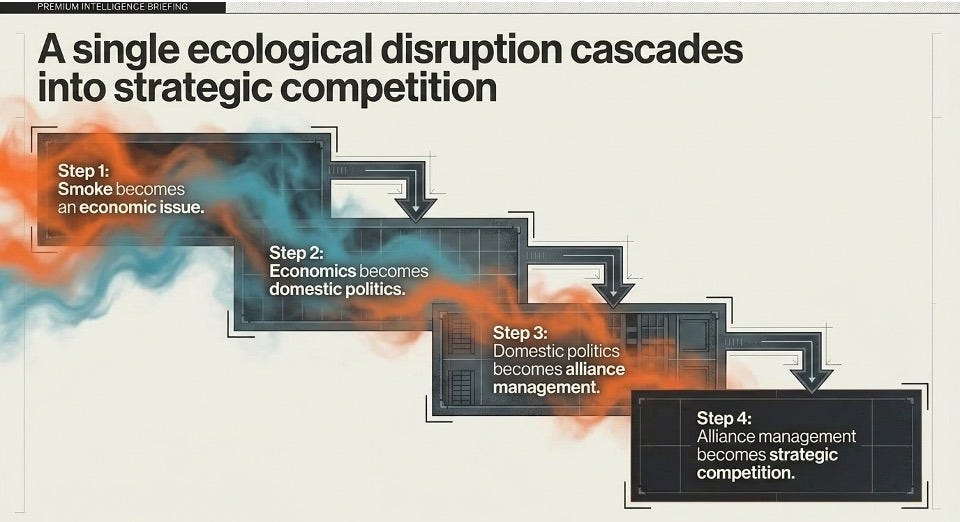
Smoke becomes an economic issue.
Economics becomes domestic politics.
Domestic politics becomes alliance management.
Alliance management becomes strategic competition.
No single institution owns the resulting problem because the problem itself exists primarily within the interactions among institutions.
This institutional mismatch represents one of the defining governance challenges of the twenty-first century.
Recognizing this transformation does not require embracing alarmism. The probability that wildfire smoke alone would precipitate military confrontation remains exceedingly remote. Yet strategic history repeatedly demonstrates that major geopolitical shifts rarely originate from isolated events. Rather, they emerge when recurring disruptions gradually reshape political assumptions regarding legitimacy, responsibility and acceptable state behavior.
Climate change accelerates precisely this kind of gradual transformation.
Its most consequential effects may therefore prove less environmental than political. Rising temperatures matter not only because they intensify fires, floods and droughts, but because they continually generate opportunities for states, political movements and publics to reinterpret the meaning of security itself.
The greatest danger facing the international system may not be climate change in isolation, nor renewed great-power rivalry alone, nor the resurgence of transactional nationalism by itself. It is the convergence of all three.
Together they produce an environment in which environmental crises increasingly become strategic narratives, transboundary harms become questions of sovereignty and humanitarian emergencies become susceptible to geopolitical exploitation.
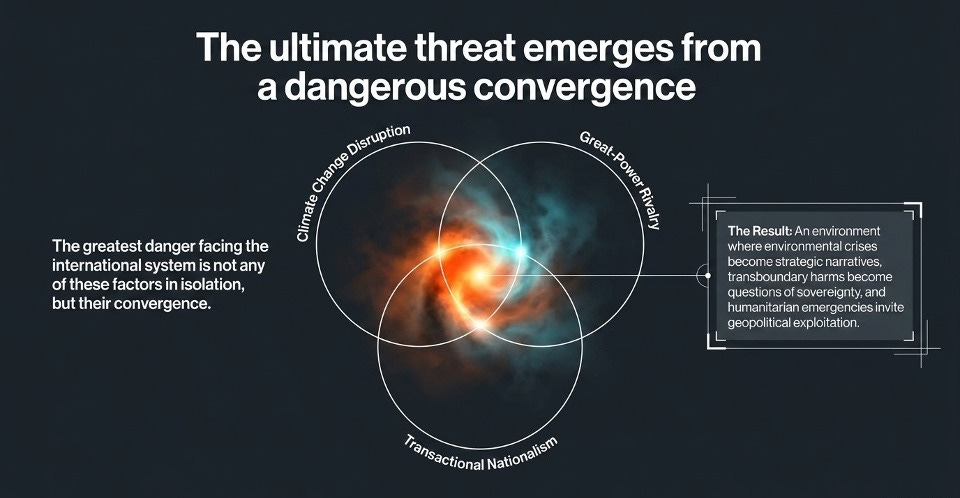
The Compound Age is distinguished precisely by such convergences.
Its defining feature is not simply that multiple crises occur simultaneously, but that each transforms the strategic meaning of the others. Climate becomes competition. Competition reshapes institutions. Institutions redefine sovereignty. Sovereignty alters the politics of environmental risk.
The smoke drifting south from Canada’s forests therefore represents more than a seasonal atmospheric phenomenon. It offers a glimpse into an emerging international order in which the boundaries separating environmental disruption, economic security and geopolitical competition become progressively more difficult to distinguish.
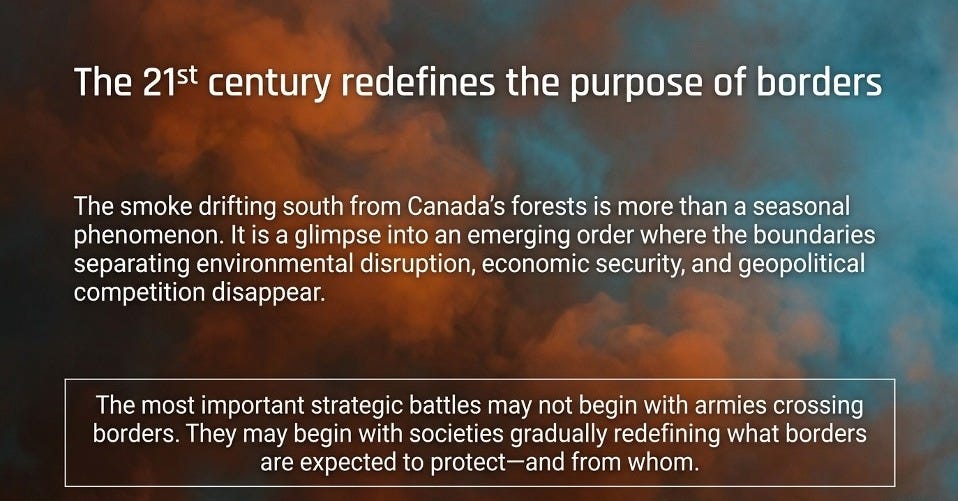
In that world, the most important strategic battles may not begin with armies crossing borders. They may begin with societies gradually redefining what borders are expected to protect—and from whom.

If you value this work, here are three ways you can step into the story with us:
📰 Subscriber (Free)
Stay informed. Receive every new essay, briefing, and analysis straight to your inbox. Join a growing community committed to civic resilience and national security.
🎧 Supporter (Paid Pledge)
Strengthen the signal. Your support sustains both Compound Security, Unlocked and our companion podcast The Civic Brief. Supporters ensure these conversations remain accessible to the wider public while elevating the quality, depth, and reach of the work.
🛡️ Sustainer (Patron Level)
Invest in the mission. Sustainers fuel new research, convenings, and storytelling that enlarge the civic frame of security. This is more than content — it’s a civic project. Your sponsorship helps preserve an independent voice committed to equipping citizens, leaders, and institutions for the compound challenges ahead.