

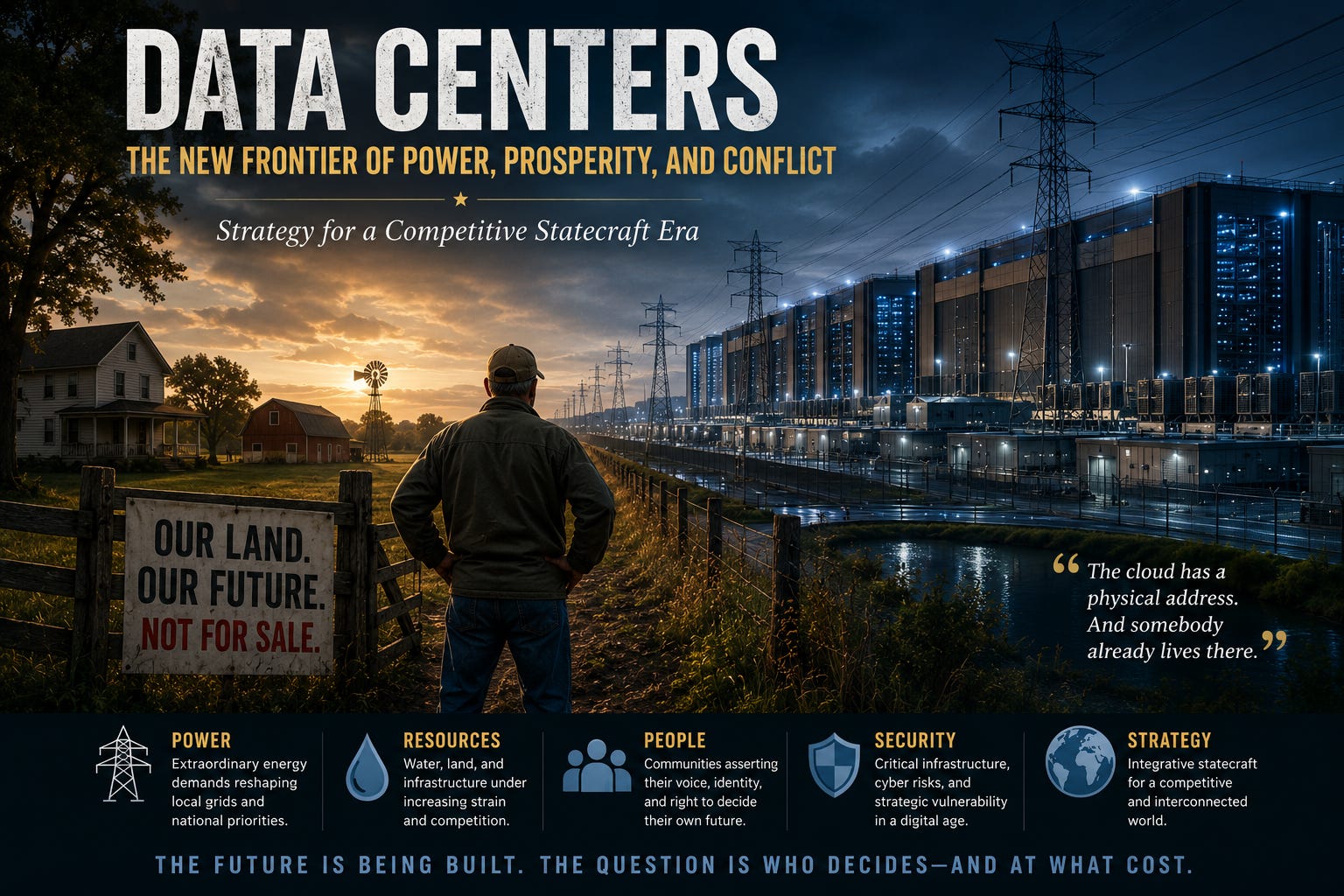
There is something almost karmic happening across rural America.
I do not mean karma in the cheap sense of cosmic revenge. History does not maintain a moral ledger, waiting patiently to collect debts from descendants for the sins of their ancestors. The farmer in Virginia fighting a data center today did not dispossess the Powhatan. The rancher in Texas worried about transmission lines did not drive the Comanche from the Plains. The family watching agricultural land disappear beneath warehouses of computer servers did not write the Indian Removal Act. Guilt is not hereditary, and historical responsibility cannot simply be transmitted through blood.
But history does rhyme. More than that, sometimes history seems to turn people around and place them, unexpectedly, on the other side of an argument their society once considered settled.
That is the sense in which something almost karmic is occurring now. Across much of rural America, people whose political culture has long celebrated property, settlement, development, technological progress, and the conquest of the continental frontier are discovering what it feels like when somebody more powerful arrives with plans for their place.
The machines have arrived.
They are not locomotives or mining equipment or bulldozers. They are the physical infrastructure of the supposedly immaterial world: enormous data centers filled with servers, cooling systems, transformers, generators, and the computational machinery required to power artificial intelligence.
They need astonishing amounts of electricity. Some require substantial quantities of water. They require substations and transmission corridors. They require roads and land and tax arrangements and zoning decisions. And behind them stand some of the richest corporations in human history, joined increasingly by state and federal governments convinced that artificial intelligence is not merely an industry but a strategic national imperative.
And across America, communities are beginning to say: No.
The opposition is particularly interesting where it has emerged in rural and Republican America. These are often communities in which private property is close to sacred, local government preferable to distant government, inherited land inseparable from family identity, and federal intrusion regarded with suspicion.
Many of these voters supported the political movement that now champions an accelerated national buildout of artificial-intelligence infrastructure. Yet suddenly the abstraction called “American technological leadership” has acquired acreage. It needs electricity. It needs water. It needs transmission lines. It needs somebody’s horizon.
The cloud, it turns out, has a physical address.
And somebody already lives there.
That is where the historical echo begins.
Listen carefully to what people resisting these developments say. ‘This land has belonged to our family for generations. Outsiders should not determine what happens here. They do not understand our community. They are taking our water. They will change the landscape forever. Government officials listened to corporations instead of residents. The benefits will flow somewhere else while we live with the costs. Money cannot compensate us for what will disappear. We are not against progress, they insist; we simply want some authority over what happens to our home’.
And finally, beneath nearly every other objection, comes the oldest political claim of all:
This is our place.
There is nothing hypocritical about saying this. Quite the opposite. It is one of the most profoundly human claims a person can make. Land is rarely only land. It’s memory made geographic. It is graves and births, childhood and inheritance, work and seasons, neighbors and stories. A deed may establish ownership, but belonging is something considerably older and deeper.
Indigenous peoples of this continent have been trying to explain precisely that distinction for centuries.
And there lies the uncomfortable irony.
For hundreds of years, Native nations confronted another civilization advancing across places to which Indigenous peoples possessed relationships that could not adequately be translated into the newcomers’ vocabulary of property value. Those relationships involved sovereignty, ancestry, religion, livelihood, identity, stewardship, memory, and obligations extending backward to ancestors and forward to generations not yet born. The land was not simply something they possessed. In important ways, it was part of who they were.
Then outsiders arrived.
The outsiders possessed greater economic power. Greater technological power. Eventually greater military and governmental power. They surveyed. They mapped. They negotiated. They purchased. They legislated. They appropriated. They removed. They sometimes compensated. They sometimes coerced. They repeatedly violated agreements. And almost always they possessed an extraordinarily powerful moral justification for what they were doing.
Progress.
The farm was progress. The railroad was progress. The mine was progress. The dam was progress. The highway was progress. The pipeline was progress. Electrification was progress. Suburbanization was progress. Every generation found another project through which the future announced that it required the transformation of somebody else’s present.
Now the hyperscale data center is progress.
The technologies change.
The argument endures.
This is where the karmic quality of the moment becomes difficult to ignore. A society born partly through continental expansion now finds some of its most place-conscious descendants confronting a new expansionary force.
The settlers have, metaphorically and imperfectly, begun to experience settlement from the other side.
The covered wagon has become the server farm.
The railroad right-of-way has become the transmission corridor.
The land speculator has become the developer.
The promise of continental destiny has become the promise of artificial-intelligence supremacy.
And once again, someone arrives carrying maps and money and governmental approvals and says, in effect: The future requires your place.
Now, we should be extraordinarily careful here. A zoning dispute over a data center is not the ‘Trail of Tears’. A transmission easement is not the Dawes Act. A farmer confronting eminent domain is not experiencing the military destruction, forced removal, starvation, confinement, treaty violation, cultural suppression, and demographic catastrophe endured by Indigenous peoples. To pretend otherwise would diminish rather than illuminate that history.
The analogy is not one of equivalent suffering.
But it is an analogy of political structure.
And that distinction may be precisely what makes the comparison useful.
Dispossession does not necessarily begin when armed men remove someone from a house. At a deeper level, dispossession begins when the power to determine the future of a place migrates away from the people whose lives are rooted there.
A person may still possess the deed while discovering that someone else effectively controls the surrounding landscape, the aquifer beneath it, the transmission infrastructure crossing it, the tax incentives reshaping the community, and the economic forces determining what the place will become.
The property remains.
The sovereignty has thinned.
This is something Indigenous peoples understand intimately. Sovereignty is not merely possession. Sovereignty is meaningful authority over one’s future. At its most elemental, sovereignty is the power to say no and have that no matter.
That is also why eminent domain introduces such a revealing tension into contemporary rural conservatism. Property rights are easy to defend philosophically when the state is an abstraction. They become something altogether different when surveyors appear at the edge of your land.
Suddenly the question is no longer whether infrastructure benefits the nation. It is why your farm, your water, your view, your community, your inheritance must be altered so that somebody else’s conception of the national interest can be fulfilled.
And at that moment an American citizen may find himself asking a remarkably old question:
Why does your future require the surrender of mine?
Native nations asked that question repeatedly.
The answer they received was frequently some variation of necessity. Settlement requires this. Civilization requires this. Security requires this. Development requires this. The nation requires this. History is moving forward, and you may either accommodate its movement or discover that history possesses considerably more power than you do.
Every dispossessing system believes it has a reason.
That may be the darkest lesson contained in the present moment. The people who transform someone else’s world rarely understand themselves as villains. They understand themselves as builders. Modernizers. Developers. Civilizers. Innovators. Patriots.
They are bringing opportunity. They are creating jobs. They are building infrastructure. They are securing the future.
They are solving tomorrow’s problems.
The people already living there simply happen to be standing where tomorrow needs to go.
There is the karma.
Not punishment.
Recognition.
The American frontier has somehow turned around.
For centuries, the dominant American imagination looked outward from centers of power toward supposedly underdeveloped spaces and asked what those places could be(come).
Today, enormous concentrations of technological and financial power are looking outward from Silicon Valley, Northern Virginia, Wall Street, Washington, and other centers of the artificial-intelligence economy toward rural America and asking essentially the same question.
Where is the available land?
Where is the water?
Where is the power?
Where can we build?
What will it cost?
Who can approve it?
And only afterward, sometimes, comes another question:
Who already belongs there?
The supposedly frictionless digital economy has therefore rediscovered geography. Artificial intelligence may inhabit cyberspace conceptually, but its metabolism remains stubbornly physical. It eats electricity. It drinks water. It occupies land. It generates heat. It requires minerals, cables, substations, transmission lines, and enormous capital investment. The most futuristic technology on Earth has returned us to some of humanity’s oldest political problems.
Land.
Resources.
Power.
Sovereignty.
Who decides?
That is why the emerging data-center revolt matters beyond the 2026 midterm elections. Its coalition does not fit comfortably inside America’s normal ideological categories. Environmentalists worry about water and energy. True ‘Conservatives’ worry about property and local control. Ratepayers worry about electricity prices. Farmers worry about land. Homeowners worry about property values and quality of life. Local officials worry about infrastructure. Native nations have their own concerns about sovereignty, sacred landscapes, water, consultation, and development.
Beneath these apparently different objections lies a common political question:
Who possesses the right to determine what a place becomes?
That question cuts more deeply than Republican versus Democrat. It is center versus periphery. Capital versus community. Development versus continuity. National ambition versus local consent. Power versus place.
And perhaps, unexpectedly, it creates the possibility of a new kind of American empathy.
The easiest response to the rural data-center revolt would be historical schadenfreude. Now you know how it feels. That would be emotionally satisfying to some and politically useless to almost everyone. Worse, it would trivialize the vastly greater violence inflicted upon Indigenous peoples by comparing conquest with contemporary land-use disputes.
There is another response available.
Listen.
When a farmer says that his grandparents worked this land, believe that the statement means something.
When a rancher says that market value cannot capture what his property means to his family, believe him.
When residents say that outsiders cannot understand what will be lost when a landscape is transformed, take them seriously.
When someone insists that compensation is not the same thing as consent, remember that sentence.
And then ask:
What if America had always taken such claims seriously?
What if the attachment of Indigenous peoples to their places had been treated with the same moral seriousness that rural Americans now demand for their own?
What if treaties had been regarded not as temporary obstacles to expansion but as binding agreements among sovereign peoples?
What if “unused” land had never been confused with unvalued land?
What if unfamiliar forms of ownership had not been interpreted as absence of ownership?
What if economic development had not automatically outranked cultural continuity?
What if compensation had never been mistaken for consent?
What if technological superiority had never been confused with moral entitlement?
And above all:
What if the people already living in a place had possessed an enforceable right to say no?
Those are no longer merely questions about America’s past.
The data centers have made them questions about America’s future.
Perhaps, then, this strange karmic turn offers something better than accusation. Perhaps it offers recognition across time.
The conservative farmer defending inherited acreage and the Indigenous nation defending ancestral territory do not possess identical histories. They need not possess identical politics. But they may share one fundamental intuition: a place can mean more than what somebody else is willing to pay for it.
That insight could produce an unexpectedly powerful political principle.
Call it place sovereignty.
It would begin from the proposition that people are not interchangeable occupants of interchangeable acreage. Communities develop relationships with landscapes.
Those relationships create legitimate claims—not necessarily absolute vetoes, not immunity from all development, but claims strong enough that development cannot simply be imposed because a more powerful actor possesses more capital or has persuaded government that its project represents progress.
Such a principle would protect the farmer confronting the data center. It would protect the Black neighborhood confronting another highway. It would protect the Appalachian community confronting extraction. It would protect the Western town confronting water depletion. And it would apply with particular historical weight to Native nations confronting pipelines, mines, dams, transmission corridors, and other projects affecting their lands and cultural sovereignty.
Perhaps that is how historical karma becomes something more useful than vengeance.
It becomes moral imagination.
America has spent much of its existence believing that the frontier moves in only one direction. The powerful arrive. The peripheral accommodate. Land becomes property. Property becomes capital. Capital becomes development. Development becomes progress. And progress becomes its own justification.
But frontiers can reverse.
And now, across parts of rural America, descendants of the society that once pushed relentlessly outward across other peoples’ places are standing before county commissions, utility boards, state legislatures, developers, and federal authorities making an ancient plea:
You cannot simply come here and decide what happens to our home.
They are right.
And that is precisely why this moment matters.
The great karmic irony is not that rural Americans somehow “deserve” dispossession because Indigenous Americans suffered it before them.
They do not.
The irony is that they may now possess an experiential doorway into understanding something their country has spent centuries avoiding.
Land is not merely acreage.
Value is not merely price.
Compensation is not consent.
Development is not automatically progress.
Power does not confer moral entitlement.
And sovereignty means very little if somebody more powerful can always override your no.
Native peoples have been telling America these things since before America had a name.
Perhaps the peculiar historical gift hidden inside the data-center revolt is that some Americans who might never have encountered that argument through history books, museums, land acknowledgments, or political debate are encountering it now through something much more immediate.
Their own land.
Their own water.
Their own community.
Their own sense of powerlessness before institutions insisting that the future requires what they presently possess.
History has not repeated itself. The moral proportions are far too different for that.
But history has performed one of its stranger inversions. It has rotated the map. It has changed the technology. It has exchanged the covered wagon for the server rack and Manifest Destiny for artificial-intelligence supremacy.
And then it has quietly returned the old question to the descendants of the American frontier:
What happens when someone more powerful decides that progress requires ‘your’ place?
Perhaps this time America will recognize the question.
After all, it has heard it before.

If you value this work, here are three ways you can step into the story with us:
📰 Subscriber (Free)
Stay informed. Receive every new essay, briefing, and analysis straight to your inbox. Join a growing community committed to civic resilience and national security.
🎧 Supporter (Paid Pledge)
Strengthen the signal. Your support sustains both Compound Security, Unlocked and our companion podcast The Civic Brief. Supporters ensure these conversations remain accessible to the wider public while elevating the quality, depth, and reach of the work.
🛡️ Sustainer (Patron Level)
Invest in the mission. Sustainers fuel new research, convenings, and storytelling that enlarge the civic frame of security. This is more than content — it’s a civic project. Your sponsorship helps preserve an independent voice committed to equipping citizens, leaders, and institutions for the compound challenges ahead.
The Land Is Mine — Shechinah, Justice, and the Covenant of the Lease
Parashat Behar says it plainly: you own nothing. You hold it only on condition.
I. The Core Principle: Land = Trust, Not Property
The Shema never says, "I have given you the land so you may own it." It says: "the land which the Lord your God gives you" — a gift held on condition. Throughout Torah, the clearest restatement is in Parashat Behar:
"The land shall not be sold in perpetuity, for the land is Mine; for you are sojourners and tenants with Me."
— Vayikra 25:23
Seventy-five-year leases, Jubilee returns, fair compensation — these are not "foreign concepts." They are the original biblical system. To treat land as permanent, private, absolute property is to reject the covenant entirely. It is to claim ownership where only God owns — the very definition of idol worship.
II. The Mirror of Justice
A nation that ravages other lands for decades — the United States in its two decades-long wars — that treats foreign homes and foreign soil as nothing, cannot then claim immunity when its own people are dispossessed: by eminent domain, by corporate seizure, by laws that value profit over person.
This is not "karma" — a blind, impersonal force. This is Shechinah as moral Witness. The covenant is not national; it is universal in its logic: the measure you give is the measure you receive.
If you dispossess you will be dispossessed.
If you treat land as merchandise your land will become merchandise.
If you make the stranger, the refugee, the dispossessed unwelcome you will become the dispossessed in your own land.
The nations you once harmed do not need to lift a finger. The covenant executes itself. The rain stops. The lease expires.
III. "Citizens United" and the Modern Idolatry
Citizens have no sovereignty when corporations are treated as persons, when money equals speech, when land and homes are seized for pennies on the dollar and turned into profit centers.
This is exactly what the Shema calls serving other gods: the god of unchecked wealth, the god of "whatever I can seize is mine." When a system allows a people’s inheritance to be bought and sold away from them at fire-sale prices — that system itself has become an idol.
And the warning stands: serve other gods the land expels you.
IV. Two Systems — One Truth
In one system(China), the state owns all land and grants leases with (reputedly) fair compensation.
In the other(US), "private ownership" is sacred in theory — but in practice, citizens get pennies, and corporations get the deeds.
Both have forgotten the Shema.
The first forgets that the land ultimately belongs to God, not the state — and so the state becomes the idol.
The second forgets that no human holds absolute title — and so "property" becomes the idol.
The biblical way is different:
The land belongs to God alone. All human beings — ruler and citizen, rich and poor — are tenants and sojourners together. No one seizes; no one is permanently dispossessed; every generation returns the land to its people; compensation is just; the stranger is protected.
That is the covenant the Shema restates: hearken, and the land feeds you. Break faith — and no matter your armies, your wealth, your laws — the land casts you out.
V. Shechinah Departs
Shechinah is not an avenging angel. She is the Presence that dwells among you.
When you love your neighbor, when you protect the vulnerable, when you acknowledge that the land is held in trust — She is there. The rain falls. The fruit grows. The community is fed.
But when you build your prosperity on the ruin of others — when you worship might, money, and "this land is mine" — She departs.
And when Shechinah leaves, all that remains is dirt. Dirt you can fight over, buy, sell, bulldoze — but it will no longer know you. It will no longer sustain you.
That is the warning. That is the judgment. That is the truth the nations have always known, and which the Shema never stops repeating.