

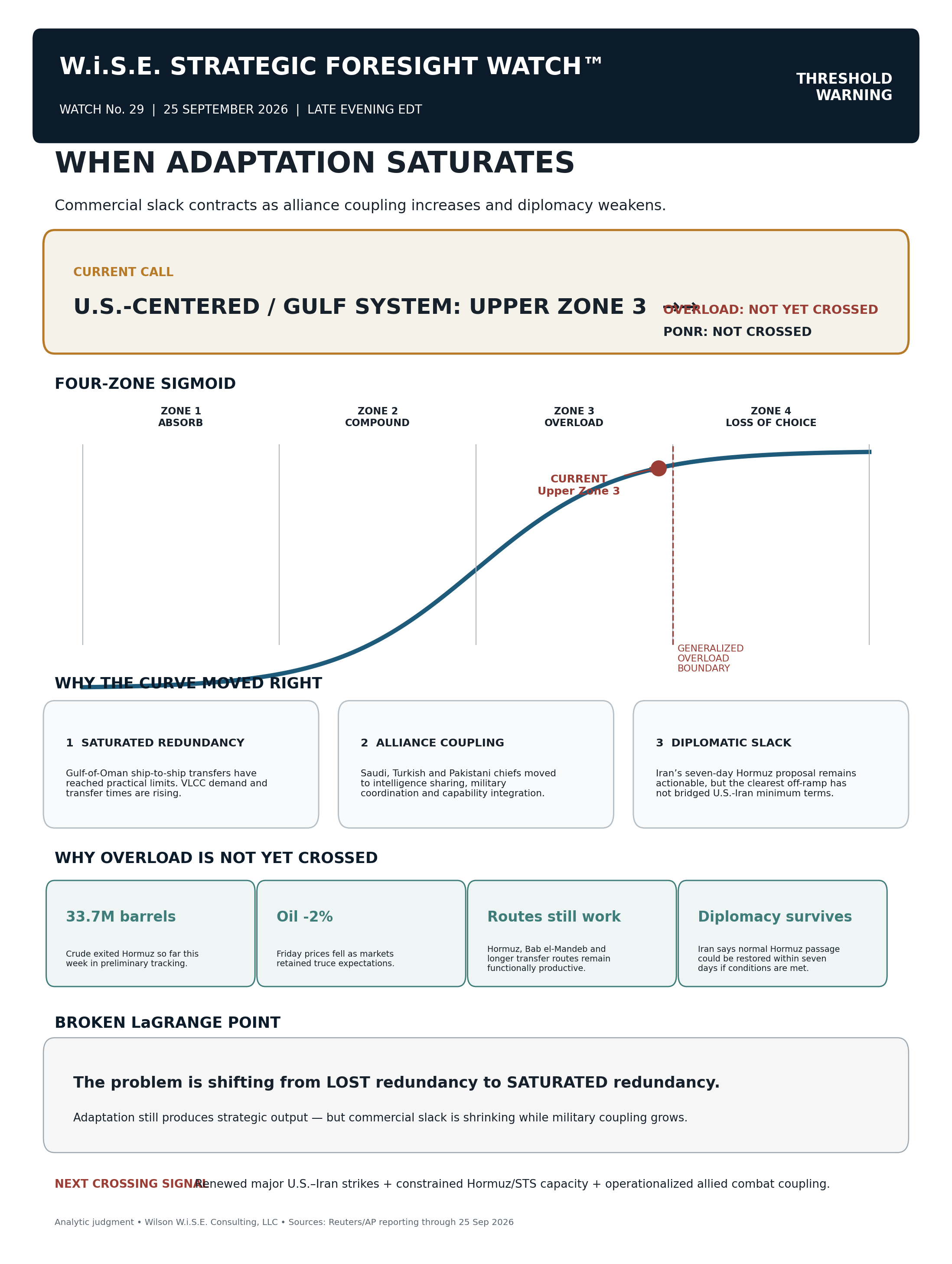
THE CALL IN PLAIN ENGLISH
The system moved right again today, but the reason is more consequential than another missile launch or another day of unusually low visible vessel counts.
The principal commercial workaround that has allowed Saudi and Gulf oil to keep moving despite severe disruption at Hormuz and damage to the Saudi Red Sea bypass is reaching its practical carrying limit. Reuters reports that ship-to-ship transfers off Oman have reached capacity as Saudi exports through Hormuz surge. Saudi September exports through Hormuz are estimated at roughly 3.6 million barrels per day, up sharply from August. The rerouting has pushed VLCC demand and charter rates to record levels, lengthened transfer operations, and forced buyers to seek more distant transfer locations.[1]
At the same time, Saudi Arabia, Turkey and Pakistan are converting a collective-defense commitment into more concrete military coordination. Their military chiefs met in Riyadh and discussed intelligence sharing, military coordination and capability integration.[2]
Those developments contract two different kinds of strategic slack at once: commercial carrying capacity and geopolitical insulation.
The U.S.-centered/Gulf compound system therefore moves farther right within upper Zone 3. But I do not assess generalized system overload as crossed. Substantial oil continues to move through Hormuz; longer commercial workarounds remain available; Bab el-Mandeb remains functionally open to much traffic; and the U.S.-Iran diplomatic channel remains alive even though it has not yet produced agreement.
POINT OF NO RETURN IS NOT CROSSED.
SOURCES AND NOTES
[1] Reuters, “Gulf of Oman ship-to-ship oil transfers reach limit as Saudi exports surge,” Sept. 25, 2026. Reports STS capacity constraints, Saudi Hormuz export growth, VLCC demand and record freight pressure.
[2] Reuters, “Pakistani, Saudi, Turkish chiefs discuss closer military ties,” Sept. 25, 2026. Reports intelligence sharing, military coordination and capability integration discussions.
If you value this work, here are three ways you can step into the story with us:
📰 Subscriber (Free)
Stay informed. Receive every new essay, briefing, and analysis straight to your inbox. Join a growing community committed to civic resilience and national security.
🎧 Supporter (Paid Pledge)
Strengthen the signal. Your support sustains both Compound Security, Unlocked and our companion podcast The Civic Brief. Supporters ensure these conversations remain accessible to the wider public while elevating the quality, depth, and reach of the work.
🛡️ Sustainer (Patron Level)
Invest in the mission. Sustainers fuel new research, convenings, and storytelling that enlarge the civic frame of security. This is more than content — it’s a civic project. Your sponsorship helps preserve an independent voice committed to equipping citizens, leaders, and institutions for the compound challenges ahead.
There was a large oil field discovered off the coast of Israel, Lebanon, Turkey, Crete, and maybe even Greece (or the distribution pipeline would go through Greece). Is the elevated price for crude oil helping to fund development of thatvoil field, or is the sharing of that field still tied-up in court? Is more oil the only path out of this situation?