For decades, European strategy rested on the assumption that economic interdependence would moderate power politics. Markets would discipline states. Trade would soften rivalry. Infrastructure would remain politically neutral.
That assumption has collapsed.
Energy flows have been weaponized. Export controls have become strategic tools. Access to markets, finance, and technology now functions as leverage. The United States, China, and Russia have each demonstrated willingness to exploit interdependence for advantage.
The question confronting Europe is no longer whether it is vulnerable.
It is whether it can convert vulnerability into leverage.
The emerging argument—articulated recently in debates about European semiconductor dominance and supply-chain dependencies—is that Europe should weaponize its own chokepoints.
The instinct is correct.
But the framework must go deeper.
Because this is not merely a story about leverage.
It is a story about compound security competition.
From Complex Interdependence to Compound Contestation
Much of the economic security debate remains trapped in the language of complexity: fragile supply chains, nonlinear disruptions, cascading shocks.
Complex systems thinking has improved our understanding of fragility. But it is insufficient for the moment we are in.
Today’s strategic environment is not simply complex. It is compound.
In complex systems, interactions occur within bounded domains. In compound systems, multiple complex systems—economic, military, technological, financial, informational—collide and amplify one another simultaneously.
Under compound conditions:
• Energy shocks amplify political polarization. • Export controls reshape alliance cohesion. • Financial sanctions alter escalation thresholds. • Industrial policy triggers retaliatory trade dynamics.
Effects are not additive.
They are multiplicative.
Europe’s chokepoints—whether in extreme ultraviolet lithography, uranium supply, turbines, or pharmaceuticals—exist within this compound system.
To weaponize them is to alter multiple domains at once.
The Illusion of Resilience
Europe’s first instinct has been defensive: autonomy, resilience, diversification.
These are necessary—but insufficient.
Resilience answers the question: Can we survive disruption?
It does not answer the more strategic question: Can we shape the conditions under which disruption occurs?
In a weaponized world, endurance without agency is managed decline.
The real objective of economic security is not insulation. It is rule-setting under stress.
Who determines what constitutes acceptable economic behavior during crisis?
Who defines emergency norms?
Who controls fallback options?
These are the modern commanding heights.
Chokepoints as Positional Advantage
Europe’s dominance in extreme ultraviolet lithography is often described as sectoral leadership.
In compound terms, it is positional advantage at a systemic node.
Chokepoints are not valuable merely because they are scarce. They are valuable because they sit at intersections where multiple systems converge—technology, finance, military capability, alliance structures.
The logic of Compound Security Competition (CsC) suggests that strategic success depends on maximizing advantage at such nodes while minimizing exposure elsewhere.
This requires:
• Integration across defense, diplomacy, development, and commercial policy (3D+C). • Institutional capacity to anticipate cascading effects. • Political cohesion sufficient to sustain pressure without fracture.
Weaponizing chokepoints without this architecture risks self-harm.
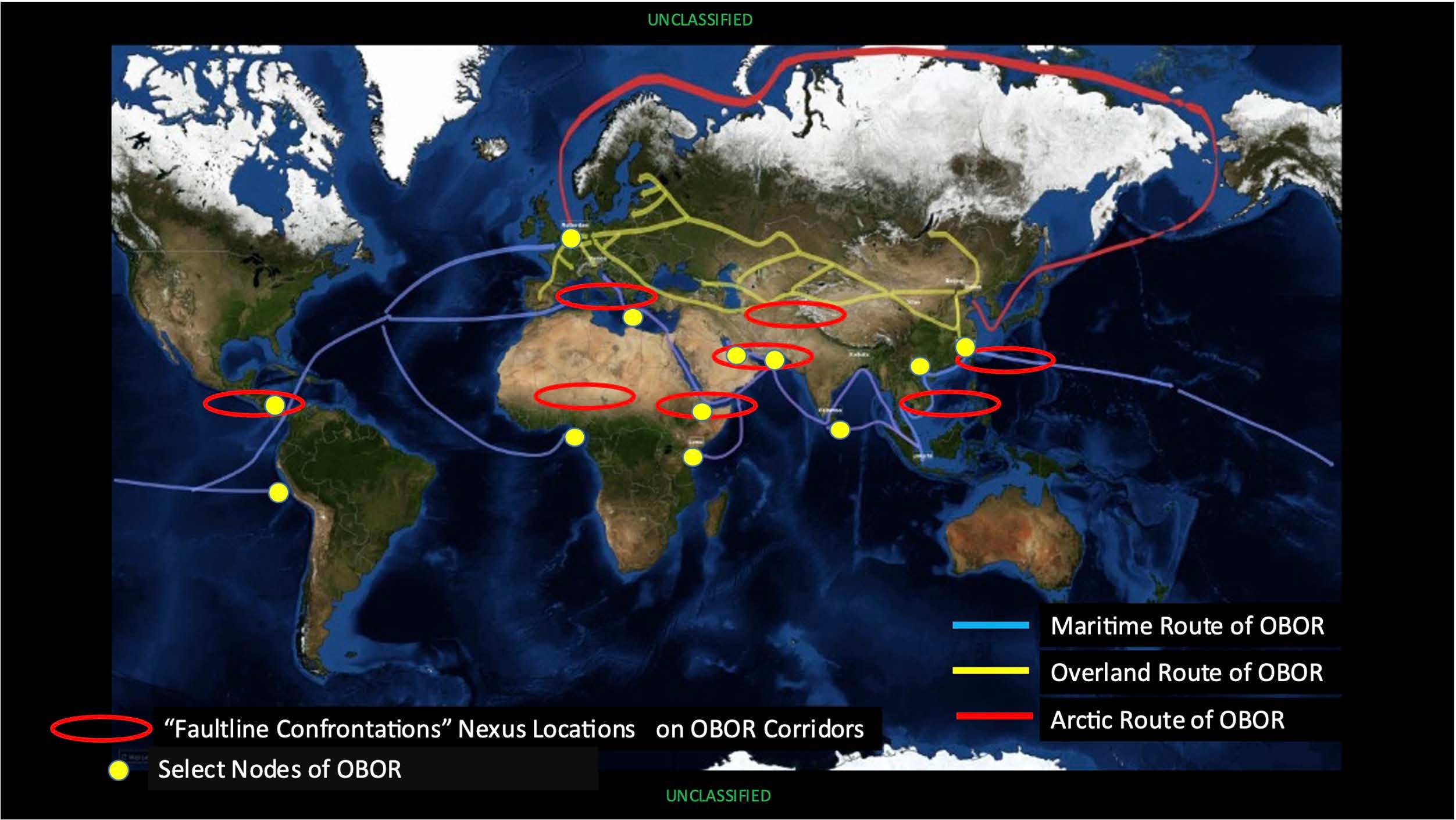
These locations—key maritime chokepoints, straits, and trade routes—are historically recurring points of convergence for compound threats. Actors who gain positional and cognitive advantages at these nexuses can achieve maximum returns on minimal investments, setting the conditions for strategic victories before a fight ever begins.
Figure. Geostrategic “Faultline Confrontations” Key ‘Nexes’ and Xi’s China’s Belt & Road Initiative Key ‘Nodes’
The convergence of economic, cyber, and military threats at such points poses challenges for U.S. policymakers but also offers opportunities to apply resources with precision, in partnership with enduring allies.
This understanding has informed the theater strategies of U.S. military and security institutions, with leaders emphasizing the importance of securing geostrategic access and influence at key locations.
Winning Without Fighting: Strategic Positional Advantage
It imposes adjustment burdens—on domestic constituencies and on allies.
In a compound system, legitimacy is infrastructure.
If weaponization fractures coalition trust or imposes asymmetric costs on partners, conversion efficiency collapses.
The history of sanctions regimes illustrates this dynamic: poorly sequenced measures alienate allies faster than adversaries.
Europe must therefore ask not only whether it can wield chokepoints—but whether it can convert them into sustained strategic effect.
Power unused is irrelevant.
Power misused is corrosive.
The U.S.–Europe Dimension
The most delicate implication of weaponized chokepoints is transatlantic.
If Europe seeks strategic autonomy through indispensability, it must decide whether the United States is a partner, a rival, or both.
Weaponized interdependence cuts both ways.
Europe controls inputs critical to American industry. The United States controls military capabilities and financial infrastructure critical to Europe.
Compound competition among allies is not inevitable—but unmanaged leverage can create it.
The transatlantic question, therefore, is not decoupling.
It is coordination of chokepoints before crisis, not during it.
China and the System-Level Contest
China has long understood compound leverage.
Its Belt and Road investments were not merely commercial—they were positional.
Its export restrictions on rare earths were not isolated—they were signaling mechanisms embedded in broader strategic competition.
The contest now unfolding is not over trade balances.
It is over who governs the system when cooperation breaks down.
Europe must decide whether it is content to react within rules others set—or whether it is prepared to shape those rules.
The Strategic Risk
There is a deeper danger.
Weaponized interdependence increases the likelihood of escalation coupling.
Economic retaliation can spill into security postures. Supply restrictions can provoke military signaling. Financial coercion can trigger alliance fragmentation.
In compound systems, domains do not remain separate.
Europe must therefore treat chokepoint strategy not as industrial policy, but as escalation management.
Toward Governance, Not Just Guardrails
The most important shift Europe must make is conceptual.
Economic security is not insurance.
It is governance under stress.
The objective is not simply to prevent coercion—but to shape the norms, thresholds, and escalation pathways of economic competition.
That requires institutional capacity, political cohesion, and strategic clarity about when leverage should be used—and when restraint preserves greater power.
Europe does indeed have more cards than it thinks.
The question is whether it can play them in a compound game without compounding instability.
Conclusion: The Test of Strategic Maturity
Weaponizing chokepoints is a sign of geopolitical maturity.
But maturity is not measured by possession of leverage.
It is measured by disciplined use of it.
In a compound era—where economic, military, and informational systems converge—the actor that thinks in systems-of-systems terms will shape outcomes.
Those who do not will discover that leverage exercised without foresight becomes vulnerability multiplied.
Europe’s awakening is real.
Its strategic test has just begun.
If you value this work, here are three ways you can step into the story with us:
📰 Subscriber (Free)
Stay informed. Receive every new essay, briefing, and analysis straight to your inbox. Join a growing community committed to civic resilience and national security.
Invest in the mission. Sustainers fuel new research, convenings, and storytelling that enlarge the civic frame of security. This is more than content — it’s a civic project. Your sponsorship helps preserve an independent voice committed to equipping citizens, leaders, and institutions for the compound challenges ahead.