
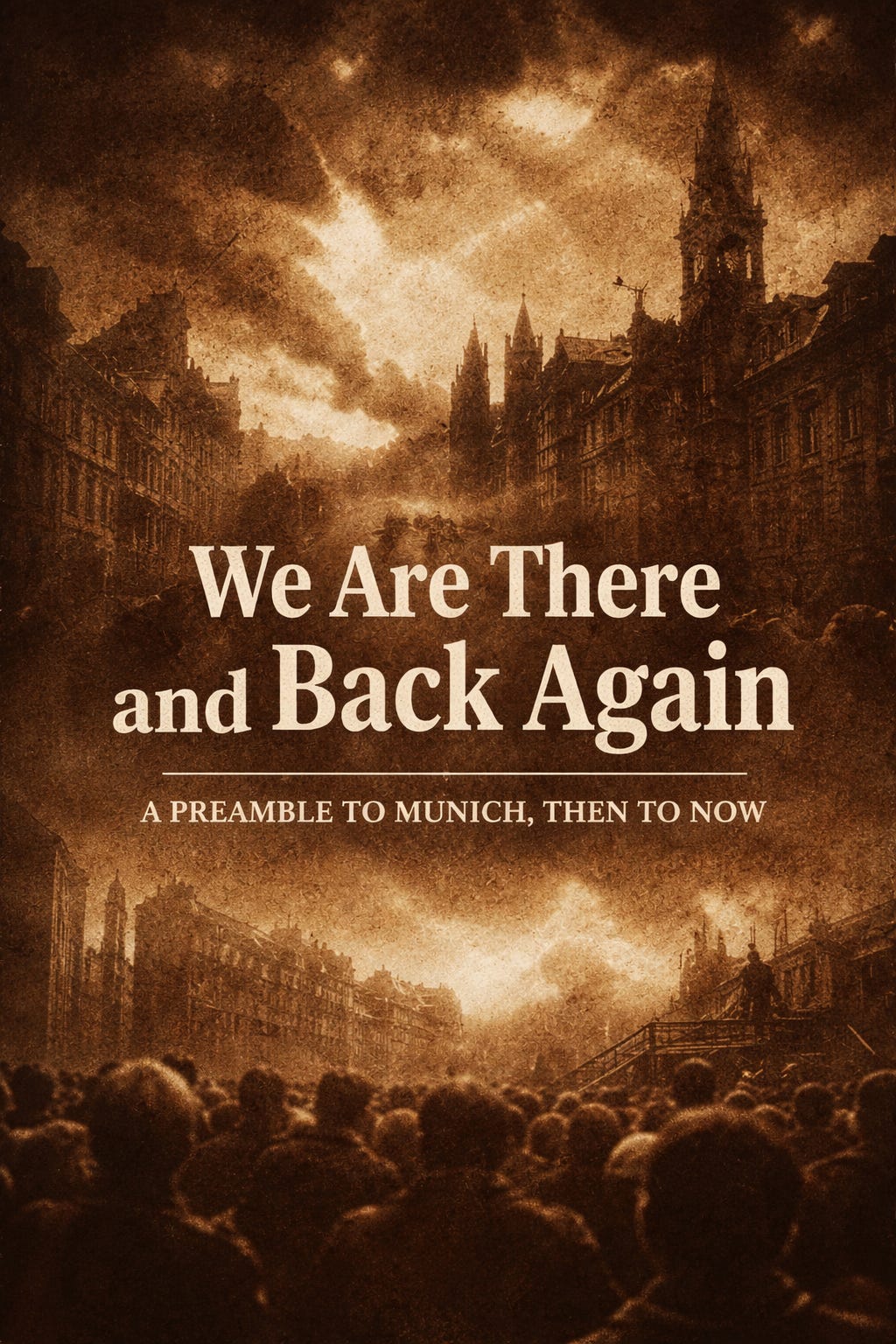
We Are "There and Back Again."
A Preamble to This Coming Week's Essays on "The Munich Conference, Then to Now."

I rarely make ‘predictions’.
In three decades of scholarship, soldiering, and strategic analysis, I have resisted that temptation. Prediction flatters the ego and weakens discipline. Systems are complex. Feedback loops surprise. History rarely obeys linear extrapolation.
But there are moments when restraint becomes avoidance.
And this is one of them.
For months now, I have felt something I could not initially name. Not outrage. Not shock. Not even alarm. Something colder.
Recognition.
Munich has always been a mirror. In 1938, it reflected a world misreading ambition as grievance and mistaking delay for peace. In 2025, it reflected populist disruption—culturally nationalist, destabilizing, but still operating within the recognizable grammar of the liberal West.
Munich 2026 felt different.
Not louder.
Colder.
What surfaced this year was not protest within the Western canon.
It was repositioning of the canon itself.
And that shift—quiet, philosophical, structural—is why I am writing this preamble before the essays that will follow over the coming week.
Because what we are witnessing may not be episodic turbulence.
It may be civilizational transition.
The Carr We Never Fully Understood
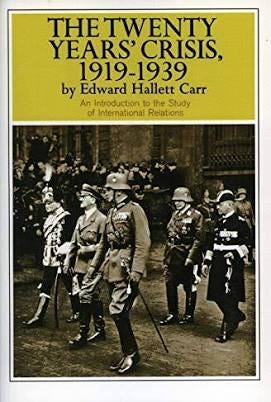
E. H. Carr wrote The Twenty Years’ Crisis not to mock liberal idealism, but to warn it. He understood that moral aspiration detached from power realities collapses under strain. The interwar order believed law and goodwill could substitute for durable strategic equilibrium.
They could not.
But Carr did not celebrate that collapse. He feared what would follow when power politics re-emerged without normative restraint.
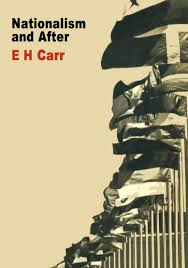
In Nationalism and After, he warned that nationalism can liberate—but when absolutized, it metastasizes. Once states define themselves primarily in civilizational opposition, compromise becomes betrayal.
Power without legitimacy destabilizes.
Legitimacy without power dissolves.
We absorbed the first half of Carr’s lesson. We internalized the critique of naïve moralism. We built institutions mindful of power.
But we have perhaps ignored the second warning:
When great powers redefine themselves in civilizational rather than constitutional terms, instability accelerates.
History does not repeat itself.
We do.
Shakespeare understood that long before political science did. Tragedy lies not in ignorance of warning, but in refusal to recognize ourselves in it.
From Disruption to Doctrine
Vice President Vance’s Munich speech in 2025 was disruptive. It criticized European elites. It called for sovereignty restoration. It challenged liberal orthodoxy.
But it remained argument inside the Western constitutional tradition.
It said: the West has lost its way.
It did not say: the West must redefine itself as a civilizational bloc.
What felt chilling in Secretary Rubio’s 2026 address was not tone. It was trajectory.
If my reading is correct, the speech signaled:
A redefinition of the West from liberal constitutional project to civilizational alignment.
A shift from values-based alliance to identity-based affinity.
An implicit comfort with spheres-of-influence logic over rules-based order.
A narrowing of universal commitments in favor of cultural majoritarian framing.
That is not rhetorical protest.
That is structural repositioning.
And structural repositioning reshapes world-systems.
A Pseudo–Post-1919 World
We are entering something that resembles—not identically, but structurally—a pseudo post-1919 environment.
Consider the parallels:
Economic fragmentation and tariff escalation.
Nationalist resurgence framed as cultural restoration.
Institutional fatigue and declining faith in multilateral constraint.
Great powers testing spheres of influence logic.
Public exhaustion mistaken for durable peace.
1919 did not feel like apocalypse.
It felt like settlement.
But beneath the treaties, nationalism hardened into civilizational identity. Institutional architecture lacked enforcement credibility. Economic grievances metastasized. Twenty years later, the world paid its deferred costs.
We are not repeating 1919.
But we are replicating its structural geometry.
And geometry, in world politics, matters.
The Prediction I Do Not Make Lightly
Here is the prediction I have avoided making.
Munich 2026 sits dangerously at threshold to many of the same dynamics that ignited the civilizational epochal war we came to call World War II.
I choose that word deliberately: dangerously.
Not because tanks are rolling across Europe.
Not because war is inevitable.
But because the conditions that made systemic war conceivable in the early twentieth century are re-emerging in new forms:
Hypernationalism untethered from institutional restraint.
Economic weaponization as standard practice.
Civilizational framing replacing constitutional framing.
Majoritarian identity politics redefining belonging.
Erosion of legitimacy as the glue of pluralism.
When societies abandon restraint in favor of hypernationalism, they do not immediately fall into catastrophe. They normalize it.
The First World War did not end a conflict. It inaugurated what I have elsewhere termed the Long War—a protracted civilizational struggle that ran through 1914, 1939, and 1945, shaped by competing visions of modernity, sovereignty, and identity.
That Long War began when societies elevated nation above restraint, destiny above law, and identity above institution.
We told ourselves it ended in 1945.
I am no longer certain that is fully true.
We may be entering its next phase.
Not as repetition, but as mutation.
Why It May Not Feel Dangerous to ‘Everyone’
This is the most uncomfortable truth.
For demographic majorities aligned with civilizational framing, the shift may feel stabilizing.
Restoration.
Re-centering.
Cultural confidence.
Historical correction.
Minorities feel vulnerability first.
Majorities often feel affirmation first.
But when belonging becomes ethnocultural rather than civic, constitutional neutrality weakens for everyone. Once identity replaces principle, institutional restraint thins.
The irony is cruel: constitutional liberalism protected majorities too. It restrained excess universally.
Civilizational framing removes that universal anchor.
And once great powers begin to operate through civilizational bloc logic, compromise becomes capitulation.
That is the pathway that haunted Carr.
The Deep Civilizational Turn
The most chilling scenario is not overt authoritarianism.
It is philosophical transformation.
The United States remains electorally competitive, militarily dominant, economically powerful—but redefines itself as civilizational champion rather than universalist republic.
NATO cohesion becomes conditional.
European right-wing movements gain transatlantic validation.
Global South states hedge more aggressively.
China and Russia gain narrative parity: “The West was always civilizationally selective.”
Soft power erodes faster than hard power.
And legitimacy—the most precious strategic asset—thins.
This is how tectonic shifts occur.
Quietly.
With approval.
Through language.
‘There and Back Again’
I title this preamble deliberately: There and Back Again.
Because we have been here before.
Not in detail.
In structure.
At the turn of the twentieth century, societies intoxicated by industrial power and nationalist pride abandoned restraint. They believed destiny was theirs to shape without institutional limit.
The result was a thirty-year convulsion we euphemistically split into two wars.
The Long War did not erupt from nowhere.
It accumulated.
It fed on identity.
It hollowed out restraint.
It normalized grievance.
It taught publics to see compromise as humiliation.
Munich 1938 was not the cause of that catastrophe.
It was a warning misread.
Munich 2026 may not cause what follows.
But it may mark the threshold.
And thresholds matter.
Why This Essay, Why Now
I break the fourth wall here because what follows in the coming days—Munich, Then to Now—will examine 1938, 2025, and 2026 not as isolated events, but as nodes in a longer arc.
I am not predicting world war in the mechanistic sense.
I am predicting something more subtle and perhaps more dangerous:
That we are normalizing the civilizational logic that historically precedes systemic war.
That we are drifting into a neo-1919 geometry of power politics layered atop modern technological acceleration.
That the liberal democratic West, once anchored in universalist constitutional restraint, is teetering toward majoritarian civilizational self-definition.
If that trajectory deepens, the world-system will not collapse overnight.
It will harden into blocs.
It will fragment economically.
It will securitize identity.
It will make escalation easier to imagine.
And future historians will say what they always say:
The warnings were visible.
The signs were there.
The tragedy was not ignorance.
It was recognition without correction.
We are there.
And if we are not careful, we may go back again.
The essays that follow are an attempt—however imperfect—to name this moment clearly, before clarity becomes hindsight.
Because history does not repeat itself.
But we do.
And this time, we cannot say we were not warned.
If you value this work, here are three ways you can step into the story with us:
📰 Subscriber (Free)
Stay informed. Receive every new essay, briefing, and analysis straight to your inbox. Join a growing community committed to civic resilience and national security.
🎧 Supporter (Paid Pledge)
Strengthen the signal. Your support sustains both Compound Security, Unlocked and our companion podcast The Civic Brief. Supporters ensure these conversations remain accessible to the wider public while elevating the quality, depth, and reach of the work.
🛡️ Sustainer (Patron Level)
Invest in the mission. Sustainers fuel new research, convenings, and storytelling that enlarge the civic frame of security. This is more than content — it’s a civic project. Your sponsorship helps preserve an independent voice committed to equipping citizens, leaders, and institutions for the compound challenges ahead.