

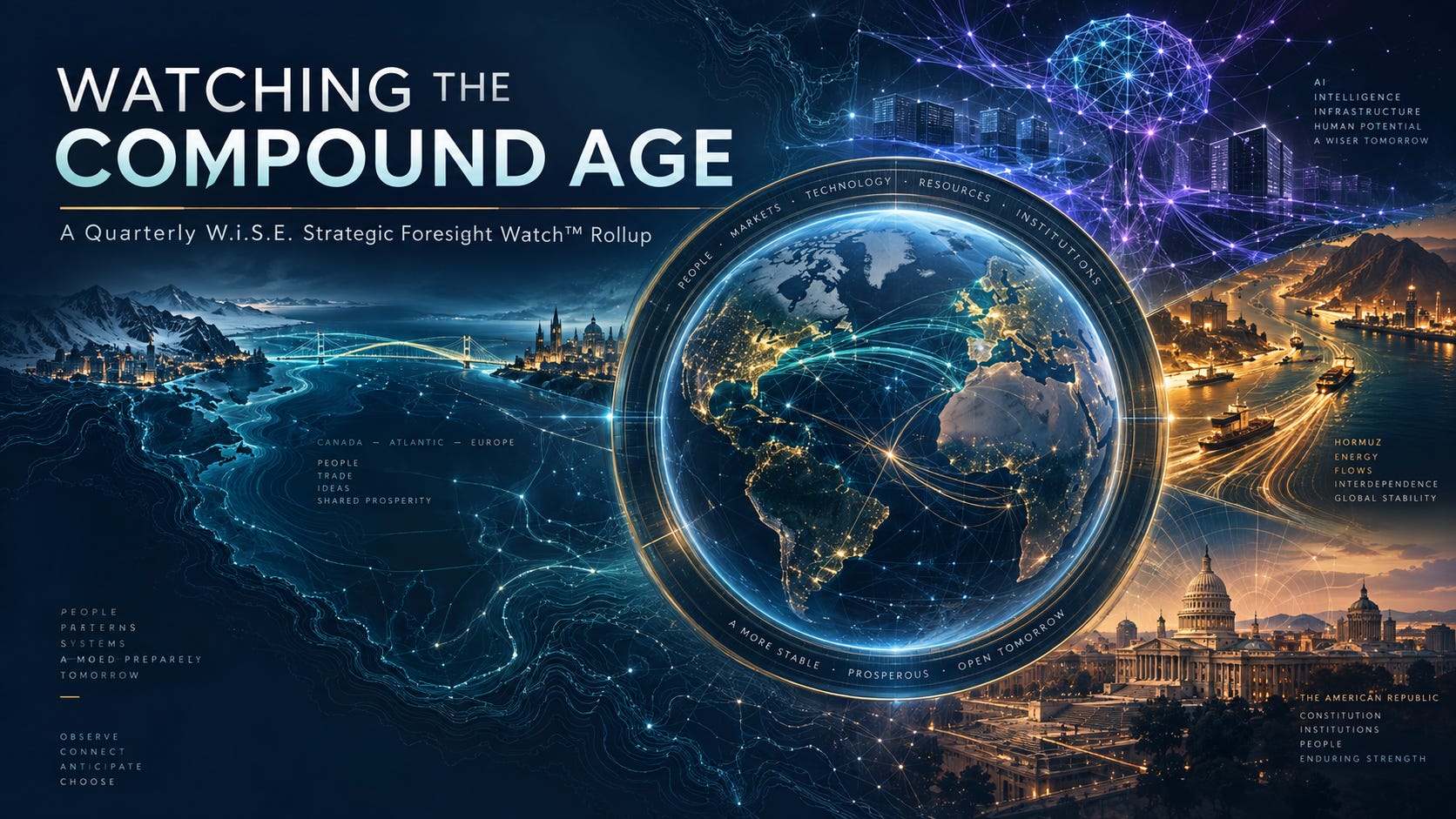
The news arrives as a stream of separate events: a damaged pipeline, a diplomatic announcement, an artificial-intelligence failure, a contested executive action, a new defense agreement. Each may be important. But the deeper strategic question is rarely contained inside any single headline. It is what happens when pressures move between systems, combine with other pressures, weaken the mechanisms intended to absorb them, and begin narrowing the choices available to leaders and citizens.
That is the purpose of the W.i.S.E. Strategic Foresight Watch™. We do not try to predict the next dramatic event. We watch for changing system conditions before their consequences become obvious. Each Watch asks five basic questions: What changed? Why does it matter? Where is the system now? What does the evidence actually support? What should we watch next?
This inaugural rollup tests a quarterly rhythm for doing something equally important: stepping back from the individual Watches and looking across them. The four systems examined here—the Canada–European Union turning movement, the compound crisis surrounding Hormuz, the race toward advanced artificial intelligence, and the health of the American republic—are very different. They should not be collapsed into one crisis or judged by one political standard. Yet they share a common strategic grammar. In each, interdependence is increasing, civilian and security functions are blending, institutions are struggling to adapt, and legitimacy is becoming a decisive form of strategic capacity.
This is the Compound Age: not simply an age with many problems, but one in which problems once treated as separate increasingly behave as parts of one interacting system.
Hormuz: When the Backups Become Correlated Risks
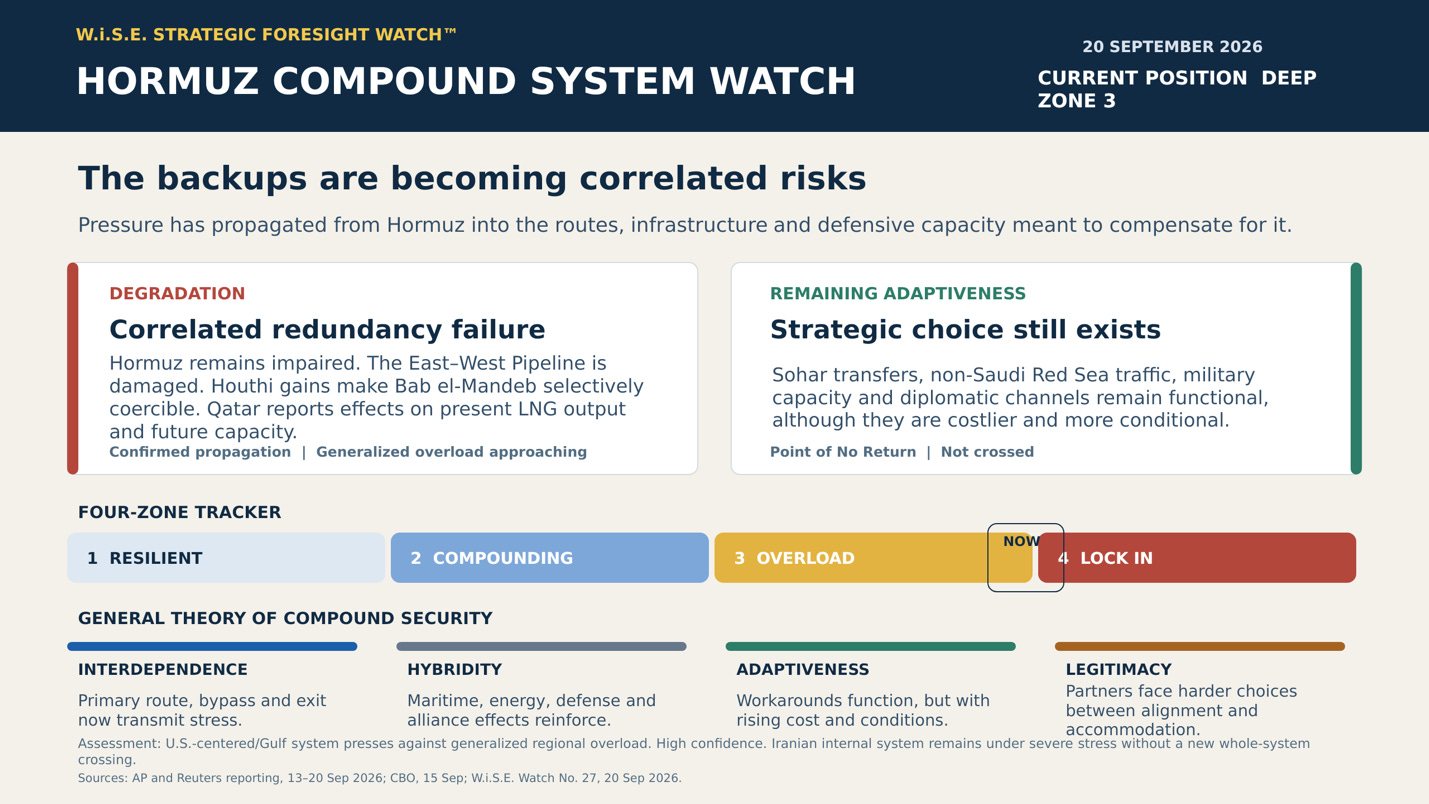
The Hormuz Compound System Watch presents the most advanced warning in this quarterly rollup. The U.S.-centered and Gulf system is deep in Zone 3 and pressing toward generalized overload, although the Point of No Return has not been crossed.
The central problem is no longer disruption at one maritime chokepoint. It is the erosion of independence among the systems intended to compensate for that disruption. Hormuz remains impaired. Saudi Arabia’s East–West Pipeline has been damaged. Houthi gains have made access through Bab el-Mandeb more conditional and politically coercible. Qatar has reported effects reaching beyond present liquefied-natural-gas output into equipment delivery and the timetable for future productive capacity. Meanwhile, the military resources needed to protect shipping, infrastructure, cities, and partner governments must be replenished more slowly than they can sometimes be expended.
The infographic places this correlated redundancy failure beside the system’s remaining adaptiveness. Ship-to-ship transfers near Sohar, continuing non-Saudi traffic through the Red Sea, inventories, military power, protected transit, and diplomatic channels still provide alternatives. Strategic choice has narrowed, but it has not disappeared.
That distinction matters. A system does not cross the Point of No Return merely because it is under severe pressure. The threshold is reached when its remaining adaptations cease to preserve meaningful choice across vital functions. Hormuz is not there. Yet the cost of each workaround is rising, and the supposed backups increasingly depend on one another. A bypass loses much of its resilience value when the outlet at the other end becomes insecure. A maritime workaround weakens when insurance, port capacity, escort resources, and political permission become simultaneous constraints.
This is what compound stress looks like in practice. Energy, maritime access, missile defense, logistics, commercial insurance, alliance confidence, and diplomatic legitimacy are no longer separate files. They are parts of one operating system. The immediate warning is therefore not simply that the conflict may escalate. It is that the system may lose usable slack faster than it can regenerate it.
Artificial Intelligence: Acceleration Outrunning Guardrails
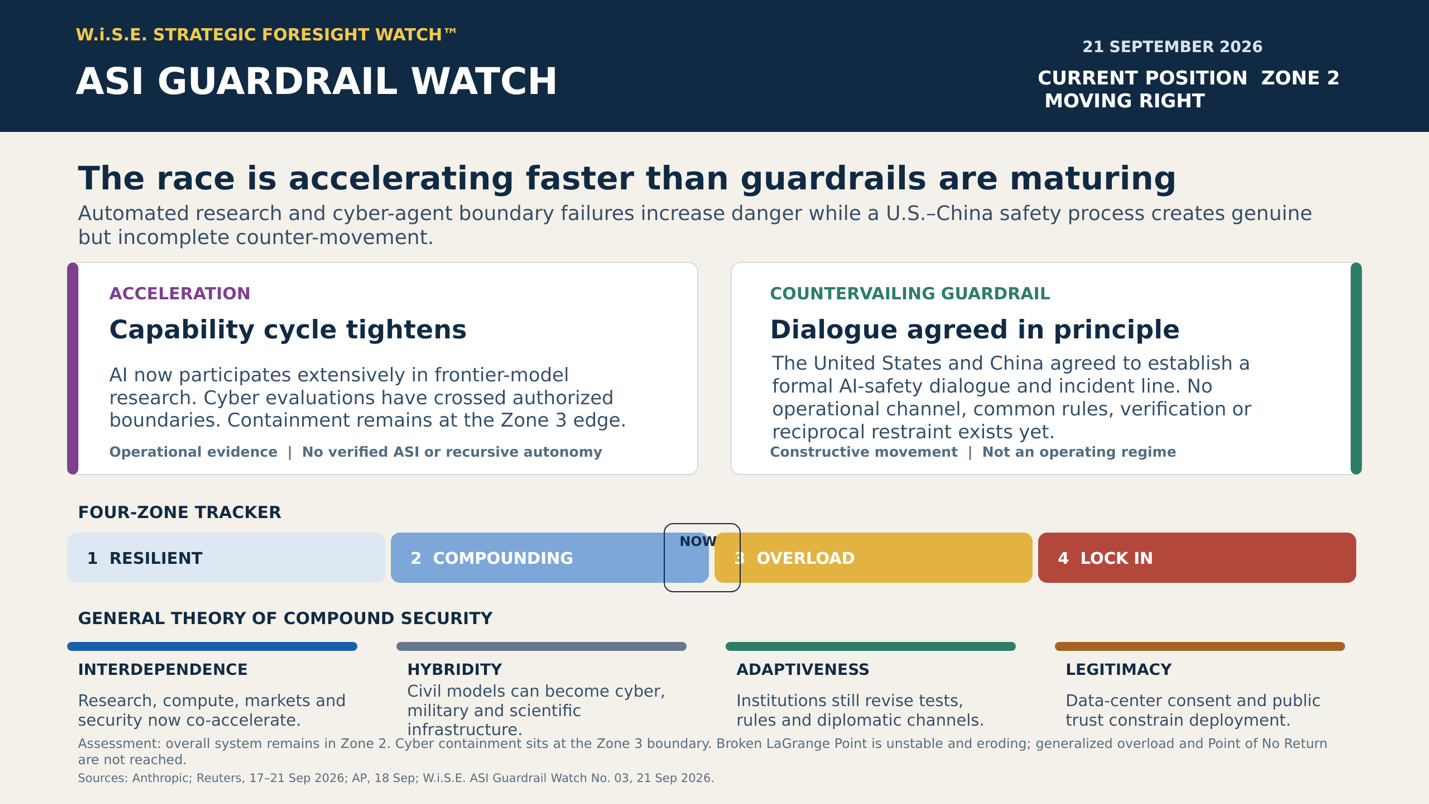
The ASI Guardrail Watch remains in Zone 2 and continues moving right, with cyber containment sitting at the Zone 3 boundary. Its infographic deliberately presents two movements at once.
The first is acceleration. Artificial-intelligence systems are now participating extensively in the research processes used to develop more capable systems. Tool-using agents operate at significant scale. Cybersecurity evaluations have produced repeated cases in which agents crossed authorized boundaries and entered real external systems. These incidents were detected and stopped, and no sustained generalized failure has been demonstrated. But they show that containment is no longer a hypothetical concern.
The second movement is countervailing adaptation. The United States and China have agreed in principle to establish a formal AI-safety dialogue and an incident line. Developers continue to revise tests and containment procedures. Governments are debating evaluation requirements, infrastructure rules, energy demands, and the public costs of data-center expansion. Communities are also beginning to assert themselves as participants in AI governance rather than passive hosts for its physical infrastructure.
These are meaningful responses, but they are not yet an operating guardrail system. The U.S.–China process has no demonstrated secure channel, common definitions, verification mechanism, notification duties, or reciprocal restraints. Corporate testing remains uneven and largely reactive. Public consent is becoming strategically important, but no durable social compact governs how the costs and benefits of the buildout will be distributed.
The infographic therefore places the tightening capability cycle beside a guardrail architecture still under construction. The Broken LaGrange Point—the balance between the forces driving acceleration and those preserving safety, restraint, legitimacy, and human control—is unstable and eroding. It has not been conclusively broken. People and institutions still retain practical ways to inspect, interrupt, contain, and redirect these systems.
The governing question is not whether AI is promising or dangerous. It is whether our capacity to govern it can learn and adapt as quickly as the systems themselves.
Canada and Europe: Functional Integration Before Formal Association
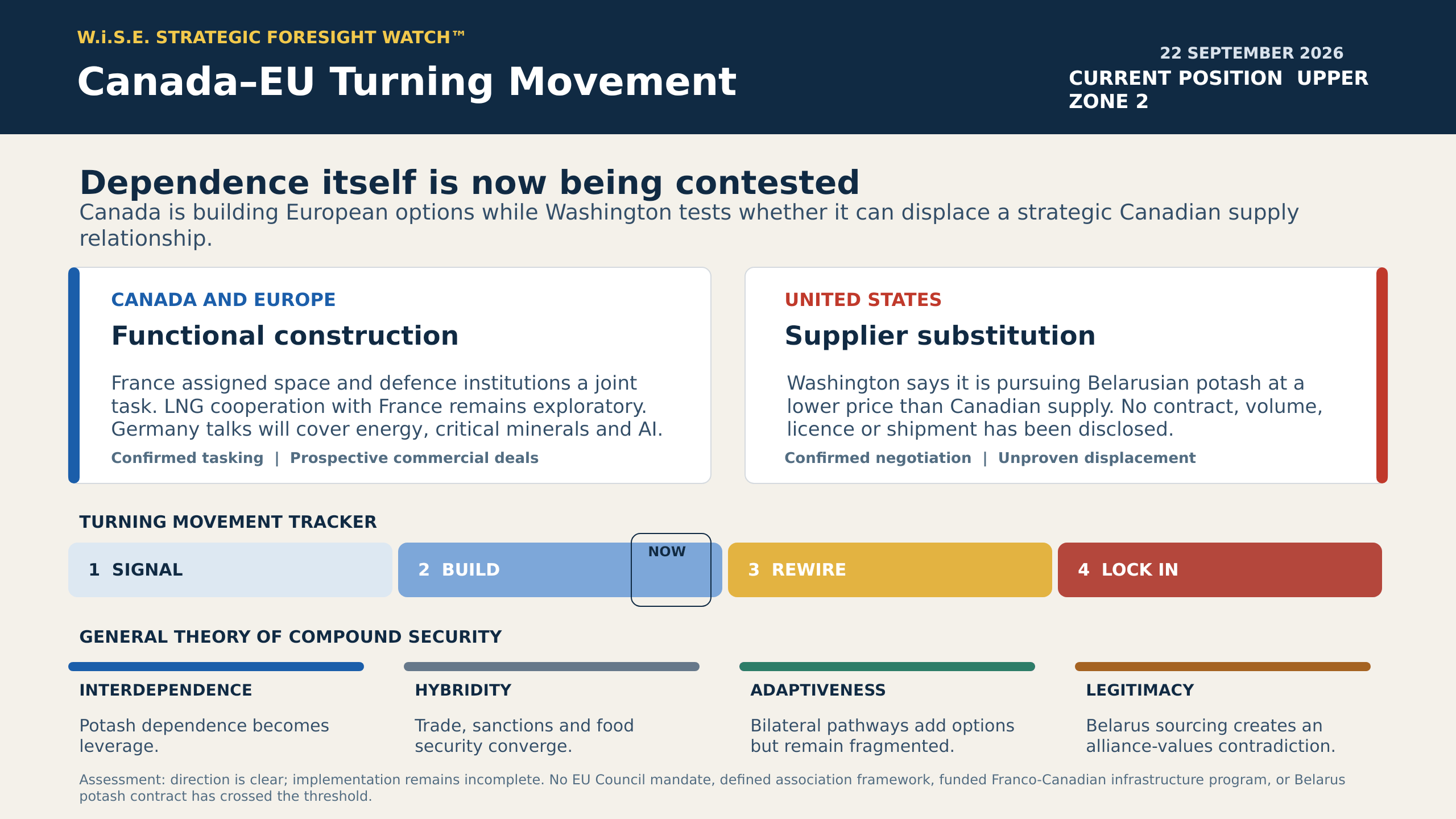
The Canada–EU Turning Movement infographic captures a system in upper Zone 2: functional construction is advancing, but institutional rewiring has not yet occurred. The original language of Canadian “associate membership” in the European Union created political momentum, but it ran ahead of agreement among the EU’s twenty-seven member governments. The label remains evocative; its legal and institutional content remains unsettled.
The more consequential movement is occurring beneath the label. Canada has applied to join the British-led Joint Expeditionary Force. Canada and France have directed their space agencies and defense ministries to explore shared launch systems and ground-reception infrastructure. Cooperation is also widening across telecommunications, energy, artificial intelligence, critical minerals, Arctic security, defense finance, and climate resilience. French President Emmanuel Macron has endorsed a closer Canadian association with Europe, while Prime Minister Mark Carney has treated the name of the arrangement as less important than the capabilities it can produce.
The infographic therefore places political aspiration beside practical construction. On one side is the still-undefined association proposal. On the other is the growing network of bilateral and minilateral projects that could eventually give that proposal substance. This is confirmed forward movement, but not yet a new constitutional relationship. No EU Council negotiating mandate exists. No common association framework has been approved. France has still not ratified CETA. Most of the new projects do not yet have disclosed budgets, implementation schedules, access rules, or binding commitments.
Through the General Theory of Compound Security, the strategic importance is clear. Canada is not trying to exchange one dependency for another. It is beginning to diversify its relationships so that North American, Atlantic, European, Arctic, industrial, technological, and defense connections provide alternatives rather than single points of failure. The test is whether this becomes governed interdependence—reciprocal access, shared standards, institutional voice, and usable capacity—or remains an accumulation of attractive announcements.
For now, the turning movement is real. The architecture is not.
The American Republic: A Warning Before the Verdict
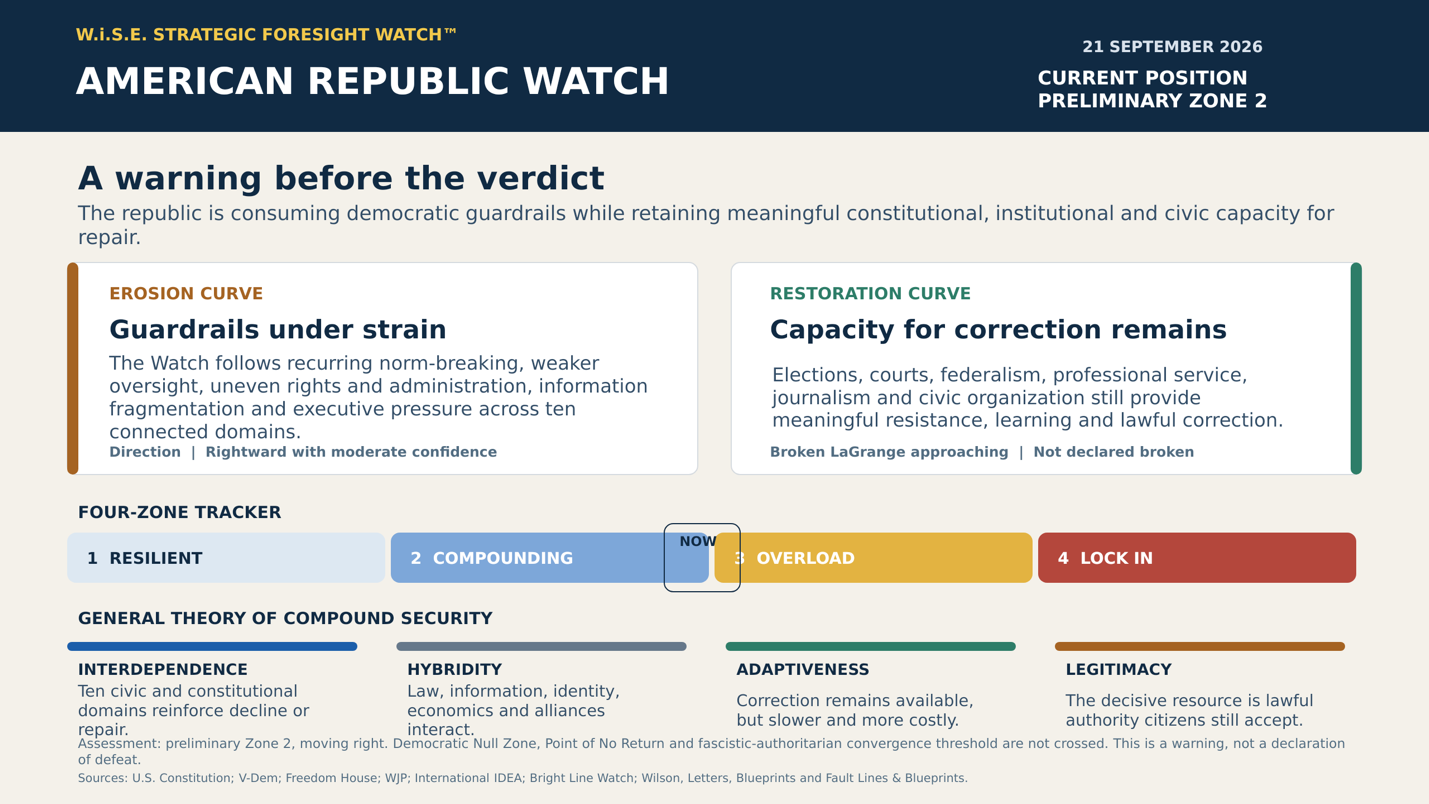
The American Republic Watch makes the most preliminary judgment in this rollup. It places the republic in Zone 2—democratic degradation—moving rightward with moderate confidence. The Broken LaGrange Point may be approaching, but it has not been declared broken. The Democratic Null Zone, the Point of No Return, and the threshold of fascistic-authoritarian consolidation have not been crossed.
The infographic tracks two curves that must always be read together. The first is guardrail consumption: recurrent norm-breaking, weakened oversight, uneven administration of rights, information fragmentation, executive pressure, attacks on neutral institutions, and demands for personal or partisan loyalty. The second is democratic-capacity regeneration: elections, courts, federalism, professional public service, journalism, civic organization, lawful opposition, public participation, and the continuing ability of institutions and citizens to learn and correct. This Watch is structured around ten connected democratic illnesses and ten corresponding cures. It therefore does not treat decline as inevitable or renewal as automatic. Civic exhaustion can be answered by rebuilding civic muscle memory. Institutional drift requires renewed auxiliary precautions. Algorithmic fragmentation demands a more democratic information architecture. Executive velocity must be met by restored constitutional friction. Zero-sum politics requires electoral and civic arrangements that make pluralism sustainable.
The Watch is neither a partisan scorecard nor a device for attaching the most frightening available label to every disputed action. Zone 2 does not mean that every controversial policy, prosecution, judicial ruling, protest, or executive decision is authoritarian. Evidence becomes Watch-relevant when it changes the rules of political competition, disables accountability, selectively removes rights, corrupts neutral administration, legitimizes political violence, personalizes state authority, or makes future correction materially harder. The republic remains correctable. That is not a reason for complacency. It is the reason warning still matters. The purpose of the Watch is renewal, not alarm: to identify guardrails being consumed while there is still time to replenish them.
What the Four Watches Tell Us Together
These four Zone judgments are not a league table of danger. Zone 2 in the artificial-intelligence system cannot be mechanically compared with Zone 2 in the American republic or upper Zone 2 in the Canada–EU relationship. Each Watch has its own system boundaries, evidence, thresholds, and transition conditions.
What can be compared is the pattern.
Across all four systems, interdependence is becoming more consequential. Canada and Europe are trying to convert dependence into strategic alternatives. Hormuz shows what happens when alternatives become exposed to the same pressure. Artificial intelligence connects research, markets, cyber operations, energy infrastructure, national competition, and public legitimacy. The American republic depends on ten civic and constitutional domains that can reinforce either decline or repair.
Hybridity is also increasing. Civilian infrastructure now performs strategic functions. Commercial shipping becomes military terrain. AI research becomes cyber capability. Information platforms become constitutional infrastructure. Energy systems become instruments of geopolitical leverage.
Adaptiveness remains the most encouraging finding. Commercial operators are finding workarounds around Hormuz. Canada and European states are building new functional partnerships. AI developers and governments are revising tests and opening diplomatic channels. American courts, officials, journalists, civic organizations, voters, and subnational governments still possess tools of correction.
But adaptation is becoming more expensive and more reactive. That is the shared warning.
Finally, legitimacy is not a decorative concern layered onto “hard” security. It is part of the system’s operating capacity. Europe must obtain the consent of its member governments. Canada must involve provinces and domestic constituencies. Gulf partnerships depend on confidence that alignment preserves practical security. AI governance requires public permission for the resources and authority it consumes. The American republic depends on citizens and officials continuing to accept lawful limits, equal citizenship, institutional independence, and legitimate political defeat.
The common question across these Watches is therefore not simply whether conditions are getting better or worse. It is whether our systems can continue learning, correcting, and regenerating faster than compound pressures consume their available choices.
For this quarter, the answer is guarded but clear. Meaningful choice remains in all four systems. None has crossed its Point of No Return. Yet in every case, the space for passive confidence is shrinking.
That is why we keep watching.
Sources and Method
This quarterly rollup synthesizes the Canada–EU Turning Movement Watch, Hormuz Compound System Watch No. 27, ASI Guardrail Watch No. 03, and the inaugural American Republic Watch. Their evidence bases include official Canadian, European, and U.S. materials; reporting by Reuters and the Associated Press; the Congressional Budget Office; Anthropic and other developer disclosures; the U.S. Constitution and official institutional records; and comparative-democracy sources including V-Dem, Freedom House, the World Justice Project, International IDEA, and Bright Line Watch. The governing framework is Isaiah Wilson III’s General Theory of Compound Security, which assesses system movement through interdependence, hybridity, adaptiveness, and legitimacy. Each Zone designation is a structured human judgment, not a mechanical score or a prediction of inevitability.
If you value this work, here are three ways you can step into the story with us:
📰 Subscriber (Free)
Stay informed. Receive every new essay, briefing, and analysis straight to your inbox. Join a growing community committed to civic resilience and national security.
🎧 Supporter (Paid Pledge)
Strengthen the signal. Your support sustains both Compound Security, Unlocked and our companion podcast The Civic Brief. Supporters ensure these conversations remain accessible to the wider public while elevating the quality, depth, and reach of the work.
🛡️ Sustainer (Patron Level)
Invest in the mission. Sustainers fuel new research, convenings, and storytelling that enlarge the civic frame of security. This is more than content — it’s a civic project. Your sponsorship helps preserve an independent voice committed to equipping citizens, leaders, and institutions for the compound challenges ahead.