
There Is Nothing Common About Common Sense
How Political Intuition Masquerades as Universal Truth in an Age of Distrust, Complexity, and Legitimacy Collapse.

Author’s Note —
I am writing this at a moment when the United States feels less like a polity in disagreement and more like a system under strain.
Not collapse. Not yet. But strain—persistent, structural, and increasingly normalized.
In that kind of environment, something subtle begins to happen.
We simplify.
We reach for language that feels grounding, stabilizing, and familiar. We look for ways to make sense of complexity without having to fully confront it. And one of the most powerful tools we reach for—often without realizing it—is what we call “common sense.”
I’ve spent much of my career working at the intersection of war, policy, and strategy—spaces where reality has a way of punishing oversimplification. What appears obvious at first glance is often incomplete. What feels intuitive is frequently misleading. And what is widely accepted can still be profoundly wrong.
That experience has made me wary of anything that presents itself as self-evident in a system that is anything but simple.
Today’s hyper-partisan environment amplifies that concern.
We are not just divided in our preferences. We are increasingly divided in how we process reality itself—what we see as credible, what we accept as true, and what we are willing to question.
In that context, appeals to “common sense” no longer function as shared grounding. They function as signals of belonging—markers of who is “with us” and who is not.
That is where the heuristic turns dark.
Because what is being invoked as “common sense” is often not common at all. It is conditioned intuition—shaped by media ecosystems, social identity, institutional trust (or the lack of it), and lived experience. It feels obvious precisely because it is reinforced.
And when that intuition is elevated to the level of unquestioned truth, it begins to do something more consequential:
It shuts down inquiry.
It delegitimizes complexity.
It replaces analysis with assertion.
In a less strained system, that might be manageable. In today’s environment, it becomes dangerous.
Because the challenges we are facing—geopolitical competition, technological disruption, institutional erosion, societal fragmentation—are not problems that yield to intuition alone. They are compound, adaptive, and often counterintuitive.
They require us to think beyond what feels immediately obvious.
This essay is not an argument against practical judgment. Nor is it a defense of detached expertise.
It is an argument for something harder:
A recognition that in complex systems, what we call “common sense” is often provisional at best—and, under certain conditions, actively misleading.
And that in a moment like this, we cannot afford to confuse familiarity with truth.
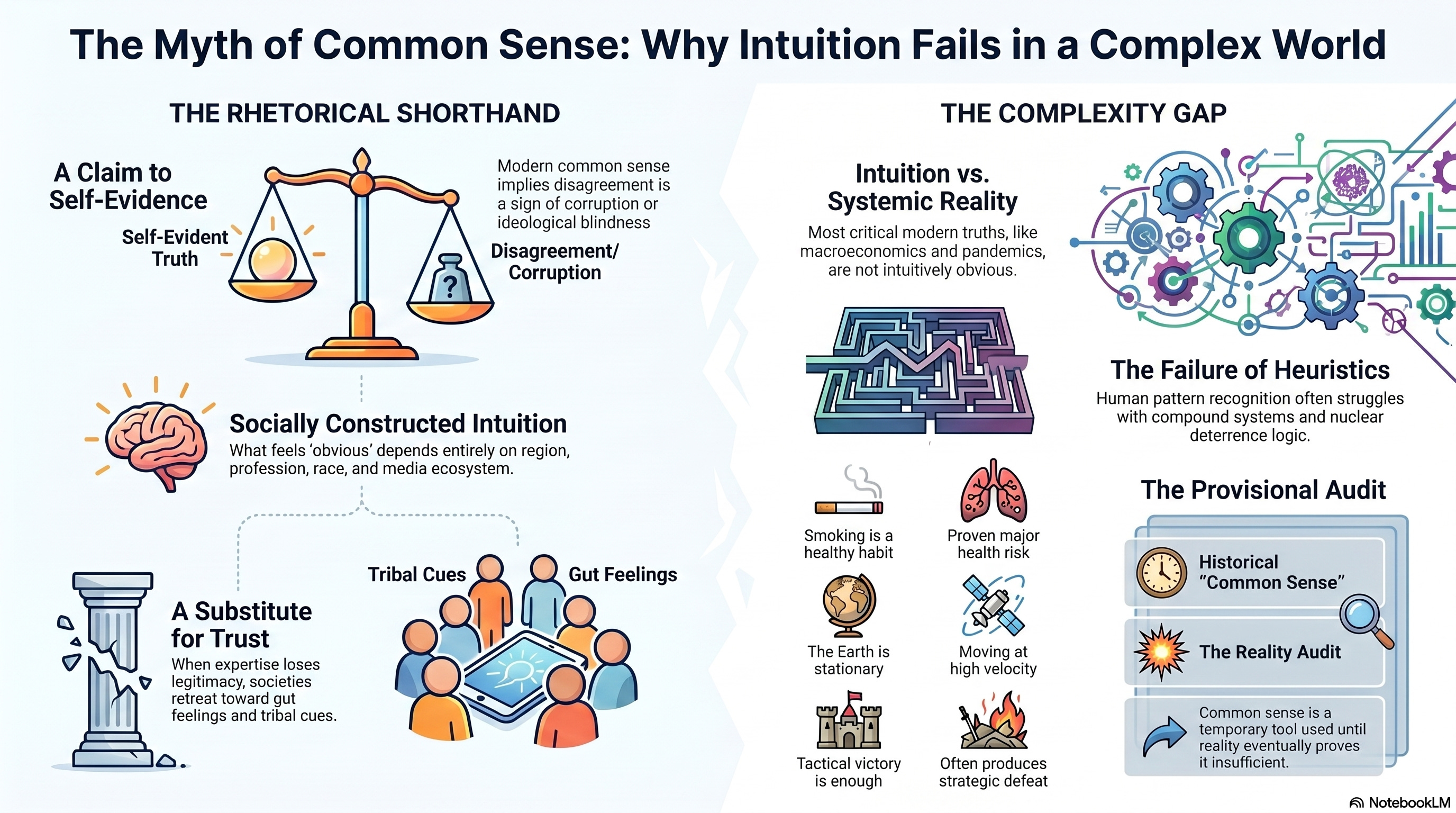
There is a reason the phrase “common sense” is so politically powerful.
It sounds democratic.
Humble.
Grounded.
Anti-elitist.
It implies that truth is obvious to ordinary people and that only fools, ideologues, or corrupt experts could disagree.
But historically and philosophically, there is very little that is actually “common” about common sense.
The phrase itself carries at least three different—and often conflicting—meanings.
First, there is the older philosophical meaning, stretching back to Aristotle and later thinkers like Thomas Paine and Thomas Reid.
Here, “common sense” referred to the basic shared faculties of perception and judgment that allow humans to navigate reality together. Fire burns. Gravity exists.
Human beings require food, trust, and social cooperation. In this sense, common sense was less about ideology than about baseline cognitive orientation toward the world.
But modern politics rarely uses the term this way.
Today, “common sense” is usually rhetorical shorthand for something else entirely: a claim that one’s own assumptions are so self-evidently true that disagreement itself becomes suspect.
That is not universality.
It is social positioning.
What counts as “common sense” changes dramatically across time, class, region, religion, race, profession, and political culture.
At various moments in American history, it was considered “common sense” that:
women should not vote,
slavery was economically necessary,
segregation preserved order,
smoking was healthy,
homosexuality was pathological,
empires were natural,
democracy itself was dangerous.
All were once defended as plain, practical realism against supposedly detached intellectualism.
Which reveals the deeper truth: common sense is often just normalized cultural intuition masquerading as objective truth.
And that intuition is usually produced by institutions, incentives, media ecosystems, upbringing, and lived experience—not by some universally distributed civic wisdom.
A rancher in Texas, a hedge-fund manager in New York City, a Black church pastor in Atlanta, and a software engineer in San Francisco may all invoke “common sense” while meaning radically different things.
Even neuroscience and cognitive psychology complicate the idea.
Human beings are not naturally rational in any pure sense. We are heuristic creatures. We simplify complexity through stories, tribal cues, emotion, pattern recognition, and social imitation.
What feels like “common sense” is often merely what feels familiar, morally comfortable, or socially reinforced.
Which is why appeals to common sense become especially potent during periods of institutional distrust.
When expertise loses legitimacy, people retreat toward intuition.
When systems become too complex to understand, societies hunger for simplification.
When legitimacy velocity collapses—as my General Theory of Compound Security would frame it—“common sense” becomes a substitute currency for trust.
It says:
“You may not trust institutions, but trust your gut. Trust people like you. Trust what feels obvious.”
That can be healthy in moderation. Technocracies absolutely can become detached from lived reality. Experts can become insulated, self-referential, and blind to practical consequences.
But the danger emerges when “common sense” ceases to mean practical wisdom and instead becomes a mechanism for delegitimizing complexity itself.
Because many truths are not intuitively obvious.
Quantum mechanics is not common sense.
Macroeconomics is not common sense.
Pandemics are not common sense.
Nuclear deterrence is not common sense.
Compound systems behavior is not common sense.
Indeed, many of the most important discoveries in human history initially appeared to violate common sense altogether.
The Earth feels stationary.
Yet it moves.
Heavy objects appear to fall faster.
Yet they do not.
War feels decisive.
Yet, as I’ve argued repeatedly in Thinking Beyond War, tactical victory often produces strategic defeat.
So perhaps the most responsible definition of “common sense” is not “what everybody naturally knows.”
Perhaps it is something humbler:
the provisional practical judgments societies use to navigate complexity—until reality proves them insufficient.
And reality always eventually audits common sense.
If you value this work, here are three ways you can step into the story with us:
📰 Subscriber (Free)
Stay informed. Receive every new essay, briefing, and analysis straight to your inbox. Join a growing community committed to civic resilience and national security.
🎧 Supporter (Paid Pledge)
Strengthen the signal. Your support sustains both Compound Security, Unlocked and our companion podcast The Civic Brief. Supporters ensure these conversations remain accessible to the wider public while elevating the quality, depth, and reach of the work.
🛡️ Sustainer (Patron Level)
Invest in the mission. Sustainers fuel new research, convenings, and storytelling that enlarge the civic frame of security. This is more than content — it’s a civic project. Your sponsorship helps preserve an independent voice committed to equipping citizens, leaders, and institutions for the compound challenges ahead.