

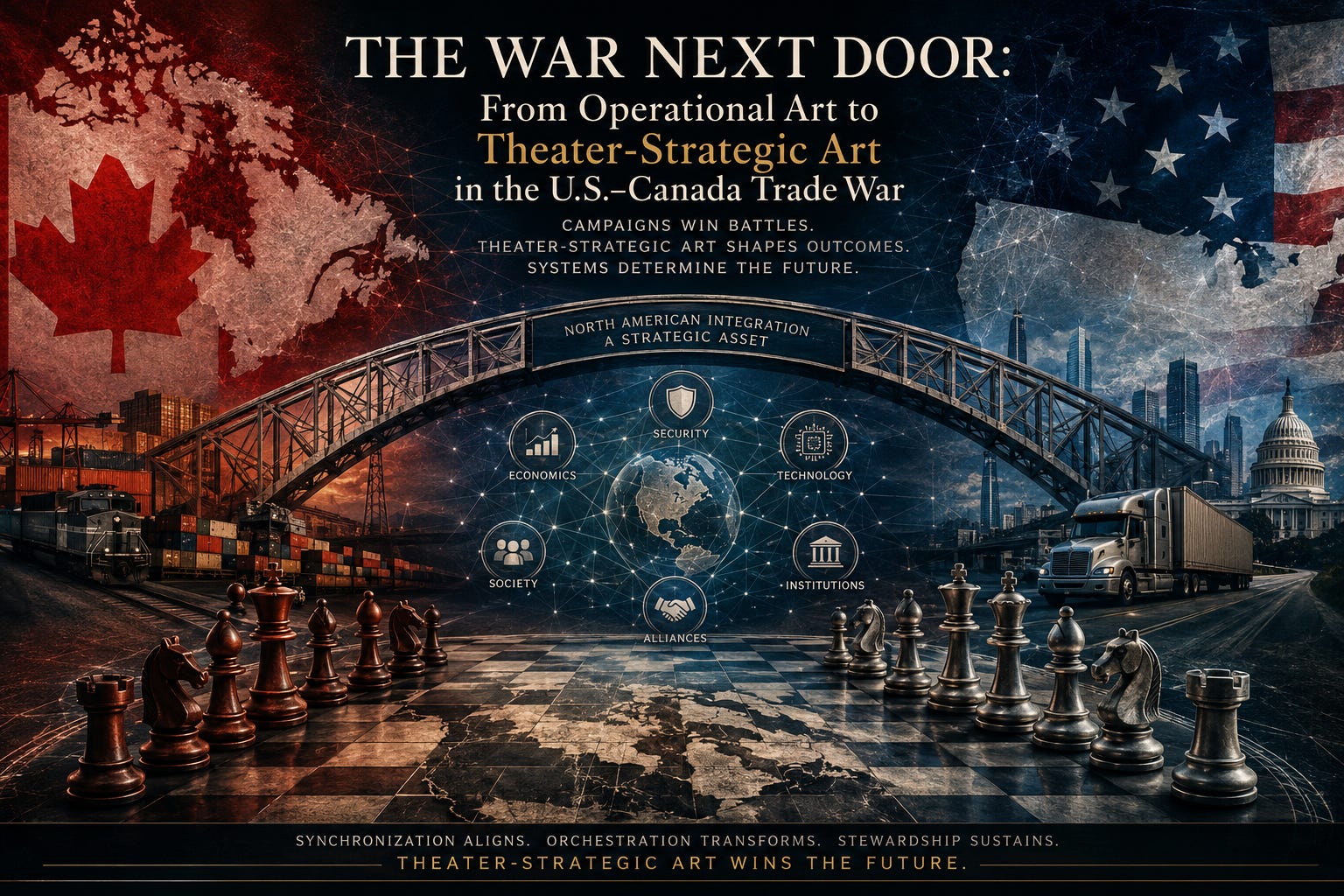
An assessment …
… at the close of Sunday, August 23, 2026
On Monday morning, August 24, American and Canadian fighter aircraft will take to the skies across North America. U.S. F-16s and Royal Canadian Air Force CF-18s will operate alongside one another. American and Canadian personnel will integrate mixed fighter-force operations, command-and-control organizations, and air battle management while rehearsing coordinated responses along the eastern and western approaches to North America and cruise-missile-defense scenarios involving binational assets.
The exercise—AMALGAM DART—will run from August 24 through September 1 across the Alaskan, Canadian, and Continental U.S. NORAD regions. Its stated purpose is to enhance readiness and strengthen the defense of North America.[1]
Forty-eight hours before that exercise begins, however, the United States and Canada effectively entered another kind of war against one another. Not an armed war, obviously. A trade war. But increasingly a “war” in considerably more than the casual journalistic sense.
On August 21, Prime Minister Mark Carney suspended negotiations with Washington after concluding that last-minute American terms were “unfair, uneconomic,” and called into question the reliability of any agreement. The following day, after meeting with Canada’s provincial and territorial premiers, his government announced dollar-for-dollar Canadian counter-tariffs to take effect the Tuesday after Labour Day.
More consequential than the tariffs themselves was the strategic narrative Carney supplied for them. The United States, he argued, had changed the nature of its relations with even its closest allies and had begun to “use economic integration as a weapon.” Canada would therefore strengthen itself at home, diversify abroad, and reduce its dependence upon the United States.[2]
The juxtaposition is extraordinary.
On Monday, American and Canadian military officers will sit beside one another looking at the same operational picture, defending the same continent against the same external threats. At precisely the same time, their governments will be escalating an economic contest deliberately intended to impose costs upon one another.
A military planner should find this more than ironic. It is a warning.
It suggests that the United States may be conducting one campaign in the economic domain while simultaneously conducting another in the defense domain without adequately determining whether those campaigns support the same theater-strategic political purpose.
At the School of Advanced Military Studies, we would recognize the problem quickly. The lines of effort are no longer necessarily converging. When one line of effort begins degrading another, the planner has to consider a more troubling possibility: strategic fratricide.
That is where my assessment of this U.S.–Canada “war” begins. But it cannot end there, because the crisis exposes not merely a flaw in a particular tariff policy but a limitation in the way we traditionally think about operational art itself. The first analytical pass through this conflict should indeed employ the familiar tools of campaign design: political purpose, competing theories of victory, centers of gravity, critical requirements and vulnerabilities, operational reach, decisive points, lines of effort, culmination, branches and sequels, risk, and termination.[3]
Yet once we have conducted that assessment, we should deliberately conduct the analysis again through a wider aperture. We need to move from operational art toward what I call theater-strategic art.
The distinction matters because the central problem here is no longer simply how one state compels another to behave differently. It is how states compete inside a deeply interconnected political-economic-security system whose degradation may leave both participants strategically weaker regardless of which side “wins” the immediate contest. Operational art remains necessary for understanding such a problem. It is no longer sufficient.
The First Pass: Operational Art
The planner should begin where strategy always begins: with political purpose.
Before drawing lines of effort, identifying decisive points, allocating resources, or selecting instruments, we should ask what political condition the United States actually seeks to create.
Washington has articulated multiple grievances. Most concretely, the administration argues that Canadian policies discriminate against American automobile producers and exporters. On July 20, President Donald Trump invoked Section 338 of the Tariff Act of 1930, finding that Canadian treatment of U.S. motor vehicles disadvantaged American commerce and imposing additional duties of 50 percent on selected Canadian products, effective August 19. The proclamation explicitly argued that tariffs could expand opportunities for U.S. producers, enhance American production and employment, and spur Canada to remove the offending discrimination.[4]
Those are discernible objectives. They are not yet a strategic end state.
A tariff is an action. Modification of Canadian commercial behavior is an objective. But what larger political condition is supposed to exist after the tariff works? That distinction matters because campaigns can accomplish every assigned tactical task and still produce a strategic environment worse than the one they were intended to improve. Clausewitz’s insistence that war is an instrument of policy is useful precisely because it forces the strategist to judge military—or in this case economic—action according to the political condition it creates rather than according to the violence or pressure it successfully applies.[5]
Canada’s political objective has become considerably clearer.
On August 21, Carney publicly identified five negotiating objectives: maintaining tariff-free access to the American market for the overwhelming majority of Canadian businesses; restoring stability to the commercial relationship; reducing American tariffs on key strategic industries; protecting small and medium-sized Canadian firms; and preserving Canada’s “flexibility, independence, and sovereignty.” He suspended negotiations when he concluded that the latest U.S. terms could not meet those objectives.[6] The following day, he broadened the argument from bargaining over tariffs to a reconsideration of the entire bilateral relationship. He described the decades-long movement toward steadily increasing integration with the United States as effectively over and portrayed the weaponization of economic integration as something against which Canada now had to build resilience.[7]
The resulting asymmetry in war aims should concern Washington.
The United States appears principally to be fighting for concessions. Canada increasingly believes that it is defending sovereign freedom of action. One government is bargaining over interests while the other is moving toward a language of identity and independence. Those are different kinds of political objects, and coercion behaves differently against them.
The next correction is geographical.
Look at a political map and this appears to be a bilateral confrontation between the United States and Canada. Look instead at the underlying productive, energy, transportation, industrial, and security systems and a different theater emerges. The relevant theater is North America.
In 2025, U.S. goods and services trade with Canada totaled an estimated $872.3 billion. U.S. goods exports to Canada were $333.6 billion and imports were $381.9 billion, while the United States simultaneously maintained a $27.7 billion services surplus.[8] Energy demonstrates an even deeper structural interdependence. U.S.–Canadian energy trade totaled approximately $137 billion in 2025, of which roughly $111 billion consisted of American energy imports from Canada. Crude oil represented 69 percent of the total value of bilateral energy trade.[9] These are not two self-contained economies simply exchanging finished products across a line. Automobile components move repeatedly across the border before becoming completed vehicles. Electricity moves through interconnected grids. Canadian petroleum feeds American refineries. Rail networks, trucking corridors, Great Lakes shipping, aerospace production, agriculture, energy infrastructure, critical minerals, finance, telecommunications, tourism, and defense production all operate across the political boundary.
The strategic geography therefore runs through Detroit and Windsor, Buffalo and Fort Erie, Seattle and Vancouver, Ontario and Michigan manufacturing, Alberta-to-Midwest petroleum systems, Quebec-to-New England electricity, Great Lakes shipping, continental rail and road networks, North American aerospace, and the Arctic approaches.
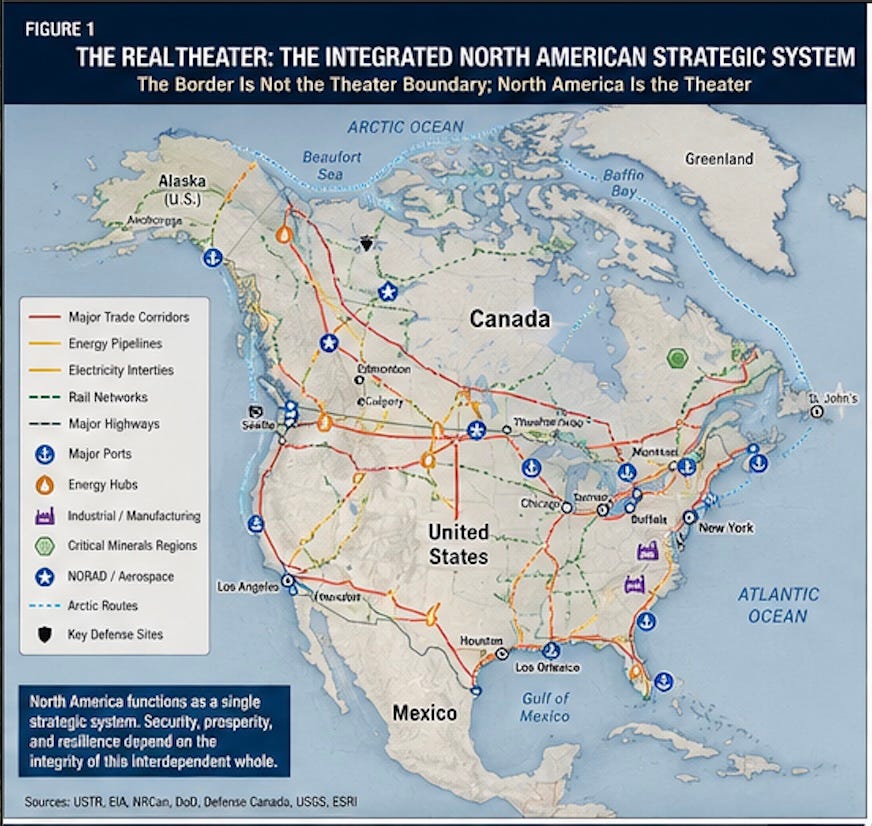
Figure 1. The Real Theater: The Integrated North American Strategic System. The relevant strategic geography is not defined principally by the U.S.–Canadian political boundary but by the continental systems crossing it: trade, transportation, manufacturing, energy, critical resources, defense infrastructure, aerospace warning, and Arctic access.
That changes the character of economic coercion.
A tariff placed upon a distant competitor’s finished product can behave approximately like an externally directed economic weapon. A tariff inserted into a deeply integrated production system does something different. It travels backward and forward through the system, raising input costs, altering sourcing decisions, redirecting investment, creating uncertainty, encouraging substitution, and changing political behavior on both sides of the border.
The operational analogy is difficult to escape. This is not merely a matter of interdicting the adversary’s sustainment network. The sustainment network is shared. The front line runs through portions of both sides’ logistical bases.
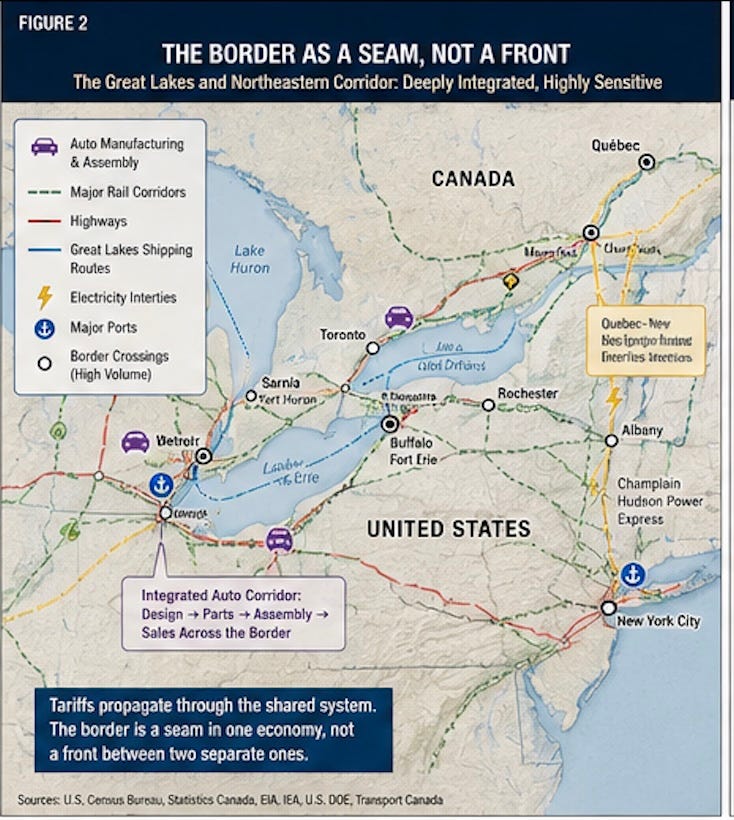
Figure 2. The Border as a Seam, Not a Front. In the Great Lakes–Northeast corridor, the border passes through rather than separates integrated automotive, transportation, electricity, manufacturing, and logistics systems. Economic coercion introduced at the border therefore propagates through a shared continental system.
Here lies one of the deeper strategic misconceptions animating the confrontation: the tendency to conflate force with power. The United States unquestionably possesses greater economic force. Its economy is vastly larger. Its internal market is more important to Canada than the Canadian market is to the United States. Washington therefore possesses enormous capacity to impose economic costs. But the ability to impose costs is not synonymous with the ability to produce desired political behavior. Schelling’s foundational work on coercion emphasized that compellence depends not simply upon the amount of pain one can inflict but upon how that threatened or imposed pain alters an opponent’s choices.[10] Alexander George’s work on coercive diplomacy similarly demonstrated that overwhelming capability does not eliminate the requirements for credible demands, proportionality, reciprocal inducements, and a workable route by which the target can comply.[11]
The proper question is therefore not whether the United States can hurt Canada more than Canada can hurt the United States. It plainly can. The strategically useful question is whether superior American economic force can be converted into the particular Canadian political behavior Washington seeks at costs acceptable to the United States and without creating larger consequences inimical to American interests.
That question leads directly to the competing theories of victory.
The apparent American theory is straightforward. Economic pressure creates disproportionate Canadian pain; Canadian pain creates political pressure upon Ottawa; political pressure produces concessions; the concessions create better market conditions for American producers; and those advantages strengthen American production and economic sovereignty.
There is nothing inherently irrational about this logic. The problem is that every arrow in the causal chain rests upon assumptions. It assumes Canadian public anger will be directed primarily toward Ottawa rather than Washington. It assumes economic pain will weaken rather than strengthen Canadian political cohesion. It assumes retaliation will not create intolerable concentrated costs inside politically important American sectors. It assumes firms will not substantially reorganize supply chains. It assumes Canada cannot diversify rapidly enough to reduce American leverage. It assumes other allies will not interpret the episode as a reason to reduce their own economic dependence upon the United States. Most importantly, it assumes Canada will eventually decide that concession is politically preferable to continued resistance.
What happens if Canada refuses? That is the branch for which coercive strategies are often least prepared.
Canada’s emerging theory of victory is different.
Ottawa cannot hope to prevail in a simple contest of economic attrition. The disparity is too large. Its rational strategy instead is to absorb the initial pressure, preserve national cohesion, retaliate selectively, protect the most vulnerable domestic sectors, invest in resilience, diversify markets, reduce structural dependence upon the United States, and thereby deny Washington an inexpensive coercive victory until American calculations change.
Carney’s August 21 and 22 statements come surprisingly close to articulating precisely this theory. Canada cannot control what Washington does, he argues, but it can make itself stronger domestically, build one Canadian market, accelerate infrastructure, diversify international relationships, and become less dependent upon the United States.[12]
This distinction transforms time itself into contested terrain. Washington benefits if political concessions occur before Canadian diversification erodes American leverage. Ottawa benefits if it can endure long enough for that diversification to become credible. The campaign is therefore not merely a competition in economic mass. It is a race between coercion and adaptation.
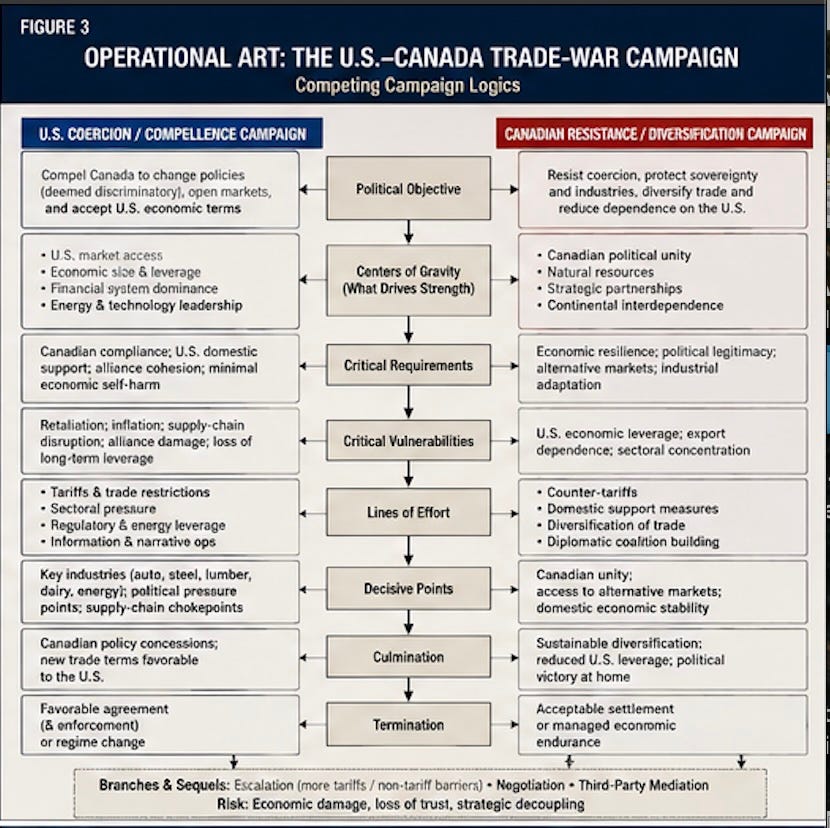
Figure 3. Operational Art and the U.S.–Canada Trade-War Campaign. The competing theories of victory reveal an asymmetric contest: the United States seeks to convert superior economic coercive capacity into Canadian concessions, while Canada seeks to convert time, resilience, political cohesion, retaliation, and diversification into sufficient strategic endurance to deny Washington an inexpensive victory.
Center-of-gravity analysis makes the problem still more interesting. Canada’s apparent center of gravity is access to the American market. It is certainly a critical requirement and an extraordinary economic vulnerability. But the political center of gravity increasingly may be national cohesion around the preservation of sovereign autonomy. If that is correct, American pressure may be attacking an important vulnerability while inadvertently strengthening the source of Canadian resistance.
Washington’s preferred mechanism runs from economic pain to domestic dissatisfaction, political pressure, and eventual concession. Yet the emerging Canadian mechanism may instead run from economic pain to external-threat perception, heightened national solidarity, greater political legitimacy for adaptation, and a harder negotiating posture.
Canada’s August 22 First Ministers’ meeting is suggestive. Ottawa and the provinces are framing counter-tariffs, worker and industry protection, internal-market integration, export diversification, and “nation-building projects” as components of a common “Team Canada” response.[13]
If economic pain becomes socially interpreted as the cost of defending Canadian sovereignty rather than evidence of failed Canadian government policy, the causal mechanism begins running backward.
The tariff still hurts. But the hurt makes the political concession the tariff was intended to produce less rather than more acceptable. This is a recurring problem in coercive strategy. Populations often accept costs that appear economically irrational when the object at stake becomes dignity, sovereignty, national identity, territory, faith, or survival. A spreadsheet can measure economic loss without measuring the political utility function through which that loss is interpreted.
The concept of operational reach is similarly useful in understanding the campaign.
Economic coercion does not possess unlimited reach. Tariffs can be expanded. Additional industries can be targeted. Procurement can be restricted. Domestic-content rules can tighten. Investment and financial measures can follow. Energy and critical minerals could be incorporated. But every escalation also creates adaptation. Importers switch suppliers. Businesses postpone investment. Manufacturers redesign supply chains. Consumers change purchases. Capital moves. Trading relationships migrate. Political coalitions reorganize.
Every escalation therefore consumes some portion of the interdependence through which coercion itself operates.
This creates an economic version of culmination.
The crucial question is when the marginal coercive value of additional pressure becomes smaller than the strategic cost created by the target’s response. Canada’s dependence upon the United States is simultaneously Canada’s critical vulnerability and America’s principal source of leverage. But the more effectively Washington demonstrates that dependence can be weaponized, the stronger Canada’s incentive becomes to eliminate the dependence.
Here the American campaign encounters a strategic paradox. Coercion stimulates diversification. Diversification reduces dependence. Reduced dependence diminishes future coercive leverage. The employment of the weapon gradually consumes the strategic condition that makes the weapon effective.
Canada’s wider industrial policy reinforces the point.
Ottawa’s 2026 Defence Industrial Strategy explicitly links defense production with sovereignty, strategic autonomy, resilient domestic capacity, expanded Canadian sourcing, and greater exports to trusted foreign partners. The government’s Spring Economic Update states that the strategy seeks to raise the share of Canadian defense acquisitions awarded to Canadian firms to 70 percent and increase defense exports by 50 percent over ten years.[14] These policies were not created solely by the present tariff confrontation, but American economic coercion can accelerate the political logic behind them.
Several decisive points now become visible.
Canada’s counter-tariffs are scheduled to begin the Tuesday after Labour Day, September 8, marking a shift from predominantly American initiative toward sustained reciprocal action. The November 2026 U.S. midterm elections create another decision point because aggregate American economic superiority does not eliminate sensitivity to concentrated regional and sectoral costs. USMCA/CUSMA constitutes another. The greatest damage may ultimately result not from the precise tariff rate but from the destruction of expectations that negotiated continental rules will remain sufficiently stable for long-term capital allocation. Industrial relocation constitutes another decisive point because tariffs can disappear rapidly while factories, suppliers, logistics systems, and export relationships generally do not.
Canadian diversification may be the decisive point Washington should fear most.
Every durable alternative market or supply relationship reduces Canada’s future susceptibility to American coercion. Yet beneath all these lies something less tangible and potentially more consequential: trust.
Trust is strategic capital. It reduces transaction costs, permits specialization, facilitates institutional integration, and allows partners to accept dependence because dependence is not interpreted as vulnerability. Once a partner concludes that interdependence can deliberately be weaponized against it, rational behavior changes. It begins to hedge.
That introduces escalation.
The present ladder begins with targeted tariffs, proceeds through reciprocal tariffs and sectoral expansion, and could continue into procurement restrictions, domestic-content discrimination, investment controls, financial measures, energy, electricity, minerals, transportation, or infrastructure. Beyond these economic rungs lies a more dangerous threshold at which commercial diversification becomes diplomatic diversification, diplomatic diversification becomes defense-industrial diversification, and economic estrangement begins affecting security policy.
This threshold matters because Canada and the United States are not ordinary trading partners. Their defense relationship is unusually integrated. Canadian defense officials describe the North American defense industrial base as the product of more than seven decades of close cooperation and note that more than 60 percent of Canadian defense-industry exports go to the United States.[15] NORAD itself is a binational command. AMALGAM DART will integrate American and Canadian fighter operations, command-and-control systems, air battle management, and cruise-missile defense across the continent at the same moment the two governments intensify economic coercion against one another.[16]
The operational-art estimate is therefore relatively clear.
The United States possesses overwhelming aggregate economic superiority, while Canada possesses a dangerous degree of economic dependence upon American access. Yet Canada also possesses geographic indispensability, a highly integrated position within American supply chains, the ability to concentrate retaliation politically, and, if given sufficient time, the capacity to diversify. America’s critical vulnerability lies not in its aggregate capacity but in the exposure of domestic industries and political constituencies to secondary costs and in the possibility that its coercion destroys the very interdependence that produces leverage. Canada’s operational risk is that economic damage accumulates faster than adaptation can compensate. America’s operational risk is culmination: reaching the point at which further pressure continues to impose pain but no longer increases the probability of political concession.
From the standpoint of traditional operational art, therefore, the logical termination condition is not Canadian capitulation. It is a negotiated adjustment that produces sufficiently valuable American commercial gains to justify the costs of the campaign while preserving the larger continental relationship from which both countries derive much greater strategic benefit. That is a defensible operational estimate.
It is also incomplete.
The Second Pass: Theater-Strategic Art
Traditional operational art asks how tactical actions, operations, and campaigns can be arranged in time, space, and purpose to accomplish strategic objectives. It remains indispensable.
But the modern theater is no longer merely a geographic container within which military operations occur. It is a complex political-economic-security ecosystem. Military capability exists inside it alongside financial systems, trade networks, energy infrastructures, industrial capacity, alliance relationships, political identities, information flows, legitimacy, technology, private firms, subnational governments, transportation networks, and social expectations. These systems overlap. They cross boundaries. They adapt. They generate feedback. Effects produced in one domain routinely migrate into others.
This is the domain I mean by theater-strategic art.
The concept is new in formulation but not disconnected from the intellectual path that produced it. Indeed, it grows directly out of a problem I have been pursuing for more than two decades: America’s persistent tendency to mistake its extraordinary capacity to apply force for an equivalent capacity to exercise power.
Thomas Schelling’s distinction between brute force and coercion points toward the same problem: punishment matters strategically only insofar as it changes choices. Alexander George likewise demonstrated that coercive diplomacy depends not simply upon superior capability but upon demands, proportionality, credibility, inducements, and a politically viable route through which the target can comply. Albert Hirschman, writing much earlier, showed how asymmetric commercial dependence can become political leverage. Henry Farrell and Abraham Newman later demonstrated how central positions within global networks can create “weaponized interdependence.”[17]
In Thinking Beyond War, I framed the problem initially through America’s repeated ability to win the military phase of interventions while failing to create the political peace those victories were supposed to enable. In “The True Tragedy of American Power” and later “Reconsidering American Power,” I sharpened the argument explicitly into a distinction between force and power. The United States had become extraordinarily accomplished at generating and applying force while too often assuming that force itself constituted power. It did not. Power depended upon what force actually displaced politically over time: the choices it induced, the relationships it created or destroyed, the legitimacy attached to its employment, and the political condition that remained afterward.[18]
That problem subsequently became larger than war termination. Jason Lyall and I had already demonstrated empirically in “Rage Against the Machines” that superior military capability could generate strategically counterproductive effects when the organization and employment of force degraded the information, relationships, and selective control required for political success in counterinsurgency. The broader lesson was not that military force lacked utility. It was that the effects of force were mediated by the social and political systems into which it was introduced. Capabilities could perform exactly as designed and still generate the wrong strategic outcome.[19]
The concept of Compound Security emerged from that same intellectual problem at a wider scale. Scott Smitson and I argued in 2020 that contemporary threats increasingly arise at the nexus of conflicts, confrontations, and destabilizing situations operating across political, economic, social, technological, environmental, and military systems. The resulting “compound security dilemma” could not be adequately understood by treating those pressures as separable categories. Security increasingly had to be conceived as the performance of interconnected systems under converging stress.[20] Subsequent work extended that argument into what I have called the Compound Age: an environment in which geopolitical competition, domestic resilience, economic networks, legitimacy, technology, alliances, institutions, and military capability interact continuously rather than sequentially.[21]
Theater-strategic art is therefore not an attempt simply to rename grand strategy or to make operational art geographically larger. Nor does it replace either. It identifies a missing level of strategic cognition between campaign-centric operational design and the abstraction of national grand strategy.
Operational art solved a particular historical problem: how to connect tactical engagements and battles through campaigns to strategic purpose. The Compound Age presents a related but different problem: how to connect multiple simultaneous campaigns and instruments operating through interacting systems to a sustainable political condition across an entire theater.
That demands a shift from synchronization to orchestration. Synchronization aligns activities. Orchestration manages relationships among systems. Synchronization asks whether separate operations occur at the appropriate time and place. Orchestration asks what the interaction among military, political, economic, informational, technological, institutional, societal, and alliance activities causes the larger strategic ecosystem to become. Operational art seeks coherence within campaigns. Theater-strategic art seeks coherence across ecosystems.[22]
The distinction is especially important because the strategic failures of the Compound Age increasingly occur not when individual instruments fail, but when they succeed separately and fail collectively.
A military campaign can accomplish its assigned objectives while undermining diplomatic legitimacy. An economic coercion campaign can impose precisely the intended financial costs while accelerating an adversary’s diversification. A technological program can increase tactical efficiency while creating institutional brittleness. A sanctions regime can punish a target while incentivizing the construction of alternative networks that weaken the coercer’s future leverage. A trade policy can strengthen one domestic sector while degrading alliance cohesion, continental industrial resilience, or military interoperability.
The problem is therefore no longer merely one of coordinating effects. It is one of compound effects.
The U.S.–Canada trade war offers an unusually clean empirical demonstration.
Theater-strategic art therefore changes the unit of analysis. Operational art naturally privileges actors, objectives, capabilities, geography, time, and decisions. Theater-strategic art adds relationships, networks, institutions, and adaptive systems as primary analytical objects.[23]
The automobile industry is no longer merely a commercial sector; it is a continental production ecosystem. Energy is not simply a commodity but simultaneously an industrial input, household necessity, infrastructure system, source of political leverage, and military enabler. Critical minerals are trade goods, technological dependencies, defense inputs, and instruments of strategic autonomy. The Arctic is simultaneously homeland, Indigenous space, environmental system, economic frontier, missile avenue, maritime route, sovereignty question, and arena of great-power competition. NORAD is simultaneously a military command, alliance mechanism, technical architecture, and institutionalized relationship of political trust.
Trade therefore connects to energy; energy to industry; industry to defense; defense to alliance confidence; confidence to domestic legitimacy; legitimacy to coalition formation; coalition formation to negotiating latitude; and negotiating latitude back to trade.
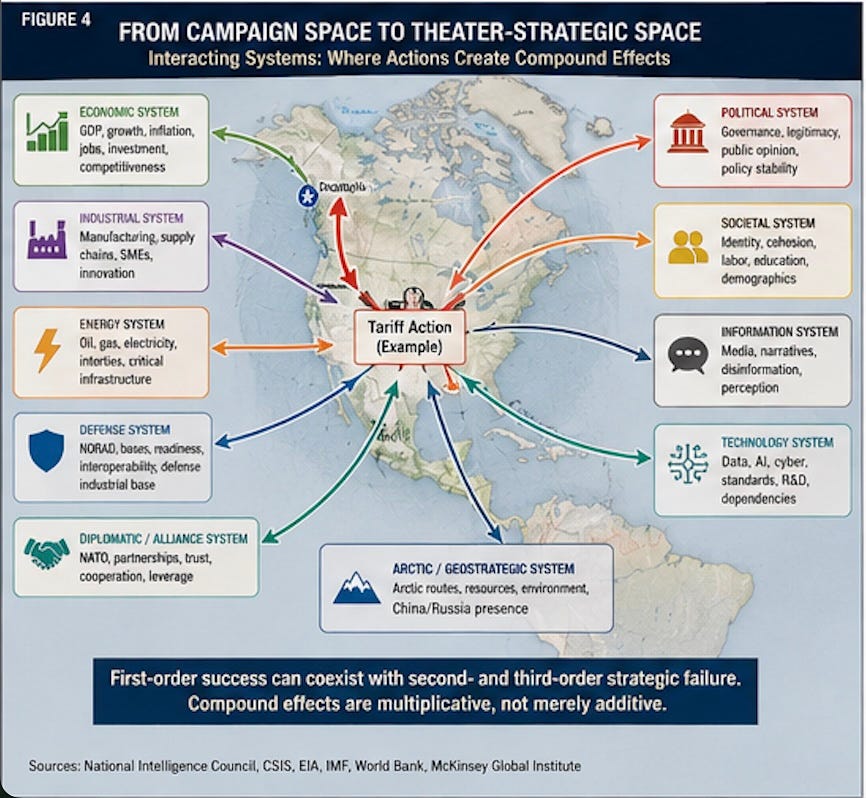
Figure 4. From Campaign Space to Theater-Strategic Space. Theater-strategic art changes the unit of analysis from campaigns and instruments alone to relationships among interacting economic, industrial, energy, military, political, societal, informational, technological, diplomatic, and geostrategic systems. Effects migrate among these systems, producing compound consequences that may diverge sharply from the intended first-order effect.
That is not a linear campaign environment. It is a compound system.
Once we follow those interdependencies, the possibility of a compound-security cascade becomes visible. American economic coercion increases Canadian economic pain, but it simultaneously increases Canadian perceptions of vulnerability. Heightened vulnerability can strengthen national cohesion and provide political legitimacy for greater domestic industrial investment. Greater investment accelerates infrastructure and encourages alternative trade relationships. Alternative relationships reduce reliance upon the United States. Reduced reliance decreases future American leverage. Meanwhile, retaliation and uncertainty affect American firms, alter input costs, encourage redesign of continental production systems, and mobilize domestic constituencies. Each effect changes the environment in which the next decision is made.
The critical theater-strategic principle is therefore that the effect of an action cannot be judged solely by what it does to the intended target. It has to be judged by what it causes the system to do in response. This logic closely resembles the insights of complex-systems scholarship, from Donella Meadows’s emphasis on feedback and leverage points to Robert Jervis’s analysis of systemic effects in international politics.¹⁸ It also connects directly to recent work on “weaponized interdependence,” which demonstrates how states occupying central positions within global networks can exploit those networks coercively. Henry Farrell and Abraham Newman show why network centrality creates extraordinary opportunities for coercion; the Canadian case raises the reciprocal question of what happens when repeated exploitation of that centrality causes others deliberately to reorganize the network.¹⁹
Consider, from this perspective, the principal American lines of effort in North America. Washington seeks improved commercial conditions and greater American economic sovereignty. It simultaneously seeks deeper continental defense integration through NORAD and integrated air and missile defense. It seeks a more capable and resilient North American defense-industrial base. It also seeks to constrain Russian and Chinese influence across the Arctic and Western Hemisphere. Each of these objectives is individually intelligible. The problem is whether their combined effects remain mutually reinforcing.
Economic coercion encourages Canadian industrial autonomy. Industrial autonomy may reduce defense-industrial integration. Weaponized interdependence lowers trust. Reduced trust complicates military specialization and deeper integration. American efforts to reduce Chinese economic influence collide with Canadian incentives to diversify beyond the United States wherever alternative partners are available. Demands for greater Canadian contributions to Arctic defense coexist with policies encouraging Ottawa to regard economic independence from Washington as a national-security imperative.[24]
The individual lines of effort can each remain bureaucratically synchronized. Trade policy may be internally coherent. NORAD modernization may be internally coherent. Defense-industrial policy may be internally coherent. Arctic strategy may be internally coherent. Yet the combined American strategy can still be incoherent because the outputs of one campaign become negative inputs into another. This is why theater-strategic art requires more than synchronization. It requires orchestration.
Seen this way, America’s greatest strategic advantage over Canada may not be its ability to inflict economic costs at all. It’s more important advantage is the existence of a continental order within which Canada has historically been willing voluntarily to accept deep integration with the United States.
That arrangement gives America a friendly and stable northern frontier, secure energy supplies, strategic geographic depth, a large adjacent market, integrated production, critical-resource access, aerospace warning, industrial specialization, intelligence cooperation, Arctic reach, and a neighboring state whose fundamental geopolitical orientation has overwhelmingly supported cooperation with Washington.
Those are not trivial benefits. They are an extraordinary stock of strategic capital.
Great powers have fought wars attempting to produce buffers and spheres of influence possessing only a fraction of the advantages the United States receives from a cooperative Canada. Theater-strategic art therefore asks a question trade policy rarely does: how much of that strategic capital should the United States rationally spend to obtain the commercial concessions currently at issue?
Carney’s description of America using “economic integration as a weapon” captures the danger because it changes the perceived meaning of interdependence itself.²⁰ For generations, Canadian-American integration was possible not because Canada failed to understand that it was asymmetrically dependent upon the United States but because that dependence existed inside an institutionalized, relatively predictable, and broadly mutually beneficial relationship.
Dependence therefore did not always feel like vulnerability. Once dependence is overtly weaponized, however, resilience logically requires reducing it.
That insight also travels beyond Canada.
Japan, Europe, South Korea, Australia, Mexico, and other American partners need not interpret the United States as an enemy in order to draw the conclusion that extensive dependence upon the United States requires insurance.
The insurance may consist of alternative suppliers, markets, payment systems, industrial bases, infrastructure, technologies, diplomatic relationships, or greater domestic productive capacity. Each hedge may be individually rational.
Collectively, however, such hedging can erode the structural centrality from which much American influence derives.
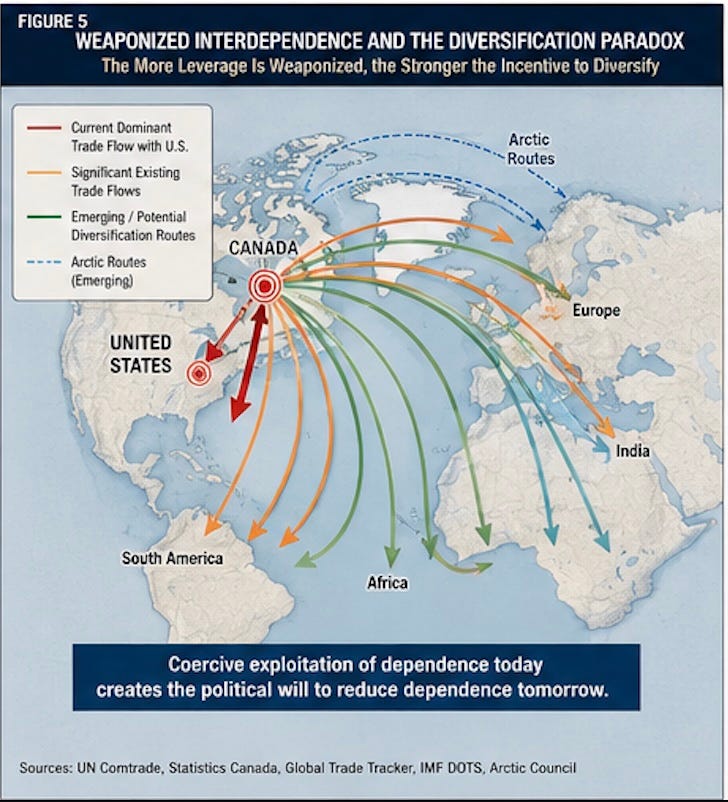
Figure 5. Weaponized Interdependence and the Diversification Paradox. Asymmetric interdependence provides the United States substantial coercive leverage. Yet repeated exploitation of that leverage creates incentives for Canada—and potentially other partners—to construct alternative markets, suppliers, infrastructure, industrial capacity, and relationships. Coercive success today can therefore diminish structural leverage tomorrow.
That is the difference between economic force and systemic power. The United States possesses power not simply because it can punish other states but because states voluntarily choose to operate within systems centered on American markets, finance, technology, institutions, security guarantees, and alliances.
Those choices themselves generate American power. If the repeated employment of economic force encourages other states to reorganize their choices in ways that reduce future dependence upon America, force begins consuming power.
The Canadian case therefore becomes an unusually clean illustration of the force–power paradox. Through the operational lens, American economic force is an obvious advantage. Through the theater-strategic lens, excessive reliance upon that force may reduce American power. The United States could dominate Canada in virtually every measurable category of bilateral coercive capacity and nevertheless produce a Canada substantially less susceptible to American influence ten years from now. Such an outcome would constitute a victory of force and a defeat of power.
This broader lens also reveals a different form of culmination.
Traditional operational culmination occurs when a force can no longer successfully continue its offensive. Theater-strategic culmination occurs when continued pursuit of an immediate objective begins degrading the larger political condition strategy exists to create or preserve.
By that standard, the American campaign could culminate while Washington still possesses enormous unused tariff capacity. Culmination might instead occur when Canadian adaptation becomes politically or economically irreversible: when major infrastructure permanently redirects trade; when companies make durable non-American investments; when Canadian defense procurement becomes systematically more autonomy-oriented; when public attitudes toward integration shift; when political leaders discover that appearing excessively dependent upon the United States has become electorally costly; or when allied governments elsewhere begin making comparable calculations.
At that point, America would retain immense economic force. But the strategic environment upon which its power depended would already have changed.
The Arctic provides perhaps the clearest theater-strategic test.
North America’s strategic frontage is moving northward as Russian military capabilities, Chinese polar interests, long-range aviation, submarines, cruise and hypersonic missiles, new maritime routes, critical infrastructure, energy systems, and sensing requirements make the Arctic increasingly central to continental defense.
Canada’s geography is indispensable to this project.
The binational defense architecture depends upon Canadian territory, political consent, infrastructure, personnel, sensors, industries, and sustained public legitimacy. Washington therefore cannot indefinitely sustain two propositions without generating strategic contradiction. The first is that Canada should become more deeply integrated into continental defense. The second is that Canada should remain sufficiently dependent upon American economic access that this dependence can be exploited as coercive leverage. The first proposition depends upon trust in interdependence. The second deliberately weaponizes it. The first rewards specialization. The second teaches redundancy. The first treats North America as a single defensive theater. The second reminds Canadians that the international border is where their vulnerability begins.
Theater-strategic art forces both propositions onto the same map.[25]
It also forces third parties onto that map.
China need not create the U.S.–Canadian dispute to benefit from it. Europe does not need to displace the United States politically to benefit from greater Canadian diversification into European industrial and defense relationships. Russia need not fracture NORAD to benefit from additional political friction inside continental defense. Mexico cannot help but watch how Washington manages asymmetric dependence with its other continental partner.
The system contains more players than the immediate dispute suggests, and every American action alters opportunity structures for them.
There is also a legitimacy dimension.
External pressure can generate what I have elsewhere described as legitimacy velocity: the rate at which political actions or shocks accelerate the acquisition or loss of legitimacy within a system.
American pressure may be giving Ottawa political permission to undertake domestic transformations—interprovincial economic integration, industrial policy, accelerated infrastructure, defense expansion, and export diversification—that would otherwise encounter greater political friction. Economic sacrifice can then be narrated as investment in sovereignty. “Buy Canadian” becomes civic action. Infrastructure becomes nation-building. Defense production becomes autonomy. Diversification becomes patriotism. The tariff ceases to operate only as a price and becomes a political symbol, and symbols can generate effects far larger than their nominal economic value.[26]
There is an accompanying danger of what I call null-zone drift.[27]
The North American economic relationship has historically functioned inside an increasingly institutionalized expectation that disputes would occur but that the basic system would endure and rules would remain meaningful. If governments repeatedly suspend, bypass, reinterpret, or subordinate those institutional mechanisms, the system may drift toward a zone in which neither the old rules nor a stable successor regime adequately governs expectations. Businesses then stop planning principally according to rules and begin planning around political contingency. Governments seek insurance. Industries lobby for protection. Temporary exceptions proliferate. The formal architecture may remain standing even as actors increasingly behave as though it cannot be trusted. That is institutional fragility of a particularly corrosive kind.
The theater-strategic branches and sequels therefore differ from the operational ones.
One possible future is competitive accommodation, in which serious commercial competition persists but both governments consciously protect the larger continental system. Another is managed estrangement, in which Canada remains a close military ally while steadily increasing its economic and industrial autonomy from the United States. A third is continental fragmentation, in which economic separation begins producing defense-industrial separation and durable political mistrust.
A fourth possibility is the most paradoxical: a successfully coerced but strategically alienated Canada.[28]
Washington could obtain the commercial concessions it currently seeks. Canada could sign an agreement. Tariffs could fall. The immediate crisis could end. Yet Ottawa might still conclude that the central lesson of the experience is that Canada must never again permit itself to become so vulnerable to American pressure. It could therefore spend the following decade deliberately reducing precisely the dependence Washington successfully exploited.
This reveals the difference between operational victory and theater-strategic victory. The agreement is not the end state. The system emerging from the experience is the end state.
The appropriate response is therefore not the abandonment of competition. Canada and the United States will continue to possess conflicting interests, and Washington need not surrender legitimate commercial grievances merely because Ottawa is an ally.
The more appropriate approach is competitive accommodation within deliberate system preservation. Commercial competition should continue, but the states should consciously establish firebreaks around those components of the North American system whose degradation would impose theater-wide costs: continental defense, NORAD modernization, strategic energy infrastructure, selected critical-mineral chains, defense-industrial production, aerospace, major transportation and communications systems, and the institutional mechanisms preserving confidence that today’s dispute does not place the entire continental relationship at risk.
The objective should not be harmony. It should be bounded competition inside a system both states recognize as more valuable than the marginal advantage either might extract by degrading it.
Viewed from that perspective, the theater-strategic commander’s estimate differs meaningfully from the operational one.
· The theater is North America, not two separate national spaces.
· The operating environment is an integrated economic, industrial, energy, infrastructural, political, informational, and defense ecosystem.
· The principal American strategic asset is not simply access to greater economic force but Canada’s voluntary participation in a U.S.-centered continental order.
· The immediate U.S. objective is improved commercial treatment and stronger domestic productive capacity.
· Canada’s immediate objective is continued market access without sacrificing sovereignty.
· Its emerging strategic objective is reduced structural dependence upon the United States.
The central contradiction follows directly: the United States is employing Canadian dependence as a coercive instrument while simultaneously relying upon deep Canadian interdependence for continental defense, industrial resilience, Arctic security, and wider geopolitical advantage.
The critical feedback loop therefore runs from increased American coercion to heightened Canadian threat perception, stronger Canadian cohesion, increased resilience investment, greater diversification, declining dependence, and ultimately reduced future American leverage.
The theater-strategic center of gravity is therefore not a particular commodity, industry, or governmental institution. It is the legitimacy and durability of the North American partnership itself—the continuing willingness of both societies to regard integration primarily as a source of mutual strength rather than reciprocal vulnerability.
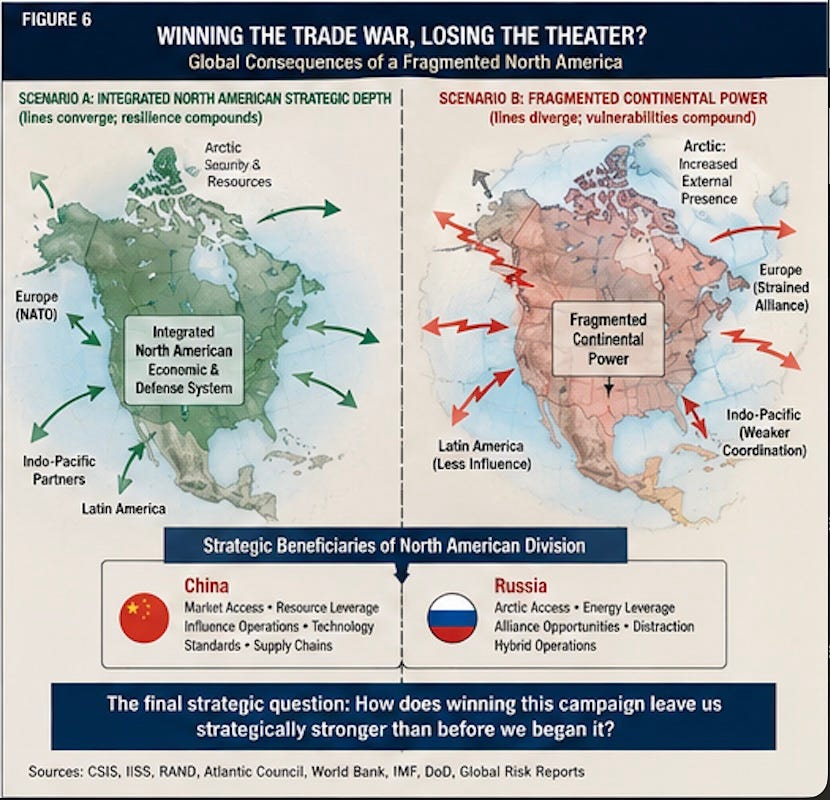
Figure 6. Winning the Trade War, Losing the Theater? The relevant theater-strategic comparison is not simply American versus Canadian tariff losses. It is between alternative future North American systems. An integrated continent compounds economic, industrial, energy, military, alliance, and geographic advantages; a fragmented continent converts many of those same interdependencies into vulnerabilities while creating strategic opportunities for external competitors.
The principal risk is not that Canada defeats the United States. It is that the United States successfully demonstrates how powerful weaponized interdependence can be and thereby teaches Canada, and perhaps other partners, that their long-term security requires dismantling enough of that interdependence to prevent its future use.
The desired theater-strategic end state should therefore be ... a North American system in which legitimate national competition occurs inside a resilient architecture of economic, industrial, energy, institutional, and military cooperation that leaves the continent more capable of addressing external challenges than it was before the dispute began.
The ultimate criterion of victory is not whether Canada concedes. It is whether American ‘power’—understood as the sustainable capacity to shape political choices and strategic conditions—is greater at the end of the campaign than it was at the beginning.
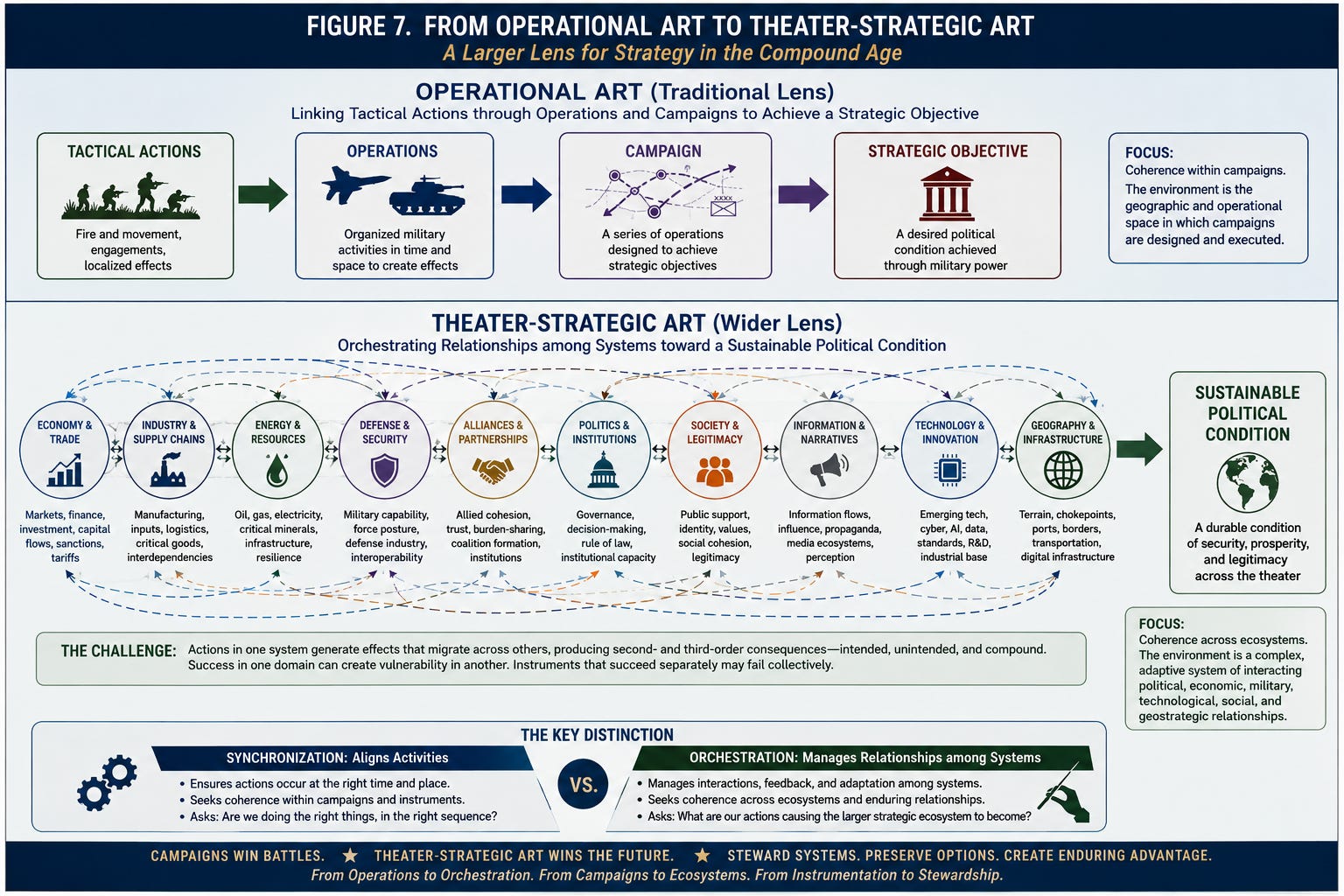
Figure 7. From Operational Art to Theater-Strategic Art. Operational art connects tactical actions through operations and campaigns to strategic objectives; theater-strategic art widens the aperture to the orchestration of interacting economic, industrial, energy, defense, alliance, political, societal, informational, technological, and geographic systems toward a sustainable political condition. The essential shift is from synchronization—aligning activities within campaigns—to orchestration—managing relationships, feedback, adaptation, and compound effects across strategic ecosystems. Campaigns remain necessary, but in the Compound Age strategic success ultimately depends upon stewardship of the larger system in which campaigns occur.
From Campaign Design to System Stewardship
That may be the deepest distinction between operational art and theater-strategic art. Operational art is principally concerned with designing and conducting campaigns. Theater-strategic art must also concern itself with the stewardship of systems.
Campaigns begin and end. Systems endure across campaigns. A successful commander can identify and exploit an adversary’s vulnerability. A successful theater strategist must additionally ask whether exploiting that vulnerability damages a relationship, institution, network, or strategic asset worth more than the immediate advantage gained.
Operational art seeks decisive advantage. Theater-strategic art must sometimes preserve productive interdependence, redundancy, legitimacy, trust, institutional predictability, and relationships because those features generate future freedom of action.
Operational art asks how today’s actions create tomorrow’s decision. Theater-strategic art asks how today’s decision reshapes the strategic ecology within which every subsequent decision will occur.
That is what makes the current U.S.–Canada confrontation particularly revealing. It is not merely a test of tariffs. It is a test of whether American strategy understands the difference between dominating a relationship and benefiting from one.
If political leaders are going to describe this as a trade war, they should apply to it the seriousness we expect whenever states deliberately employ coercion against opposing political wills. Operational art provides the first set of questions. What is the political objective? What is the theory of victory? What is the opponent’s theory of resistance? What are the critical vulnerabilities? Where are the decisive points? What assumptions must remain true? Where does the campaign culminate? What are the branches and sequels? How does it terminate?
Those questions alone expose serious problems in the present campaign.
Theater-strategic art then adds another set. What system are we operating within? What relationships generate our actual power? Which interdependencies are strategic assets and which are vulnerabilities? What effects migrate between economic, industrial, political, military, institutional, and societal domains? What feedback loops are our actions activating? What adaptations are we inducing? Who else gains from those adaptations? What strategic capital are we spending? What system do we expect to remain after the campaign is over? And are the instruments of national power actually being orchestrated toward a common political condition, or are separate bureaucratic campaigns merely being synchronized internally while strategically cancelling one another externally?
Monday morning – this morning – provides the perfect final image.
American F-16 pilots and Canadian CF-18 pilots will enter the same airspace. Their controllers will build the same operating picture. Their commanders will integrate warning and response architectures across geographical approaches that do not respect a political line drawn across the continent.
They will do so because generations of American and Canadian political and military leaders built something strategically remarkable: two sovereign countries so deeply and voluntarily interconnected that important aspects of their security became functionally indivisible.
That is power.
Not American force imposed upon Canada. Not Canadian submission to the United States. Power created through relationship.
One should spend such strategic capital carefully.
The United States unquestionably possesses the economic force to hurt Canada. It possesses the force to escalate farther. It possesses the force to prevail in virtually any bilateral competition of economic attrition. None of those facts answers the strategic question.
The question is whether the exercise of that force produces the political world the United States actually wants.
If the result is a Canada that is more nationalist, more economically autonomous, more internationally diversified, more skeptical of American reliability, more protective of its defense-industrial sovereignty, and more determined never again to permit Washington comparable leverage, then America may indeed have demonstrated overwhelming force.
And diminished its power.
That is the danger hidden inside this “war.” The operational planner sees the possibility of campaign culmination. The theater strategist sees something larger: a continental system beginning to adapt against the actor attempting to dominate it.
That should concern us far more than whether the next tariff is 25 percent or 50 percent.
The enduring test of strategy has never been merely whether one can impose one’s will today. It is whether doing so creates the conditions from which one retains the power to shape tomorrow.
That is the difference between force and power.
Between synchronization and orchestration.
Between campaign design and system stewardship.
Between operational art—
and theater-strategic art.
And ultimately, between tactical victory and strategic wisdom.
Selected Works
Baldwin, David A. Economic Statecraft. Princeton, NJ: Princeton University Press, 1985.
Bertalanffy, Ludwig von. General System Theory: Foundations, Development, Applications. New York: George Braziller, 1968.
Clausewitz, Carl von. On War. Edited and translated by Michael Howard and Peter Paret. Princeton, NJ: Princeton University Press, 1976.
Department of National Defence. Security, Sovereignty and Prosperity: Canada’s Defence Industrial Strategy. Ottawa: Government of Canada, 2026.
Drezner, Daniel W. The Sanctions Paradox: Economic Statecraft and International Relations. Cambridge: Cambridge University Press, 1999.
Farrell, Henry, and Abraham L. Newman. “Weaponized Interdependence: How Global Economic Networks Shape State Coercion.” International Security 44, no. 1 (Summer 2019): 42–79.
Freedman, Lawrence. Strategy: A History. New York: Oxford University Press, 2013.
George, Alexander L. Forceful Persuasion: Coercive Diplomacy as an Alternative to War. Washington, DC: United States Institute of Peace Press, 1991.
George, Alexander L., and William E. Simons, eds. The Limits of Coercive Diplomacy. 2nd ed. Boulder, CO: Westview Press, 1994.
Gray, Colin S. The Strategy Bridge: Theory for Practice. Oxford: Oxford University Press, 2010.
Hirschman, Albert O. National Power and the Structure of Foreign Trade. Berkeley: University of California Press, 1945.
Jervis, Robert. System Effects: Complexity in Political and Social Life. Princeton, NJ: Princeton University Press, 1997.
Meadows, Donella H. Thinking in Systems: A Primer. Edited by Diana Wright. White River Junction, VT: Chelsea Green, 2008.
Naveh, Shimon. In Pursuit of Military Excellence: The Evolution of Operational Theory. London: Frank Cass, 1997.
Nye, Joseph S., Jr. The Future of Power. New York: PublicAffairs, 2011.
Pape, Robert A. “Why Economic Sanctions Do Not Work.” International Security 22, no. 2 (Fall 1997): 90–136.
Schelling, Thomas C. Arms and Influence. New Haven, CT: Yale University Press, 1966.
Schneider, James J. “The Loose Marble—and the Origins of Operational Art.” Parameters 19, no. 1 (1989): 85–99.
Snyder, Glenn H. Alliance Politics. Ithaca, NY: Cornell University Press, 1997.
Strachan, Hew. The Direction of War: Contemporary Strategy in Historical Perspective. Cambridge: Cambridge University Press, 2013.
United States Department of the Army. Operations. Field Manual 3-0. Washington, DC: Department of the Army, 2022.
United States Joint Chiefs of Staff. Joint Planning. Joint Publication 5-0. Washington, DC: Joint Chiefs of Staff.
Wilson, Isaiah III. “The True Tragedy of American Power.” Parameters 43, no. 3 (Autumn 2013).
Wilson, Isaiah III. Thinking Beyond War: Civil-Military Relations and Why America Fails to Win the Peace. [Publication information to be conformed to author’s definitive edition.]
Primary Sources Consulted
Department of National Defence, Canada. “Appearance Before the Standing Senate Committee on National Security, Defence and Veterans Affairs: Mandate, Priorities, and NATO 2%.” April 27, 2026.
Government of Canada. Spring Economic Update 2026: Canada Strong for All. Ottawa: Department of Finance Canada, 2026.
North American Aerospace Defense Command. “NORAD and USNORTHCOM to Conduct Exercise AMALGAM DART.” August 20, 2026.
Office of the Prime Minister of Canada. “Prime Minister Carney Chairs First Ministers’ Meeting.” August 22, 2026.
———. “Prime Minister Carney Delivers Remarks on Canada-U.S. Trade Negotiations.” August 22, 2026.
———. “Statement by Prime Minister Carney on Canada-U.S. Trade Negotiations.” August 21, 2026.
Trump, Donald J. “Imposing Additional Duties to Offset Canadian Discrimination Against the Commerce of the United States with Respect to Motor Vehicles.” Proclamation. White House, July 20, 2026.
U.S. Energy Information Administration. “Lower Crude Oil Prices Reduced U.S.-Canada Energy Trade Value in 2025.” Today in Energy, July 29, 2026.
Office of the United States Trade Representative. “Canada.” 2026.
The Author’s Conceptual Lineage
Lyall, Jason, and Isaiah Wilson III. “Rage Against the Machines: Explaining Outcomes in Counterinsurgency Wars.” International Organization 63, no. 1 (Winter 2009): 67–106. https://doi.org/10.1017/S0020818309090031.
Wilson, Isaiah III. Thinking Beyond War: Civil-Military Relations and Why America Fails to Win the Peace. Revised ed. New York: Palgrave Macmillan, 2013. Originally published 2007.
———. “The True Tragedy of American Power.” Parameters 43, no. 4 (Winter 2013–14): 15–26. https://doi.org/10.55540/0031-1723.2950.
———. “Reconsidering American Power.” In American Grand Strategy and the Future of U.S. Landpower, edited by Joseph Da Silva, Hugh Liebert, and Isaiah Wilson III, 81–94. Carlisle, PA: Strategic Studies Institute and U.S. Army War College Press, 2014.
———. “‘Hole’ of Government: What COVID-19 Reveals about American Security Planning.” Special Commentary. Carlisle, PA: Strategic Studies Institute, U.S. Army War College, May 6, 2020.
Wilson, Isaiah III, and Scott A. Smitson. “The Compound Security Dilemma: Threats at the Nexus of War and Peace.” Parameters 50, no. 2 (Summer 2020): 5–20. https://doi.org/10.55540/0031-1723.1014.
Wilson, Isaiah III. “Compound Security, Unlocked: Decoding the Future of Global Security.” Compound Security, Unlocked, September 30, 2024.
———. “Still ‘Raging Against the Machines’: Preventive Defense in the Age of Social Media Platforms.” Small Wars Journal, March 25, 2025.
———. “War Without Peace Is Not Strategy: Why America Studies War-Fare but Neglects Peace-Fare—and Why That Failure Now Threatens the Republic.” Compound Security, Unlocked, January 29, 2026.
———. “The Age of Compound Risk.” Compound Security, Unlocked, 2026.
———. “The Compound Threshold: Iran, Hormuz, and the Emerging Ecology of Global Competition.” Compound Security, Unlocked, May 13, 2026.
———. “The Jedi Knights Were Never Enough: Toward a Theory of Theater-Strategic Art in the Age of Compound Security.” Compound Security, Unlocked, May 2026.
———. “The Strait of Hormuz and the Shape of Strategy to Come.” World Politics Review, June 8, 2026.
———. “The Purge of Strategic Thought: From Svechin to the Jedi Knights to Theater-Strategic Art, Or, … Why Great Military Institutions Often Suppress the Ideas They Most Need.” Compound Security, Unlocked, June 12, 2026.
———. “The War America Has Already Lost.” Compound Security, Unlocked, 2026.
Operational Art, Strategy, and Systems
Baldwin, David A. Economic Statecraft. Princeton, NJ: Princeton University Press, 1985.
Bertalanffy, Ludwig von. General System Theory: Foundations, Development, Applications. New York: George Braziller, 1968.
Clausewitz, Carl von. On War. Edited and translated by Michael Howard and Peter Paret. Princeton, NJ: Princeton University Press, 1976.
Farrell, Henry, and Abraham L. Newman. “Weaponized Interdependence: How Global Economic Networks Shape State Coercion.” International Security 44, no. 1 (Summer 2019): 42–79.
Freedman, Lawrence. Strategy: A History. New York: Oxford University Press, 2013.
George, Alexander L. Forceful Persuasion: Coercive Diplomacy as an Alternative to War. Washington, DC: United States Institute of Peace Press, 1991.
Gray, Colin S. The Strategy Bridge: Theory for Practice. Oxford: Oxford University Press, 2010.
Hirschman, Albert O. National Power and the Structure of Foreign Trade. Berkeley: University of California Press, 1945.
Jervis, Robert. System Effects: Complexity in Political and Social Life. Princeton, NJ: Princeton University Press, 1997.
Meadows, Donella H. Thinking in Systems: A Primer. Edited by Diana Wright. White River Junction, VT: Chelsea Green, 2008.
Naveh, Shimon. In Pursuit of Military Excellence: The Evolution of Operational Theory. London: Frank Cass, 1997.
Nye, Joseph S., Jr. The Future of Power. New York: PublicAffairs, 2011.
Schelling, Thomas C. Arms and Influence. New Haven, CT: Yale University Press, 1966.
Schneider, James J. “The Loose Marble—and the Origins of Operational Art.” Parameters 19, no. 1 (1989): 85–99.
Snyder, Glenn H. Alliance Politics. Ithaca, NY: Cornell University Press, 1997.
Strachan, Hew. The Direction of War: Contemporary Strategy in Historical Perspective. Cambridge: Cambridge University Press, 2013.
Svechin, Aleksandr A. Strategy. Edited by Kent D. Lee. Minneapolis: East View Publications, 1992.
U.S. Department of the Army. Operations. FM 3-0. Washington, DC: Department of the Army, 2022.
U.S. Joint Chiefs of Staff. Joint Planning. JP 5-0. Washington, DC: Joint Chiefs of Staff.
Economic Coercion and Interdependence
Drezner, Daniel W. The Sanctions Paradox: Economic Statecraft and International Relations. Cambridge: Cambridge University Press, 1999.
Farrell, Henry, and Abraham L. Newman. “Weaponized Interdependence: How Global Economic Networks Shape State Coercion.” International Security 44, no. 1 (Summer 2019): 42–79.
Hirschman, Albert O. National Power and the Structure of Foreign Trade. Berkeley: University of California Press, 1945.
Pape, Robert A. “Why Economic Sanctions Do Not Work.” International Security 22, no. 2 (Fall 1997): 90–136.
Essential 2026 Primary Sources
Department of National Defence, Canada. Security, Sovereignty and Prosperity: Canada’s Defence Industrial Strategy. Ottawa: Government of Canada, 2026.
North American Aerospace Defense Command. “NORAD and USNORTHCOM to Conduct Exercise AMALGAM DART.” August 20, 2026.
Office of the Prime Minister of Canada. “Statement by Prime Minister Carney on Canada-U.S. Trade Negotiations.” August 21, 2026.
———. “Prime Minister Carney Delivers Remarks on Canada-U.S. Trade Negotiations.” August 22, 2026.
———. “Prime Minister Carney Chairs First Ministers’ Meeting.” August 22, 2026.
Trump, Donald J. “Imposing Additional Duties to Offset Canadian Discrimination Against the Commerce of the United States with Respect to Motor Vehicles.” Presidential proclamation. Washington, DC: White House, July 20, 2026.
U.S. Energy Information Administration. “Lower Crude Oil Prices Reduced U.S.-Canada Energy Trade Value in 2025.” Today in Energy, July 29, 2026.
Office of the United States Trade Representative. “Canada.” 2026.
Endnotes —
[1] North American Aerospace Defense Command, “NORAD and USNORTHCOM to Conduct Exercise AMALGAM DART,” press release, August 20, 2026. NORAD states that the exercise runs August 24–September 1, includes forces from the Alaskan, Canadian, and Continental U.S. NORAD Regions, and integrates U.S. and Canadian fighter forces, command-and-control organizations, air battle management, eastern and western approach responses, and binational cruise-missile-defense scenarios.
[2] Office of the Prime Minister of Canada, “Statement by Prime Minister Carney on Canada-U.S. Trade Negotiations,” August 21, 2026; Office of the Prime Minister of Canada, “Prime Minister Carney Delivers Remarks on Canada-U.S. Trade Negotiations,” August 22, 2026; Office of the Prime Minister of Canada, “Prime Minister Carney Chairs First Ministers’ Meeting,” August 22, 2026. Carney’s August 22 formulation that the United States had begun to “use economic integration as a weapon” is particularly significant because it transforms the Canadian government’s characterization of the dispute from a disagreement over tariff levels into a structural assessment of dependence itself.
[3] See U.S. Department of the Army, Operations, Field Manual 3-0 (Washington, DC: Department of the Army, 2022), especially its treatment of operational art, operational approach, centers of gravity, decisive points, lines of operation and effort, operational reach, culmination, and risk; Joint Chiefs of Staff, Joint Planning, Joint Publication 5-0 (Washington, DC: Joint Chiefs of Staff, current ed.). For the intellectual development of American operational art, see James J. Schneider, “The Loose Marble—and the Origins of Operational Art,” Parameters 19, no. 1 (1989): 85–99; and Shimon Naveh, In Pursuit of Military Excellence: The Evolution of Operational Theory (London: Frank Cass, 1997).
[4] Donald J. Trump, “Imposing Additional Duties to Offset Canadian Discrimination Against the Commerce of the United States with Respect to Motor Vehicles,” proclamation, White House, July 20, 2026. The proclamation invokes §338 of the Tariff Act of 1930 and explicitly connects the additional duties to increasing American industrial output, investment, employment, and Canadian policy change.
[5] Carl von Clausewitz, On War, ed. and trans. Michael Howard and Peter Paret (Princeton, NJ: Princeton University Press, 1976), esp. bk. 1, chap. 1. Clausewitz’s larger analytical relevance here is not an assertion that tariffs and armed warfare are equivalent. It is that organized coercion must ultimately be evaluated according to the political object toward which it is directed.
[6] Office of the Prime Minister of Canada, “Statement by Prime Minister Carney,” August 21, 2026.
[7] Office of the Prime Minister of Canada, “Prime Minister Carney Delivers Remarks,” August 22, 2026.
[8] Office of the United States Trade Representative, “Canada,” 2026. USTR reports total U.S.–Canadian goods and services trade of $872.3 billion in 2025, including $333.6 billion in U.S. goods exports, $381.9 billion in goods imports, and a $27.7 billion U.S. services surplus.
[9] U.S. Energy Information Administration, “Lower Crude Oil Prices Reduced U.S.-Canada Energy Trade Value in 2025,” Today in Energy, July 29, 2026. EIA estimates total bilateral energy trade at $137 billion in 2025, including $111 billion of U.S. energy imports from Canada. Crude oil represented approximately 69 percent of total bilateral energy-trade value.
[10] Thomas C. Schelling, Arms and Influence (New Haven, CT: Yale University Press, 1966). Schelling’s distinction between brute force and coercive bargaining is particularly useful here. The relevant question is not simply how much harm a state can produce but whether actual or threatened harm alters the opponent’s choices in the desired direction.
[11] Alexander L. George, Forceful Persuasion: Coercive Diplomacy as an Alternative to War (Washington, DC: United States Institute of Peace Press, 1991); Alexander L. George and William E. Simons, eds., The Limits of Coercive Diplomacy, 2nd ed. (Boulder, CO: Westview Press, 1994). For a later assessment of the conditions under which economic sanctions and coercion succeed or fail, see Robert A. Pape, “Why Economic Sanctions Do Not Work,” International Security 22, no. 2 (Fall 1997): 90–136; and Daniel W. Drezner, The Sanctions Paradox: Economic Statecraft and International Relations (Cambridge: Cambridge University Press, 1999).
[12] Office of the Prime Minister of Canada, “Statement by Prime Minister Carney,” August 21, 2026; Office of the Prime Minister of Canada, “Prime Minister Carney Delivers Remarks,” August 22, 2026.
[13] Office of the Prime Minister of Canada, “Prime Minister Carney Chairs First Ministers’ Meeting,” August 22, 2026. The readout identifies dollar-for-dollar counter-tariffs, assistance for affected workers and businesses, accelerated “nation-building projects,” export diversification, and the removal of internal Canadian trade barriers as elements of the common response.
[14] Government of Canada, Spring Economic Update 2026: Canada Strong for All (Ottawa: Department of Finance Canada, 2026), 81; Department of National Defence, Security, Sovereignty and Prosperity: Canada’s Defence Industrial Strategy (Ottawa: Government of Canada, 2026). The strategy predates the August rupture and should not be interpreted as having been caused by it. Its importance to the present argument is that the dispute reinforces an already emerging Canadian policy emphasis on sovereign productive capacity, resilience, and diversification.
[15] Department of National Defence, “Appearance Before the Standing Senate Committee on National Security, Defence and Veterans Affairs: Mandate, Priorities, and NATO 2%,” April 27, 2026. The department describes the North American defense industrial base as “highly integrated,” reflecting more than seven decades of cooperation, and reports that more than 60 percent of Canadian defense-industry exports are destined for the United States.
[16] North American Aerospace Defense Command, “NORAD and USNORTHCOM to Conduct Exercise AMALGAM DART.”
[17] Thomas C. Schelling, Arms and Influence (New Haven, CT: Yale University Press, 1966); Alexander L. George, Forceful Persuasion: Coercive Diplomacy as an Alternative to War (Washington, DC: United States Institute of Peace Press, 1991); Albert O. Hirschman, National Power and the Structure of Foreign Trade (Berkeley: University of California Press, 1945); Henry Farrell and Abraham L. Newman, “Weaponized Interdependence: How Global Economic Networks Shape State Coercion,” International Security 44, no. 1 (Summer 2019): 42–79. Hirschman’s analysis of asymmetric commercial dependence and Farrell and Newman’s analysis of network centrality provide particularly useful foundations for understanding the American source of leverage over Canada. The present argument emphasizes the adaptive sequel: coercive exploitation of asymmetry can increase the target’s willingness to incur present costs to reduce future dependency. David A. Baldwin, Economic Statecraft (Princeton, NJ: Princeton University Press, 1985). Baldwin’s work remains foundational for treating economic instruments not as analytically separate from strategy but as instruments of statecraft whose effectiveness should be judged by political effects, alternatives, and opportunity costs.
[18] I use theater-strategic art here as an analytical concept rather than a currently codified doctrinal term. It grows out of the traditional problem operational art addresses—the connection of tactical activity to strategic purpose—but shifts the principal object from the design and synchronization of campaigns toward the orchestration and stewardship of interacting political, economic, military, technological, societal, institutional, and informational systems across a theater. The conceptual lineage includes Clausewitz, operational theory, systems thinking, and the literature on complexity and strategy. See Clausewitz, On War; Naveh, In Pursuit of Military Excellence; Ludwig von Bertalanffy, General System Theory: Foundations, Development, Applications (New York: George Braziller, 1968); Robert Jervis, System Effects: Complexity in Political and Social Life (Princeton, NJ: Princeton University Press, 1997); and Donella H. Meadows, Thinking in Systems: A Primer, ed. Diana Wright (White River Junction, VT: Chelsea Green, 2008).
[19] Jervis, System Effects; Meadows, Thinking in Systems. Both works are especially useful for understanding why linear action–effect reasoning becomes unreliable in systems characterized by feedback, adaptation, delays, and indirect effects.
[20] Henry Farrell and Abraham L. Newman, “Weaponized Interdependence: How Global Economic Networks Shape State Coercion,” International Security 44, no. 1 (Summer 2019): 42–79. Farrell and Newman explain how network centrality can create coercive “panopticon” and “chokepoint” effects. The argument advanced here extends their insight toward a further strategic problem: systematic exploitation of network centrality may incentivize targets and observers to invest in network redesign, redundancy, and exit options, thereby eroding the coercer’s future structural leverage.
[21] Office of the Prime Minister of Canada, “Prime Minister Carney Delivers Remarks,” August 22, 2026. Carney’s characterization is analytically noteworthy because it mirrors, whether deliberately or not, the scholarly vocabulary of “weaponized interdependence.” His political prescription—greater domestic resilience and reduced dependence upon America—also demonstrates the adaptive response predicted when actors begin perceiving network dependence as vulnerability.
[22] Glenn H. Snyder, Alliance Politics (Ithaca, NY: Cornell University Press, 1997), is useful for understanding the persistent alliance tension between the benefits of cooperation and the risks generated by dependence, abandonment, and entrapment. The Canadian-American case differs markedly from the competitive alliance bargaining Snyder principally analyzes, but his insight that alliance relationships alter both capabilities and vulnerabilities remains relevant.
[23] James J. Schneider, “The Loose Marble—and the Origins of Operational Art,” Parameters 19, no. 1 (1989): 85–99; Shimon Naveh, In Pursuit of Military Excellence: The Evolution of Operational Theory (London: Frank Cass, 1997); Aleksandr A. Svechin, Strategy, ed. Kent D. Lee (Minneapolis: East View Publications, 1992); U.S. Department of the Army, Operations, FM 3-0 (Washington, DC: Department of the Army, 2022); Joint Chiefs of Staff, Joint Planning, JP 5-0 (Washington, DC: Joint Chiefs of Staff). Theater-strategic art begins from rather than rejects this tradition. Its proposition is that the historical problem solved by operational art—linking tactical actions through campaigns to strategic objectives—has been supplemented in the Compound Age by a second problem: orchestrating multiple campaigns and instruments operating through interacting systems toward a sustainable theater-wide political condition.
[24] David A. Baldwin, Economic Statecraft (Princeton, NJ: Princeton University Press, 1985); Daniel W. Drezner, The Sanctions Paradox: Economic Statecraft and International Relations (Cambridge: Cambridge University Press, 1999); Robert A. Pape, “Why Economic Sanctions Do Not Work,” International Security 22, no. 2 (Fall 1997): 90–136. These works represent differing assessments of the effectiveness and measurement of economic coercion, but collectively reinforce the necessity of evaluating economic instruments according to political outcomes rather than simply economic damage inflicted.
[25] James J. Schneider, “The Loose Marble—and the Origins of Operational Art,” Parameters 19, no. 1 (1989): 85–99; Shimon Naveh, In Pursuit of Military Excellence: The Evolution of Operational Theory (London: Frank Cass, 1997); Aleksandr A. Svechin, Strategy, ed. Kent D. Lee (Minneapolis: East View Publications, 1992); U.S. Department of the Army, Operations, FM 3-0 (Washington, DC: Department of the Army, 2022); Joint Chiefs of Staff, Joint Planning, JP 5-0 (Washington, DC: Joint Chiefs of Staff). Theater-strategic art begins from rather than rejects this tradition. Its proposition is that the historical problem solved by operational art—linking tactical actions through campaigns to strategic objectives—has been supplemented in the Compound Age by a second problem: orchestrating multiple campaigns and instruments operating through interacting systems toward a sustainable theater-wide political condition.
[26] David A. Baldwin, Economic Statecraft (Princeton, NJ: Princeton University Press, 1985); Daniel W. Drezner, The Sanctions Paradox: Economic Statecraft and International Relations (Cambridge: Cambridge University Press, 1999); Robert A. Pape, “Why Economic Sanctions Do Not Work,” International Security 22, no. 2 (Fall 1997): 90–136. These works represent differing assessments of the effectiveness and measurement of economic coercion but collectively reinforce the necessity of evaluating economic instruments according to political outcomes rather than simply economic damage inflicted.
[27] The concepts Compound Security, legitimacy velocity, null-zone drift, the force–power distinction developed here, and theater-strategic art form part of the author’s larger body of work on security as system performance under compound stress and on the limits of force-centric conceptions of strategy. For related published antecedents, see Isaiah Wilson III, “The True Tragedy of American Power,” Parameters 43, no. 3 (Autumn 2013); and Isaiah Wilson III, Thinking Beyond War: Civil-Military Relations and Why America Fails to Win the Peace [publication details to be conformed to author’s edition]. The final submission should also cite the author’s relevant Compound Security and theater-strategic-art publications or manuscripts by their definitive publication data where appropriate.
[28] Glenn H. Snyder, Alliance Politics (Ithaca, NY: Cornell University Press, 1997); Joseph S. Nye Jr., The Future of Power (New York: PublicAffairs, 2011). Snyder illuminates the vulnerabilities produced inside alliance relationships by asymmetry and dependence, while Nye’s distinction among resources, behavior, and outcomes provides another basis for resisting the equation of material capability with political power.

If you value this work, here are three ways you can step into the story with us:
📰 Subscriber (Free)
Stay informed. Receive every new essay, briefing, and analysis straight to your inbox. Join a growing community committed to civic resilience and national security.
🎧 Supporter (Paid Pledge)
Strengthen the signal. Your support sustains both Compound Security, Unlocked and our companion podcast The Civic Brief. Supporters ensure these conversations remain accessible to the wider public while elevating the quality, depth, and reach of the work.
🛡️ Sustainer (Patron Level)
Invest in the mission. Sustainers fuel new research, convenings, and storytelling that enlarge the civic frame of security. This is more than content — it’s a civic project. Your sponsorship helps preserve an independent voice committed to equipping citizens, leaders, and institutions for the compound challenges ahead.
Writing this I feel my inner Chinese greasy uncle coming out after he spent an afternoon at the footbath.....nonetheless there is some truth woven in.....I did a bit of the Trump weave......
When I was a cadet 99 years ago, we used to put six of us in a rented car and drive to Montreal, to St. Catherine Street, for entertainment and strong beer — legal at age 18 back then. Relations between our two countries seemed almost brotherly. Yet RMC and CMR never impressed me. They were nothing like the French Foreign Legion — fighters of exceptional quality. They seemed more like National Guard in calibre.
It is indisputable that Canada has underpaid its NATO commitment by a full percentage point for many years — amounting to hundreds of billions of dollars. Like any family, this relationship is complex and multifaceted.
The U.S. Gini coefficient is 33% higher. In Rust Belt cities like Buffalo, people see that inequality, and resentment is human and inevitable.
But the real difference is this: 89% of Canada is Crown land. Let us not hide from history — neither Canada nor the United States was founded with the slightest respect for its original inhabitants......unless you call genocide respect. What came easily can depart just as easily, I suppose.
Since Canada cannot meaningfully defend its Crown land, I would propose this: set aside all non-Crown land as a reservation for its people — and place the vast Crown territories under the control of a shared continental defence arrangement. If Canada wishes to keep its sovereignty over lands it cannot defend, then let them pay tribute, in the old Chinese manner — fairly, fully, and without discount — for the protection they receive.
The First Nations of Canada will tell you that the land was taken anyway. The law of the jungle remains: you hold what you can defend. The Canadians have grown arrogant. Let them pay their share of the NATO bill, and let brotherhood be restored through fairness rather than free protection.
If Canada rejects the proposal......send the 82nd........Crown Land is now US territory 100%.......If we feel charitable we might respect their non Crown Land boundaries as well as they did to First Nations Reservations in history. Any US citizen that wants a homestead of 160 acres on Crown land should be allowed to apply free of charge. Give a bit of that enormous crown land back to the Inuit, First Nations and the Metis. Restore them as first class citizens in their own society and let the remaining Canadians cluster inside of the non Crown land like an Indian reservation. As the saying goes....Hung by their own petard......
A lifetime supply of maple syrup in lieu of my Doge and tariff checks isn't the worst outcome.....
For the record I really wish someone would revive that hoochie GreatSatansGirlfriend. Bibi has certainly has been effective at playing pin the tail on the donkey with the title LittleSatan.
If you think Trump, Stephen Miller, Kegsbreath and Little Marco have the slightest respect for international borders....I have some ice cream you can sell to eskimos. They are probably thinking Madura 2.0 if Carney doesn't sign a one sided agreement.
I heard Reverend Barber speak tonight about march to the polls. He invoked John Lewis from my home state who I met on several occasions. Over the years I have been inspired by many others including Gore Vidal, James Baldwin, Ed Koch, Arundhadi Roy, Shantaram, Papillon, Tagore, and Chimamanda Ngozi Adichie. These are the people who have captured my spirit and loyalty. I hope to live a life true to their courage.