

Tonight’s update corrects two tempting but misleading accounts of the Hormuz crisis.
The first is that “the danger has passed” because oil exports are recovering. The second is that “systemic collapse remains imminent because the conflict continues.”
Neither is quite right. The system has demonstrated more capacity to adapt than many expected, but it is adapting inside the danger zone—not moving out of it.
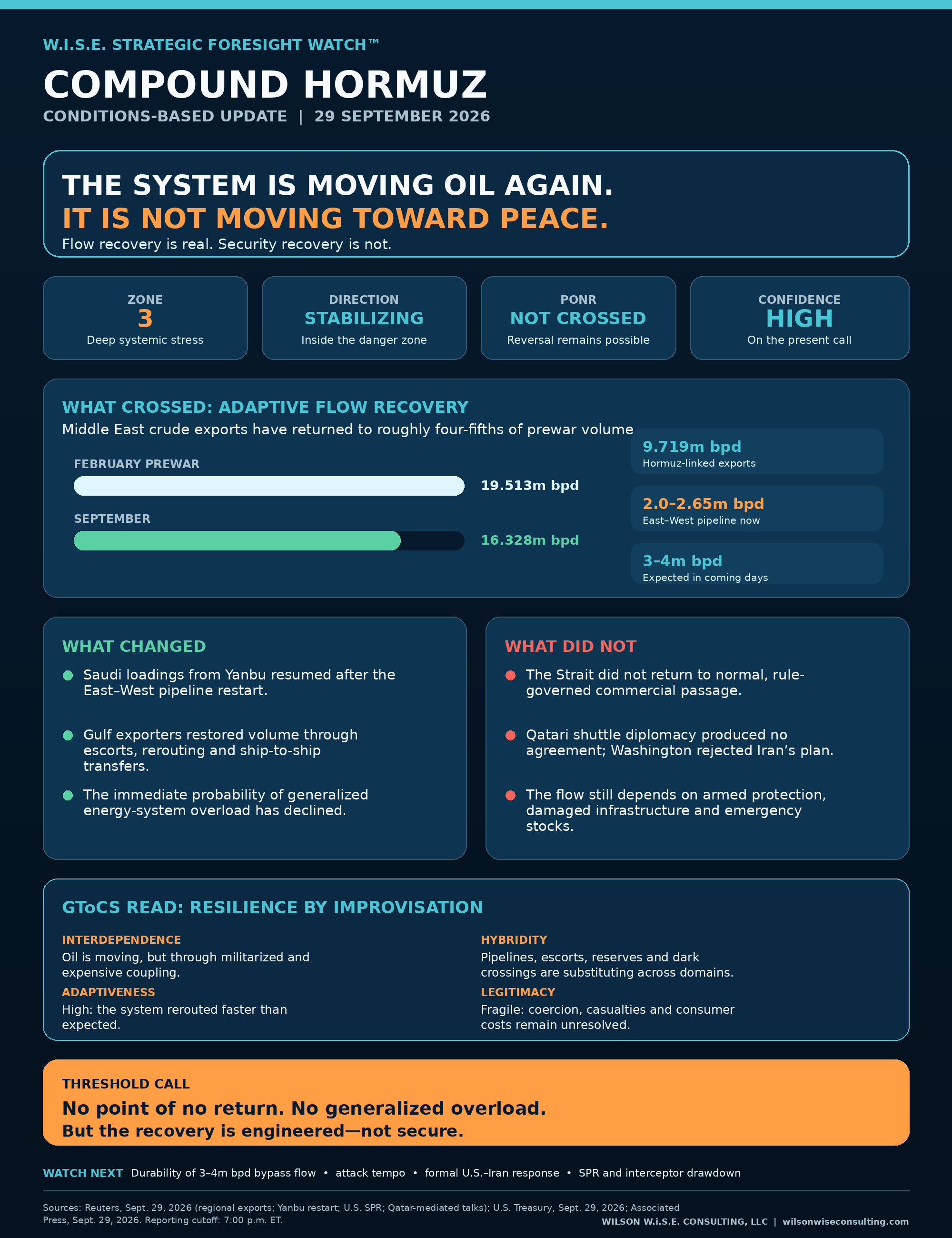
Crude exports from the principal Middle Eastern producers reached approximately 16.328 million barrels per day in September, compared with 19.513 million before the war. Hormuz-linked exports recovered to approximately 9.719 million barrels per day. This is a material improvement: the region is once again moving roughly four-fifths of its prewar export volume.
Saudi Arabia has also restarted tanker loadings at Yanbu following the reopening of its East–West Pipeline. Current throughput is estimated at between 2 million and 2.65 million barrels per day and could rise to between 3 million and 4 million in the coming days. A complete return to the pre-attack rate may still take another month.
This crosses an important Watch threshold: adaptive flow recovery. Gulf producers, shipping firms and supporting governments have restored volume through rerouting, naval protection, ship-to-ship transfers, repaired infrastructure and emergency reserves. The immediate probability of a generalized energy-system overload has therefore declined.
But this is not security recovery.
The Strait has not returned to normal, rule-governed commercial passage. Qatari shuttle diplomacy has produced no agreement, Washington has rejected Iran’s proposed seven-day pathway, and the parties have still failed to establish a credible off-ramp. The United States is simultaneously offering another 40 million barrels from the Strategic Petroleum Reserve, now below 284 million barrels—its lowest level since 1982.
Through the General Theory of Compound Security, the picture is one of “resilience by improvisation.” Adaptiveness is high: the system rerouted faster than expected. Hybridity is unmistakable: pipelines, naval escorts, sanctions, emergency stocks, commercial shipping and diplomacy are functioning as one interdependent security system. Yet the underlying interdependence remains militarized and expensive, while legitimacy is weakened by coercion, casualties, higher consumer costs and the continued absence of a political settlement.
The Compound Hormuz Watch therefore remains in Zone 3—deep systemic stress, but its present direction is stabilizing. The point of no return has not been crossed, and generalized overload has not occurred. What must now be watched is whether the restored flow proves durable, whether attacks begin rising again, whether the diplomatic exchanges produce a formal response, and how long governments can sustain the expenditure of strategic reserves, interceptors and political consent.
The system has bought time. It has not bought peace. That is enough to change tonight’s call—but not enough to stand down the Watch.

If you value this work, here are three ways you can step into the story with us:
📰 Subscriber (Free)
Stay informed. Receive every new essay, briefing, and analysis straight to your inbox. Join a growing community committed to civic resilience and national security.
🎧 Supporter (Paid Pledge)
Strengthen the signal. Your support sustains both Compound Security, Unlocked and our companion podcast The Civic Brief. Supporters ensure these conversations remain accessible to the wider public while elevating the quality, depth, and reach of the work.
🛡️ Sustainer (Patron Level)
Invest in the mission. Sustainers fuel new research, convenings, and storytelling that enlarge the civic frame of security. This is more than content — it’s a civic project. Your sponsorship helps preserve an independent voice committed to equipping citizens, leaders, and institutions for the compound challenges ahead.