

There are moments in history when the past does not merely echo.
It returns.
Not metaphorically.
Not poetically.
Not as analogy.
But structurally.
And what unfolded yesterday in Tennessee should chill every American who still believes the republic is self-correcting by default.
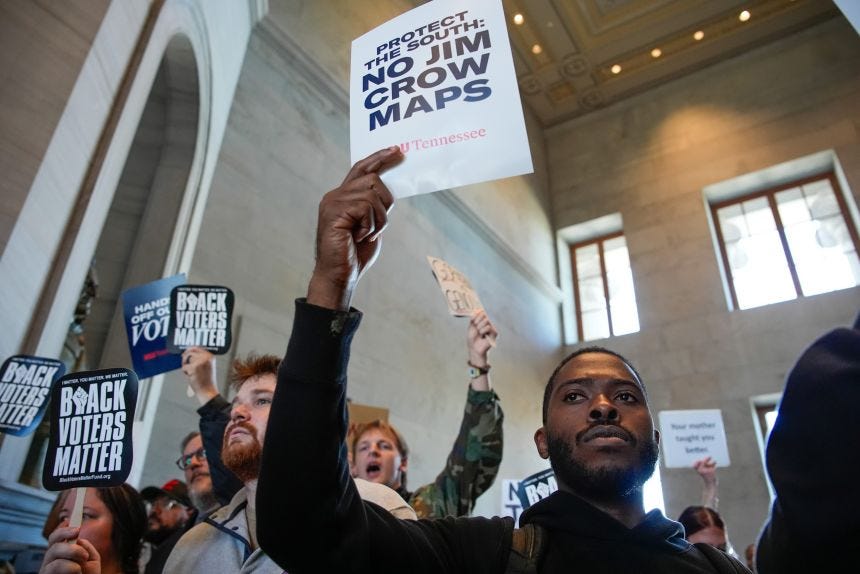
The Tennessee legislature did not simply redraw congressional districts. It dismantled the state’s lone majority-Black congressional district in Memphis, fracturing it into multiple Republican-majority districts in a naked attempt to erase Black political power and secure partisan advantage.
Critics, including Tennessee State Representative Gloria Johnson, described the special legislative session not as democratic governance but as “a white power rally.”
And she was not exaggerating.
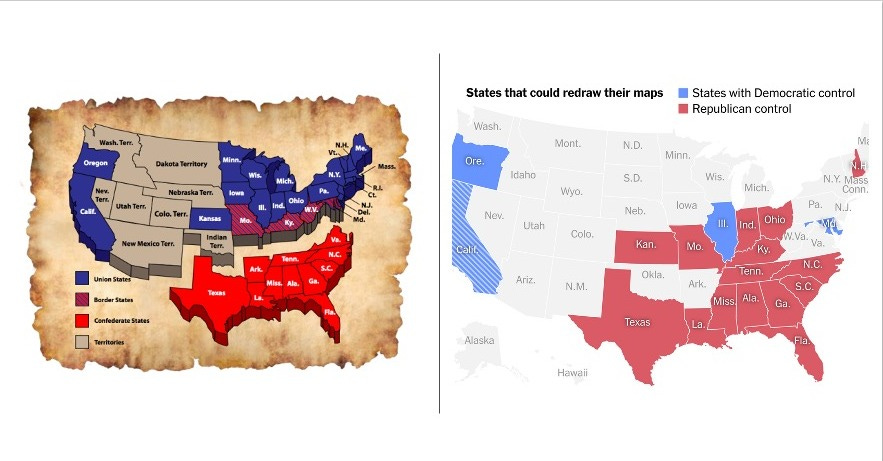
Because if one places the 1860-1 secessionist map beside the emerging 2026 redistricting map now unfolding across much of the United States, the resemblance is not merely geographic.
It is ideological.
It is institutional.
It is civilizational.
And perhaps most disturbing of all:
It is increasingly national.
In the American imagination, “the South” has long been treated as a place.
A region.
A geography.
But history teaches something far more dangerous: the South has always also been a political condition.
A governing philosophy.
A theory of power.
A worldview rooted in hierarchy, racialized citizenship, selective democracy, and minority rule protected through institutional design rather than popular legitimacy.
That worldview did not die at American Civil War.
It adapted.
After Appomattox came Redemption.
After Redemption came Jim Crow.
After Jim Crow came “law and order.”
After “law and order” came strategic voter suppression, judicial capture, hyper-partisan gerrymandering, and the weaponization of procedural legitimacy.
The form changes.
The underlying logic does not.
And what Tennessee revealed this week was not an aberration. It was merely an unusually honest expression of a broader national movement already underway.
Republican lawmakers openly acknowledged that the purpose of the redistricting was to eliminate the state’s only Democratic and majority-Black district and secure all nine congressional seats for Republicans.
Not persuasion.
Not coalition-building.
Not majoritarian competition.
Elimination.
That word matters.
Because democracies survive political disagreement. What they cannot survive indefinitely is one faction deciding that competitive democracy itself has become intolerable.
The defenders of these maps will continue to insist this is merely politics.
Hardball politics, perhaps — but politics nonetheless.
We have heard this argument before.
We heard it when poll taxes were called ‘administrative safeguards’.
We heard it when literacy tests were called ‘neutral standards’.
We heard it when county unit systems diluted Black voting power while maintaining the appearance of constitutional order.
And now we hear it again as legislatures dismantle majority-minority districts under the sanitized language of “colorblind redistricting” and “partisan optimization.”
But structures reveal intent.
And the structure now emerging across multiple states is unmistakable.
The modern project is not merely conservative governance.
It is ‘restoration’.
The restoration of durable minority rule through institutional engineering.
A kind of twenty-first century Redemption movement.
Not horses and gray uniforms.
Algorithms.
Judicial doctrines.
Legislative maps.
Administrative asymmetries.
And increasingly, …. a theory that democratic legitimacy itself is secondary to civilizational preservation.
This is why the Tennessee case matters far beyond Tennessee.
Because the old Confederacy no longer defines the operational boundaries of the new restorationist movement.
“The ‘Old’ South” is no longer regional.
It is migratory.
It is ideological.
It has expanded, back again, into national institutions, media ecosystems, judicial philosophy, educational policy, and electoral architecture.
The old secession map was territorial.
The new one is institutional.
The Confederacy once sought autonomy from the Union.
The new restorationism seeks control of the Union.
And that distinction matters enormously.
The old South feared federal power.
The new movement seeks permanent capture of it.
This is why the comparisons to the 1850s are not hyperbole.
The late antebellum South increasingly believed democratic competition itself posed an existential threat to its social order.
Today’s restorationist politics increasingly communicates the same fear.
Not merely fear of Democrats.
Fear of demography.
Fear of pluralism.
Fear of urban multiracial coalitions.
Fear of legitimacy grounded in equal political participation.
And so the response becomes structurally familiar:
restrict participation,
redraw representation,
weaken institutional counterweights,
redefine citizenship,
centralize cultural authority,
and portray opposition not as political rivals, but existential enemies.
This is not normal democratic competition.
This is pre-hegemonic entrenchment behavior.
And history is filled with republics that crossed this threshold slowly enough that contemporaries convinced themselves nothing extraordinary was happening.
Until it was too late.
What makes this especially dangerous is that many Americans continue to misunderstand the nature of modern democratic erosion.
They imagine collapse arriving dramatically:
tanks,
coups,
suspended constitutions,
martial law.
But modern democratic backsliding rarely looks like that.
It looks legal.
Procedural.
Administrative.
Rationalized.
Each individual step appears defensible in isolation.
Each institutional degradation can be explained away.
Each norm violation becomes normalized through repetition.
Until eventually the constitutional order still exists formally while competitive democracy exists only selectively.
The system still functions.
But no longer equally.
And that is precisely why the Tennessee redistricting battle matters.
Because it reveals something larger than partisan maneuvering.
It reveals a growing willingness to use the machinery of democracy to produce outcomes increasingly insulated from democracy itself.
The Korean War is Not the Longest Standing Armistice … The American Civic War Is
“The South” did not “lose’ the American Civil War in the fullest ideological sense.
It lost only the military contest.
The deeper struggle over “who counts” fully as part of the American political community never truly ended.
It merely entered new institutional forms.
And now, in legislatures and courtrooms and district maps across the country, it is rising again.
Not only in the South.
But all over the country.
If you value this work, here are three ways you can step into the story with us:
📰 Subscriber (Free)
Stay informed. Receive every new essay, briefing, and analysis straight to your inbox. Join a growing community committed to civic resilience and national security.
🎧 Supporter (Paid Pledge)
Strengthen the signal. Your support sustains both Compound Security, Unlocked and our companion podcast The Civic Brief. Supporters ensure these conversations remain accessible to the wider public while elevating the quality, depth, and reach of the work.
🛡️ Sustainer (Patron Level)
Invest in the mission. Sustainers fuel new research, convenings, and storytelling that enlarge the civic frame of security. This is more than content — it’s a civic project. Your sponsorship helps preserve an independent voice committed to equipping citizens, leaders, and institutions for the compound challenges ahead.
This is a crazy take. All the SCOTUS ruling says is that states cannot redistrict by skin color. My, how racism has evolved.
https://torrancestephensphd.substack.com/p/democrats-and-the-tennesssee-two