

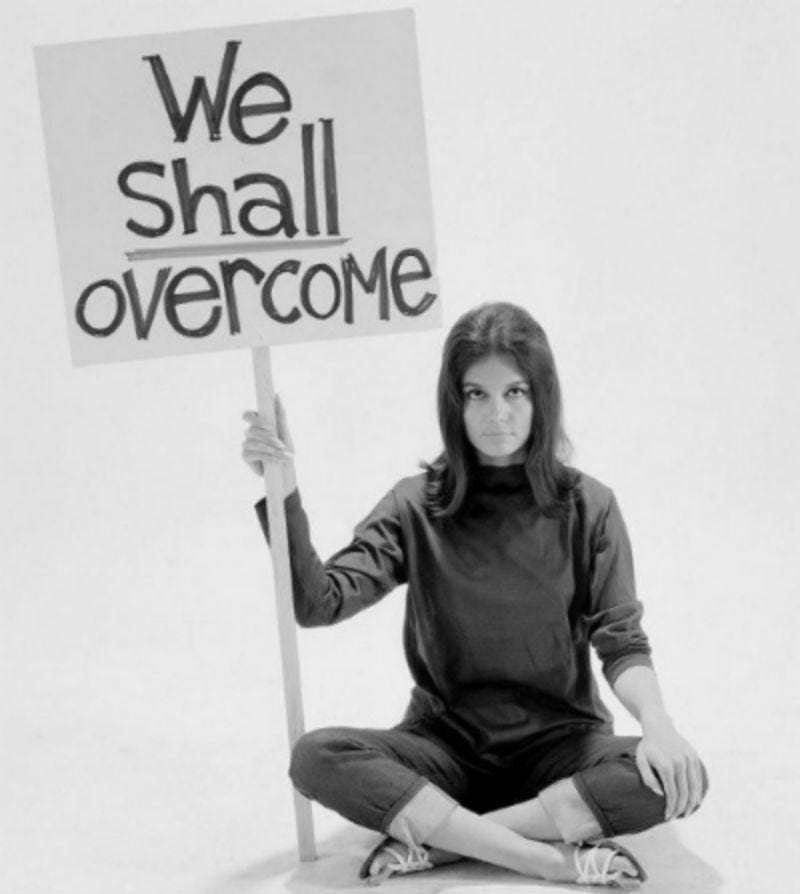
Source: From “The Ins and Outs of Pop Culture” an article by Gloria Steinem in the Aug. 20, 1965 issue of LIFE magazine. Yale Joel The LIFE Picture Collection/Shutterstock
Gloria Steinem died earlier today, September 3rd, 2026, at the age of ninety-two.[1]
There will rightly be remembrances of the journalist, organizer, political activist, feminist icon, co-founder of Ms. magazine, and one of the most recognizable public faces of second-wave American feminism. There will be photographs of the aviator glasses and parted hair; recollections of marches, speeches, organizing campaigns, arguments won and arguments still unfinished.
But I find myself thinking instead about something much smaller.
Two letters.
And a period.
Ms.
There is extraordinary power compressed into that tiny moniker.
Before it became ordinary enough to disappear into everyday language, “Ms.” represented something quietly revolutionary: a woman could enter the public world without announcing whether she belonged, matrimonially, to a man.
“Miss” and “Mrs.” encoded information that “Mr.” had never required of men. “Ms.” interrupted that asymmetry.
Gloria Steinem did not invent the word.
The honorific had appeared in print long before the modern feminist movement, and activist Sheila Michaels became its indispensable modern champion beginning in the 1960s. Michaels saw in “Ms.” the possibility of identifying a woman without simultaneously identifying her marital relationship to a man. Her advocacy eventually reached Steinem as she and others were searching for a name for a new feminist publication.[2]
What Steinem helped accomplish was something different—and, from a systems perspective, enormously important.
She helped an innovation scale.
That distinction between invention and diffusion is precisely what makes “Ms.” such a useful case study in systems change.
Systems rarely transform because somebody produces a good idea. They change when an idea acquires networks, legitimacy, repetition, institutional reinforcement, cultural visibility, and finally enough social acceptance that yesterday’s deviance becomes today’s convention.
Michaels helped champion the innovation.
Steinem and the women around Ms. helped generate the network effects.
And society changed.
That is where I want to begin my remembrance of Gloria Steinem—not principally as a man attempting to explain feminism to women, but as someone interested in systems, power, identity, security, and human freedom trying to understand what this woman helped change about the system all of us inhabit.
For me, there are four ways of understanding her importance.
The first is Steinem as a system in herself—and as a systems-change leader.
The second is Steinem as an architect, amplifier, and translator of second-wave feminism.
The third is Steinem as a human Lagrange Point: a person occupying a critical position among otherwise competing social and political forces.
And the fourth concerns what comes after Gloria Steinem: the obligations belonging to those of us living through what may prove to be a fourth age of feminism at precisely the moment when achievements once mistaken for permanent have again become contested.
All four ultimately converge upon a proposition larger than feminism alone: that perhaps the most elemental human freedom is ‘the unalienable right to be left alone, free, in one’s own indigenous Self’.
I. Steinem as System
We have a tendency to explain social change through heroic individuals.
Rosa Parks sat down.
Martin Luther King Jr. spoke.
Gloria Steinem organized.
History moved.
But systems don’t work that way.
Transformative people matter because they become nodes inside larger systems—connecting previously separated actors, ideas, institutions, grievances, opportunities, and resources. Their influence becomes greater than the sum of the individual actions attributed to them because they alter the relationships among other things.
Seen this way, Gloria Steinem was herself a remarkable system.
She connected journalism to activism, activism to electoral politics, women’s private experiences to public policy, celebrity to organizing, reproductive autonomy to economic independence, and feminism increasingly to questions of race, class, sexuality, violence, and political power. She helped build institutions that could continue moving ideas after a speech ended or a magazine issue disappeared from the newsstand. Among them were Ms., the National Women’s Political Caucus, and an expanding network of feminist political and civic organizations.[3]
Her significance was therefore never merely that millions of people knew who Gloria Steinem was.
Her greater significance was that millions of people who did not know one another increasingly came to understand that experiences they had regarded as private might instead be manifestations of structures they shared.
That’s systems change.
The founding of Ms. provides an almost perfect illustration.
Conventional women’s magazines overwhelmingly operated within an existing social architecture. They largely taught women how to succeed inside the prevailing system: marriage, beauty, domesticity, motherhood, consumption. Ms. asked a fundamentally different question.
What if the system itself needed changing?
Its pages addressed abortion, economic inequality, domestic violence, sexual harassment, political representation, racism, work, sexuality, and the Equal Rights Amendment. Problems previously compartmentalized as unfortunate individual experiences became visible as patterns.[4]
And once a pattern becomes visible, a system becomes contestable.
This may be among Steinem’s most important lessons for our own compound age. Systems maintain themselves partly by convincing individuals that systemic problems are personal failures.
The isolated worker thinks the problem is her salary negotiation.
The abused woman thinks the problem is her marriage.
The woman denied advancement thinks the problem is her qualifications.
The woman denied control over her reproduction is told that the matter concerns somebody else’s authority rather than sovereignty over her own Self.
Connect those experiences, however, and the topology changes.
The personal becomes political because the pattern becomes visible.
And the pattern becomes actionable because people who once understood themselves as isolated discover one another.
That is the difference between grievance and movement.
It is also the difference between an individual reformer and a systems-change leader.
The latter does not merely persuade people to think differently. The systems-change leader alters the connections through which people, ideas, institutions, resources, and power move.
Steinem did that.
II. Second Wave—and the Revolution of the Ordinary
Steinem belongs historically to what we call second-wave feminism, although movements are always messier than the waves historians subsequently use to describe them.
The first wave fought principally for formal political and legal standing, most famously suffrage. The second wave pushed deeper into the social architecture. It asked whether political equality could be meaningful while enormous inequalities persisted within workplaces, homes, marriages, sexuality, reproduction, education, language, and culture.
That move was profound.
It suggested that freedom could not simply mean admission into institutions designed without women in mind.
The institutions themselves might require redesign.
Here again the humble “Ms.” becomes almost perfect as metaphor.
“Ms.” did not demand that a woman tell society whether she was married or unmarried before society knew how to address her.
It removed the question.
That is a different category of reform.
Sometimes equality means providing everybody the same answer.
Sometimes liberation means discovering that the question should never have been asked.
This is why the title Ms. was so powerful. It performed feminism every time somebody said it. The revolution entered correspondence, classrooms, newsrooms, government forms, business cards, introductions, and eventually ordinary speech.
Language had altered the architecture of permissible identity.
The history of the word allows us to see that transformation almost empirically. The Ms. preview appeared as an insert in New York magazine in 1971 and generated enormous demand; the magazine became a regular publication in 1972. Yet The New York Times did not adopt “Ms.” as standard usage until 1986—fourteen years later.[5]
Think about that trajectory:
deviance → contestation → diffusion → institutionalization → normality
That is almost a textbook model of successful systems change.
An innovation appears at the margins. The dominant system rejects or ridicules it. Networks transmit it. Institutions adopt it. Repetition normalizes it. Eventually the system incorporates the innovation so completely that later generations struggle to remember why it was controversial.
The radical becomes mundane.
That may be one of the greatest victories any social movement can achieve.
But therein lies a danger.
Once victories become ordinary, we begin mistaking them for inevitable.
They were never inevitable.
Nor, as our present moment reminds us, are they necessarily permanent.
That is another reason the little word “Ms.” matters today. It reminds us that social progress has a history. Someone had to imagine the alternative. Someone else had to name it. Others had to ridicule it. Still others had to insist upon it. Institutions had to resist it. Different institutions had to adopt it. Eventually millions of people had to repeat it until the extraordinary became ordinary.
This is how systems change.
Not with one grand victory.
Through accumulation.
Through persistence.
Through language.
Through institutions.
Through people.
III. Gloria Steinem at the Lagrange Point
There is another way I have come to think about Steinem.
Borrowing imperfectly but usefully from celestial mechanics, I have increasingly used the idea of Lagrange Points to think about leadership inside complex systems.[6]
In astrophysics, a Lagrange Point describes a location produced by interacting gravitational forces at which a smaller object can maintain a relatively stable relationship with the larger bodies around it.
The metaphor matters because the Lagrange Point does not eliminate gravity.
It exists because multiple gravitational forces remain present.
I have used this concept elsewhere as part of what I call the WiSE Lagrange Point Doctrine: the proposition that effective systems leadership often involves identifying consequential points of intersection among competing forces and understanding where relatively small, well-positioned interventions can have disproportionately large systemic effects.[7]
This is not equilibrium understood as stillness.
It is adaptive equilibrium amid persistent disruption.
That distinction matters.
Because Gloria Steinem was not standing serenely between competing camps. She was operating among them.
She stood between movement radicalism and mainstream America; journalism and activism; celebrity and grassroots organizing; institutional politics and insurgent social movements; generations of feminists who did not always agree with one another; and, increasingly, feminism and broader struggles involving racial, economic, reproductive, LGBTQ, and human rights.
Steinem became, across decades, one of those points—not a place of ideological stillness, but a human node of adaptive equilibrium amid persistent disruption.
She was criticized from multiple directions precisely because equilibrium is not unanimity.
This is important when assessing her legacy.
Historical importance should not require converting Steinem into a secular saint.
Second-wave feminism did contain blind spots. Women of color, working-class women, lesbians, and later generations of feminists repeatedly challenged portions of the movement to recognize experiences that a predominantly white, middle-class feminist vocabulary sometimes inadequately captured. Arguments occurred over race, class, sexuality, capitalism, family, pornography, political strategy, and even what liberation itself ought to mean.
Steinem herself evolved.
And that matters.
A useful Lagrange Point does not abolish gravitational forces. It creates a place from which their interaction can be navigated.
Steinem became, across decades, one of those places.
But there is another systems insight buried here.
Lagrange Points are conditional.
Change the surrounding bodies enough and the equilibrium changes.
Remove one of those bodies entirely and the system must reorganize.
Which raises the question her death places before us:
What happens when the Lagrange Point disappears but the gravitational forces remain?
That question should concern us because the forces surrounding feminism have not disappeared.
Some have intensified.
IV. The Fourth Age: From Progress to Reversibility
Gloria Steinem died eight years short of one hundred.
And hat unfinished distance matters. Here’s why ….
When Vogue interviewed her on her ninetieth birthday in 2024, Steinem was asked what she hoped to be celebrating when she reached one hundred.
Her answer is worth lingering over.
She hoped for much less emphasis upon race, ethnicity, gender, and what she called “groupism,” and greater recognition of our shared but unique human individuality.[8]
Read superficially, the statement might sound like a retreat from identity.
I read it almost exactly the opposite way.
It is the destination toward which struggles over identity were always supposed to lead.
The point of fighting against discrimination based upon sex was never to imprison human beings permanently inside sex categories. The point of identifying systems of racial hierarchy was never to make race the permanent organizing principle of human life.
Categories must sometimes be made visible precisely because power has been organized through them. This was, and remains, the essential purpose and power of Black Lives Matter.
But liberation’s ‘ultimate destination’ cannot simply be a better arrangement of the boxes.
It must eventually include freedom from being confined by the boxes themselves. And that’s where, and why and how, Black Lives Matter always meant and intends an ultimate desitination of … All Lives Matter.
Here Steinem’s late-life hope converges strikingly with what I have elsewhere described as the indigenous Self.
She did not live to see the world she imagined at one hundred.
Neither have we.
Indeed, we arrive at her death during a period when one of the most dangerous assumptions of the late twentieth-century liberal order has collapsed: the assumption that rights, once achieved, become permanent.
They do not.
Rights are institutional accomplishments maintained by law, norms, political coalitions, administrative capacity, civic vigilance, and ultimately human beings willing to defend them. Remove enough of those supports and rights can regress astonishingly quickly.
The reversal of Roe v. Wade in Dobbs v. Jackson Women’s Health Organization demonstrated this with particular force. Whatever one’s position within America’s enduring abortion debate, something historically consequential happened in 2022: a federal constitutional protection surrounding abortion that had existed for nearly half a century disappeared.[9]
The larger lesson extends well beyond abortion.
Rights can move backward
And that should force us to reconsider the familiar metaphor of feminist “waves.”
Perhaps what we are entering is not simply another wave advancing farther onto shore.
Perhaps we are entering a fourth age of feminism—one in which the task is simultaneously to advance, consolidate, defend, and sometimes recover rights under conditions of compound stress.
This fourth age differs from its predecessors partly because the systems affecting women’s freedom have become more tightly coupled.
Reproductive autonomy, economic equality, political representation, sexual violence, digital harassment, artificial intelligence, bodily privacy, LGBTQ rights, racial inequality, democratic backsliding, surveillance technologies, information manipulation, and the changing meaning of work increasingly interact.
They cannot easily be separated because the systems producing them no longer operate separately.
A restriction on reproductive autonomy can become an economic constraint.
An economic constraint can become a geographic constraint.
Digital surveillance can become reproductive surveillance.
Political polarization can become institutional paralysis.
Institutional paralysis can become rights regression.
Technological innovation can magnify harassment, discrimination, or exploitation faster than law can adapt.
The feminist problem therefore becomes simultaneously a human-rights problem, a democratic problem, a technological problem, an economic problem, a security problem and, ultimately, a problem concerning sovereignty over the Self.
That is what makes this fourth age a problem of compound (in)security as much as one of equality.
Security, understood in its fullest sense, is not merely protection from an external threat. It is the capacity of a human system to continue functioning with dignity, legitimacy, adaptability, and resilience under compound stress.
By that measure, women’s security is not separable from democratic security.
Nor is women’s freedom separable from human freedom.
And that returns me to “Ms.”
The Indigenous Self
I am writing this as a man.
That matters, although perhaps not for the reason sometimes assumed.
It does not disqualify me from thinking about feminism. But it does impose a responsibility concerning how I enter the conversation.
My role is not to explain women’s experience to women.
It is to examine the systems men inhabit, benefit from, reproduce, challenge, teach to our sons, and leave to our daughters.
Feminism cannot ultimately succeed as a project conducted only by women because patriarchy was never a system inhabited only by women.
Men are inside the system too.
We therefore carry obligations within its transformation.
And perhaps here Gloria Steinem’s legacy meets a proposition I have increasingly come to regard as foundational to human liberty:
the unalienable right to be left alone, free, in one’s own indigenous Self.
I have elsewhere called this the Fourth Right: “the right to be left alone within one’s indigenous self.”[10]
But by “indigenous Self,” I do not mean a human being stripped of history, ancestry, sex, community, place, memory, or belonging.
I mean almost the opposite.
I mean a Self sufficiently secure in those things that it does not require somebody else’s diminishment in order to exist.
It means moving from identity as dominance toward identity as participation; from inheritance as entitlement toward inheritance as stewardship.
The Fourth Right is therefore not a demand for isolation. Nor is it indifference toward other people.
It is the right to inhabit one’s identity and belonging without threat, compulsory validation, or the requirement that someone else be made lesser so that I might become greater.
That distinction matters here, because feminism’s ultimate objective cannot be to make sex irrelevant by pretending that women do not have histories, bodies, communities, identities, or experiences particular to being women.
Nor can racial justice mean pretending that race never structured human opportunity.
Liberation requires us first to see the category precisely because power has operated through it.
But the destination must be larger than the category.
Here Gloria Steinem’s hope for her hundredth birthday and my own idea of the indigenous Self unexpectedly meet.
She imagined less “groupism” and greater recognition of our shared yet unique human individuality.
I imagine a society in which one’s belonging is sufficiently secure that identity need not become either a weapon against another person or a cage around oneself.[11]
Perhaps those are different languages for approaching the same distant human horizon:
I can be fully who I am without requiring you to become less fully who you are.
That, to me, is the deepest meaning of the unalienable right to be left alone, free, in one’s own indigenous Self.
And it also reveals something deeper about Steinem’s feminism.
Her historical importance lies not simply in helping women secure greater equality as women. At its deepest level, the struggle in which she spent her life was about creating the conditions under which a woman could first be recognized as a person—a sovereign human Self whose existence preceded society’s categories for her.
That is why Steinem’s hope for her hundredth birthday matters so much.
After a lifetime spent insisting that society see gender, she imagined a future in which gender would possess less power to determine who a person could be.
There is no contradiction there.
There is an arc.
First, the category is invisible while discrimination operates through it.
Then the category must be named.
Then inequality organized through that category must be contested.
Then rights must be institutionalized.
And perhaps, finally, the category can lose some of its power over the person.
visibility → recognition → contestation → equality → individuation.
That is not the abandonment of feminism.
It may be feminism’s ultimate success condition.
The Power of “Ms.”
Which brings us back to where we began.
Ms.
The extraordinary thing about the honorific is not that it erased womanhood.
It did nothing of the kind.
It removed compulsory relational definition from womanhood.
You could still be married.
You could still be unmarried.
You could be a mother.
You could be a daughter.
You could love a man, love a woman, live alone, raise children, pursue a profession, build a family, reject convention, embrace convention, or change your mind somewhere along the way.
But none of those relationships had to precede your recognition as a person.
“Ms.” therefore accomplished something considerably more radical than giving women another title.
It changed the default.
It said:
You do not need to know whether this woman is married.
You do not need to know to whom she belongs.
You do not need that information in order to recognize her standing.
She is sufficient unto herself.
And here the two systems-change sequences in Steinem’s story finally converge.
The first describes how an idea changes a system:
deviance → contestation → diffusion → institutionalization → normality.
The second describes how a person becomes freer within that changing system:
visibility → recognition → contestation → equality → individuation.
The first changes the environment.
The second liberates the Self.
“Ms.” did both.
The Obligation After Gloria
Gloria Steinem did not create that philosophy alone, nor did she complete the revolution it demanded.
No individual could.
Indeed, giving Steinem exclusive ownership of “Ms.” would contradict the very systems argument her life helps illuminate. Sheila Michaels mattered. Feminists before Michaels mattered. The women who founded and built Ms. mattered. Black feminists who challenged the movement mattered. Working women mattered. LGBTQ activists mattered. Women who marched mattered. Women who never marched but changed their homes and workplaces mattered. Men who changed mattered. Institutions that eventually yielded mattered.
Movements are systems.
Their heroes are nodes, not gods.
What Gloria Steinem did was spend much of ninety-two years helping move an enormous human system closer toward recognizing something deceptively simple:
A woman belongs first to herself.
And now the Lagrange Point is empty.
The gravitational forces remain.
That is the obligation contained within this moment of mourning.
We should resist turning Gloria Steinem into history too quickly.
Memorialization can become another form of containment: photographs, quotations, documentaries, anniversaries—the comforting suggestion that the struggle belonged to another generation.
It belongs to ours.
Especially now.
For those of us who are men, that obligation has a particular dimension.
It is insufficient merely to admire the women who changed the system.
We must examine the portions of the system that continue to advantage us.
We must ask what assumptions we transmit to sons.
What freedoms we defend for daughters.
What behaviors we tolerate among other men.
What institutions we lead.
What laws we support.
What language we normalize.
What silence we mistake for neutrality.
Systems reproduce themselves through ordinary behavior.
Systems change the same way.
The question after Gloria Steinem is therefore not simply what she accomplished.
It is what we are prepared to prevent from being undone.
And beyond that, what remains ours to complete.
She did not make it to one hundred.
Perhaps our obligation is to carry her question those remaining eight years—and considerably farther:
Can we construct a society in which being born into a particular body no longer predetermines the boundaries of one’s liberty, opportunity, dignity, safety, identity, or Self?
I do not know whether we will.
But I know what one of the smallest versions of that revolution looks like.
Ms.
Two letters.
One period.
An entire philosophy of personhood compressed between them.
It was never merely punctuation.
It was a tiny declaration of sovereignty.
And perhaps, after Gloria Steinem, it can remind us of something still larger.
No woman belongs first to a husband.
No man belongs first to an ideology.
No child belongs first to the categories awaiting them.
No human being should be required to surrender the sovereignty of Self as the price of belonging.
That is where feminism finally becomes something larger than feminism.
It becomes human freedom.
Ms.
The period matters.
It says the sentence is complete.
So is the person.
Thank you, Ms. Steinem.
Ike.
Endnotes
1. Associated Press, “Gloria Steinem, a Potent Voice of US Feminism and Co-Founder of Ms. Magazine, Dies at 92,” September 3, 2026; Reuters, “Feminist Activist Gloria Steinem Dies at Age 92,” September 3, 2026. Steinem died at her home in New York at age ninety-two after more than six decades as a journalist, organizer, writer, and advocate for women’s equality and reproductive and civil rights.
2. Micaela Brinsley, “Remembering Sheila Michaels, Champion of ‘Ms.’ and Equality,” Ms., July 7, 2017; Dennis Baron, “What’s in a Name? For ‘Ms.,’ a Long History,” Ms., August 27, 2010. Forms of “Ms.” substantially predated second-wave feminism, but Michaels encountered the honorific in 1961 and became its persistent modern advocate. Steinem learned of Michaels’s advocacy after Michaels discussed the term on New York radio station WBAI in 1969.
3. Associated Press, “Gloria Steinem”; Reuters, “Feminist Activist Gloria Steinem.” In addition to co-founding Ms., Steinem helped establish the National Women’s Political Caucus and participated in or helped develop numerous other organizations dedicated to women’s political participation, representation, media, and civil rights.
4. See “About Ms.,” Ms. Magazine; and Kathy Spillar et al., eds., 50 Years of Ms.: The Best of the Pathfinding Magazine That Ignited a Revolution (New York: Knopf, 2023). The magazine consciously distinguished itself from conventional women’s publications centered primarily upon domestic life, beauty, marriage, and consumption, instead providing a national journalistic platform for feminist political and social analysis.
5. Meliss Arteaga, “Today in Feminist History: The New York Times Says ‘Ms.,’” Ms., June 20, 2017; Brinsley, “Remembering Sheila Michaels.” The Ms. preview appeared as an insert in New York magazine in 1971 and sold out in eight days. The New York Times did not adopt “Ms.” as standard usage until 1986, fourteen years after the magazine’s regular publication began. The history offers an unusually clear example of cultural diffusion from marginal or contested usage to institutional normalization.
6. In celestial mechanics, the Lagrange Points are positions associated with the interacting gravitational forces of two large bodies and the orbital motion of a smaller object. I use the concept analogically rather than literally to describe consequential relational positions within complex human systems.
7. Isaiah Wilson III, “The WiSE Way: Applying ‘The WiSE Lagrange Point Doctrine,’” Compound Security, Unlocked, June 4, 2026; see also Wilson, “Six Missing Variables: A ‘Retro-Speculative Futures’ View from the Compound Age,” Compound Security, Unlocked, August 14, 2026; Wilson, “The Three-Body Problem of Power—And Why It Cannot Be Solved… or, Can It?,” Compound Security, Unlocked, April 15, 2026; and Wilson, “Governing the Ungovernable: Strategy in a ‘Three-Body’ World,” Compound Security, Unlocked, April 17, 2026. The WiSE Lagrange Point Doctrine treats effective systems leadership as, in part, the identification and exploitation of consequential points of interaction among competing forces, where appropriately positioned interventions can generate effects disproportionate to their apparent size.
8. Christian Allaire, “‘Hope Is Practical and Necessary’: Gloria Steinem on Activism, Jewelry, and Life at 90,” Vogue, March 25, 2024. Asked what she hoped to be celebrating at age one hundred, Steinem envisioned less emphasis upon race, ethnicity, gender, and “groupism,” together with greater recognition of shared yet unique human individuality.
9. Dobbs v. Jackson Women’s Health Organization, 597 U.S. 215 (2022). The Supreme Court overruled Roe v. Wade, 410 U.S. 113 (1973), and Planned Parenthood of Southeastern Pennsylvania v. Casey, 505 U.S. 833 (1992), holding that the Constitution does not confer a right to abortion and returning regulatory authority principally to elected governments. Whatever one’s normative position regarding abortion, Dobbs is analytically significant here as an unusually clear demonstration that rights and constitutional protections experienced by multiple generations as established can nevertheless prove institutionally reversible.
10. Isaiah Wilson III, “Indigenous to This Place, This Self, This Republic: A ‘Walk With Me’—Among My ‘Selves,’” Compound Security, Unlocked, April 24, 2026. Under the heading “The Fourth Right,” Wilson advances “the right to be left alone within one’s indigenous self.” The concept treats the indigenous Self not as atomistic isolation but as secure belonging without domination: a movement from identity as dominance toward identity as participation and from inheritance as entitlement toward inheritance as stewardship.
11. The convergence drawn here between Steinem’s late-life aspiration toward shared and unique human individuality and Wilson’s indigenous Self is interpretive rather than genealogical; there is no suggestion that Steinem employed or derived her thinking from Wilson’s terminology. The conceptual affinity lies in their common movement toward personhood that can retain identity and belonging without permitting categorical identity to exhaust, imprison, or subordinate the individual. See Allaire, “‘Hope Is Practical and Necessary’”; Wilson, “Indigenous to This Place, This Self, This Republic.”
12. For the broader systems framework informing the argument here, see Isaiah Wilson III’s writings on compound security and systems leadership in Compound Security, Unlocked. The argument advanced in this essay—that feminism’s contemporary challenge increasingly involves interacting political, technological, economic, social, and institutional stresses—treats rights not merely as abstract legal possessions but as properties whose durability depends upon the performance and resilience of the larger systems supporting them.

If you value this work, here are three ways you can step into the story with us:
📰 Subscriber (Free)
Stay informed. Receive every new essay, briefing, and analysis straight to your inbox. Join a growing community committed to civic resilience and national security.
🎧 Supporter (Paid Pledge)
Strengthen the signal. Your support sustains both Compound Security, Unlocked and our companion podcast The Civic Brief. Supporters ensure these conversations remain accessible to the wider public while elevating the quality, depth, and reach of the work.
🛡️ Sustainer (Patron Level)
Invest in the mission. Sustainers fuel new research, convenings, and storytelling that enlarge the civic frame of security. This is more than content — it’s a civic project. Your sponsorship helps preserve an independent voice committed to equipping citizens, leaders, and institutions for the compound challenges ahead.
She was one of the best essayists in 20th century America. Her sarcastic lampooning when she wrote If Men Could Menstruate was legendary.