
The Next Double V
Black America, Democratic Survival, and the Fight Against Fascism at Home and Abroad.

“We return. We return from fighting. We return fighting.”
— W. E. B. Du Bois, 1919
“Freedom is never voluntarily given by the oppressor; it must be demanded by the oppressed.”
— Martin Luther King Jr.
There are seasons in the life of a republic when contradictions sharpen into clarity.
The banners still wave. The anthem still plays. Elections still occur. The language of freedom remains ubiquitous. And yet beneath the ritual affirmations, something unsettled stirs: a widening distrust of pluralism; a nostalgia for homogeneity; a comfort with strongman authority; a politics of grievance that masquerades as restoration.
In such moments, history does not repeat. It rhymes.
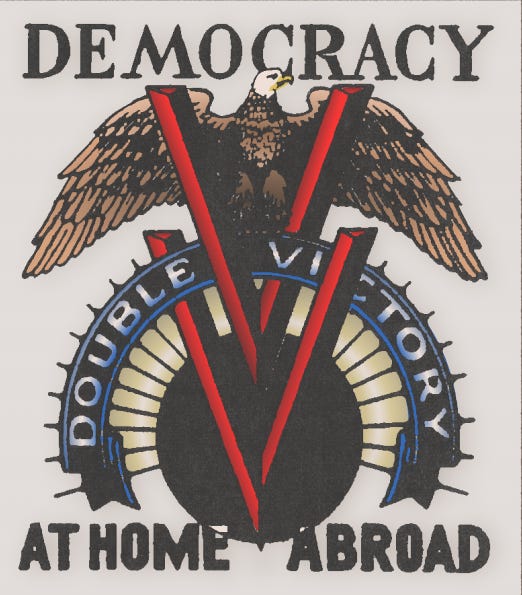
During World War II, Black Americans articulated what became known as the Double V campaign:
… victory against fascism abroad, and victory against racial injustice at home.
It was not a slogan of abstraction. It was a moral and strategic doctrine.
Today, under the politics of President Donald Trump and the broader MAGA-Republican movement, the United States finds itself in another Double V moment.
But this time, the imperatives are even more layered.
We are confronting not only the persistence of racial inequity at home. We are confronting the reemergence—globally and domestically—of ethno-nationalism, identitarian movements, and illiberal governance models that echo the ideological structures the original Double V generation helped defeat.
And we must add another dimension: class.
The modern Double V is not only racial and institutional. It is also economic. It concerns who belongs not just symbolically, but materially.
This moment demands victory across three fronts: democracy, pluralism, and shared economic dignity.
I. The Original Double V: A Democratic Audit
The Double V campaign of the 1940s was a demand for coherence.
If fascism was evil in Europe, segregation was evil in America.
If authoritarianism abroad threatened civilization, racial hierarchy at home undermined it.
Black Americans were asked to fight and die for a democracy that denied them full citizenship. They did so—while insisting that the contradiction be resolved.
The Double V was not anti-American. It was a profound act of constitutional faith. It held America accountable to its professed ideals.
That generation understood something essential: the struggle against fascism was not only geopolitical. It was ideological.
It concerned what kind of political community would prevail in the modern world.
II. Fascism Never Fully Vanishes
Fascism rarely returns wearing the same uniform.
The regimes defeated in 1945—Benito Mussolini and Adolf Hitler—fell militarily. But the ideological elements that animated them—mythic nationalism, grievance politics, racial hierarchy, contempt for liberal pluralism—never disappeared.
Today, we observe their mutation:
Ethno-nationalist parties rising across Europe.
Identitarian movements warning of “replacement.”
Leaders undermining independent courts and media.
Majoritarian governments narrowing the definition of belonging.
The language has softened; the architecture has modernized. But the pattern remains recognizable: the elevation of identity over citizenship, the leader over institutions, unity over pluralism, grievance over equality.
And this ideological drift is not confined overseas.
III. The Domestic Mirror
In the United States, the rhetoric of “America First” often intertwines with demographic anxiety and civilizational nostalgia.
The boundaries of belonging are debated in cultural, religious, and racial terms.
Electoral legitimacy becomes conditional. Institutional friction is cast as sabotage. Executive dominance is framed as strength.
The politics of identitarian grievance—particularly the “great replacement” thesis and its variants—have migrated from fringe discourse into mainstream debate.
Black Americans, and other marginalized communities, experience the consequences first:
Voting restrictions framed as “integrity.”
Curriculum revisions that sanitize racial history.
Public policy battles over diversity initiatives.
Rhetorical conflation of immigration and criminality.
Cultural signals that pluralism itself is suspect.
This is not Jim Crow revived in original form.
It is subtler.
More adaptive.
More networked.
But the structural question is familiar: Is American democracy pluralist, or is it majoritarian?
IV. Class: The Overlooked Front
The modern Double V cannot be waged solely on racial terms.
Class inequality has widened dramatically over the past half-century. Working-class Americans—Black, white, Latino, rural, urban—experience precarity, stagnation, and loss of institutional trust.
In this environment, grievance becomes combustible.
Identitarian politics—whether racialized or nationalist—often function as displacement mechanisms for economic insecurity. Political entrepreneurs redirect economic anger toward cultural enemies.
If racial justice is pursued without economic inclusion, resentment festers.
If economic reform is pursued without racial equity, hierarchy persists.
The new Double V must therefore include a third imperative:
Victory over class stratification that corrodes shared citizenship.
Liberation must include:
Economic dignity.
Fair wages and labor protections.
Accessible healthcare.
Educational opportunity.
Infrastructure investment in neglected communities—rural and urban alike.
Crucially, this is not a zero-sum vision.
White working-class Americans are not adversaries in this struggle. They are potential allies. Many have also experienced institutional abandonment and political manipulation.
The Double V must not devolve into identity camps. It must build a civic coalition grounded in shared material stake.
V. Compound Security and Legitimacy Collapse
From the perspective of the General Theory of Compound Security, legitimacy is the keystone variable.
When legitimacy fractures:
Polarization accelerates.
Conspiracy thinking spreads.
Institutional compliance weakens.
Executive power expands.
Social cohesion declines.
Racial hierarchy, class inequality, and democratic erosion are not separate phenomena. They are interdependent.
An attack on voting rights weakens institutional trust.
Economic stagnation fuels grievance narratives.
Grievance narratives legitimize exclusionary politics.
Exclusionary politics erode pluralist norms.
This is compound insecurity: adaptive, hybrid, interlocking.
The Double V moment is therefore systemic.
Victory abroad against identitarian authoritarianism is inseparable from victory at home for democratic inclusion and economic fairness.
VI. Abroad “and” At Home: The Twin Fronts
The original Double V campaign confronted fascism externally and segregation internally.
Today’s version must confront:
Abroad:
Resurgent ethno-nationalism.
Illiberal governance.
Democratic backsliding.
Alliances strained by authoritarian drift.
At Home:
Electoral delegitimization.
Identity-driven polarization.
Executive overreach.
Cultural warfare supplanting policy debate.
Economic stratification deepening civic alienation.
The United States cannot credibly oppose authoritarian nationalism abroad while flirting with its logic domestically.
Foreign policy credibility is inseparable from domestic democratic health.
VII. The Discipline Required
The first Double V generation fought under conditions of explicit segregation. They demanded rights while affirming constitutional principles.
Today’s discipline is different but equally demanding.
It requires:
Defending institutions even when they frustrate partisan goals.
Resisting reciprocal extremism.
Building cross-racial, cross-class coalitions.
Reframing patriotism as inclusive rather than exclusionary.
Refusing the temptation to abandon democratic procedure in pursuit of immediate justice.
Despair is strategically dangerous.
Cynicism accelerates institutional collapse.
Victory requires stamina, coalition, and constitutional faith.
VIII. A Coalition of Shared Citizenship
The most important expansion of the modern Double V is this:
…. It must include white Americans not as reluctant tolerators, but as co-equal partners in civic renewal.
Pluralism is not a concession to minorities. It is a safeguard for all.
Economic reform is not racial favoritism. It is systemic repair.
Democratic restraint is not partisan weakness. It is institutional survival.
A republic that secures liberty for Black Americans, economic dignity for working families, and institutional accountability for all citizens becomes stronger—not weaker.
IX. The Strategic Choice Before Us
The United States stands at a structural crossroads:
A pluralist constitutional republic rooted in equal citizenship and shared opportunity; or
A grievance-driven majoritarian identity state comfortable with selective democracy and stratified belonging.
The Double V moment demands that we choose the former.
Not rhetorically.
Institutionally.
Economically.
Culturally.
X. Conclusion: The Republic Is Still Being Decided
The original Double V helped catalyze the civil rights revolution.
It exposed hypocrisy and demanded coherence.
Today’s Double V must do the same—against democratic erosion, racial retrenchment, class stratification, and the re-rising tide of identitarian authoritarianism.
We are not merely debating policy preferences.
We are deciding what kind of republic endures.
Victory abroad requires moral credibility at home.
Victory at home requires economic inclusion across race.
Victory across class requires pluralist democracy.
The republic is not self-executing.
It must be defended—twice over.
And perhaps, in this generation, three times.
Appendix
Blueprints from the Double V: A Strategic Framework for Democratic Renewal
“We must build dikes of courage to hold back the flood of fear.”
— Martin Luther King Jr.
The modern Double V moment demands more than rhetorical clarity. It requires institutional redesign, civic discipline, and material inclusion.
If Victory One is the preservation of pluralist constitutional democracy, and Victory Two is racial and economic inclusion, then what follows is a blueprint architecture—structured across three strategic domains:
1. Democratic Resilience
2. Pluralist Citizenship
3. Shared Economic Dignity
Each domain reinforces the others. None stands alone.
⸻
I. Democratic Resilience
(Securing Victory Against Authoritarian Drift)
1. Restore Electoral Legitimacy Infrastructure
• National minimum standards for voting access (early voting windows, mail ballot baseline access, uniform ballot curing processes).
• Automatic voter registration nationwide.
• Independent, nonpartisan redistricting commissions in all states.
• Severe penalties for intimidation of election officials.
Democracy cannot survive procedural uncertainty. Legitimacy must be administratively visible.
⸻
2. Rebalance Executive Authority
• Sunset provisions on emergency powers.
• Congressional reauthorization requirements for prolonged emergency declarations.
• Codify norms limiting the politicization of DOJ and federal law enforcement.
• Codify similar norms — a revised ‘Code of Conduct’ — limiting the potential of “executive capture” of the use and utility of the military armed forces.
• Clear statutory guardrails on the domestic use of federal forces.
The concentration of power is the seedbed of Caesarism. Friction is a feature, not a flaw.
⸻
3. Depoliticize Civic Ritual
• Return the State of the Union to a written report with structured hearings.
• Establish bipartisan civic affirmations appended to major national addresses.
• Reform primary election systems to reduce extremism incentives (open primaries or ranked-choice voting).
Scandology thrives on spectacle. Institutional sobriety disarms it.
⸻
II. Pluralist Citizenship
(Securing Victory Against Identitarian Authoritarianism)
4. Constitutional Literacy & Civic Education
• National investment in K–12 constitutional education grounded in primary sources.
• Honest instruction on Reconstruction, Jim Crow, civil rights, and democratic reform movements.
• Civic service incentives for youth engagement across communities.
• Embrace and implement a 21st century-appropriate ‘National Public Service’ Project.
Pluralism requires knowledge. Ignorance is fertile soil for grievance mythology.
⸻
5. Anti-Extremism Without Overreach
• Expand monitoring of violent extremist networks while preserving First Amendment protections.
• Clear distinction between protected speech and criminal incitement.
• Strengthen digital transparency requirements for algorithmic amplification of hate content.
• Adopt additional “auxiliary precautions” reinforcing strong religious non-establishment-and-free exercise norms and guardrails.
The challenge is to protect democracy without becoming illiberal in its defense.
⸻
6. Coalition Infrastructure
• Incentivize cross-racial and cross-class civic partnerships through federal grants.
• Support local democracy labs—community forums, deliberative assemblies.
• Expand national service programs that intentionally integrate rural and urban populations.
The Double V cannot be won through siloed mobilization. It requires durable civic relationships.
⸻
III. Shared Economic Dignity
(Securing Victory Against Class Stratification)
7. Economic Inclusion Strategy
• National living wage indexed to inflation.
• Expanded Earned Income Tax Credit.
• Federal infrastructure and industrial investment in deindustrialized regions.
• Small business capitalization support for marginalized entrepreneurs.
Economic exclusion fuels identitarian politics. Inclusion diffuses it.
⸻
8. Labor Empowerment
• Protect collective bargaining rights.
• Incentivize worker ownership models.
• National apprenticeship pipelines tied to emerging industries.
Shared prosperity stabilizes democratic commitment.
⸻
9. Health & Education as Democratic Infrastructure
• Universal access to affordable healthcare.
• Debt relief and reform in higher education financing.
• Public university reinvestment to reduce tuition burdens.
A democracy of chronic precarity is vulnerable to authoritarian promises.
⸻
IV. Foreign Policy Coherence
(Victory Abroad and Credibility at Home)
10. Recommit to Democratic Alliances
• Strengthen NATO and democratic multilateral institutions.
• Coordinate sanctions against regimes advancing ethnonationalist repression.
• Increase support for independent media abroad.
You cannot credibly oppose authoritarianism overseas while tolerating its logic domestically.
⸻
11. Economic Diplomacy Against Authoritarian Capital
• Screen foreign investment tied to state-backed authoritarian enterprises.
• Incentivize democratic supply chain diversification.
• Align trade policy with labor and environmental standards.
Democracy requires material backbone, not just rhetoric.
⸻
V. Cultural Reset
(Reframing Patriotism)
12. Civic Patriotism Narrative
• Reassert American identity as constitutional, not ethnic.
• Publicly elevate stories of cross-racial alliance in American history.
• Celebrate pluralism as strength, not concession.
The Double V is not anti-American.
It is the deepest form of Americanism.
⸻
VI. Guardrails Against Democratic Despair
13. Institutional Resilience Planning
• Scenario planning for election disputes.
• Civil-military norm reinforcement around nonpartisanship.
• Strengthen Inspector General independence.
14. Media Reform Incentives
• Encourage public-interest journalism funding models.
• Transparency in political advertising.
• Combat disinformation through civic education, not censorship reflex.
⸻
VII. Strategic Doctrine Summary
The modern Double V requires three integrated victories:
• Institutional Victory: Guardrails against authoritarian drift.
• Pluralist Victory: Equal citizenship across race and identity.
• Economic Victory: Shared dignity across class lines.
If any pillar fails, the structure weakens.
Racial justice without economic inclusion invites backlash.
Economic reform without democratic guardrails invites oligarchy.
Democracy without pluralism invites hierarchy.
⸻
VIII. Final Strategic Principle
The first Double V generation understood a hard truth:
… Freedom abroad is unsustainable without justice at home.
Today we add:
… Justice at home is unsustainable without economic inclusion across race and class.
And economic inclusion is unsustainable without democratic guardrails.
This is not a partisan platform.
It is a regime survival doctrine.
A republic that secures dignity across race and class while preserving constitutional restraint becomes resilient.
One that does not becomes brittle.
The Double V moment is not symbolic.
It is structural.
⸻
If you value this work, here are three ways you can step into the story with us:
📰 Subscriber (Free)
Stay informed. Receive every new essay, briefing, and analysis straight to your inbox. Join a growing community committed to civic resilience and national security.
🎧 Supporter (Paid Pledge)
Strengthen the signal. Your support sustains both Compound Security, Unlocked and our companion podcast The Civic Brief. Supporters ensure these conversations remain accessible to the wider public while elevating the quality, depth, and reach of the work.
🛡️ Sustainer (Patron Level)
Invest in the mission. Sustainers fuel new research, convenings, and storytelling that enlarge the civic frame of security. This is more than content — it’s a civic project. Your sponsorship helps preserve an independent voice committed to equipping citizens, leaders, and institutions for the compound challenges ahead.