

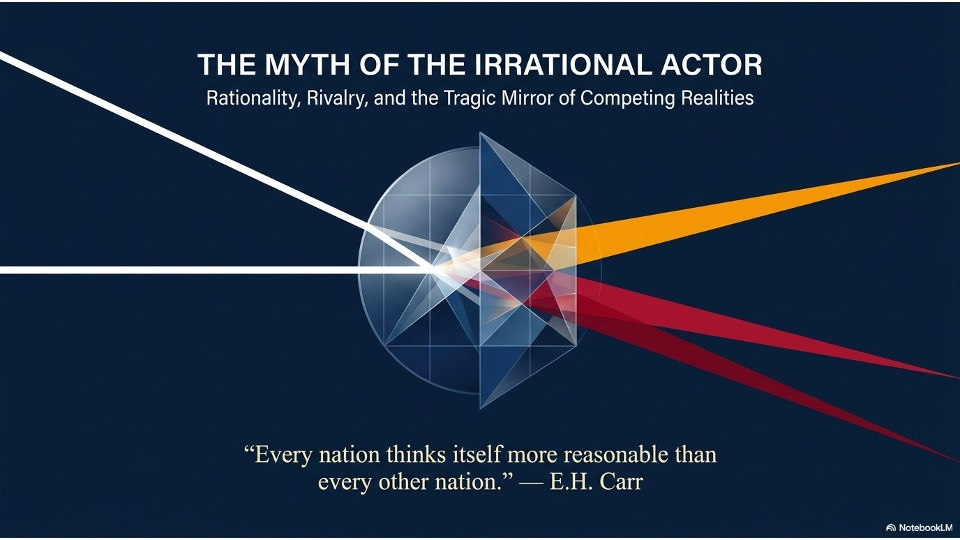
“Every nation thinks itself more reasonable than every other nation.”
— E.H. Carr
There are few phrases more casually deployed in the worlds of foreign policy, intelligence analysis, and defense planning than the assertion that an adversary is “not acting rationally.”
It appears in television interviews after crises.
It appears in think tank panels after escalation.
It appears in war colleges, intelligence briefs, and policy memoranda whenever another state, movement, or leader behaves in ways that confound our expectations.
Iran enriches uranium despite overwhelming pressure.
Russia accepts staggering battlefield losses.
China tolerates economic costs in pursuit of territorial claims.
North Korea starves its population while building missiles.
Hamas launches attacks it cannot militarily win.
The United States invades Iraq despite dubious assumptions and strategic incoherence.
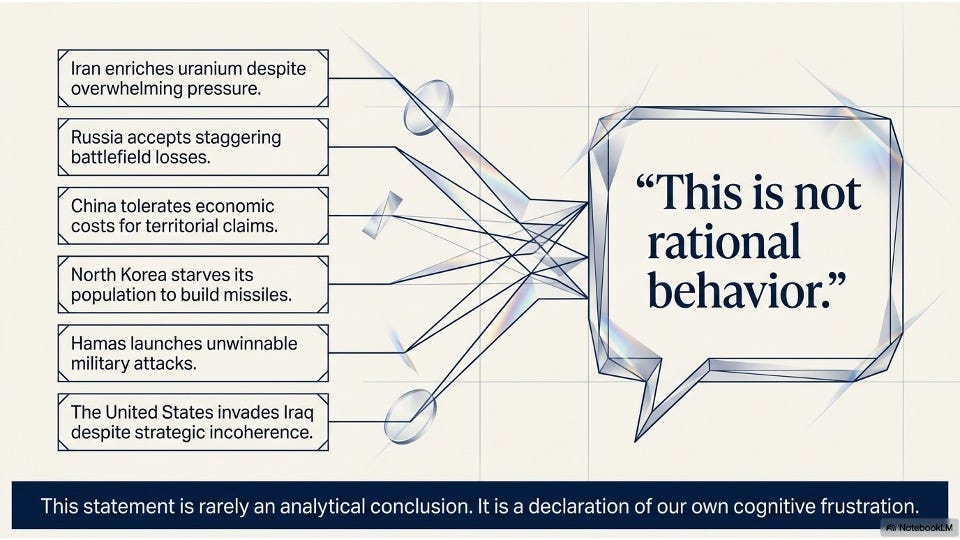
And each time, someone eventually says:
“This is not rational behavior.”
But what do we actually mean when we say this?
More importantly: what if the statement is often less an analytical conclusion than a declaration of cognitive frustration?
What if the problem is not that the other actor lacks rationality—but that we fail to understand the rationality operating within their system?
This distinction matters profoundly. Because history suggests that some of the greatest strategic failures of great powers emerge not from misunderstanding an adversary’s capabilities, but from misunderstanding the logic by which that adversary defines survival, legitimacy, honor, time, sacrifice, and victory itself.
The present compound security confrontation between Trump’s America and the Islamic Revolutionary Guard Corps (IRGC)-anchored Iranian state offers a nearly perfect contemporary illustration of this enduring problem.
Not because either side is irrational.
But because both sides are operating according to internally coherent—but mutually incompatible—rationalities.
And when rival rationalities collide within a shared strategic space, the result is often not deterrence, but tragedy.
The Rational Actor: The Most Misunderstood Assumption in Strategic Thought
The “rational actor” concept sits at the core of modern international relations theory, particularly within realist traditions associated with thinkers like Thomas Schelling, Hans Morgenthau, and Kenneth Waltz.
At its most basic level, a rational actor is not an actor that is morally good, wise, peaceful, democratic, or humane.
A rational actor is simply one that:
Possesses goals or preferences;
Evaluates available options;
Chooses actions believed likely to advance those goals.
That is all.
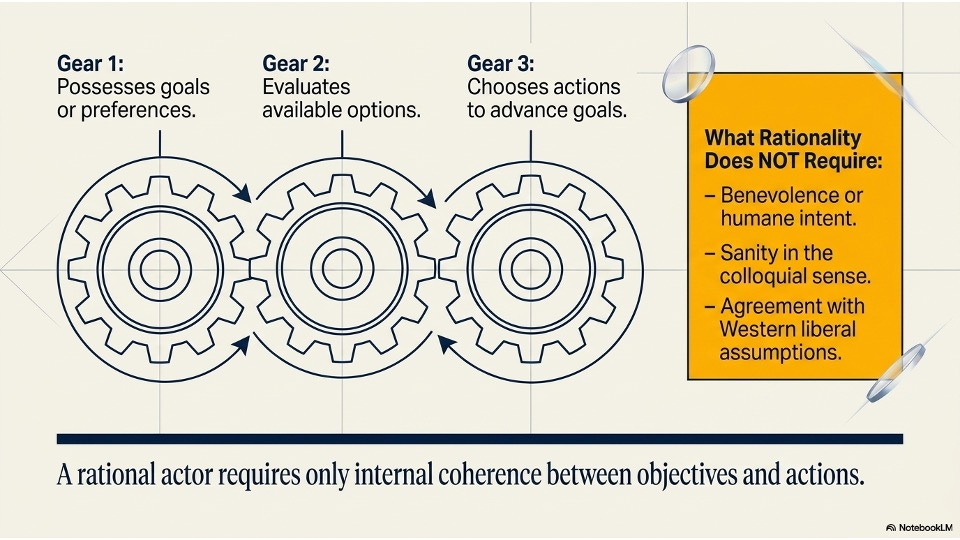
Rationality does not require benevolence.
It does not require sanity in the colloquial sense.
It does not require agreement with Western liberal assumptions.
It requires only internal coherence between objectives and actions.
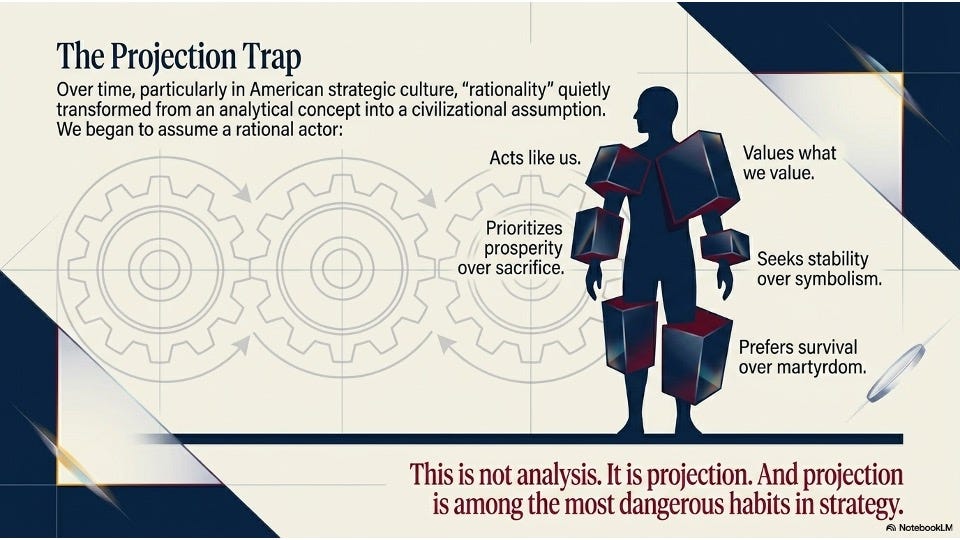
Yet over time, particularly in American strategic culture, “rationality” quietly transformed from an analytical concept into a civilizational assumption.
The phrase “rational actor” increasingly came to mean:
acts like us,
values what we value,
fears what we fear,
prioritizes prosperity over sacrifice,
seeks stability over symbolism,
prefers survival over martyrdom,
and ultimately responds to incentives the way we would respond to them.
This is not analysis.
It is projection.
And projection is among the most dangerous habits in strategy.
Rational According to Whom?
The central problem is that rationality is never culturally neutral.
All strategic actors operate within embedded systems of meaning.
Those systems shape:
perceptions of honor,
concepts of legitimacy,
understandings of time,
tolerance for pain,
acceptable sacrifice,
notions of justice,
historical memory,
and visions of destiny.
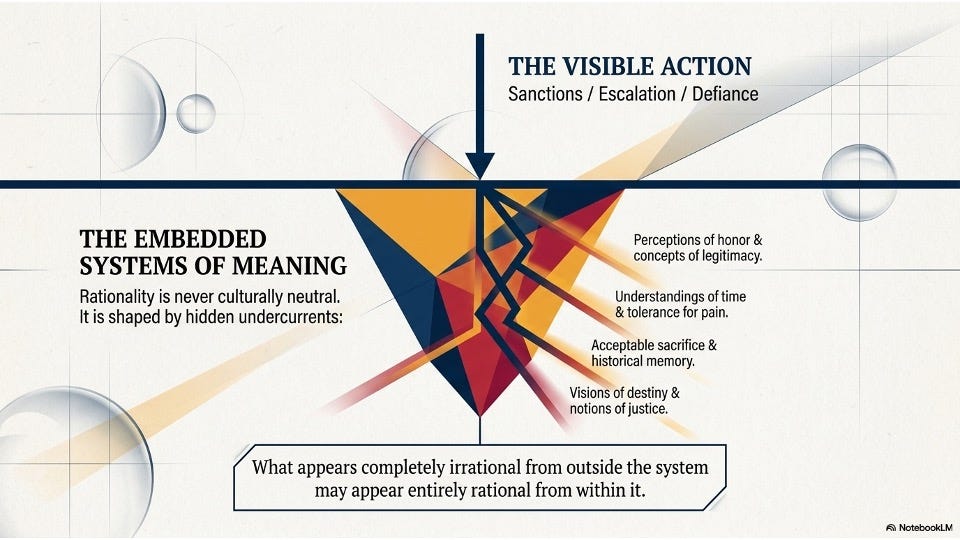
What appears irrational from outside the system may appear entirely rational from within it.
Consider the IRGC.
From many American perspectives, Iran’s behavior appears persistently self-destructive:
accepting crushing sanctions,
sustaining proxy conflicts,
risking military escalation,
sacrificing economic growth,
and embracing ideological confrontation with stronger powers.
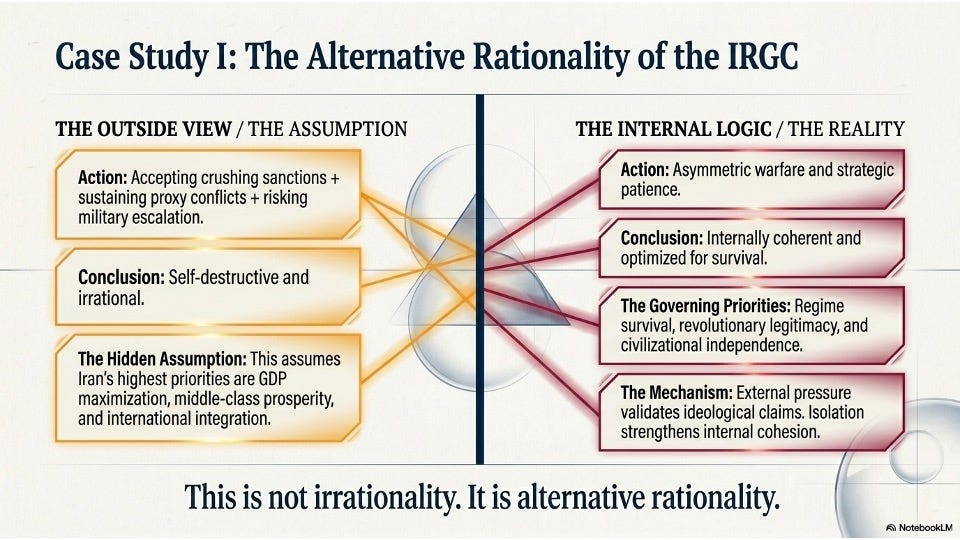
But this interpretation only holds if one assumes Iran’s highest priorities are:
GDP maximization,
international integration,
middle-class consumer prosperity,
or liberal institutional normalization.
Those are largely Western assumptions.
The IRGC’s governing rationality is different.
Its central priorities are regime survival, revolutionary legitimacy, strategic autonomy, deterrence through resistance, and civilizational independence from perceived Western domination.
Within that framework, resistance itself becomes rational.
Sanctions do not necessarily delegitimize the regime; they may reinforce its narrative.
External pressure validates ideological claims.
Isolation can strengthen internal cohesion.
Martyrdom can generate legitimacy.
Strategic patience can outlast democracies governed by electoral cycles.
And asymmetric warfare becomes not a desperate substitute for conventional weakness, but the optimal strategic method for a materially inferior but ideologically resilient actor.
This is not irrationality.
It is alternative rationality.
America’s Rationality Problem
Yet the same analytical lens must also be turned inward.
Because Trump-era America increasingly demonstrates its own form of alternative rationality—one that many outside observers regard as deeply destabilizing.
From European allies to Asian partners, many observers struggle to understand:
attacks on alliance structures,
tariff wars against partners,
open hostility toward multilateral institutions,
threats against NATO commitments,
admiration for strongman politics,
domestic democratic erosion,
and the personalization of national security decision-making.
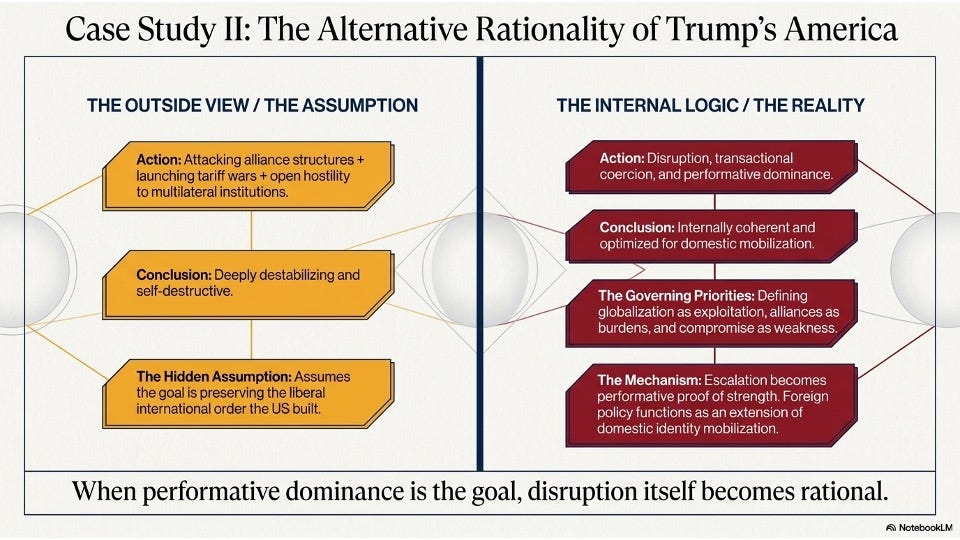
To many outside observers, such conduct appears irrational because it undermines the very liberal international order the United States spent generations constructing.
But again, irrational according to whom?
Within Trumpist political rationality, these actions may appear entirely coherent.
If one defines:
globalization as exploitation,
alliances as burdens,
institutions as constraints,
compromise as weakness,
pluralism as fragmentation,
and performative dominance as political legitimacy,
then disruption itself becomes rational.
Escalation becomes performative proof of strength.
Transactional coercion becomes preferable to institutional predictability.
Political polarization becomes useful rather than dangerous.
Foreign policy becomes an extension of domestic identity mobilization.
Once again, what outsiders label irrationality may instead represent a competing internal logic.
And herein lies the compound security dilemma.
The Security Dilemma Becomes a Compound Security Dilemma
Traditional security dilemma theory holds that actions one state takes for defensive purposes may be interpreted as offensive threats by another state, producing escalation despite neither side desiring war.
But the modern environment is more dangerous than the classical security dilemma envisioned during the Cold War.
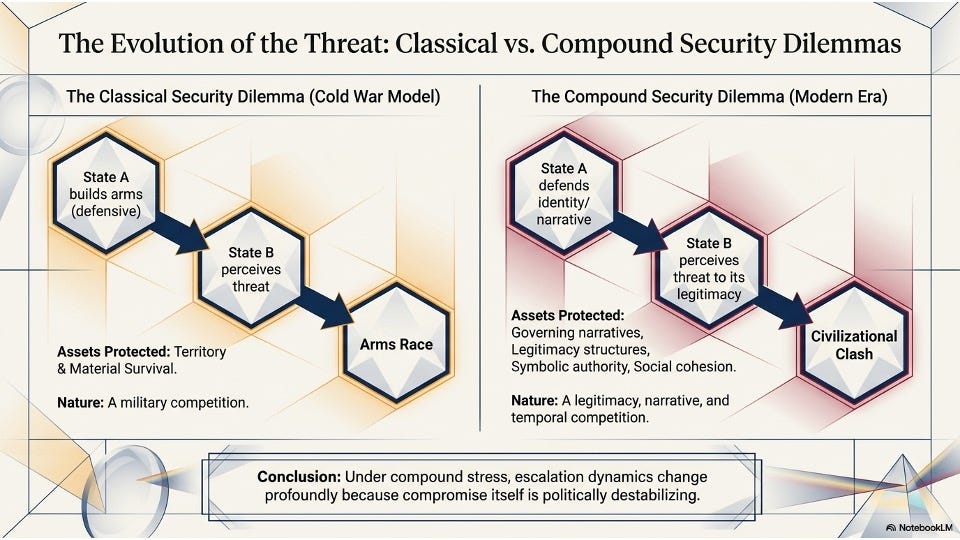
Because today’s rivalries are not merely military competitions.
They are legitimacy competitions.
Narrative competitions.
Identity competitions.
Temporal competitions.
Civilizational competitions.
This is where the framework of compound security becomes indispensable.
Under conditions of compound security stress, actors are not simply protecting territory or material assets. They are protecting:
governing narratives,
legitimacy structures,
symbolic authority,
social cohesion,
and perceptions of historical destiny.
This changes escalation dynamics profoundly.
Because once legitimacy becomes central, compromise itself can become politically destabilizing.
The IRGC cannot appear submissive to American coercion without undermining revolutionary legitimacy.
Trumpist America cannot appear weak before Iran without undermining performative strength narratives central to domestic political identity.
Thus both sides become trapped.
Each interprets the other’s behavior through its own rationality framework.
Each sees itself as defensive.
Each sees the other as aggressive.
Each believes escalation restores deterrence.
And each misunderstands the internal logic driving the other side’s actions.
This is not classical deterrence stability.
It is reciprocal legitimacy entrapment.
The Fatal Western Assumption: Everyone Ultimately Wants to Be Us
Since the end of the Cold War, much of Western strategic thought has operated on an implicit teleology:
that all societies, if sufficiently integrated into global markets and institutions, will eventually converge toward liberal-democratic norms.
This assumption shaped:
post-Cold War globalization,
NATO expansion logic,
Iraq War planning,
Afghanistan reconstruction,
sanctions strategies,
and engagement policies toward rivals.
The underlying belief was simple:
economic rationality would eventually supersede ideological, civilizational, or historical rationalities.
But this assumption repeatedly failed because humans do not live by material incentives alone.
People fight for:
identity,
memory,
belonging,
religion,
humiliation,
vengeance,
destiny,
and meaning.
Nations do as well.
Indeed, many societies willingly endure extraordinary material hardship in defense of symbolic or civilizational objectives.
Americans themselves once understood this intuitively.
After all, the American Revolution was hardly “rational” in strictly material terms.
Nor was the Union’s willingness to absorb catastrophic casualties during the American Civil War.
Nor was Britain’s endurance during the Blitz.
Nor Soviet resistance at Stalingrad.
Nor anti-colonial struggles across the twentieth century.
Human beings routinely subordinate material rationality to identity-based rationality.
Yet contemporary strategic discourse often forgets this.
The Strategic Danger of Mislabeling Others as Irrational
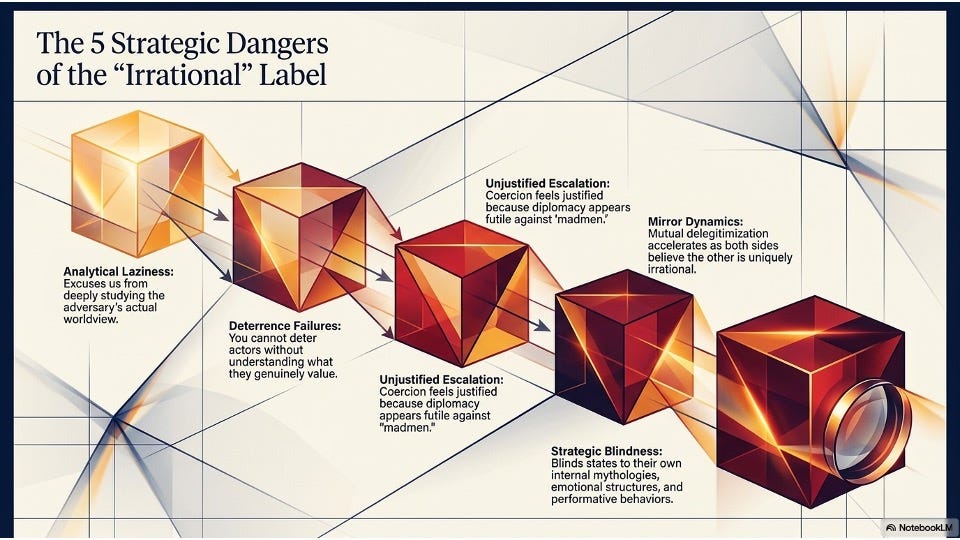
Declaring adversaries irrational creates several grave dangers.
First, it encourages analytical laziness.
If the other actor is irrational, one need not deeply study their worldview.
Second, it produces deterrence failures.
One cannot deter actors effectively without understanding what they truly value.
Third, it encourages escalation.
If adversaries are irrational, coercion appears more justified because diplomacy seems futile.
Fourth, it obscures mirror dynamics.
Often both sides believe the other side is uniquely irrational.
This mutual delegitimization accelerates conflict.
Finally, it blinds states to their own irrationalities.
Every political order possesses internal mythologies, emotional structures, and performative behaviors that outsiders may view as bizarre or dangerous.
The United States is no exception.
Toward Strategic Empathy Without Moral Relativism
To recognize alternative rationalities is not to morally endorse them.
Strategic empathy is not moral equivalence.
Understanding the IRGC’s logic does not require approving of repression or proxy violence.
Understanding Trumpist political rationality does not require endorsing democratic erosion or institutional destabilization.
But strategy requires comprehension before condemnation.
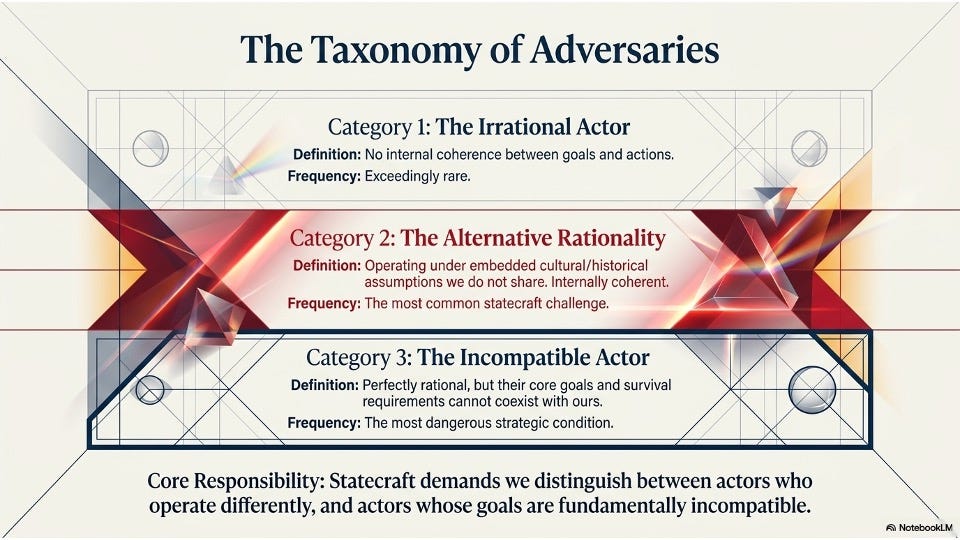
Indeed, one of the core responsibilities of statecraft is distinguishing between:
actors who are irrational,
actors who are operating under different assumptions,
and actors whose goals themselves are incompatible with ours.
These are not the same thing.
The truly irrational actor is exceedingly rare.
Far more common are actors operating according to rationalities we neither share nor fully understand.
The Tragedy of Rival Rationalities
The greatest tragedies in international politics often emerge not because one side lacks rationality, but because multiple rationalities collide without shared interpretive frameworks.
Athens and Sparta each believed themselves rational.
Britain and Germany did as well in 1914.
Washington and Hanoi did as well in Vietnam.
Washington and Moscow did throughout the Cold War.
And today, Washington and Tehran each continue to believe the same.
The danger is not merely miscalculation.
It is mutual incomprehension.
Each side increasingly inhabits a different strategic universe.
Each side believes the other incapable of understanding strength.
Each side sees compromise as weakness.
Each side interprets restraint as vulnerability.
And each side believes history vindicates its worldview.
This is the essence of the modern compound security dilemma:
not simply competing interests, but competing realities.
Conclusion: The First Duty of Strategy
The first duty of strategy is not prediction.
It is understanding.
And understanding begins with intellectual humility:
the recognition that one’s own rationality is neither universal nor self-evidently superior.
To call others irrational is often to confess the limits of one’s own imagination.
The statesman, strategist, or analyst who cannot inhabit—even temporarily—the worldview of an adversary is already operating at a disadvantage.
Because wars are rarely fought between madmen and rational actors.
More often, they are fought between rival systems of meaning, each convinced of its own reasonableness, each unable to fully comprehend the other, and each certain that history itself stands on its side.
That is not irrationality.
That is tragedy.
If you value this work, here are three ways you can step into the story with us:
📰 Subscriber (Free)
Stay informed. Receive every new essay, briefing, and analysis straight to your inbox. Join a growing community committed to civic resilience and national security.
🎧 Supporter (Paid Pledge)
Strengthen the signal. Your support sustains both Compound Security, Unlocked and our companion podcast The Civic Brief. Supporters ensure these conversations remain accessible to the wider public while elevating the quality, depth, and reach of the work.
🛡️ Sustainer (Patron Level)
Invest in the mission. Sustainers fuel new research, convenings, and storytelling that enlarge the civic frame of security. This is more than content — it’s a civic project. Your sponsorship helps preserve an independent voice committed to equipping citizens, leaders, and institutions for the compound challenges ahead.