

We are racing to build machines that can think. We should be equally concerned about whether we are still learning how to.
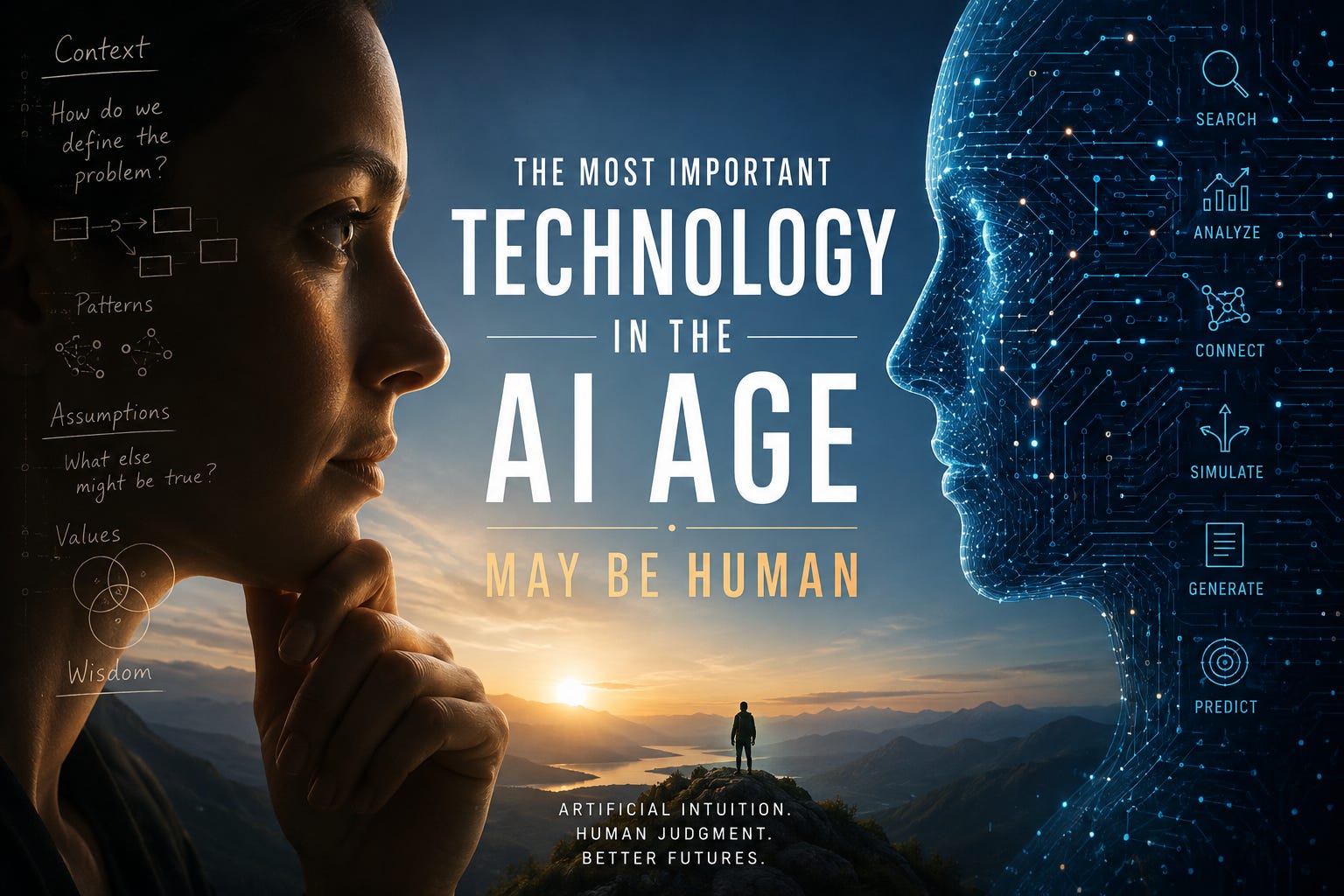
Artificial intelligence is getting astonishingly good at giving us answers.
That may not be the unqualified good we imagine it to be.
The great competition of the AI age is usually described as a race for better models, more computing power, larger data sets, faster processors, and increasingly autonomous machines. Nations are racing. Corporations are racing. Militaries are racing. Universities are racing.
But I increasingly suspect we are watching the wrong race.
The consequential competition may not ultimately be between humans and artificial intelligence.
It may be between artificial intelligence and human judgment.
And in that competition, the danger is not that the machine becomes too intelligent.
The danger is that we become less so.
There is an important distinction here.
Intelligence is not the same thing as judgment. Information is not understanding. Prediction is not wisdom. Optimization is not strategy. And generating an answer is not the same thing as making sense of a situation.
AI is extraordinarily capable at the former.
Human beings remain uniquely responsible for the latter.
That distinction matters enormously because the world into which AI is arriving is not becoming simpler. It is becoming more interconnected, accelerated, ambiguous, and consequential. Climate, technology, economics, information, military power, politics, identity, and social trust increasingly collide with one another.
I call this compound complexity.
In such an environment, the hardest problems rarely announce themselves clearly. The data are incomplete. Causes interact. Effects cascade. Adversaries adapt. Values conflict. Yesterday’s solution becomes tomorrow’s vulnerability.
There often isn’t a single correct answer waiting to be calculated.
Someone must first determine what is actually happening.
That is sensemaking.
And sensemaking may become one of the most valuable human capabilities of the twenty-first century.
For decades we have built technologies that extend human physical power. Engines made us stronger. Aircraft made us faster. Computers expanded our ability to calculate. Networks expanded our ability to communicate.
Artificial intelligence is different.
For the first time at enormous scale, we are building technology that can occupy part of the cognitive space between information and decision.
That creates extraordinary possibilities.
It also creates an extraordinary temptation:
to outsource the thinking along with the computation
The machine searches. The machine summarizes. The machine recommends. The machine drafts. The machine forecasts.
Eventually, perhaps without noticing it, the human role can shrink from thinking to approving.
And that is precisely where we should become cautious.
Because judgment is not a resource we simply possess.
It is a capability we develop.
We develop it through experience, failure, reflection, disagreement, uncertainty, pattern recognition, moral reasoning, and the accumulation of what Michael Polanyi famously called tacit knowledge—knowing more than we can fully explain.
Call the resulting capability artificial intuition.
Not intuition instead of analysis.
Not instinct instead of evidence.
Artificial intuition is cultivated human judgment: the deliberate development of our ability to recognize patterns, interrogate assumptions, connect seemingly unrelated signals, detect anomalies, understand context, and decide responsibly when neither the data nor the algorithm can tell us with certainty what something means.
That may sound paradoxical in an age obsessed with artificial intelligence.
I think it is exactly the point.
The proper relationship between humans and AI should therefore not be competition.
Nor should it be surrender.
It should be complementarity.
Let machines do what machines increasingly do extraordinarily well: search enormous information spaces, detect correlations, model alternatives, test assumptions, generate possibilities, and reveal patterns beyond unaided human cognition.
But preserve—and deliberately strengthen—the human capabilities machines cannot relieve us of responsibility for exercising:
judgment,
context,
meaning,
imagination,
ethics,
wisdom,
and ultimately, choice.
The most powerful operating system of the AI age may therefore not be artificial intelligence alone.
It may be the combination of machine intelligence and cultivated human intuition.
AI expands the field of the possible.
Human judgment determines what matters.
AI can tell us what patterns exist.
Human beings must decide what those patterns mean.
AI can generate courses of action.
Human beings must determine which futures are worth pursuing.
And AI can increasingly help us answer questions.
But humans must retain responsibility for something much more important:
asking the right ones.
That is the argument I develop more fully in the attached essay, The Most Important Technology in the AI Age May Be Human: Artificial Intuition and the Human-Machine Operating System for Compound Complexity.
The central proposition is deliberately simple:
The more powerful artificial intelligence becomes, the more valuable genuinely human intelligence becomes.
The future does not belong to the machine.
Nor does it belong to the human who refuses the machine.
It belongs to those who learn how to combine the two—without forgetting which one must ultimately decide why.
Perhaps the defining technology of the AI age will turn out to be us.

If you value this work, here are three ways you can step into the story with us:
📰 Subscriber (Free)
Stay informed. Receive every new essay, briefing, and analysis straight to your inbox. Join a growing community committed to civic resilience and national security.
🎧 Supporter (Paid Pledge)
Strengthen the signal. Your support sustains both Compound Security, Unlocked and our companion podcast The Civic Brief. Supporters ensure these conversations remain accessible to the wider public while elevating the quality, depth, and reach of the work.
🛡️ Sustainer (Patron Level)
Invest in the mission. Sustainers fuel new research, convenings, and storytelling that enlarge the civic frame of security. This is more than content — it’s a civic project. Your sponsorship helps preserve an independent voice committed to equipping citizens, leaders, and institutions for the compound challenges ahead.
A few quick notes...It feels like drinking out of a firehose keeping up with AI evolution and the quest for AGI/sentience:. The fatigue is real.
Debates over AI sentience and general intelligence are distracting us from a far more urgent risk: transhuman enhancement is quietly creating permanent biological inequality, turning money and power into irreversible genetic and physiological advantage that will split humanity into a superior enhanced class and a permanent unenhanced underclass.
The U.S. military’s new testosterone screening program exemplifies exactly how this danger unfolds—deliberately erasing the critical line between therapy (curing disease) and enhancement (surpassing normal human limits), redefining natural age-related decline as a defect requiring treatment, and masking coercion as voluntary choice, so that enhanced service members will eventually re-enter civilian life with permanent advantages that will be bought and sold, creating a biological caste system no amount of policy or wealth redistribution can ever fix.