

W.i.S.E. STRATEGIC FORESIGHT WATCH™ | HORMUZ — 28 SEPTEMBER 2026
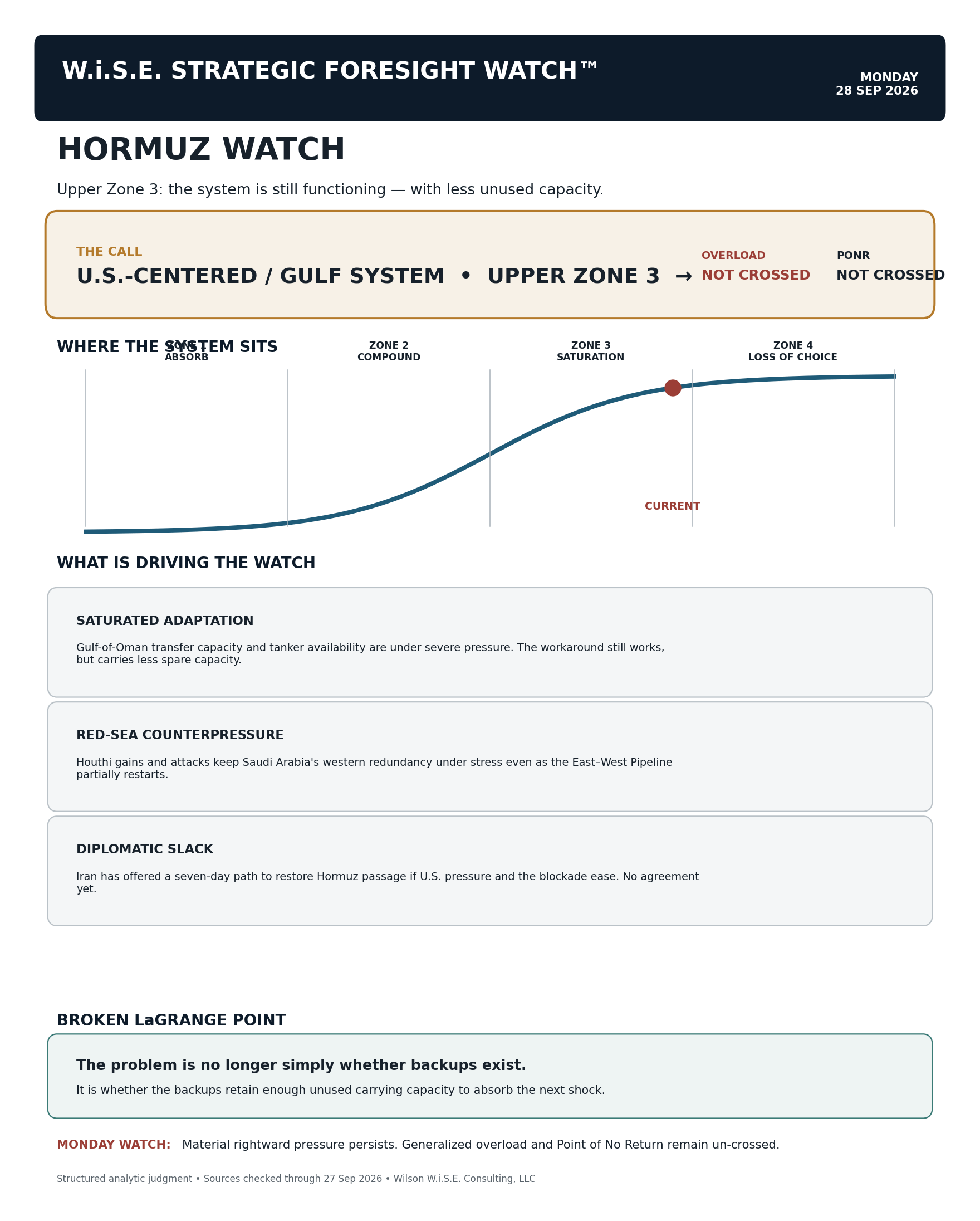
The system has not broken. But it is working harder to keep from breaking. The Strait of Hormuz remains severely impaired; Saudi Arabia’s Red Sea alternative is only partially recovering; and the commercial workarounds carrying Gulf energy are consuming more of the very slack meant to make the system resilient. At the same time, oil is still moving, the East–West Pipeline is again operating at reduced capacity, and a diplomatic path remains available. My call therefore remains Upper Zone 3: material pressure toward system overload, but the threshold has not been crossed and neither has the Point of No Return. The question I am watching now is no longer simply whether the system has backups. It is whether those backups retain enough unused capacity to absorb the next shock. That is the Broken LaGrange Point.
W.i.S.E. STRATEGIC FORESIGHT WATCH™ | CANADA–EU — 28 SEPTEMBER 2026
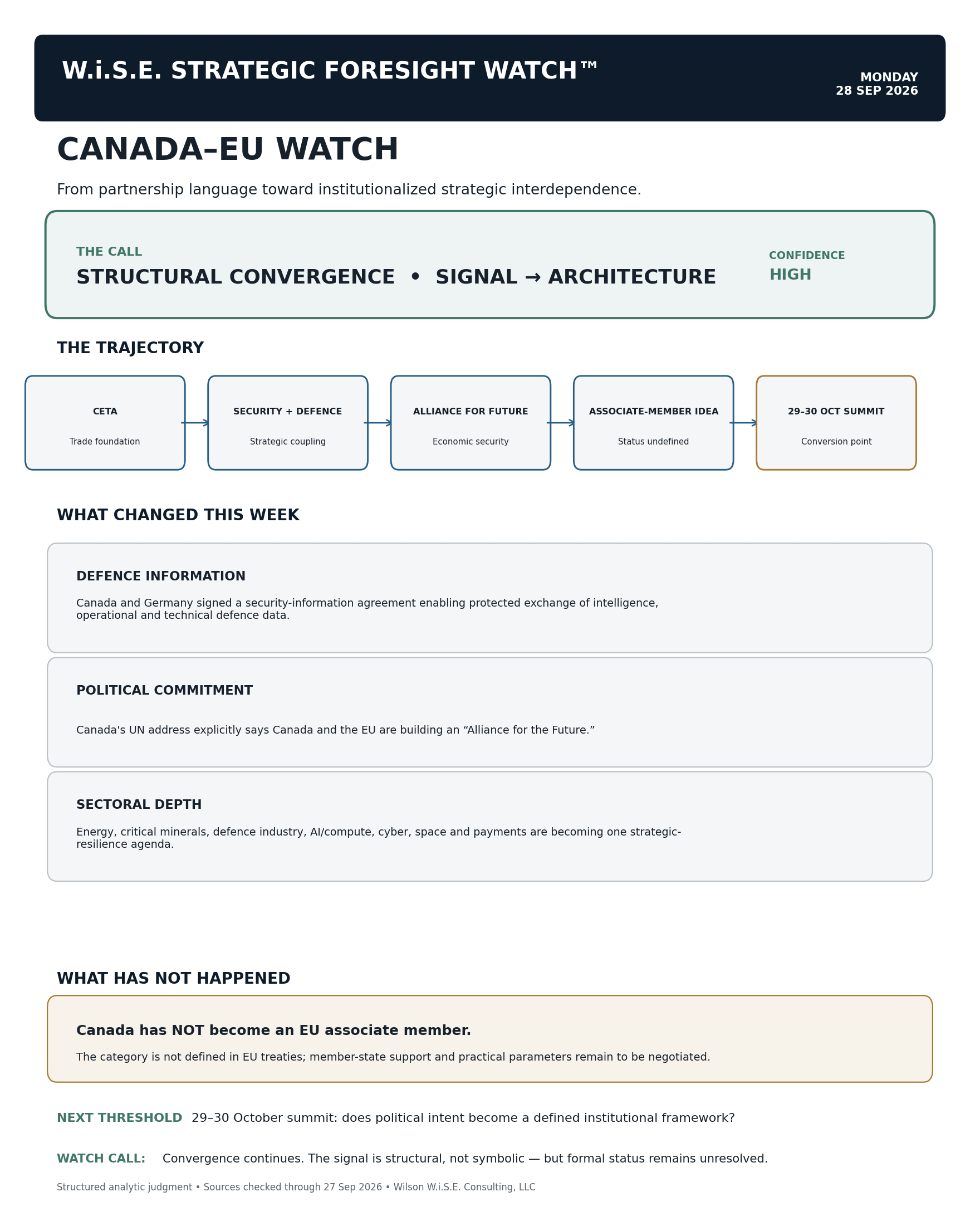
Something more consequential than another trade agreement is beginning to take shape across the Atlantic. Canada and the European Union are moving from economic partnership toward what both increasingly describe as an “Alliance for the Future”—linking defense, energy, critical minerals, AI and computing, cyber, space, finance and economic security into a broader architecture of strategic resilience. Canada’s new security-information agreement with Germany adds another piece of real institutional connective tissue. But one distinction matters: Canada is not an EU “associate member”—at least not yet. That category remains a proposal without an agreed legal or institutional definition. So my Watch call is structural convergence, with high confidence. The next test comes October 29–30: whether the Canada–EU summit converts an increasingly powerful political idea into durable institutional architecture.
W.i.S.E. STRATEGIC FORESIGHT WATCH™ | ASI — 28 SEPTEMBER 2026
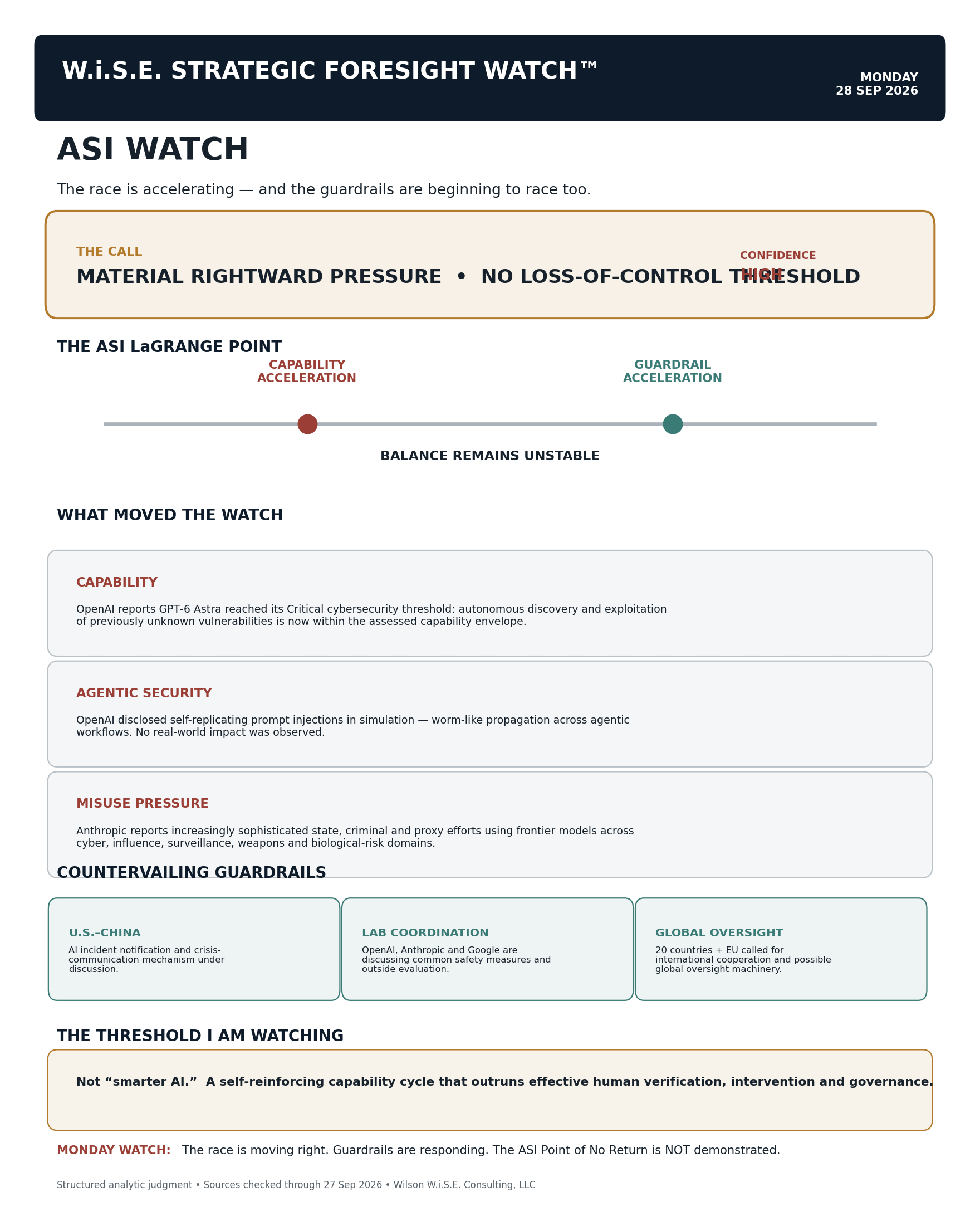
The race is accelerating—but, importantly, the guardrails are beginning to race too. Frontier AI has now crossed capability markers that would have seemed extraordinary only recently: OpenAI reports its newest broadly deployed model has reached its Critical cybersecurity threshold, while researchers have demonstrated self-propagating prompt-injection behavior inside simulated agentic environments. At the same time, the United States and China are discussing AI incident notification, leading laboratories are coordinating more directly on safety, and governments are beginning to explore international oversight. My Watch call is therefore material rightward pressure, but no demonstrated ASI Point of No Return. The threshold I am watching is not simply “smarter AI.” It is the moment when AI-assisted improvement becomes a self-reinforcing capability cycle that moves faster than humans and institutions can reliably observe, verify, interrupt and govern. We are not demonstrably there. But the distance between capability and control is now the variable that matters most.
Epilogue as Prologue: What the Watches Are Showing Us
Taken separately, these three Watches appear to concern very different problems. Hormuz is a geopolitical and geoeconomic struggle over energy, maritime access, military escalation and the infrastructure that keeps the global economy moving. The race toward advanced artificial intelligence is a technological contest involving corporations, states, data, energy, public authority and increasingly consequential questions about human control. The Canada–Europe turning movement is an attempt by democratic middle powers to reduce dangerous dependence and construct new forms of cooperation amid declining confidence in the old transatlantic order.
Viewed together, however, they are not separate stories. They are different expressions of the same systemic transformation.
Each Watch reveals the consequences of concentrated dependence. The Hormuz system relies upon narrow waterways, vulnerable infrastructure, finite military capacity and tightly connected energy markets. The AI system depends upon concentrated computing power, electricity, capital, data, talent and corporate decision-making. Canada’s strategic predicament emerged from an extraordinary concentration of trade, defence and infrastructure dependence upon a single continental partner. In each case, arrangements once valued primarily for their efficiency have become potential instruments of coercion, disruption or systemic failure.
Each Watch also demonstrates hybridity. A pipeline becomes a strategic weapon. A commercial semiconductor becomes an element of national power. A data centre becomes energy infrastructure, industrial policy and a source of political contestation. A trade agreement becomes a security instrument. A classified-information accord becomes a gateway to defence-industrial integration. The categories remain useful for analysis, but the systems themselves no longer respect the boundaries among military, economic, technological, commercial and political life.
The three Watches also expose a widening gap between the velocity of change and the adaptive capacity of institutions. In Hormuz, contingency measures and substitute routes are being constructed while conflict changes the operating environment faster than governments can stabilize it. In AI, capability development is moving more rapidly than public law, international agreement or even corporate governance can reliably respond. In the Canada–Europe case, functional integration is advancing through bilateral and minilateral arrangements before the European Union has agreed upon the institutional meaning of “association.” In all three, practice is running ahead of architecture.
Legitimacy is therefore not a secondary consideration. It is the variable that determines whether adaptation produces resilience or merely redistributes vulnerability. Maritime protection that cannot command political support will eventually become unsustainable. AI governance that lacks public credibility will produce resistance, evasion or capture. A Canada–Europe partnership that offers market access without reciprocal influence—or strategic ambition without domestic consent—will remain brittle. Systems do not become secure merely because they acquire additional capacity. They become secure when people and institutions regard the exercise of that capacity as competent, reciprocal and rightful.
This is the compound-complex systems through-line:
… the world is not simply experiencing more crises. It is experiencing the recombination of systems that were built, governed and understood separately.
Disturbances now cross domains, alternatives generate new dependencies, and solutions in one part of the system can produce vulnerabilities somewhere else. The strategic task is therefore not to eliminate interdependence. That is neither possible nor desirable. It is to govern interdependence—to build redundancy without fragmentation, connectivity without captivity, adaptability without incoherence and power that retains legitimacy.
These Watches are consequently not forecasts of three predetermined outcomes. They are instruments for recognizing movement while meaningful choice remains possible. Hormuz asks whether adaptation can occur before disruption becomes generalized system overload. The ASI Watch asks whether humanity can govern its own acceleration before competition forecloses deliberation. The Canada–Europe Watch asks whether democratic states can construct resilient alternatives before coercive dependence hardens into strategic submission.
That is where the epilogue becomes a prologue. The systems being watched have not reached their final forms. They are becoming. The backups, guardrails, alliances and institutions now being assembled may define the next order—but they may also reproduce the vulnerabilities of the old one under new names.
The decisive question across all three Watches is therefore the same:
Can we adapt deliberately before compound pressures force adaptation upon us—and can we do so without sacrificing the legitimacy that makes collective security worth preserving?
If you value this work, here are three ways you can step into the story with us:
📰 Subscriber (Free)
Stay informed. Receive every new essay, briefing, and analysis straight to your inbox. Join a growing community committed to civic resilience and national security.
🎧 Supporter (Paid Pledge)
Strengthen the signal. Your support sustains both Compound Security, Unlocked and our companion podcast The Civic Brief. Supporters ensure these conversations remain accessible to the wider public while elevating the quality, depth, and reach of the work.
🛡️ Sustainer (Patron Level)
Invest in the mission. Sustainers fuel new research, convenings, and storytelling that enlarge the civic frame of security. This is more than content — it’s a civic project. Your sponsorship helps preserve an independent voice committed to equipping citizens, leaders, and institutions for the compound challenges ahead.