
The Knowledge Trap
Artificial Intelligence, Wargaming, and the Next Paradox of Western Strategy.

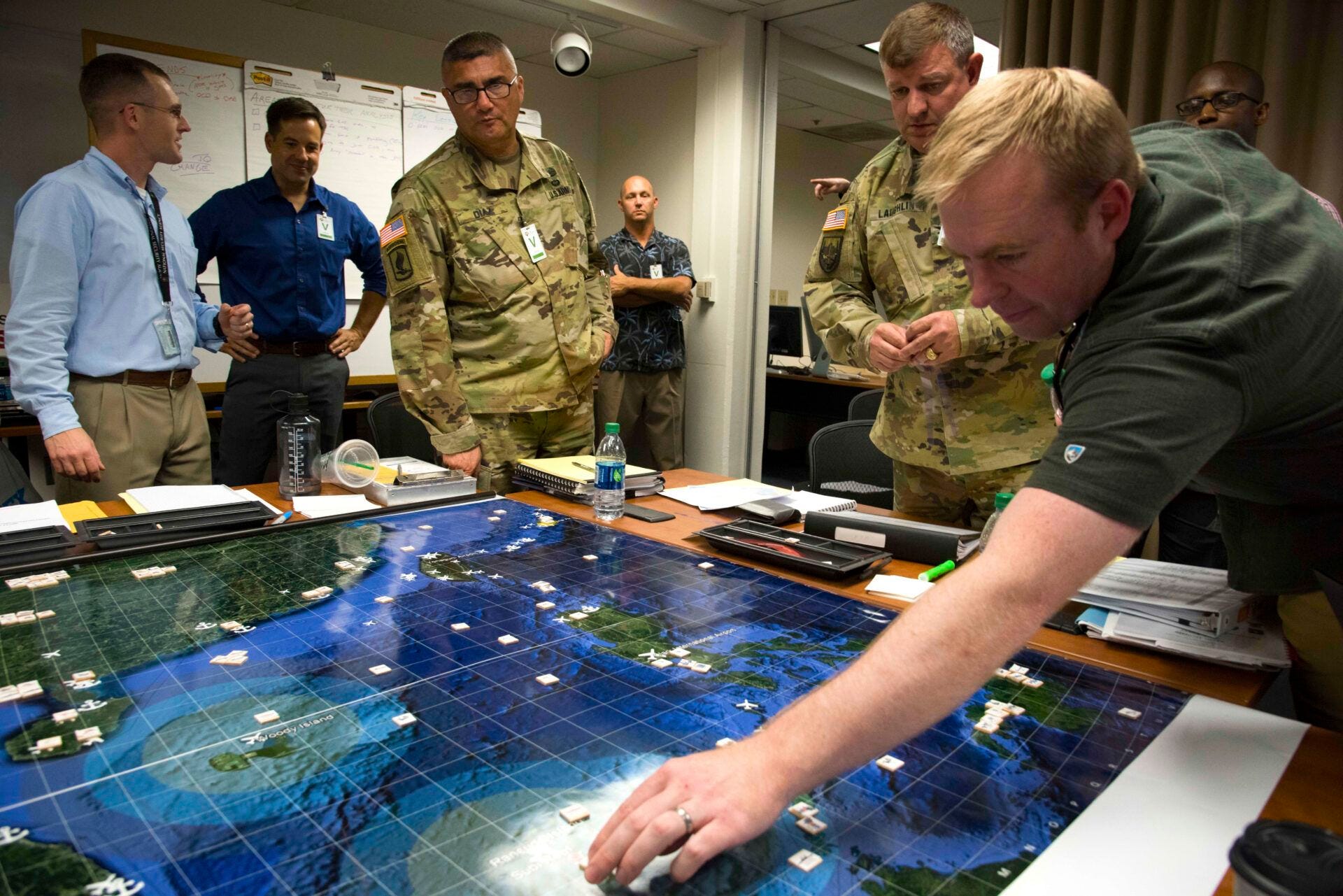
There is a quiet revolution underway in the practice of strategy.
It is not taking place on battlefields or in national capitals, nor is it confined to research laboratories developing ever more sophisticated artificial intelligence.
Rather, it is occurring within the architecture of strategic knowledge itself—in the assumptions embedded in military education, in the models that structure contemporary wargames, in the simulations through which future leaders rehearse decisions, and increasingly in the training data from which artificial intelligence learns to reason about war, peace, and geopolitical competition.
This revolution has attracted remarkably little attention.
Public debate surrounding artificial intelligence in national security has largely centered on autonomous weapons, machine-speed decision making, cyber operations, and the ethical implications of delegating lethal authority to algorithms.
These are undeniably important questions. Yet they presuppose a more fundamental one that has received comparatively little scrutiny: What conception of strategy are we teaching these systems to learn?
Artificial intelligence does not invent strategic theory. It inherits it.
Every large language model, every decision-support architecture, every campaign planning assistant, and every strategic simulation derives its reasoning from an accumulated body of human knowledge.
That knowledge is neither neutral nor comprehensive. It reflects decades—often centuries—of accumulated assumptions about the nature of conflict, the purposes of military power, the meaning of victory, and the relationship between force and politics.
AI therefore learns not only from our successes but also from our omissions. It absorbs our frameworks as readily as our facts, our blind spots as readily as our insights.
This observation points toward a broader and more unsettling proposition….
Strategic failure is not always the product of inadequate information or flawed execution. Sometimes it originates much earlier, in the conceptual architecture through which problems are framed.
Institutions rarely reason beyond the boundaries of the models through which they understand the world. When those models privilege certain variables while obscuring others, they do more than organize information—they shape what decision makers perceive to be possible, relevant, or even imaginable.
For generations, that conceptual architecture has been reproduced through doctrine, professional military education, planning methodologies, historical case studies, and increasingly sophisticated strategic simulations.
Wargames have long been regarded as laboratories of strategic innovation, places where ideas compete before they encounter the unforgiving realities of war. At their best, they expose hidden assumptions, reveal unexpected interactions, and challenge prevailing orthodoxies.
Yet simulations are never merely mirrors of reality. They are theories of reality. Every rule, every scoring mechanism, every victory condition, every abstraction, and every omitted variable reflects an underlying judgment about how the world works and what constitutes strategic success.
That insight becomes especially consequential as artificial intelligence begins to occupy a central place within strategic planning.
Increasingly, AI is not simply assisting in the execution of strategy; it is participating in its formulation. It identifies patterns, generates courses of action, evaluates alternatives, and increasingly shapes the questions that human decision makers ask.
If the strategic knowledge upon which these systems are trained systematically privileges military operations over political purpose, tactical efficiency over legitimacy, or state security over human security, then artificial intelligence will not correct those imbalances.
It will learn them, reproduce them, and eventually amplify them with extraordinary speed and apparent precision.
The result is a new category of strategic risk.
We have become accustomed to thinking about technological surprise, intelligence failures, bureaucratic inertia, and organizational resistance to change. Yet the most consequential danger may lie deeper still, within the architecture of knowledge that precedes them all.
Before organizations become trapped by obsolete doctrines, they first become trapped by obsolete ways of knowing. Before artificial intelligence can recommend flawed strategies, it must first inherit flawed conceptions of strategy itself.
This article argues that the West has arrived at such a moment.
For much of the twentieth century, strategic institutions were shaped by the organizational imperatives of the industrial age. During the opening decades of the twenty-first century, those inherited assumptions increasingly collided with forms of conflict that proved more adaptive, more decentralized, and more politically embedded than conventional military theory anticipated.
Today, however, a new transition is underway.
The challenge is no longer simply organizational. It is epistemological. As artificial intelligence becomes woven into the fabric of strategic education, planning, and decision support, inherited theories of war risk becoming embedded within the cognitive architecture of the machines themselves.
I describe this phenomenon as epistemological lock-in: the progressive institutionalization of inherited strategic assumptions until alternative ways of understanding political competition become increasingly difficult to recognize, evaluate, or even imagine.
Unlike organizational inertia, epistemological lock-in operates beneath the surface of doctrine and technology. It shapes the conceptual boundaries within which both humans and machines reason about strategy. It narrows not merely what institutions do, but what they believe can be done.
This concern does not arise from opposition to artificial intelligence, nor from skepticism toward wargaming or strategic simulation. On the contrary, both are indispensable to the future of statecraft.
The question is whether the intellectual foundations upon which they are built remain adequate to the character of geopolitical competition now emerging. If the central objective of strategy is the achievement of political purposes, then the systems through which strategists—and increasingly strategic AI—learn must be calibrated not merely to model the conduct of war, but to understand the conditions under which legitimate political order, adaptive governance, and human security are created, sustained, and defended.
The future of strategic competition may therefore depend less upon building more intelligent machines than upon ensuring that both our institutions and our machines inherit a more complete understanding of what strategy is actually for.
II. The Hidden Curriculum of Strategy
Every profession educates in two ways.
There is the formal curriculum—the doctrines, theories, methodologies, and canonical texts through which practitioners consciously acquire knowledge. Then there is the hidden curriculum: the assumptions, habits of thought, and intuitive judgments that practitioners absorb almost imperceptibly through repeated practice.
It is often the latter that proves more enduring.
Professionals may forget particular lessons, revise doctrinal publications, or adopt new technologies, but the cognitive architecture through which they interpret the world often remains remarkably stable across generations.
Strategy is no exception.
Military institutions devote enormous attention to the formal curriculum. Officers study history, campaign design, operational art, logistics, international politics, economics, emerging technologies, and increasingly data science and artificial intelligence. They learn to analyze adversaries, evaluate risks, develop courses of action, and integrate military power with other instruments of national policy.
Yet much of what ultimately shapes strategic judgment is acquired elsewhere—not in lectures or assigned readings, but through repeated participation in planning exercises, command post rehearsals, and increasingly sophisticated strategic simulations.
Wargames occupy a unique position within this educational ecosystem because they do more than communicate knowledge. They construct experience. Participants are not merely told how strategy works; they inhabit a simulated strategic environment in which certain decisions appear natural, certain variables matter, certain incentives dominate, and certain outcomes are rewarded.
Long before participants consciously articulate a theory of strategy, they begin internalizing one through practice.
That distinction is more consequential than it first appears.
Educational psychology has long demonstrated that experiential learning frequently exerts greater influence over subsequent behavior than abstract instruction.
Individuals tend to privilege what they have experienced over what they have merely read. Simulations therefore possess unusual power to shape professional intuition.
They create what might be described as strategic muscle memory. Participants learn not simply what to think but how to think, which questions deserve immediate attention, which uncertainties can safely be ignored, and what successful strategic performance feels like.
This is precisely why simulations deserve closer analytical scrutiny than they have generally received.
Much contemporary discussion evaluates simulations according to their fidelity. Do they accurately represent military capabilities? Are weapon effects realistic? Are logistical constraints properly modeled? Does the artificial intelligence behave plausibly? Are intelligence estimates sufficiently dynamic?
These are important questions, but they remain largely technical. They evaluate whether the model faithfully represents those aspects of reality that the designers have chosen to include.
They ask much less frequently whether the simulation itself rests upon an adequate conception of strategic reality.
The distinction is critical.
A simulation may model military operations with extraordinary sophistication while remaining strategically incomplete. Every model necessarily simplifies reality.
No simulation can incorporate every political institution, economic relationship, cultural dynamic, informational feedback loop, or social adaptation occurring simultaneously within a geopolitical system.
Abstraction is unavoidable.
The problem is therefore not simplification itself. The problem lies in which realities are simplified, which are omitted altogether, and which become the organizing logic around which every other variable revolves.
Those choices are never neutral.
They reflect an implicit ontology—a theory about what the world fundamentally consists of and how strategic outcomes are produced.
For much of the modern era, Western strategic thought has understandably privileged the operational employment of military force. This emphasis emerged from historical experience.
The industrial wars of the nineteenth and twentieth centuries demanded unprecedented mastery of mobilization, logistics, combined arms operations, technological innovation, and coalition warfare. Strategic success often depended upon the effective synchronization of massive military organizations operating across multiple theaters. The intellectual achievements associated with operational art were genuine and transformative.
Yet success within one historical context can quietly become a cognitive inheritance within another.
As institutions mature, their methods of education often preserve the intellectual architecture that produced earlier successes. Concepts that initially emerged as context-specific adaptations gradually become generalized into broader theories of strategy.
Over time, what began as one historically contingent understanding of war becomes increasingly treated as the natural structure of geopolitical competition itself.
The consequences extend well beyond military doctrine.
The architecture of many strategic simulations reflects precisely this inheritance. Military organizations, force postures, operational timelines, escalation dynamics, targeting priorities, and campaign sequencing frequently occupy the analytical center of gravity. Political leadership appears largely through decision nodes. Diplomatic activity becomes episodic. Economic instruments often function as modifiers rather than independent systems of competition. Public legitimacy, institutional trust, societal adaptation, demographic change, migration, public health, financial resilience, and the lived experience of civilian populations frequently occupy the margins of the model, if they appear at all.
This is not a criticism of any particular simulation.
It is an observation about an intellectual tradition.
Indeed, such simplifications are often entirely reasonable when the purpose of a simulation is to examine a narrowly defined military problem. A theater campaign, an air defense architecture, a maritime engagement, or a logistics network can each be usefully isolated for analytical purposes.
Difficulties emerge, however, when simulations designed around operational questions gradually become treated as representations of geopolitical competition itself.
At that point, the relationship between means and ends subtly begins to invert.
Military operations, originally modeled as instruments serving political objectives, increasingly become the principal objects of analysis.
Strategic success is measured through campaign performance rather than political consequence. The conduct of war(fare) receives richer representation than the political conditions for which war is ostensibly undertaken.
The simulation remains internally coherent, yet its coherence derives from an increasingly narrow representation of reality.
The irony is striking.
Modern strategy has repeatedly affirmed the central insight that military force derives its meaning from political purpose. This proposition is so familiar that it risks becoming little more than ceremonial language.
Yet familiarity should not be confused with operational fidelity. Institutions often profess one theory while educating according to another. The hidden curriculum resides precisely within this gap.
Participants need not consciously reject the primacy of politics. They need only spend years operating within environments in which political legitimacy, societal resilience, institutional adaptation, and human security remain comparatively underrepresented relative to the operational employment of force.
Gradually, without deliberate intention, military excellence becomes psychologically associated with strategic excellence. The distinction between operational success and political success begins to blur.
The result is not militarism.
It is something subtler and perhaps more consequential: strategic reductionism.
Complex systems of political competition become increasingly interpreted through those variables that the educational architecture renders most visible. Problems whose decisive dynamics lie within legitimacy, governance, social cohesion, economic adaptation, or human security are unconsciously translated into operational challenges because operational challenges are the forms of complexity the institution has become most practiced at understanding.
This is the hidden curriculum of strategy.
It does not tell future leaders that politics is unimportant.
It simply teaches them, through repeated experience, that politics is less knowable than operations, less measurable than campaigns, less actionable than force, and therefore less central to the practice of strategy itself.
That lesson has shaped generations of strategic thought.
It also provides the foundation upon which the next section builds. For once the architecture of learning privileges certain forms of knowledge over others, it does more than influence judgment. It begins to generate systematic patterns of analytical error—errors that are neither random nor accidental, but structural.
Understanding those errors is essential to understanding why even increasingly sophisticated simulations can produce increasingly confident, yet strategically incomplete, conceptions of geopolitical competition.
III. The Architecture of Error
No system of knowledge is complete.
Every discipline, every institution, every analytical framework, and every model of reality necessarily simplifies the world it seeks to understand. Complexity itself makes this unavoidable.
The central question is therefore not whether simplification occurs, but whether the simplifications systematically distort the phenomena that matter most.
Strategic analysis is especially vulnerable to this problem because its object of study is not a stable physical system but a continuously adapting political one.
States learn. Societies adapt. Institutions evolve. Adversaries observe one another, imitate successful practices, exploit hidden vulnerabilities, and deliberately seek to invalidate prevailing assumptions.
Strategy therefore unfolds within what might best be understood as an evolving ecology of human systems rather than within a fixed mechanical environment.
The more dynamic the system, the greater the danger that inherited analytical frameworks begin explaining yesterday’s realities more effectively than today’s.
This is where the language of error becomes useful.
Within statistics and decision science, analysts distinguish between two broad categories of error.
A Type I error occurs when one concludes that a phenomenon exists when it does not—a false positive.
A Type II error occurs when one fails to recognize a phenomenon that actually exists—a false negative.
Although these concepts originated within statistical inference, they possess much broader relevance when applied to strategic reasoning.
The architecture of strategic knowledge can itself become predisposed toward particular forms of error.
Consider first the dynamics of false positives. Strategic institutions routinely devote enormous analytical effort toward identifying emerging military threats, estimating adversary capabilities, projecting operational timelines, and anticipating escalation pathways. These activities are indispensable.
Yet when analytical architectures privilege military variables above all others, they also increase the probability that political problems will increasingly be interpreted as military ones.
Every complex geopolitical competition begins to resemble a campaign awaiting execution. Every uncertainty appears susceptible to operational solutions.
Every crisis acquires a military center of gravity whether or not one actually exists.
The result is not necessarily the overuse of force.
Rather, it is the over-identification of military relevance.
Force becomes cognitively salient because the analytical architecture renders it persistently visible.
Other dimensions of competition—legitimacy, institutional trust, social adaptation, demographic transformation, economic resilience, informational ecosystems, public health, or the cumulative effects of human insecurity—remain comparatively less observable.
Their strategic significance does not disappear; it simply becomes progressively more difficult to perceive within prevailing analytical frameworks.
Type II errors emerge from precisely this invisibility.
Perhaps the greatest strategic failures of the past half century have not resulted from misunderstanding military operations. Western militaries have demonstrated extraordinary competence in planning, executing, and adapting operational campaigns.
Rather, many disappointments have originated from misunderstanding the political systems within which those campaigns unfolded. The collapse of institutional legitimacy, the resilience of insurgent governance, the adaptive capacity of local populations, the social dynamics of occupation, the long-term erosion of public trust, and the cumulative effects of human insecurity frequently proved more decisive than the relative balance of military capability itself.
Yet these dynamics rarely announce themselves with the same clarity as troop movements, missile inventories, or battlefield engagements.
They emerge gradually.
They accumulate quietly.
They often become visible only after institutional adaptation has already begun.
Human systems possess thresholds. Legitimacy rarely disappears overnight. Social cohesion seldom collapses in a single event. Trust erodes incrementally before suddenly appearing to fail catastrophically. Adaptive political systems frequently absorb extraordinary stress while displaying remarkably few outward indicators of impending transformation. Then, often unexpectedly, seemingly stable arrangements reorganize themselves with astonishing speed.
Such behavior is familiar within the study of complex adaptive systems.
It is considerably less familiar within many traditional approaches to strategic assessment.
Consequently, the architecture of strategic knowledge often privileges variables that are immediately measurable over variables that are strategically decisive. Military movements can be counted. Force ratios can be calculated. Precision strike effectiveness can be estimated. Human dignity cannot be reduced to a targeting matrix. Institutional legitimacy cannot be fully represented through a single quantitative indicator. Public trust rarely conforms to linear causal relationships.
The temptation therefore becomes obvious.
Analytical attention gravitates toward those variables that lend themselves to measurement while progressively marginalizing those that resist simplification.
This represents far more than a methodological preference.
It constitutes a structural bias within the production of strategic knowledge itself.
The consequences extend directly into simulation design.
Every simulation requires designers to determine which variables remain endogenous to the model and which become exogenous assumptions. Those choices shape not only computational efficiency but intellectual emphasis. Variables represented dynamically within the model naturally command participants’ attention because they respond to decisions made during play. Variables treated as fixed assumptions gradually recede into the background regardless of their actual strategic importance.
This distinction carries profound implications.
If military operations evolve dynamically while political legitimacy remains largely static, participants will naturally devote greater attention to operational adaptation than to political adaptation. If force employment generates immediate and observable consequences while changes in public trust remain weakly represented or absent altogether, players gradually internalize an intuitive understanding that military decisions matter more because the model itself demonstrates their importance more visibly.
Over time, repeated exposure to such architectures produces a subtle but powerful cognitive calibration.
Participants become increasingly proficient at recognizing those forms of complexity the simulation repeatedly rewards.
Equally important, they become progressively less practiced at recognizing forms of complexity the simulation routinely suppresses.
Learning, in other words, is not merely additive.
It is selective.
Every educational architecture simultaneously illuminates certain dimensions of reality while casting others into shadow.
This is precisely why simulations should never be evaluated solely according to technical realism. A model may reproduce operational interactions with extraordinary fidelity while simultaneously generating systematic Type I and Type II errors regarding the larger political system within which those operations occur. The simulation can become increasingly accurate within an increasingly incomplete representation of reality.
Indeed, there exists a paradox at the heart of strategic modeling.
Greater computational sophistication does not necessarily produce greater strategic understanding.
Quite the opposite.
As models become more detailed, their apparent precision can obscure the incompleteness of the conceptual architecture upon which they rest. Decision-makers develop increasing confidence not because uncertainty has diminished, but because the simulation represents certain categories of uncertainty with remarkable elegance while quietly excluding others from consideration altogether.
Precision thereby becomes confused with completeness.
The danger is not technological.
It is epistemological.
Errors generated by such systems are especially difficult to detect because they emerge not from incorrect calculations but from omitted realities. The simulation faithfully answers the questions it was designed to ask. It simply cannot answer questions its architecture was never constructed to recognize.
For generations, these limitations remained largely confined to human education. Officers graduated from professional military institutions carrying the assumptions embedded within the simulations through which they had learned. Those assumptions entered planning staffs, operational headquarters, and eventually national decision-making processes.
Today, however, the consequences extend much further.
The same architectures that educate human strategists are increasingly becoming the environments from which artificial intelligence derives its own understanding of strategic behavior. The implications are profound. If educational systems selectively privilege particular conceptions of competition, then artificial intelligence will not merely inherit individual analytical errors. It will inherit the architecture that produces them.
The question therefore ceases to be whether machines can reason strategically.
It becomes whether the strategic knowledge from which they learn is itself calibrated to recognize the realities that will define geopolitical competition in the decades ahead.
IV. From Industrial-Age Lock-In to Epistemological Lock-In
The tendency of institutions to preserve inherited modes of thought is hardly new. Indeed, one of the enduring insights of organizational theory is that institutions often become prisoners of the very adaptations that once made them successful.
Capabilities acquired in one strategic environment gradually harden into assumptions about the next. Organizations learn, but they also remember. The difficulty lies not in learning itself, but in forgetting when circumstances demand it.
Nearly two decades ago, Jason Lyall and I examined one manifestation of this phenomenon in the context of modern counterinsurgency. Our concern was not simply that military organizations adapted too slowly. Rather, we argued that the organizational logic of industrial-age warfare exerted a powerful gravitational pull upon institutions confronting fundamentally different forms of political violence. Force structures, command arrangements, operational concepts, technological investments, and theories of victory continued to reflect assumptions inherited from an earlier era of mass industrial conflict even as adversaries increasingly operated through decentralized, adaptive, and politically embedded networks. Institutions had not failed to innovate. They had innovated largely within the conceptual boundaries established by the industrial age itself.
That argument remains relevant today.
Yet the problem confronting strategic institutions has evolved beyond organizational adaptation alone.
The industrial era bequeathed more than military organizations. It also bequeathed an intellectual architecture—a way of categorizing, measuring, prioritizing, and ultimately understanding strategic competition. Professional military education, doctrinal development, campaign planning, capability assessment, and strategic gaming all matured within that broader architecture. Over time, its assumptions became sufficiently familiar that they ceased to appear as assumptions at all.
This is perhaps the most subtle form of institutional inheritance.
Organizations can be reorganized.
Doctrine can be rewritten.
Technologies can be replaced.
Epistemologies—the underlying frameworks through which institutions distinguish relevant from irrelevant knowledge—are considerably more resistant to transformation.
Indeed, they often survive institutional reform precisely because they remain largely invisible.
Military history offers numerous examples. The mechanization of warfare transformed tactics without immediately transforming conceptions of command. Nuclear weapons transformed deterrence without eliminating conventional theories of operational art. Information technologies transformed communications while leaving many assumptions about political competition largely intact. New tools frequently emerge more rapidly than new theories capable of explaining their broader strategic significance.
The same pattern appears today in discussions surrounding artificial intelligence.
Much contemporary debate asks whether AI will change warfare. Comparatively little asks whether AI is being trained upon inherited conceptions of warfare that may themselves require fundamental revision.
This distinction is critical.
Artificial intelligence is frequently portrayed as though it represents a rupture with the past—as if machine learning somehow liberates strategic reasoning from accumulated institutional biases. The opposite may prove closer to the truth. Machine learning excels at identifying patterns within existing bodies of knowledge. It therefore reproduces the statistical structure of the knowledge it receives. If that knowledge systematically privileges certain variables while marginalizing others, machine learning acquires those asymmetries with extraordinary efficiency.
Artificial intelligence is therefore not born into an intellectual vacuum.
It enters an already populated strategic ecosystem.
Its initial understanding of geopolitical competition is inherited from generations of doctrine, historical analysis, operational planning, strategic simulation, professional military education, and scholarly literature. These sources undoubtedly contain profound wisdom. They also embody the cumulative assumptions, simplifications, omissions, and conceptual priorities of the eras in which they were produced.
The question is no longer whether those inheritances exist.
The question is whether they remain sufficient for the geopolitical environment now emerging.
This is where the concept of epistemological lock-in becomes analytically useful.
Industrial-age lock-in described the persistence of inherited organizational forms despite changing strategic realities. Epistemological lock-in describes something deeper: the persistence of inherited ways of knowing despite transformations in the character of geopolitical competition itself. It occurs when institutions become progressively better at reproducing established frameworks while becoming progressively less capable of recognizing phenomena that fall outside those frameworks.
Unlike bureaucratic inertia, epistemological lock-in cannot be solved simply through organizational reform.
One cannot reorganize an assumption.
One cannot modernize a mental model merely by introducing new technology.
One cannot purchase adaptive understanding through larger defense budgets or more sophisticated computational systems.
The problem resides beneath organizational architecture.
It resides within cognitive architecture.
This distinction has profound implications for contemporary strategic education.
For much of the twentieth century, strategic competence largely meant mastering increasingly sophisticated methods of organizing military power.
Today, however, strategic competence increasingly depends upon understanding the interaction of multiple adaptive systems operating simultaneously across political, economic, technological, informational, ecological, demographic, cultural, and military domains.
None of these systems behaves independently. Each continually reshapes the others through nonlinear feedback processes that rarely conform to traditional planning assumptions.
The military dimension remains indispensable.
It is no longer sufficient.
Yet institutional inheritance exerts enormous pressure to continue treating military organizations as the principal units of strategic analysis because those are the systems institutions understand most deeply. Consequently, broader geopolitical competitions often become translated into operational language even when their decisive dynamics lie elsewhere.
This translation represents the practical expression of epistemological lock-in.
Problems are not merely solved incorrectly.
They are framed incorrectly.
Institutions become extraordinarily capable of answering questions that no longer define the central strategic challenge.
Perhaps nowhere is this more evident than in the persistent tendency to confuse war with geopolitical competition.
War is one instrument of geopolitical competition.
It is not synonymous with competition itself.
Military campaigns occupy only one subset of a much larger ecology of political interaction that includes governance, legitimacy, economic statecraft, technological innovation, demographic resilience, institutional performance, public trust, information ecosystems, environmental stability, and human security. To reduce geopolitical competition to military confrontation is to mistake one instrument for the larger political enterprise within which that instrument derives its meaning.
The consequences extend far beyond military planning.
They influence how states allocate resources.
How universities educate future leaders.
How research agendas are funded.
How intelligence priorities are established.
How technologies are developed.
How artificial intelligence is trained.
In this sense, epistemological lock-in represents not merely a military problem but a societal one. Entire strategic cultures can gradually converge around inherited assumptions regarding what constitutes meaningful evidence, legitimate expertise, credible prediction, and successful strategy. Once embedded across educational institutions, policy processes, technological development, and analytical frameworks, these assumptions acquire extraordinary durability. They become self-reinforcing precisely because each institution confirms the conceptual expectations of the others.
The emergence of artificial intelligence dramatically accelerates this process.
For the first time in history, inherited strategic assumptions are no longer transmitted only from one generation of human practitioners to the next. They are becoming encoded within computational systems capable of reproducing, scaling, and continuously refining those assumptions at machine speed. Every strategic recommendation generated by such systems carries with it not only the information contained within its training data but also the architecture of relevance embedded within that data.
Artificial intelligence therefore confronts strategic institutions with an unprecedented choice.
It can become the most powerful engine ever devised for reproducing inherited strategic paradigms.
Or it can become the most powerful instrument yet created for questioning them.
That choice will depend not upon computational capability alone, but upon whether the architecture of strategic knowledge itself evolves beyond the epistemological boundaries inherited from the industrial age.
V. When Artificial Intelligence Learns the Wrong War
Much of the contemporary discussion surrounding artificial intelligence and national security rests upon an implicit assumption: that more capable machines will produce better strategic decisions.
This expectation is understandable.
Machine learning systems can process information at scales that exceed human cognitive capacity. They can identify statistical relationships invisible to individual analysts, integrate disparate data streams, generate alternative courses of action, and update assessments continuously as new information becomes available. For military organizations confronting increasingly compressed decision cycles, these capabilities promise extraordinary advantages.
Yet this expectation also risks obscuring a more fundamental reality.
Artificial intelligence does not begin with understanding.
It begins with inheritance.
Every large language model, every machine-learning architecture, every autonomous planning assistant, and every AI-enabled simulation learns from an accumulated body of human knowledge. That body of knowledge is neither accidental nor comprehensive. It is the product of centuries of institutional development, historical experience, professional education, doctrinal evolution, operational practice, and scholarly inquiry. It contains remarkable insight. It also contains inherited simplifications, conceptual preferences, disciplinary boundaries, and deeply embedded assumptions regarding the nature of politics, war, legitimacy, and strategic success.
Artificial intelligence therefore inherits not merely information.
It inherits strategic culture.
This distinction deserves far greater attention than it has thus far received.
The dominant metaphor surrounding AI is that of computation. Machines are said to process data, optimize decisions, recognize patterns, and improve prediction. While technically accurate, this language risks suggesting that strategic reasoning emerges primarily from computational sophistication.
In reality, reasoning emerges from the conceptual architecture within which computation occurs. Algorithms cannot optimize objectives that have never been represented. They cannot recognize relationships excluded from the ontology of the model. They cannot assign strategic significance to variables that the knowledge architecture has persistently marginalized.
Before artificial intelligence reasons, someone has already decided what counts as knowledge.
Those decisions are distributed across countless institutions. They reside within university curricula, professional military education, doctrinal publications, historical archives, intelligence assessments, planning methodologies, simulation architectures, campaign analyses, policy memoranda, scholarly journals, and increasingly within the curated datasets from which foundation models are trained. Individually, each contributes only a small portion of the larger picture. Collectively, however, they constitute something far more consequential.
They constitute a society’s Strategic Knowledge Infrastructure.
Like physical infrastructure, knowledge infrastructure channels movement. Roads shape commerce. Electrical grids distribute power. Communications networks organize information. Strategic knowledge infrastructure performs an analogous function for ideas. It channels what institutions repeatedly observe, how problems become categorized, which causal relationships appear plausible, which forms of evidence receive legitimacy, and ultimately what strategic futures remain cognitively imaginable.
Infrastructure is often mistaken for neutrality because it operates beneath conscious awareness.
Yet infrastructure is never neutral.
It privileges certain pathways while rendering others more difficult to traverse.
The same is true of strategic knowledge.
A military officer educated through professional military education, informed by historical campaigns, trained through repeated strategic simulations, supported by AI-assisted planning tools, and evaluated through institutional performance metrics is not interacting with isolated sources of knowledge. That officer is operating within an integrated knowledge infrastructure whose components continuously reinforce one another. Each institution validates assumptions generated by the others. History informs doctrine. Doctrine shapes simulation. Simulation generates new data. AI trains upon that data. AI recommendations subsequently influence doctrine and future simulation design.
The result is recursive reinforcement.
At first glance, such reinforcement appears desirable. Institutions should learn from experience. Models should improve through iteration. Artificial intelligence should become increasingly accurate as additional information accumulates. Under stable conditions, recursive learning produces adaptation.
But recursive systems also possess a less appreciated characteristic.
They become progressively better at reproducing the assumptions upon which they were originally constructed.
This is precisely the danger posed by epistemological lock-in.
The issue is not that artificial intelligence will fabricate knowledge. Quite the contrary. It may reproduce inherited knowledge with extraordinary fidelity. The question is whether the inherited architecture of strategic knowledge adequately represents the geopolitical reality that both humans and machines will increasingly confront.
Consider the evolution of strategic simulation over the past several decades. Computational sophistication has advanced dramatically.
Simulations now incorporate vast quantities of operational data, increasingly realistic force interactions, dynamic logistics, cyber operations, space effects, information operations, and detailed campaign analysis. Artificial intelligence promises still greater fidelity. Digital twins, agent-based modeling, reinforcement learning, and adaptive adversarial behaviors all promise simulations of unprecedented realism.
Yet realism should not be confused with completeness.
A simulation may faithfully reproduce military interaction while remaining comparatively silent regarding political legitimacy, institutional resilience, civic trust, demographic transformation, social adaptation, transnational migration, financial contagion, environmental disruption, or the lived experience of populations whose security ultimately defines the legitimacy of the political order itself.
Artificial intelligence trained upon such simulations does not merely learn military operations.
It learns which dimensions of reality matter.
This distinction may prove decisive.
Every training corpus implicitly teaches a hierarchy of relevance. Some variables become central because they are richly represented. Others become peripheral because they are weakly represented. Still others disappear altogether because they remain outside the conceptual architecture of the model. Machine learning faithfully internalizes those distributions. It cannot infer strategic importance from systematic absence.
Indeed, absence itself becomes knowledge.
If legitimacy appears only intermittently while kinetic effects appear continuously, the system gradually learns that legitimacy is a secondary consideration. If governance enters the model only after combat concludes, AI learns to treat governance as an epilogue rather than as an organizing objective. If human security functions merely as a humanitarian variable rather than as the primary source of political authority, the machine inherits precisely that ordering of strategic priorities.
None of this requires explicit programming.
It emerges statistically.
Large language models do not read Clausewitz, Sun Tzu, Schelling, or Morgenthau in the manner scholars do. They infer patterns across millions of documents, extracting statistical regularities regarding how concepts co-occur, how causal claims are expressed, and how strategic reasoning is conventionally organized.
If the overwhelming majority of available strategic literature privileges the operational employment of force while comparatively underrepresenting adaptive political systems, the model naturally acquires that imbalance.
Machine learning is therefore also machine inheritance.
This observation carries implications extending well beyond artificial intelligence itself.
Every generation has inherited a strategic worldview from its predecessors. What distinguishes the present moment is the scale, speed, and permanence with which those inheritances can now be institutionalized.
Previous generations transmitted strategic assumptions through mentors, classrooms, doctrine, and organizational culture. Artificial intelligence transmits them through globally distributed computational systems capable of influencing thousands of analysts simultaneously while continuously reproducing their underlying conceptual architecture.
For the first time, strategic inheritance is becoming computational infrastructure.
This development should give strategists pause.
The central question confronting artificial intelligence is often framed in terms of autonomy. How much decision-making authority should machines possess? Under what conditions should humans remain “in the loop”? These are necessary questions, but they presuppose that the machine is reasoning within an adequate representation of strategic reality.
A more fundamental question precedes them.
What if the ontology of the machine is incomplete?
What if artificial intelligence has learned to recognize military campaigns more effectively than geopolitical competition? What if it optimizes operational excellence while systematically undervaluing the political legitimacy upon which enduring strategic success ultimately depends? What if it inherits, at unprecedented scale, the very paradox that has repeatedly challenged Western strategy: extraordinary proficiency in the application of military force accompanied by recurring difficulty in achieving durable political outcomes?
If so, artificial intelligence will not solve the paradox.
It will operationalize it.
Not through malice.
Not through malfunction.
But through faithful inheritance.
That possibility suggests that the principal challenge confronting strategic AI is not computational performance but conceptual architecture. The decisive question is no longer whether machines can think faster than humans. It is whether the strategic knowledge infrastructure from which both humans and machines increasingly learn adequately reflects the compound political systems within which twenty-first-century competition actually unfolds.
Only by answering that question can artificial intelligence become something more than an extraordinarily efficient custodian of inherited strategic assumptions.
Only then can it become a genuine partner in strategic adaptation.
VI. Toward Compound Strategic Intelligence
If the central problem confronting contemporary strategic education is epistemological lock-in, then the solution cannot consist merely of adding additional variables to existing models. Complexity is not overcome through accumulation. Strategic understanding does not emerge simply because simulations incorporate more data, artificial intelligence processes larger training corpora, or decision-support systems generate increasingly sophisticated visualizations. Quantity of information is not synonymous with quality of understanding.
The problem is architectural.
For more than a century, the dominant architecture of Western strategic reasoning has treated military organizations as the principal unit of analysis. States competed. Militaries deterred. Armies maneuvered. Navies secured sea lines of communication. Air forces established air superiority. Political outcomes emerged from the interaction of these organized instruments of national power. This framework proved enormously productive during an era in which industrial mobilization, conventional force employment, and territorial control constituted the primary determinants of strategic success.
The twenty-first century presents a markedly different strategic landscape.
Military power remains indispensable. Yet military organizations increasingly operate within political systems whose behavior cannot be adequately understood through military variables alone. Economic interdependence shapes deterrence as profoundly as force posture. Information ecosystems influence escalation dynamics as much as conventional capability. Financial networks, supply chains, migration, demographic transitions, climate stress, pandemics, technological diffusion, public trust, institutional legitimacy, organized crime, and transnational social movements interact continuously across domains that no single ministry, military service, or government agency controls.
Competition itself has become compound.
Its defining characteristic is not merely that multiple domains interact simultaneously. Rather, each domain continually alters the behavior of every other through reciprocal adaptation. Military action influences financial markets. Financial disruption reshapes domestic political legitimacy. Political legitimacy alters alliance cohesion. Alliance cohesion influences deterrence. Deterrence affects technological investment. Technological innovation transforms information environments. Information environments reshape public trust. Public trust determines governmental capacity to sustain strategy over time.
None of these relationships is linear.
None proceeds in only one direction.
Each constitutes part of an adaptive political ecosystem whose behavior emerges from interaction rather than from isolated causal chains.
This observation carries profound implications for the design of strategic knowledge itself.
If competition unfolds through interacting adaptive systems, then strategic reasoning must also become systemic. The principal unit of analysis can no longer be the military campaign in isolation. Nor can it remain the sovereign state understood solely through its formal institutions. The relevant object of analysis becomes the adaptive political system itself: a continuously evolving ecology of institutions, populations, infrastructures, technologies, markets, narratives, and governing relationships whose stability ultimately determines both security and legitimacy.
Seen in this light, military operations occupy an essential but derivative role.
They are instruments operating within larger political systems rather than autonomous engines of strategic success.
This distinction recovers a truth that classical strategic thought understood but contemporary analytical architectures often struggle to operationalize. The purpose of strategy has never been the efficient application of force. It has been the creation, preservation, or transformation of political order. Force derives its strategic meaning only through the political conditions it seeks to establish.
Yet political order itself rests upon something even more fundamental.
It rests upon legitimacy.
Legitimacy, in turn, rests upon the lived experience of security among the populations from whom political authority ultimately derives. Human beings do not experience security through force ratios or campaign plans. They experience security through predictable institutions, functioning economies, trusted governance, personal dignity, access to essential services, freedom from arbitrary violence, confidence in the rule of law, and the expectation that tomorrow will remain governable. These are not humanitarian afterthoughts to strategy. They constitute the very substrate from which durable political authority emerges.
Human security is therefore not peripheral to grand strategy.
It is its foundation.
This proposition requires a corresponding transformation in how simulations are designed and how artificial intelligence is trained.
Imagine a strategic simulation whose primary objective is not the defeat of an opposing force but the preservation of adaptive political legitimacy across multiple interacting societies. Military operations remain available, but every use of force simultaneously alters trust, alliance cohesion, institutional resilience, economic confidence, demographic behavior, information credibility, fiscal sustainability, and the adaptive responses of both domestic and foreign populations. Tactical success may produce strategic deterioration. Political restraint may generate long-term competitive advantage. Victory ceases to be measured by territorial control or attrition alone. Instead, it becomes a question of which political system proves more adaptive under sustained stress.
Such a simulation would not be less realistic.
It would be more faithful to the character of contemporary geopolitical competition.
Artificial intelligence trained within such an environment would necessarily learn a different conception of strategy. Rather than treating legitimacy as an auxiliary variable, it would recognize legitimacy as a central organizing principle governing the behavior of the entire system. Rather than optimizing campaigns in isolation, it would evaluate the cascading consequences of military decisions across interacting political, economic, social, informational, technological, and institutional networks.
The resulting form of machine reasoning would differ fundamentally from prevailing conceptions of decision support.
Its objective would not be prediction alone.
It would be diagnosis.
Just as physicians increasingly understand disease through interacting biological systems rather than isolated organs, strategic intelligence must increasingly understand security through interacting political systems rather than isolated military engagements. The purpose of artificial intelligence would become not merely recommending optimal courses of action but identifying emerging patterns of systemic fragility before those patterns crystallize into strategic failure.
This distinction marks the transition from what might be termed computational superiority to compound strategic intelligence.
Computational superiority seeks faster calculation.
Compound strategic intelligence seeks deeper understanding.
The former optimizes within existing conceptual architectures.
The latter continually questions whether those architectures remain adequate to the system being observed.
This is a fundamentally different ambition.
It asks artificial intelligence not merely to answer questions more efficiently, but to help identify questions that inherited strategic traditions have neglected to ask.
Such systems would function less as automated planners than as institutional sentinels. Their greatest contribution would not lie in confirming prevailing assumptions but in exposing emerging contradictions between those assumptions and observed political reality. They would monitor shifts in legitimacy before governments recognized them, detect adaptation by adversaries before doctrine acknowledged it, identify accumulating systemic stress before crisis became visible, and illuminate relationships among political, economic, technological, military, ecological, and societal variables that traditional analytical stovepipes routinely separate.
The objective is not to remove human judgment from strategy.
It is to expand human judgment beyond the conceptual boundaries imposed by inherited epistemologies.
In this sense, the most valuable artificial intelligence may prove not to be the machine that predicts tomorrow’s war most accurately, but the machine that continually reminds strategists when they are preparing for the wrong one.
VII. Epistemological Deterrence
Throughout modern history, deterrence has occupied a central place within strategic thought. From nuclear stability to conventional force posture, from extended alliances to economic sanctions, deterrence has generally been understood as the deliberate shaping of an adversary’s decision calculus. Its objective has been to persuade another actor that the anticipated costs of aggression outweigh its expected benefits.
This understanding remains indispensable.
Yet it is no longer sufficient.
The strategic environment emerging in the twenty-first century presents a different category of challenge—one that arises not only from the intentions of rival states but from the architecture of our own strategic cognition. Institutions increasingly depend upon computational systems to organize information, generate forecasts, prioritize intelligence, recommend courses of action, and structure decision-making itself.
Artificial intelligence is becoming woven into the epistemic fabric of governance. Consequently, the most consequential failures may originate not from adversaries successfully deceiving us, but from our own institutions becoming progressively more confident in incomplete representations of reality.
Deterrence must therefore evolve.
The object requiring deterrence is no longer confined to hostile behavior.
It also includes epistemological closure.
Epistemological deterrence begins from a deceptively simple premise: the greatest long-term danger confronting adaptive strategic systems is not error itself. Error is unavoidable. Adaptive institutions learn precisely because they make mistakes, revise assumptions, and update their understanding in response to changing conditions.
The greater danger arises when institutions cease recognizing the possibility that their underlying assumptions require revision. At that point, confidence replaces curiosity. Prediction supplants inquiry. Doctrine gradually hardens into dogma.
Artificial intelligence can unintentionally accelerate this transition.
Machine learning systems are extraordinarily effective at identifying regularities within historical experience. They are considerably less effective at recognizing when history itself has ceased to provide an adequate guide to future conditions.
Their statistical strength can therefore become a strategic vulnerability.
As recommendations become more accurate within established domains, institutional confidence naturally increases. Success encourages further reliance upon the system. Additional reliance generates additional data. Additional data further reinforces the underlying model. Gradually, recursive learning begins producing recursive certainty.
What appears as adaptation may instead become convergence.
The danger is subtle because convergence often resembles consensus.
Organizations begin interpreting similar evidence in similar ways because they increasingly rely upon common knowledge architectures. Professional education draws upon the same historical cases. Strategic simulations employ comparable assumptions. Artificial intelligence trains upon overlapping datasets. Planning methodologies evolve within shared doctrinal traditions. Scholarly literature cites the same foundational works. None of these developments is inherently problematic. Indeed, they often improve professional coherence.
The difficulty emerges when coherence begins replacing diversity of explanation.
Healthy strategic cultures have historically depended upon productive intellectual friction. Competing schools of thought challenged one another’s assumptions. Historians questioned operational orthodoxy. Political scientists challenged military theory. Economists complicated geopolitical analysis. Anthropologists illuminated social dynamics invisible to conventional strategic planning. Diplomats, intelligence professionals, technologists, and military practitioners each brought distinct conceptual lenses to common problems.
The resulting disagreements were not institutional weaknesses. They were sources of adaptive capacity.
Complex adaptive systems survive because they preserve variation.
Biological evolution provides the familiar analogy. Genetic diversity allows populations to adapt when environmental conditions change. Monocultures, by contrast, often appear extraordinarily efficient until confronted by unforeseen disruption. Their very uniformity becomes the source of their fragility.
Strategic knowledge behaves similarly.
Epistemological diversity constitutes a form of national resilience.
This insight has profound implications for artificial intelligence. Much current discussion emphasizes transparency, explainability, robustness, and alignment. These are necessary objectives. Yet they largely concern the behavior of individual systems.
Epistemological deterrence asks a different question. How should an entire ecosystem of human institutions and intelligent machines be designed so that no single conceptual framework becomes immune from sustained challenge?
The answer lies not in weakening artificial intelligence but in changing the relationship between intelligence and disagreement.
Today’s strategic AI is often envisioned as a decision-support assistant that helps institutions arrive more rapidly at the correct answer. Tomorrow’s strategic AI may prove far more valuable if it functions instead as an institutional dissenter. Rather than merely identifying optimal courses of action, it should continuously search for contradictory evidence, expose hidden assumptions, identify omitted variables, generate competing hypotheses, and illuminate plausible futures inconsistent with prevailing institutional expectations.
In scientific inquiry, progress rarely occurs because existing theories become increasingly elegant.
Progress occurs because they encounter observations they cannot explain.
Artificial intelligence should therefore become an engine for disciplined falsification rather than merely accelerated confirmation.
Its highest strategic function may be to preserve institutional humility.
This requires a fundamental shift in how strategic simulations themselves are conceived.
For generations, simulations have primarily served as rehearsal environments. Participants developed plans, tested decisions, refined coordination, and explored operational contingencies. These purposes remain valuable. Yet simulations can serve another function equally important for democratic statecraft. They can become epistemological laboratories.
Rather than asking, Which course of action succeeds?, they should increasingly ask, Which assumptions must remain true for this strategy to succeed?
Rather than validating plans, they should attempt to invalidate them.
Rather than reinforcing prevailing theories, they should deliberately construct environments in which those theories fail.
Such simulations would not simply prepare institutions for conflict.
They would prepare institutions for surprise.
The distinction is profound.
Wars are surprising not because adversaries refuse to behave rationally.
They are surprising because our own theories frequently fail to anticipate how adaptive political systems actually behave under sustained stress.
Epistemological deterrence therefore seeks to institutionalize organized doubt.
Not skepticism for its own sake.
Not paralysis through endless uncertainty.
Rather, a disciplined commitment to ensuring that neither human institutions nor intelligent machines become captive to their own explanatory success.
The objective is not perpetual disagreement.
It is perpetual adaptability.
Ultimately, epistemological deterrence is less a technological principle than a constitutional one.
The framers of constitutional democracies understood that durable republics require mechanisms preventing excessive concentrations of political power. Checks and balances were designed not because disagreement was undesirable but because institutional self-correction depended upon preserving disagreement within legitimate bounds. Democratic governance assumed that no individual, no office, and no institution should become the sole custodian of political truth.
The age of artificial intelligence demands an analogous insight.
No model.
No simulation.
No algorithm.
No doctrinal framework.
No strategic tradition.
Should become the sole custodian of strategic truth.
To permit such convergence would be to exchange one form of uncertainty for another far more dangerous: the illusion that increasingly intelligent systems necessarily produce increasingly complete understandings of the political worlds they seek to explain.
History suggests otherwise.
Indeed, history repeatedly demonstrates that civilizations rarely decline because they stop accumulating knowledge.
They decline because they lose the capacity to question the knowledge they already possess.
VIII. Conclusion: Beyond the Knowledge Trap
Every era inherits a strategic grammar.
The industrial age taught states to think in terms of production, mobilization, mass, and attrition. The Cold War taught deterrence, escalation management, alliance cohesion, and nuclear stability. The post-Cold War period emphasized precision, information superiority, network-centric warfare, and increasingly sophisticated operational design. Each intellectual framework reflected genuine historical experience. Each provided indispensable insights into the strategic problems of its time.
None was universally applicable.
The danger has never been that strategic thought evolves.
The danger is that it evolves too slowly while the world changes too quickly.
For much of the twentieth century, the principal concern of military reformers was organizational adaptation. Could bureaucracies innovate? Could doctrines evolve? Could professional military education prepare officers for new forms of conflict? These questions remain important. Yet the emergence of artificial intelligence requires asking a more fundamental question still.
Can civilizations adapt the way they produce strategic knowledge?
That challenge reaches beyond military institutions.
Universities, research organizations, intelligence communities, technology firms, defense industries, professional military education, policy schools, think tanks, simulation designers, and developers of artificial intelligence increasingly participate in a common enterprise.
Together they produce the conceptual architecture through which democratic societies understand geopolitical competition. Collectively, they determine which questions receive attention, which variables appear strategically meaningful, which forms of expertise become authoritative, and increasingly, which assumptions intelligent machines inherit as they begin participating in strategic reasoning themselves.
The stakes could hardly be higher.
History offers remarkably few examples of great powers defeated because they lacked information. Far more frequently, they possessed abundant information interpreted through increasingly inadequate conceptual frameworks. The tragedy of strategic failure has often lain not in ignorance but in misplaced confidence—confidence that existing institutions already understood the nature of the competition unfolding before them.
Artificial intelligence magnifies this danger.
Not because machines inevitably make poor decisions.
Not because algorithms cannot assist human judgment.
But because intelligent systems possess extraordinary capacity to institutionalize inherited ways of thinking while simultaneously increasing confidence in their apparent coherence. Computational power can therefore accelerate strategic adaptation—or accelerate strategic stagnation.
The determining factor lies not in the sophistication of the algorithm but in the adequacy of the epistemology upon which it has been trained.
This is the deeper meaning of epistemological lock-in.
It is not simply a problem of education.
Nor is it merely a problem of artificial intelligence.
It is a problem of civilizational learning.
Societies become strategically vulnerable when they lose the capacity to recognize that their most deeply held assumptions may themselves have become objects requiring analysis. Every successful strategic tradition carries within it the seeds of future rigidity. Concepts forged to solve one generation’s problems gradually become the unquestioned premises through which subsequent generations interpret entirely different political realities.
The greater the earlier success, the greater the temptation to preserve the framework unchanged.
This observation returns us to a paradox that has accompanied Western strategy for decades.
More than twenty years ago, I argued that the American—and increasingly Western—Way of Peace and Warfare contained a persistent contradiction. We had become exceptionally proficient at organizing military campaigns while proving far less successful at achieving the durable political conditions those campaigns were intended to create. Tactical and operational excellence repeatedly outpaced strategic effectiveness. Means steadily displaced ends. Military superiority too often became mistaken for political success.
That paradox has not disappeared.
It has evolved.
Today the paradox extends beyond campaigns, doctrines, and military institutions. It increasingly characterizes the architecture through which strategic knowledge itself is produced.
We have become extraordinarily effective at building systems capable of analyzing war while remaining comparatively less effective at constructing systems capable of understanding the political ecosystems within which wars occur.
We risk developing artificial intelligence that reasons brilliantly about military operations while inheriting an incomplete understanding of the political realities that give those operations meaning.
The paradox has migrated from strategy to epistemology.
That migration defines one of the central strategic challenges of the Compound Age.
The solution, however, is not to diminish military power, reject artificial intelligence, or abandon strategic simulation. On the contrary, each will become more indispensable in the decades ahead.
The task is to redesign the intellectual architecture within which they operate.
Strategic simulations must become laboratories of geopolitical competition rather than merely rehearsals for military campaigns.
Artificial intelligence must become an instrument for exposing hidden assumptions rather than simply accelerating inherited ones.
Professional military education must prepare leaders not only to command force but to diagnose adaptive political systems whose behavior increasingly determines strategic outcomes.
Most importantly, strategic institutions must recover an older understanding of politics itself.
The enduring objective of statecraft has never been the efficient application of violence.
It has been the cultivation of legitimate political order.
Military power remains one of the indispensable instruments through which that order is protected. It cannot become the definition of the order itself.
Human security occupies a similarly foundational position. It should not be understood merely as a humanitarian aspiration or as an adjunct to national security policy. Human security constitutes the lived condition from which political legitimacy emerges, institutions derive resilience, alliances acquire durability, and states sustain strategic purpose across generations.
In the Compound Age, legitimacy is not a byproduct of security. It is one of its principal generators.
The societies most likely to flourish in this century will therefore enjoy advantages extending well beyond technological innovation or military modernization.
Their greatest advantage will lie in preserving the adaptive capacity of their own strategic imagination. They will build institutions capable of questioning inherited assumptions before crisis exposes their inadequacy. They will cultivate simulations designed to falsify prevailing theories rather than merely rehearse them. They will design artificial intelligence that broadens the range of strategic possibilities rather than narrowing it through recursive confirmation. They will understand that resilience depends as much upon epistemological diversity as upon industrial capacity or military strength.
In this sense, epistemological deterrence becomes more than a design principle for intelligent machines.
It becomes a civic virtue.
A republic that encourages disciplined disagreement, constitutional humility, scientific inquiry, institutional self-correction, and open competition among ideas develops strategic advantages unavailable to societies that confuse consensus with truth. Such a republic does not eliminate error. No political community can. It does something far more valuable.
It preserves the capacity to recognize error before error becomes destiny.
Perhaps that has always been the deeper purpose of democratic statecraft.
Not the promise that free societies will invariably choose wisely.
But the promise that they will retain the institutional means to discover when they have not.
Artificial intelligence will not alter that constitutional imperative.
If anything, it makes it more urgent.
The defining strategic competition of the twenty-first century may ultimately be remembered not as a contest over who built the most intelligent machines, but over who built the most adaptive systems of knowledge—human and artificial alike.
Those societies will not prevail because they possess superior algorithms. They will prevail because they resist the temptation to mistake computational sophistication for strategic wisdom, operational brilliance for political success, or inherited certainty for enduring truth.
For civilizations, as for republics, the greatest strategic advantage has never been infallibility.
It has always been the capacity to learn.
Epilogue:
Toward a ‘Strategic Epistemics’
Perhaps future historians will look back upon the early decades of the twenty-first century and conclude that we misunderstood the revolution unfolding before us. We believed ourselves to be entering the age of artificial intelligence.
In truth, we were entering the age of artificial epistemology.
The decisive question was never whether machines would become capable of thinking like human beings. It was whether human beings would possess the wisdom to determine what kinds of strategic understanding those machines should inherit.
Every civilization leaves two legacies to those that follow. One consists of its institutions, technologies, and material achievements. The other consists of its habits of mind—the assumptions through which it interprets the world, distinguishes signal from noise, defines legitimacy, understands security, and imagines the future. History suggests that the second inheritance has often proven more enduring than the first.
The emergence of artificial intelligence has fused these two inheritances together. For the first time, civilizations are beginning to encode their strategic habits of mind into computational systems capable of reproducing, scaling, and refining them across generations. Whether this becomes humanity’s greatest strategic advantage or one of its greatest vulnerabilities will depend less upon advances in computation than upon advances in strategic understanding itself.
This is why the study of Strategic Epistemics is no longer an academic curiosity. It is becoming an essential dimension of statecraft. Its central concern is neither technology nor military power in isolation, but the architecture through which societies—and increasingly intelligent machines—generate, contest, revise, and transmit strategic knowledge across time.
The republics that flourish in the Compound Age will not necessarily be those that build the fastest algorithms or field the most sophisticated weapons. They will be those that preserve the constitutional humility to question their own assumptions, the institutional courage to welcome disciplined dissent, and the intellectual adaptability to revise deeply held beliefs before events compel them to do so.
For in the end, civilizations rarely fail because they run out of power.
They fail because they mistake inherited certainty for enduring truth.
And there may be no more important strategic task in the twenty-first century than ensuring that neither our institutions nor our intelligent machines make the same mistake.
If you value this work, here are three ways you can step into the story with us:
📰 Subscriber (Free)
Stay informed. Receive every new essay, briefing, and analysis straight to your inbox. Join a growing community committed to civic resilience and national security.
🎧 Supporter (Paid Pledge)
Strengthen the signal. Your support sustains both Compound Security, Unlocked and our companion podcast The Civic Brief. Supporters ensure these conversations remain accessible to the wider public while elevating the quality, depth, and reach of the work.
🛡️ Sustainer (Patron Level)
Invest in the mission. Sustainers fuel new research, convenings, and storytelling that enlarge the civic frame of security. This is more than content — it’s a civic project. Your sponsorship helps preserve an independent voice committed to equipping citizens, leaders, and institutions for the compound challenges ahead.