

There is a puzzle I have been carrying around for some time.
We live in an age of extraordinary capability.
We possess more information than any generation in human history. We can communicate across the planet almost instantaneously. We possess extraordinary military force, financial power, computing capacity, scientific capability, and technological reach. We can see farther, calculate faster, move more quickly, and connect more people than at any previous moment in our history.
And yet our ability to convert all that capability into reliable outcomes seems to be getting weaker, not stronger.
That is the puzzle with which I wanted to begin Year Two of The Civic Brief.
And it is why I decided that Year Two could not simply be another year of episodes.
It needed to become an experience.
During Year One, The Civic Brief created a conversation around citizenship, leadership, public service, strategy, history, and the health of our Republic. We brought guests into that conversation. We held something closer to virtual fireside chats. We explored consequential questions with people who had thought deeply about them, lived them, or both.
We will still do some of that.
But for Year Two, I wanted to try something more deliberate.
Each month, I want us to take one consequential idea and encounter it three different ways.
First, we EXPLAIN it.
Then, we APPLY it.
Finally, we EXPERIENCE it.
Not three unrelated episodes.
Three movements of one composition.
That is what we have built for September-October 2026.
And I think the best way to understand what The Civic Brief is becoming is to experience all three.
Movement One: EXPLAIN
See the Age
October begins with a deceptively simple question:
What if the world has changed the way it behaves?
Not simply become more dangerous.
Not simply become more complicated.
Changed its behavior.
Because that would present a very different problem.
If our environment has merely become more complicated, then perhaps we need more information, better forecasts, bigger staffs, more powerful computers, or more sophisticated versions of our existing institutions.
But if the underlying relationships among problems have changed—if military, economic, political, technological, ecological, informational, social, and civic stresses now interact differently—then improving the old tools may not be enough.
We may be carrying the wrong map.
That is where the first October episode begins.
And I chose an unusual way to begin it.
I went backward.
Sixteen years.
To 2010.
That year, I stood before the Conference on World Affairs in Boulder, Colorado, still an active-duty Army officer, to deliver its opening keynote address. I spoke about something that had troubled me for years as both a soldier and strategist:
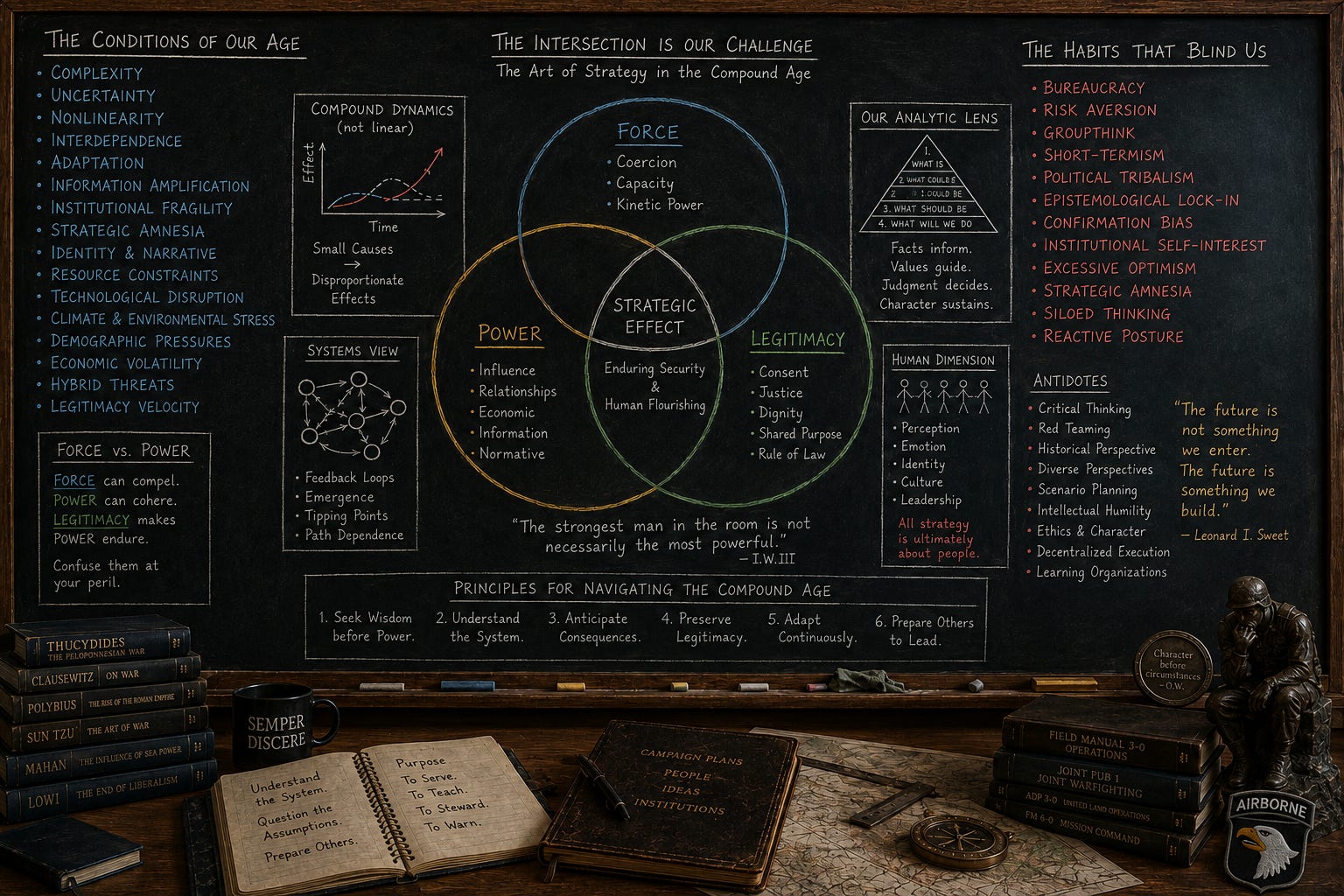
America had become very good at confusing force with power.
Military force was not power.
Market force was not power.
Capability was not power.
Power was ultimately the ability to convert capability into legitimate, sustainable political outcomes.
And something about that conversion had begun to fail.
I argued then that the United States possessed extraordinary force but was receiving progressively less strategic “purchasing power” from it. Tactical successes were not reliably becoming durable political successes. Military superiority could remove regimes yet prove incapable of creating legitimate replacements. Economic leverage could inflict costs without producing desired political choices. Information abundance was not necessarily creating understanding. Institutional authority was not necessarily generating compliance.
I did not have the vocabulary then that I use today.
That is precisely why I wanted to revisit it.
I am not interested in playing the hindsight game of claiming that the younger me somehow “predicted” the next sixteen years.
I did not.
Something more interesting was happening.
I could sense the change before I could name it.
Listening again to that 2010 address, I hear someone struggling with inherited categories—force and power, war and peace, legitimacy and authority, state power and human agency—that no longer seemed to behave according to the assumptions we had inherited.
I hear questions forming before the framework existed.
And that is important because it happens to all of us.
Sometimes the world changes before our language catches up.
Sometimes our discomfort is the first signal.
Sometimes the map begins failing before we recognize that the territory itself has changed.
The first movement of October therefore begins with a question I ask the audience to keep in mind while watching that younger version of me:
What can a person see before he has the language to explain what he is seeing?
The answer eventually takes us from 2010 to a year I now regard as a genuine historical hinge:
2014.
Not because the world suddenly transformed on January 1.
History almost never works that neatly.
2014 matters because by then the exceptions had accumulated, interacted, and become dense enough that they could no longer reasonably be dismissed as aberrations inside an otherwise stable post-Cold War order.
They were becoming the system itself.
Why 2014?
Think back to the operating assumptions of the early post-Cold War period.
The Soviet Union had disappeared.
American military predominance seemed overwhelming.
Liberal democracy appeared ascendant.
Economic globalization promised deeper interdependence.
And interdependence, many believed, would raise the cost of war.
International institutions would regularize state behavior.
Information technology would connect societies.
Markets would encourage convergence.
There were powerful reasons to believe all of that.
Then the system began sending contrary signals.
September 11, 2001 demonstrated that overwhelming conventional military superiority could not insulate the world’s most powerful state from strategically consequential violence by networked non-state actors.
The wars that followed demonstrated something equally important: destroying enemy formations and removing governments did not guarantee the ability to produce legitimate political order.
The 2008 global financial crisis showed that economic interdependence could transmit catastrophic instability as efficiently as prosperity.
The Arab uprisings demonstrated that political pressure could move across societies with extraordinary speed while producing wildly divergent outcomes—democratization in one place, state collapse in another, civil war somewhere else.
Yet each event could still be treated as an exception.
A crisis.
A fire.
A discrete problem for a discrete institution.
Then came 2014.
Russia seized Crimea using combinations of conventional power, covert intervention, proxies, information operations, political manipulation, and plausible deniability.
The Syrian civil war exposed limits in declaratory deterrence and international institutional authority.
The Islamic State seized territory across Iraq and Syria while behaving simultaneously as a terrorist organization, insurgency, proto-state, transnational recruiting network, digital media enterprise, and economic actor.
Ebola demonstrated that a biological event could generate simultaneous public-health, economic, governance, humanitarian, security, and political consequences.
And China made increasingly explicit that participation in a globally integrated economy did not imply eventual convergence toward Western liberal democratic political organization.
None of these developments began in 2014.
That is not the argument.
The significance was their interaction.
By 2014, the evidence had become dense enough to tell us something larger:
The organizing assumptions of the preceding age were no longer reliably organizing behavior.
Economic integration did not necessarily create political convergence.
Military predominance did not reliably produce strategic control.
Institutional authority did not guarantee compliance.
Information abundance did not produce shared truth.
Technological connectivity did not necessarily create social cohesion.
Deterrent declarations did not always produce deterrent effects.
In the phrase I use in the October experience:
The governing theory no longer governed.
That is why I call 2014 the hinge.
It was not the birthday of a new world.
It was the point at which enough quantitative changes had interacted to produce something qualitatively different.
The grid was becoming the web.
I call the world that emerged from that transition the Compound Age.
What Makes the Compound Age Different?
“Compound” does not simply mean that many bad things are happening at once.
That would merely describe congestion.
The Compound Age describes a condition in which different systems, stresses, actors, and domains interact in ways that change one another’s consequences.
A military strike becomes a shipping problem.
The shipping problem becomes an insurance problem.
Insurance repricing becomes an energy problem.
Energy becomes inflation.
Inflation becomes domestic politics.
Domestic politics alters alliance behavior.
Alliance behavior changes military choices.
And those military choices create a new round of effects.
Suddenly the event you thought you were studying is no longer the event you are actually living through.
The same is true outside war.
A virus becomes a public-health crisis, a supply-chain crisis, a fiscal crisis, an education crisis, an information crisis, a crisis of trust, and eventually a political and civic crisis.
A digital technology becomes commercial infrastructure, political infrastructure, an intelligence-collection environment, a social space, a disinformation vector, and a weapon.
A conflict thousands of miles away reaches an American household as an energy bill, investment loss, migration debate, cyber risk, disrupted supply chain, or political argument.
This is not simply interconnectedness.
It is consequence propagation.
And it changes what strategy means.
Movement Two: APPLY
Now Show Me How You Think
Explaining a framework is the easy part.
The test is whether it changes how we see an actual problem.
So the second movement of the October Civic Brief leaves the classroom and moves into one of the most consequential live cases in the world:
the Strait of Hormuz and the wider U.S.-Iran compound conflict.
The opening images are deliberately familiar.
Iran fires missiles at American warships.
The United States attacks Iranian oil tankers.
Commercial ships hesitate.
Military forces reposition.
Energy markets react.
Insurance rates rise.
Gulf states adjust.
What are we looking at?
The obvious answer is escalation.
That answer is not wrong.
It is simply too small.
Because if all we see are missiles, ships, targets, and retaliation, we may be looking directly at the fighting while missing the war.
And that is where the second episode becomes something different.
It is not primarily an episode about Iran.
It is a demonstration.
I wanted to show—not merely describe—how I actually approach a compound problem.
I call that discipline The W.i.S.E. Way.
And the first move sounds almost embarrassingly simple:
Do not begin only by asking, “What happened?”
Ask:
“What system am I actually inside?”
That single change in question can radically alter the analysis.
A conventional unit of analysis might be the United States versus Iran.
But the actual operating environment is much larger.
At Hormuz, military activity interacts with maritime commerce, oil and gas flows, insurance and reinsurance, shipping contracts, financial markets, Gulf-state politics, alliance behavior, domestic politics, information operations, cyber activity, infrastructure, diplomacy, and the calculations of actors far beyond Tehran and Washington.
So the analytically useful object is not simply a bilateral confrontation.
It is a U.S.-centered compound system interacting with an Iranian-centered compound system, both embedded inside a wider Gulf and global system.
Change the unit of analysis and the problem changes with it.
Five Moves
The October application episode distills The W.i.S.E. Way into five moves.
Find the system.
Do not allow the organizational chart to define the reality.
Military problems do not remain in military boxes.
Economic problems do not remain economic.
Politics does not politely wait outside the operations center.
The real world does not honor our bureaucratic seams.
Find the connections.
Ask how one event becomes many consequences.
A strike can destroy its intended target and simultaneously increase shipping risk.
Protecting commercial shipping can consume scarce interceptors needed elsewhere.
Sanctions can impose pain while accelerating alternative financial networks.
Pressure can deter one actor while mobilizing another.
The tactical action may succeed perfectly and still create a strategic liability somewhere else.
That brings us back to the problem I was wrestling with in 2010:
Force is not power.
The strategically meaningful question is not merely whether we possess enough force to do something.
It is:
How convertible is that force into the political outcome we actually want?
Find the feedback.
In the Compound Age, the key variable is often not the amount of stress but the relationship among stresses.
Systems can absorb enormous pressure when shocks remain isolated and redundancy remains available.
Danger rises when different pressures begin reinforcing one another faster than the system can compensate.
An attack affects shipping.
Shipping affects insurance and freight.
Freight affects energy prices.
Energy prices affect political tolerance.
Political pressures influence military choices.
Military choices change threat perceptions.
Those perceptions create new incentives for attack.
The feedback loop becomes the story.
Watch the thresholds.
One of the most important questions in strategic foresight is deceptively simple:
Is the system treating the disruption as an exception—or are consequential actors beginning to reorganize around it as a condition?
A shipping company rerouting for several days may simply be coping with a shock.
Governments redesigning infrastructure, firms signing multiyear replacement contracts, insurers permanently repricing risk, and countries reorganizing supply relationships tell us something deeper.
Actors are beginning to behave as though the old operating environment may not return.
The anomaly is becoming embedded.
That is how a temporary disruption begins becoming a governing condition.
And this is why one of my favorite observations in the October episode is also one of the least dramatic:
A missile is spectacular. A multi-year contract is boring television. But the contract may tell us more about the changing state of the system.
The loudest event is not always the most important signal.
Preserve decision space.
This may be the most important move of all.
We tend to measure resilience through inventories.
How many ships remain?
How many missiles?
How many dollars?
How many barrels?
How many allies?
Those things matter.
But the deeper measure of strategic resilience is:
How much meaningful choice remains?
A system becomes truly dangerous when choices narrow.
When every option becomes more expensive.
When actions become tightly coupled to the behavior of other actors.
When political costs become prohibitive.
When leaders discover that, despite enormous material capability, they have fewer and fewer viable ways to change course.
That is decision-space contraction.
And it changes how we should think about a Point of No Return.
The Point of No Return is not necessarily the moment when everything is destroyed.
It may be the moment when enough resilience, redundancy, legitimacy, and freedom of action have been consumed that the protagonists can no longer reliably choose their way back toward stability.
So I return repeatedly to one question in the Hormuz Watch:
If Washington or Tehran decides tomorrow that it wants to stop, does the system still permit it to do so?
As long as the answer is yes, meaningful choice remains.
The danger is the day the answer becomes no.
That is strategic foresight—not predicting the next missile launch, but watching whether the conditions governing what can happen next are changing.
The Method Travels
Hormuz is the case.
It is not the point.
That distinction matters.
The same discipline can be used to examine Taiwan.
Artificial intelligence.
Another pandemic.
Migration.
Debt.
The electrical grid.
Climate adaptation.
Supply-chain resilience.
The health of the American Republic.
The subject changes.
The discipline does not.
Find the system.
Find the connections.
Find the feedback.
Watch the thresholds.
Preserve decision space.
Or, stated another way:
Don’t just solve the problem in front of you. See the system it belongs to.
That is the W.i.S.E. Way.
And it brings us to the third movement.
Movement Three: EXPERIENCE
When the Grid Became the Web
After nearly two hours of explanation in the first movement and a practical application in the second, I wanted to do something entirely different.
Stop explaining.
Stop teaching.
Stop adding another diagram.
And let the audience experience the transition itself.
So October concludes with a short visual-auditory essay.
It begins inside the apparent certainty of the post-Cold War world.
The Soviet Union is gone.
American military supremacy appears uncontested.
Liberal democracy appears ascendant.
Markets integrate.
Globalization accelerates.
Institutions spread.
Technology connects.
The world seems to possess direction.
Then the confidence begins cracking.
September 11.
Afghanistan.
Iraq.
The global financial crisis.
The Arab uprisings.
Syria.
Crimea.
ISIS.
Ebola.
China’s increasingly explicit rejection of the assumption that economic modernization must culminate in Western political liberalism.
One by one the exceptions accumulate.
Then they begin interacting.
And gradually the visual order itself changes.
The clean grid gives way to tangled connections.
The map becomes the network.
The boxes stop holding.
The grid becomes the web.
That is what I wanted the third movement to accomplish.
Not another explanation of compoundedness.
An encounter with it.
Because there are some ideas we understand differently once we can see and feel their structure.
Why Call It an “Experience”?
That word is intentional.
I do not want The Civic Brief to become another place where I sit behind a desk and tell you what to think about the world.
There are plenty of those.
Nor do I pretend to possess a crystal ball.
The strategist worth listening to should be deeply suspicious of the strategist who claims certainty about complex adaptive systems.
I am trying to do something different.
I want to let you into the workshop.
To show you the maps.
To show you where they failed.
To show you how I think through a case.
To show you the indicators I watch.
To show you what would cause me to change my judgment.
To let you see the uncertainty.
And increasingly, to create experiences in which you do some of the seeing yourself.
That is why the October sequence matters beyond October.
It establishes the operating rhythm for Year Two.
Explain.
Understand the consequential idea.
Apply.
Put it against a real-world problem.
Experience.
Move beyond abstraction so we can recognize the pattern when it appears elsewhere.
That is not merely a podcast production format.
It reflects something I have come to believe about learning itself.
We rarely change how we think because somebody gives us one more fact.
We change when a new way of seeing begins reorganizing facts we already possess.
This Is Also a Civic Project
And here is where all of this returns to the word in the title:
Civic.
It would be easy to treat compound systems as the exclusive concern of presidents, generals, intelligence analysts, CEOs, economists, diplomats, scientists, or policy professionals.
They certainly need to understand them.
But they are not the only ones living inside them.
We are.
Citizens absorb the consequences.
We transmit information.
We participate in markets.
We reward political behavior.
We punish it.
We belong to institutions.
We elect leaders.
We create social trust—or destroy it.
We contribute to the resilience or brittleness of communities.
And ultimately we contribute to the resilience or brittleness of the Republic itself.
That does not mean every citizen needs to become a systems scientist.
It means we need better habits of mind.
When someone offers an extraordinarily simple solution to a compound problem, ask:
What else is connected to this?
When intervention appears obvious, ask:
What happens after the immediate effect?
When a policy promises one result, ask:
What adapts?
When we solve one problem, ask:
What new feedback might we create?
When leaders reassure us that we possess overwhelming capability, ask:
Can that capability actually be converted into the outcome we seek?
When pressure builds, ask:
What resilience are we consuming?
And perhaps most importantly:
What choices are we preserving—and what choices are we quietly eliminating?
Those are strategic questions.
But they are also citizenship questions.
From the World System to the Republic
There is another reason October is the right opening for Year Two.
The intellectual journey does not stop at Hormuz.
If compound stress can overwhelm a maritime-energy-security system, the same analytical question applies to democratic systems.
Institutions also possess resilience.
They possess redundancy.
They depend upon feedback.
They require legitimacy.
They adapt.
They can absorb stress.
They can become brittle.
Their decision space can contract.
And their temporary anomalies can become durable governing conditions.
That is one reason I have launched the W.i.S.E. American Republic Watch alongside the continuing Hormuz Watch and our other foresight efforts.
The question there is not “Will democracy collapse?”
That is too crude.
The better question is:
Is the constitutional system retaining its capacity to correct itself faster than compound stress is consuming that capacity?
That is exactly the kind of question Year Two of The Civic Brief is built to explore.
Not merely:
What happened?
But:
What system are we inside?
What is connected?
What is adapting?
What threshold are we approaching?
What choices remain?
And:
To what end?
This Is the Invitation
So if you are joining us for the first time, October is the place to begin.
Watch the three movements in order.
Do not think of them as three episodes competing for your attention.
Think of them as one experience.
I. EXPLAIN — See the Age
Go back with me to 2010.
Listen for the tension before the vocabulary.
Follow the accumulating failures of conversion.
Then move through the 2014 hinge and into the Compound Age.
II. APPLY — See the System
Come with me to the Strait of Hormuz.
Watch how the unit of analysis changes.
Follow the connections.
Trace the feedback.
Look for adaptation instead of spectacle.
Watch the thresholds.
And ask how much decision space remains.
III. EXPERIENCE — When the Grid Became the Web
Then stop analyzing for a few minutes.
Watch.
Listen.
Experience the transition.
See what happens when the boxes no longer contain the problems.
See the grid become the web.
Where We Go From Here
This is the rhythm I want us to carry through Year Two.
One consequential idea each month.
Not twenty.
One.
Enough space to explain it.
A real case through which to test it.
And an experience designed to help us recognize it outside the episode.
Some months we will range outward toward the global system.
Some months we will turn inward toward the American Republic.
Some will address technology.
Some democracy.
Some war.
Some markets.
Some resilience.
Some leadership.
But beneath all of them will be one continuing civic purpose:
learning to see more of the system before acting inside it.
Because the great danger of the Compound Age is not simply that our problems are becoming harder.
It is that we may keep applying increasingly powerful solutions to increasingly misunderstood systems.
And in doing so, we can become agents of the very consequences we are trying to prevent.
That is why Year Two begins where it does.
Not with an answer.
With a puzzle.
And not with a prediction.
With a way of seeing.
The world changed.
The grid became the web.
Now our ways of thinking—and doing—have to catch up.
Welcome to Year Two of The Civic Brief.
See the Age.
See the System.
See Your Place Within It.
For Nation, Not Self.
If you value this work, here are three ways you can step into the story with us:
📰 Subscriber (Free)
Stay informed. Receive every new essay, briefing, and analysis straight to your inbox. Join a growing community committed to civic resilience and national security.
🎧 Supporter (Paid Pledge)
Strengthen the signal. Your support sustains both Compound Security, Unlocked and our companion podcast The Civic Brief. Supporters ensure these conversations remain accessible to the wider public while elevating the quality, depth, and reach of the work.
🛡️ Sustainer (Patron Level)
Invest in the mission. Sustainers fuel new research, convenings, and storytelling that enlarge the civic frame of security. This is more than content — it’s a civic project. Your sponsorship helps preserve an independent voice committed to equipping citizens, leaders, and institutions for the compound challenges ahead.
Lindsey Graham’s sister in debate……Houston We Have a Problem…….This is how irresponsible 50% of the US electorate is……..National Divorce Now!!!!!!!!