
The Day After Next
On Eisenhower, Patton, the Quietists, and the Burden of Civic Witness.

There is one scene from the Second World War that has remained with me for most of my adult life. It has followed me through more than three decades as an Army officer, through graduate school, through years of teaching American politics and military strategy, and through an enduring fascination with how republics flourish, decay, and, when fortunate, recover.
It is not the beaches of Normandy that return most often to my mind. Nor Bastogne. Nor the crossing of the Rhine. Nor even the fall of Berlin.
It is what happened after much of the shooting had already stopped.
In April 1945, American forces advancing across central Germany under General George S. Patton entered the Nazi concentration camps. They had expected fierce resistance from a collapsing enemy. They had not expected to confront the industrial architecture of evil itself. Hardened combat veterans who had spent years fighting across North Africa and Europe suddenly found themselves standing before scenes for which neither military training nor human imagination had adequately prepared them. The smell of death reached them before many of the buildings came into view. Thousands of corpses lay where they had fallen or been discarded. Thousands more—skeletal, diseased, barely alive—wandered among them as living testimony to what organized hatred had become when fused with the machinery of a modern state.
Patton, a man not easily shaken by war, reportedly became physically ill.
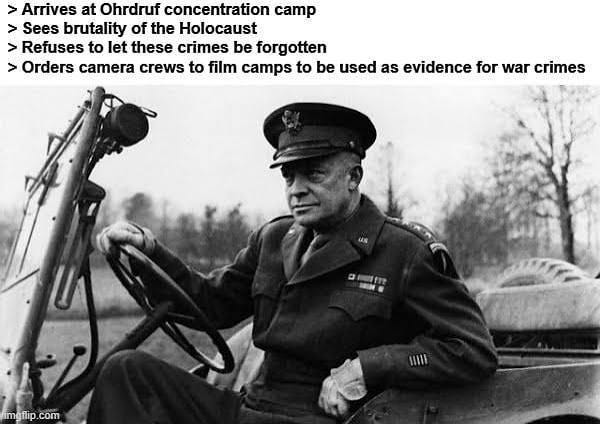
When General Dwight D. Eisenhower arrived soon afterward, he understood immediately that he was confronting something larger than military victory. He later explained that he insisted on personally inspecting the camps because he feared that one day there would be those who would deny what had happened, dismiss it as propaganda, or reduce it to wartime exaggeration.
He wanted to become an eyewitness, not simply for himself, but for history. He ordered photographers to record everything. He invited members of Congress, journalists, and Allied leaders to see what American soldiers had seen. He understood that memory is fragile, but evidence endures.
Yet it was another decision of Eisenhower’s that has always haunted me even more deeply.
Throughout many of the surrounding German towns, civilians who claimed they had known little or nothing about the camps were ordered to come and see them for themselves. They were forced to walk among the dead. They were compelled to look into the eyes of those who had survived. In many places they were made to help bury the victims.
For years I assumed this was primarily an act of accountability.
Only later did I begin to suspect it was something else.
It was an act of reconstruction.
Eisenhower understood that Germany’s future could not be built merely by defeating the Nazi regime. Armies can overthrow governments. They cannot, by themselves, restore civic legitimacy. That work belongs to citizens.
Before Germany could begin reconstructing itself as a democratic society, Germans would first have to become witnesses—not simply to crimes committed by others, but to the moral landscape that had emerged around them.
The walk through the camps was not intended to make every German equally guilty. It was intended to make denial impossible.
That distinction has become increasingly important to me because it reveals something fundamental about the life of every constitutional republic. Courts determine culpability. History examines complicity. Those are not the same thing.
Culpability asks who gave the order, who committed the crime, who violated the law. Those questions are indispensable because free societies rest upon individual responsibility and the rule of law. But complicity asks a broader and, in many ways, more uncomfortable question. How did an entire civic ecosystem gradually adapt itself until what once seemed unimaginable became tolerable? Who accommodated? Who rationalized? Who quietly accepted each incremental change because no single step, standing alone, seemed sufficient to justify resistance?
This is not an argument for collective guilt. Quite the contrary. Democracies betray themselves whenever they abandon individual responsibility in favor of inherited blame. But democracies also deceive themselves whenever they imagine that constitutional decline is produced only by those who stand at podiums or occupy high office.
Republics are shaped every bit as much by the ordinary decisions of ordinary citizens—by what they defend, what they excuse, what they ignore, and what they persuade themselves is someone else’s responsibility.
As both a student of American political development and a systems theorist and practitioner, I have spent much of my professional life examining how complex systems fail. Rarely does a healthy system collapse because of one catastrophic event. More often, failure emerges through the accumulation of individually rational decisions that gradually interact until the system itself crosses a threshold from which recovery becomes increasingly difficult. Security deteriorates in this way. Institutions deteriorate in this way. Democracies, I have come to believe, deteriorate in precisely the same manner.
That realization has led me to think differently about one word that has become central to my own understanding of civic life.
Quietism.
By quietism I don’t mean prudence, moderation, or thoughtful restraint. Democracies need all three. I mean something altogether different: the gradual surrender of civic agency. Quietism begins when citizens convince themselves that preserving personal comfort is more important than exercising public responsibility. It grows when people conclude that someone else will object, someone else will defend constitutional norms, someone else will protect the vulnerable, someone else will carry the burden of citizenship.
History suggests that authoritarian movements require true believers.
The erosion of republics requires something far more common.
It requires enough quietists.
And it is here that my thoughts leave the spring of 1945 and return, inevitably, to the America of my own lifetime.
Like every generation, we are understandably consumed by today’s political battles. We argue over elections, executive orders, judicial decisions, congressional votes, immigration policy, public education, economic inequality, foreign wars, and the endless churn of twenty-four-hour news cycles. Every day presents another controversy demanding immediate attention. Every week seems to introduce another constitutional dispute, another institutional crisis, another cultural conflict over the meaning of America itself.
Yet I find myself increasingly uninterested in tomorrow’s headlines. I find myself thinking instead about the day after next.
Not the next election.
Not even the election after that.
I find myself wondering about the America our children and grandchildren may someday inherit—and, perhaps more importantly, the questions they may ask us.
Suppose that a few years, even decades, from now historians conclude that the United States experienced a prolonged period of democratic erosion. Suppose they determine that the constitutional order endured extraordinary strain; that institutions once taken for granted proved far more fragile than anyone had imagined; that civic trust collapsed faster than it could be restored; that public life became increasingly organized around fear, resentment, grievance, and the pursuit of power rather than the difficult work of constitutional self-government.
What evidence would they place before us?
Where would they ask us to go?
Where would America’s quietists be asked to walk?
I suspect they would begin, just as Eisenhower did, not with theories or partisan arguments, but with places.
Places have a stubborn honesty about them. Political slogans fade. Campaign speeches disappear. Talking points are forgotten almost as quickly as they are uttered. But places remain. Buildings remain. Empty offices remain. Archives remain. Cemeteries remain. They become physical testimony to what a society chose to build, preserve, neglect, or dismantle.
Perhaps they would first take us through immigration detention facilities that operated in our name. They would ask us not simply whether immigration laws were enforced—every sovereign nation possesses that right—but how they were enforced, under what conditions, with what safeguards, and at what human cost. They would ask us whether we believed constitutional rights belonged only to citizens, or whether the rule of law itself required that every human being receive due process and equal justice before the law.
Perhaps they would ask us first to remember names before we debated policies.
Renée Nicole Good.
Alex Jeffrey Pretti.
History has a way of insisting that we begin with names. Before there are legal opinions, investigative reports, or political narratives, there are human lives. Before there are statistics, there are sons and daughters, friends and neighbors, families forever altered by events that governments inevitably describe in institutional language, but that ordinary people experience in deeply personal ways. Democracies begin losing something essential whenever citizens become easier to discuss as abstractions than as fellow human beings.
Perhaps the walk would continue through the headquarters and regional offices of federal agencies that had once embodied enduring constitutional purposes, but whose professional capacities had been diminished, fragmented, or redirected. We might walk through laboratories where scientific research had ceased, public health offices left understaffed, environmental monitoring programs discontinued, educational initiatives abandoned, diplomatic expertise dispersed, and civil servants dismissed not because their work lacked value but because the very idea of an independent professional civil service had come under suspicion. We would ask not only what functions disappeared, but what constitutional obligations quietly disappeared with them. The Preamble’s promise to “promote the general Welfare” is not self-executing. It depends upon institutions capable of serving the public with competence, integrity, and continuity across political generations.
Perhaps we would then visit public libraries whose shelves reveal as much through absence as through presence. Every civilization tells stories about itself. Every democratic-republic decides what future generations will be permitted to remember. We might find books removed because they challenged prevailing political orthodoxies, histories narrowed to accommodate ideological comfort, or voices excluded because they complicated simpler national narratives. We might walk through museums whose exhibits had been rewritten, postponed, or dismantled because history itself had become politically contested. We might stand before monuments no longer asking only whom they commemorate, but what their changing meanings reveal about our own evolving civic character.
Perhaps we would visit universities and schools—not to inspect what students were taught, but to ask what professors, teachers, librarians, researchers, and students had gradually learned not to say. Every authoritarian impulse begins by attempting to govern speech. Every democracy begins to weaken when citizens decide that silence is safer than honest inquiry. The most consequential censorship is often not imposed by law but internalized by fear.
Perhaps we would travel to neighborhoods and communities quietly transformed by absence. We would ask what became of families who once lived among us under Temporary Protected Status, refugee protections, asylum provisions, humanitarian parole, or other lawful forms of residence. We would remember teachers, nurses, physicians, engineers, entrepreneurs, farmworkers, caregivers, students, clergy, artists, and small business owners who had become woven into the ordinary fabric of American civic life. We would discover that communities are not measured only by those who remain but also by those whose absence leaves behind empty homes, shuttered businesses, diminished congregations, quieter classrooms, and neighborhoods somehow less whole than they once were.
None of these places, considered individually, tells the entire story of a republic.
Taken together, however, they begin to form something larger.
They become the geography of civic memory.
Or perhaps more accurately, the cartography of constitutional stress.
As a systems thinker, I have spent much of my life arguing that compound systems rarely announce their failure through one catastrophic event. They fail through accumulation. Individually rational decisions interact with one another until entirely new patterns emerge—patterns that no single decision-maker intended and that few participants fully recognized while living through them. Democratic societies are no exception. Constitutional erosion, if and when it occurs, is seldom the product of one election, one statute, one executive order, or one judicial opinion. It is the cumulative consequence of thousands of accommodations, rationalizations, institutional adjustments, and civic silences that gradually redefine what a people comes to regard as normal.
Perhaps that is what Eisenhower understood better than anyone standing with him in those liberated camps.
He didn’t compel German civilians to witness because he believed every one of them had personally committed murder. He compelled them to witness because democratic reconstruction demanded something beyond legal innocence. It demanded civic recognition. It demanded that ordinary people confront the tangible consequences of the society that had evolved around them and ask, with honesty rather than defensiveness, not merely Who did this? but How did we come to live beside it?
Perhaps that, ultimately, is why this single episode from the spring of 1945 has remained with me for so many years.
It’s not because I see history as repeating itself. History never does; although all too often ‘we’ do. Every generation confronts its own circumstances, its own institutions, its own technologies, its own leaders, and its own moral failures. The Holocaust remains singular in both its industrialized evil and its place in human history. To collapse every contemporary controversy into that singular horror would not honor history; it would diminish it.
Nor is my purpose to suggest that every political disagreement represents a constitutional crisis or that every policy dispute carries equal moral weight. Democracies are designed to accommodate disagreement. Indeed, vigorous disagreement is one of the principal signs of democratic health.
What concerns me is something different. What concerns me is the civic character that enables constitutional democracies to endure through disagreement.
For most of my professional life, I have studied power. I have studied war, strategy, insurgency, institutions, and the rise and decline of political orders. Yet I have come to believe that the ultimate strength of a republic lies neither in its military force nor in its economic output, neither in its constitutional design nor in the brilliance of its leaders.
Its deepest strength lies in the moral habits of ordinary citizens.
A republic survives because enough people continue to ask difficult questions when easier answers are available. Because enough people remain willing to defend constitutional principles even when doing so disadvantages their own political tribe. Because enough people refuse to confuse loyalty to a leader with loyalty to a Constitution. Because enough people understand that citizenship is not a spectator sport, nor a consumer preference, nor a partisan identity. It is a public trust.
That is why the quietist occupies such a central place in my thinking.
History rightly remembers its tyrants. It remembers its revolutionaries, its generals, its presidents, and its prophets. Far less often does it remember the millions of otherwise decent people who simply convinced themselves that someone else would carry the burden of citizenship. Yet those millions often become the hinge upon which history quietly turns.
The gravest threat facing any constitutional republic may not be the proliferation of radical ideologies among its citizens, nor the rise of extreme factions. Instead, the real danger lies in the gradual transformation of the populace into passive spectators.
When too many individuals choose to step back from the responsibilities of active citizenship, the fabric of self-government begins to unravel. Rather than engaging in the hard work of democracy, they become observers, perhaps even profiteers of the wrong; but assuredly, content to let others carry the burden of civic duty.
This shift toward passivity manifests in various ways. Citizens become watchers, monitoring the events around them yet taking no meaningful action. They comment from the sidelines, offering opinions without the commitment to participate in solutions. Many simply wait, hoping someone else will step forward, or persuading themselves that their involvement is unnecessary. The sense of responsibility fades as people convince themselves they are absolved from accountability, since they neither crafted the policy nor cast the decisive vote. But such rationalizations ignore the foundational principle of constitutional self-government: that it relies upon the active engagement of the governed.
Self-government is not sustained by mere observation or commentary. The Constitution itself does not begin with a reference to the president, Congress, or Supreme Court. Instead, it opens with the bold assertion, “We the People.”
This phrase is more than a description—it serves as an assignment of responsibility, reminding us that sovereignty is not the exclusive domain of those who govern. It is exercised, and sometimes surrendered, by those who are governed. The Republic’s endurance depends on the willingness of its citizens to accept and act upon this responsibility.
Reflecting on history, one might consider Eisenhower’s actions during the aftermath of the atrocities discovered in the spring of 1945. His leadership extended beyond the liberation of the camps; it was his insistence that ordinary civilians confront what had happened around them that marked his greatest statesmanship. Eisenhower understood that democratic reconstruction does not begin with forgetting, but with remembering. It is not rooted in humiliation, but in honesty. Not in vengeance, but in truth. Repair and reconciliation are impossible without first acknowledging the reality of what has transpired. Constitutional legitimacy cannot be renewed if citizens refuse to examine themselves and their society.
In the end, every republic faces its own moment of reckoning—a time when the evidence, institutions, leaders, and wounds may differ, but the underlying questions remain the same. What did we know, and what did we choose not to know? What did we defend, excuse, or fear? What did we preserve, and what did we surrender? When history called upon us to bear witness, did we accept that invitation or did we turn away? These are the enduring questions that await every free people, not just in moments of crisis, but on the day after next, as the ongoing test of their civic character.
As an old soldier of the old republic, I remain, perhaps stubbornly, a believer in America’s unfinished constitutional promise. That promise has never rested upon the comforting illusion that we are incapable of failure. It has rested instead upon a more demanding proposition: that free citizens, when willing to confront themselves honestly, possess an extraordinary capacity for renewal.
That is why I continue to believe that witnessing is not an act of despair. It is an act of constitutional hope.
To bear witness is to refuse both denial and cynicism. It is to acknowledge that truth, however painful, remains the indispensable beginning of every democratic reconstruction. It is to understand that the purpose of remembering is not to imprison ourselves in the past, but to enlarge the moral horizon of the future.
History’s final judgment is seldom rendered upon those who committed the greatest wrongs alone. It is also rendered upon the society that surrounded them.
And upon the citizens who, when their own moment arrived, chose whether—or not—to make the walk.

If you value this work, here are three ways you can step into the story with us:
📰 Subscriber (Free)
Stay informed. Receive every new essay, briefing, and analysis straight to your inbox. Join a growing community committed to civic resilience and national security.
🎧 Supporter (Paid Pledge)
Strengthen the signal. Your support sustains both Compound Security, Unlocked and our companion podcast The Civic Brief. Supporters ensure these conversations remain accessible to the wider public while elevating the quality, depth, and reach of the work.
🛡️ Sustainer (Patron Level)
Invest in the mission. Sustainers fuel new research, convenings, and storytelling that enlarge the civic frame of security. This is more than content — it’s a civic project. Your sponsorship helps preserve an independent voice committed to equipping citizens, leaders, and institutions for the compound challenges ahead.