

“The greatest deception men suffer is from their own opinions.”
— Leonardo da Vinci
Opening:
Why NIMBLE WARNING Must Be Revisited—Now
Let me be direct.
We have gotten this one wrong—profoundly wrong.
Operation NIMBLE WARNING has been misremembered, mischaracterized, and ultimately weaponized in ways that have distorted not only that moment in 2013, but how Americans now think about power, war, and what it means to win.
What actually occurred—an integrated campaign that combined credible military force with coercive diplomacy to remove a significant portion of Syria’s chemical weapons—has been flattened into a meme: “the red line that wasn’t enforced.”
That meme has done real damage.
Cognitively, it has rewired how we interpret outcomes.
Anything short of visible, kinetic destruction is now too easily dismissed as weakness. Perceptually, it has been folded into a broader narrative that equates restraint with failure, diplomacy with capitulation, and non-lethal success with defeat.
In today’s political discourse, that distortion has been taken even further—where what is labeled “liberal-democratic” is casually recast as “weak,” “soft,” or worse, as some derivative of “wokeism” that undermines “real” warfighting.
And now we see the consequences.
NIMBLE WARNING has become a kind of rhetorical weapon—invoked to justify a hardened, all-too-regularly racialized, and deeply simplified conception of “warrior lethality,” where only destruction counts, and anything else is suspect.
In this framing, the absence of bombing is not a strategic choice—it is a moral and political failure.
The implication is stark: if you didn’t strike, you didn’t win.
But this is not strategy. It is a dangerous misreading of how power actually works.
Because if we step back from the narrative and return to the facts, the uncomfortable possibility emerges:
… what has been labeled a failure may, in fact, have been a form of success that our current frameworks are incapable—or unwilling—to recognize.
And that is the deeper problem.
When a society loses the ability to recognize non-kinetic success—when it equates effectiveness exclusively with violence—it traps itself in a narrowing conception of victory.
Over time, that logic produces exactly what we claim to be trying to avoid: repeated escalation, higher costs, and a persistent drift toward what can only be described as a condition of “forever warfare.”
In that sense, NIMBLE WARNING is not just a misinterpreted operation.
It is a case study in a broader American paradox: a way of war that increasingly struggles to see peace—especially when peace is achieved without spectacle.
That is why this needs to be revisited.
Not as a historical correction alone, but as a necessary intervention in how we think, judge, and act in matters of war and strategy today.
There are moments in policy and strategy when outcomes are less determinative than the stories told about them.
The 2013 U.S. response to Syria’s use of chemical weapons—often shorthand reduced to “Obama’s red line”—has become one such moment.
In the popular imagination, it stands as a case study in failed deterrence, a symbol of presidential hesitation, and a cautionary tale about the costs of not following through on threats.
Yet from a different vantage—particularly from those actually intimately involved in the operational design and execution of what was known as Operation NIMBLE WARNING—this narrative appears not only incomplete, but fundamentally misaligned with what actually occurred.
The operation did not culminate in large-scale U.S. military strikes. That much is true.
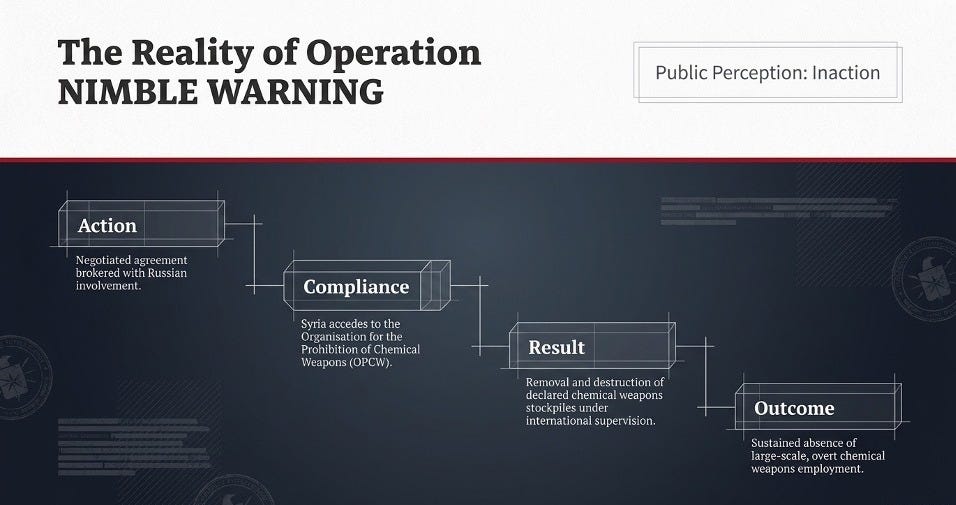
But it also coincided with—and contributed to—a verifiable outcome: the removal of a significant portion of Syria’s declared chemical weapons stockpile and the absence, for a sustained period, of large-scale, overt chemical weapons employment of the kind that triggered the crisis in the first place.
If deterrence is ultimately about shaping behavior, not satisfying rhetoric, then the more uncomfortable question emerges:
…. was NIMBLE WARNING a failure—or was it a success that we have chosen to remember as failure?
I. The Event, and the Narrative That Followed
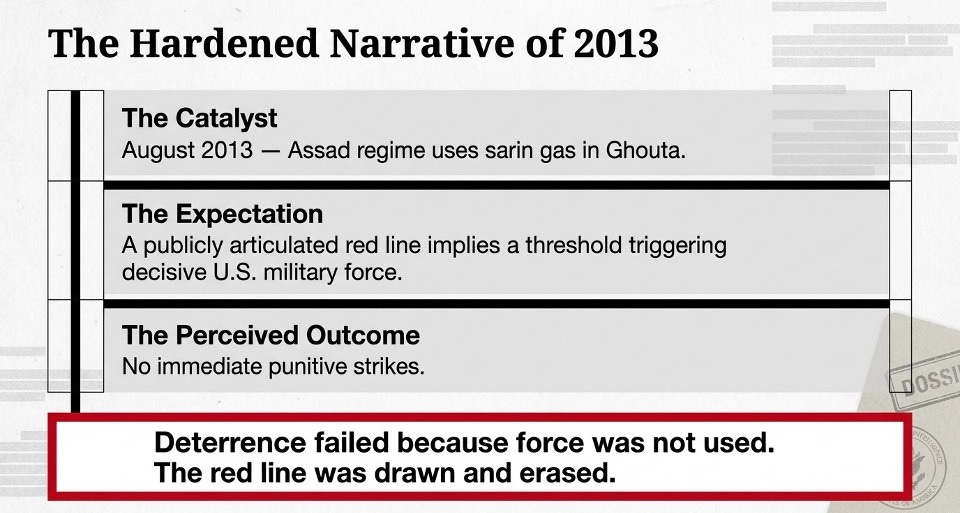
In August 2013, the Assad regime’s use of sarin gas in Ghouta catalyzed international outrage. The United States had previously articulated that the use of chemical weapons constituted a “red line,” implying a threshold that, if crossed, would trigger decisive action.
When that threshold was crossed, the expectation—domestically and internationally—was that the United States would respond with military force.
Instead, the Obama administration pursued a different path: a negotiated agreement, brokered with Russian involvement, that led to Syria’s accession to the Organisation for the Prohibition of Chemical Weapons and the subsequent removal and destruction of declared chemical weapons stockpiles under international supervision.
The absence of immediate punitive strikes became, in the public discourse, synonymous with inaction. The red line, it was said, had been drawn and then erased.
From that moment forward, a narrative hardened: deterrence had failed because force had not been used.
II. Deterrence Misunderstood
This interpretation rests on a narrow—and often unexamined—understanding of deterrence.
Deterrence is not the fulfillment of a threat; it is the prevention of an action.
Compellence, similarly, is not the act of striking, but the act of inducing a change in behavior.
Military force is one instrument among many, and often a blunt one.
The assumption embedded in the “red line failure” narrative is that credibility is binary: either a threat is executed, or it is meaningless. But in practice, credibility is relational and contextual. It is shaped not only by actions taken, but by the range of pressures applied—diplomatic, economic, informational, and yes, military.
Operation NIMBLE WARNING, as understood from within, was not a singular decision point but a coordinated campaign of signaling, preparation, and coercive diplomacy.
Military options were developed and positioned. The possibility of force was made real and credible. But it was not the only lever.
The resulting agreement—however imperfect—achieved something that immediate strikes alone might not have: the large-scale removal of declared chemical weapons without the escalation risks inherent in direct military intervention.
If the objective was to reduce the presence and use of such weapons, then the outcome complicates the narrative of failure.
III. The Problem of Visible Action
Why, then, has the perception of failure proven so durable?
Part of the answer lies in what might be called the visibility bias of modern strategy.
Kinetic action is legible. Missiles launched, targets struck, damage assessed—these are events that can be seen, measured, and narrated with clarity. They produce images, headlines, and a sense of closure.
By contrast, the effects of deterrence and coercive diplomacy are often invisible. They manifest in actions not taken, in capabilities quietly dismantled, in behaviors subtly altered over time. They lack the dramatic punctuation of force.
In a political and media environment conditioned to equate action with effectiveness, the absence of visible violence is easily misread as the absence of action altogether.
The paradox is that successful deterrence often looks like nothing happened.
IV. The Domestic Political Frame
The narrative of failure was also shaped—and amplified—by domestic political dynamics.
Within the United States, the Syria decision became a proxy for broader debates about American power, leadership, and the legacy of interventions in Iraq and Afghanistan.
For critics of the administration, the unexecuted strike became emblematic of perceived weakness.
For others, it reflected prudence and restraint.
Over time, the critique hardened into a shorthand: “the red line that wasn’t enforced.”
This framing proved politically useful.
It reduced a complex, multi-layered strategic episode into a single, emotionally resonant image.
It also aligned with a deeper cultural preference within the American way of war: the expectation that credibility is demonstrated through decisive, often kinetic, action.
In this sense, “the narrative of failure” says as much about American strategic culture as it does about the event itself.
V. The Role of Incomplete Outcomes
None of this is to suggest that the 2013 outcome was unambiguously successful.
Subsequent reports and investigations indicated that Syria retained undeclared chemical capabilities and, in later years, employed chemical agents in more limited and contested ways. The agreement did not eliminate the problem; it mitigated it.
But here, too, the standard applied is revealing.
Rarely do we judge military campaigns as failures simply because they do not produce perfect or permanent outcomes. Yet in this case, the persistence of some level of chemical weapons use has been retroactively used to invalidate the earlier achievement.
This reflects a tendency to conflate partial success with total failure—a binary framing ill-suited to the realities of complex conflict environments.
VI. The Insider’s View and the Limits of Public Memory
From an insider’s vantage, the story of NIMBLE WARNING is less about a moment of hesitation and more about a deliberate choice among imperfect options.
It is about the integration of military preparedness with diplomatic opportunity. It is about leveraging the credible threat of force to achieve outcomes that force alone might not have secured. It is about operating within constraints—legal, political, and strategic—that are often invisible to external observers.
But such perspectives rarely shape public memory.
Strategic narratives, once formed, tend to persist because they are simple, repeatable, and aligned with preexisting beliefs. They become part of a broader mythology of success and failure that informs future debates, often without being reexamined.
In this way, NIMBLE WARNING has been absorbed into a larger story about American decline, wavering resolve, and the supposed costs of restraint.
VII. The Deeper Paradox
There is, finally, a deeper paradox at work—one that resonates with my broader critique of the American way of war.
If a system is predisposed to equate effectiveness with the application of force, then outcomes achieved through other means will struggle to be recognized as success.
They will appear, instead, as deviations from the expected script.
In this light, the characterization of NIMBLE WARNING as a failure may be less an empirical judgment than a reflection of a cognitive bias: a preference for wars that look like wars, for victories that resemble destruction.
It is, in effect, a misreading born of the same paradox that privileges the “lethal tactical” over the political-strategic.
VIII. Reframing the Question
The question, then, is not simply whether the red line was enforced.
It is whether the objectives associated with that red line—reducing the use and availability of chemical weapons—were advanced, and at what cost.
It is whether alternative courses of action would have produced better outcomes, or merely different ones.
And it is whether our frameworks for judging success and failure are adequate to the kinds of conflicts we actually face.
Conclusion: The Stories We Choose
In the end, Operation NIMBLE WARNING illustrates the gap between strategy as practiced and strategy as remembered.
It shows how complex, often ambiguous outcomes can be recast into simplified narratives that serve political, cultural, and cognitive needs. It reveals how the absence of visible force can be mistaken for the absence of effectiveness.
And it raises an uncomfortable possibility:
… that we are sometimes more committed to the stories that affirm our assumptions than to the evidence that might challenge them.
If so, then the lesson of 2013 is not merely about Syria, or red lines, or a single administration.
It is about how we understand power, how we define success, and how easily we can mistake the lack of spectacle for the lack of strategy.
Or, put more plainly: sometimes the wars we think we lost are not the ones we actually fought.
If you value this work, here are three ways you can step into the story with us:
📰 Subscriber (Free)
Stay informed. Receive every new essay, briefing, and analysis straight to your inbox. Join a growing community committed to civic resilience and national security.
🎧 Supporter (Paid Pledge)
Strengthen the signal. Your support sustains both Compound Security, Unlocked and our companion podcast The Civic Brief. Supporters ensure these conversations remain accessible to the wider public while elevating the quality, depth, and reach of the work.
🛡️ Sustainer (Patron Level)
Invest in the mission. Sustainers fuel new research, convenings, and storytelling that enlarge the civic frame of security. This is more than content — it’s a civic project. Your sponsorship helps preserve an independent voice committed to equipping citizens, leaders, and institutions for the compound challenges ahead.


