
The Compound Threshold
Iran, Hormuz, and the Emerging Ecology of Global Competition

By Isaiah (Ike) Wilson III
Isaiah (Ike) Wilson III is a retired U.S. Army colonel, former senior civilian defense executive, and Professor of Practice at Arizona State University. He is founder and CEO of Wilson W.i.S.E. Consulting LLC and former president of the Joint Special Operations University. His work focuses on compound security, strategic competition, integrative statecraft, and the changing character of global conflict and geopolitical order.
Prologue: The Specter of Strategic Defeat
In a sweeping and deeply pessimistic essay in The Atlantic, Robert Kagan argues that the United States now confronts the possibility of a strategic defeat unlike any it has suffered in the postwar era. Not Vietnam. Not Iraq. Not Afghanistan.
Those conflicts, however costly, did not fundamentally alter America’s position within the global balance of power. Iran, Kagan contends, is different. If Tehran succeeds in consolidating effective control over the Strait of Hormuz—whether formally or through sustained coercive dominance—the consequences would reverberate far beyond the Persian Gulf, reshaping the geopolitical architecture of the international system itself.
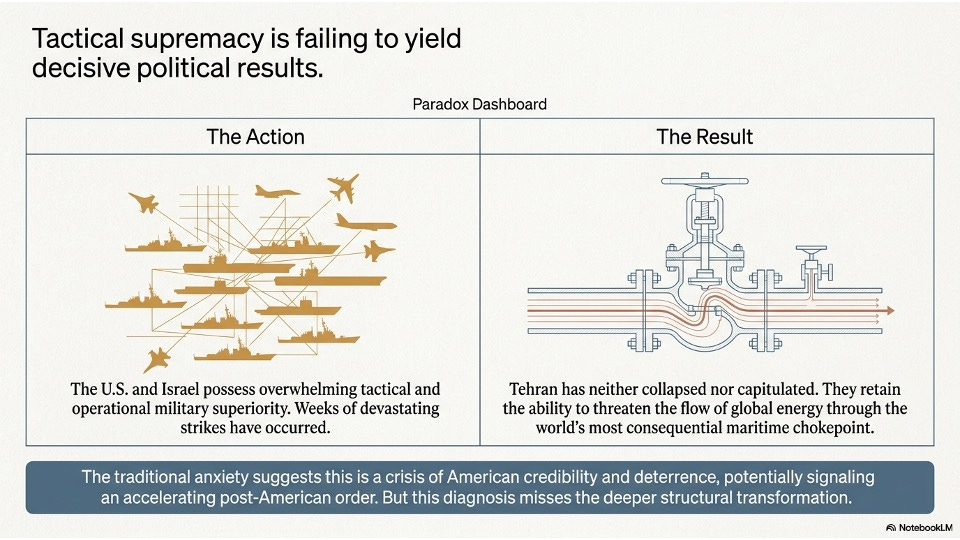
Kagan’s central claim is stark: the United States and Israel have demonstrated overwhelming tactical and operational military superiority against Iran yet failed to achieve decisive political results.
Despite weeks of devastating strikes, Tehran neither collapsed nor capitulated. Instead, Iran has emerged with perhaps its most powerful strategic weapon intact: the ability to threaten, manipulate, and potentially control the flow of global energy through the world’s most consequential maritime chokepoint. In Kagan’s telling, this marks not merely a regional setback, but the visible unraveling of American credibility, deterrence, and hegemonic authority.
The consequences, he warns, would be systemic. Gulf monarchies would gradually accommodate Tehran. European and Asian allies would lose confidence in Washington’s ability to secure the global commons. China and Russia, as Iran’s strategic partners, would gain influence. Global energy markets would remain vulnerable to Iranian coercion. And perhaps most consequentially, the world would begin adjusting psychologically and materially to what Kagan describes as an accelerating “post-American” order.
Underlying the essay is a larger anxiety about strategic exhaustion. Kagan argues that the United States now faces a dilemma from which no favorable option remains available. Renewed military escalation risks catastrophic disruption to Gulf energy infrastructure and potentially global economic crisis. Withdrawal or negotiated accommodation, meanwhile, would amount to tacit recognition of Iranian leverage over the Strait and, by extension, over the global economy itself. In his framing, Washington is approaching a form of strategic checkmate: unable to impose decisive victory, yet unable to restore the previous status quo.
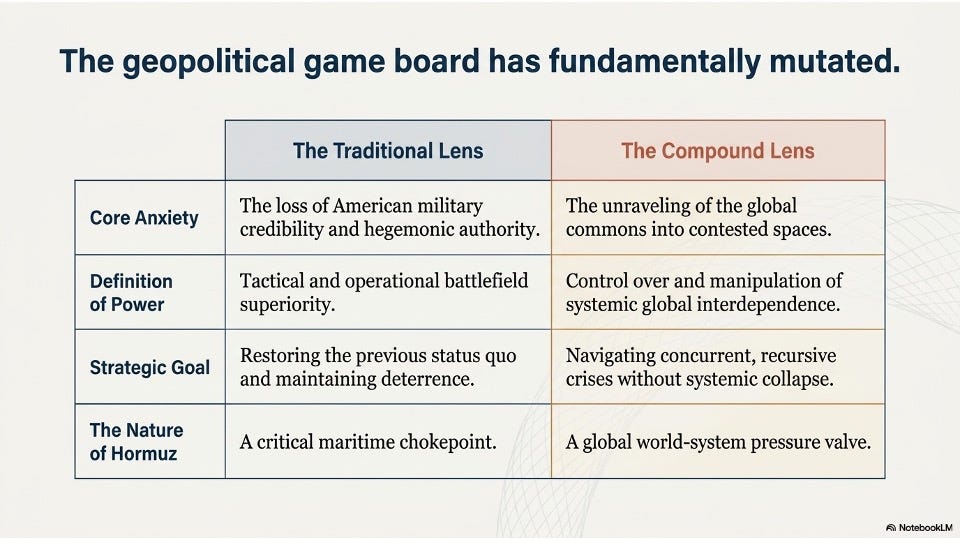
Kagan’s argument is powerful precisely because it taps into a growing unease that the international system may be entering a period in which American military superiority no longer guarantees geopolitical control. Yet while his analysis compellingly captures the consequences of the current crisis, it leaves underexplored the deeper structural transformations producing those consequences. The confrontation with Iran may indeed signal a historic inflection point—but not simply because American credibility is weakening. More fundamentally, it may reveal that the character of global competition itself has changed.
______________________
Why the Current Crisis Is About More Than American Credibility—or Iranian Power
Robert Kagan is right to sense that the current confrontation with Iran represents something larger than another episodic Middle Eastern crisis. He is also right to warn against minimizing the strategic consequences should the United States prove either unwilling or unable to restore stable access through the Strait of Hormuz.
But where Kagan sees primarily the geopolitical consequences of a potential American defeat, the deeper issue may lie elsewhere: in the emergence of a fundamentally different ecology of global competition itself.
Kagan’s analysis remains rooted in a familiar strategic grammar—one centered on military credibility, deterrence, alliance confidence, and the shifting balance among major powers. Those variables remain critically important. Yet they no longer sufficiently explain the operational realities of contemporary competition.
The present crisis is not simply about whether the United States can defeat Iran militarily. It plainly can. Nor is it about whether the combined weight of the world’s most powerful navy and two of its most lethal air forces possess overwhelming tactical superiority over Iran’s conventional military capabilities. They do.
The more consequential question is whether overwhelming superiority within a singular domain of power still reliably produces desired political outcomes under conditions of deeply interconnected, compound security competition.
That distinction matters enormously.
Beyond the Traditional Battlespace
The issue is not simply that Iran has become more capable militarily. Rather, Tehran has become increasingly adept at exploiting the connective tissue of globalization itself.
For more than two decades, Iran’s strategic adaptation has rested upon an asymmetric insight that many Western strategists continue to underestimate: in a densely interconnected global system, relatively weaker actors can exercise disproportionate leverage by targeting the systems upon which stronger powers depend.
The Strait of Hormuz is therefore not merely a maritime chokepoint in the traditional naval sense. It is a pressure valve embedded within a larger world-system architecture linking Gulf energy production, Asian manufacturing, European consumption, sovereign investment flows, insurance markets, shipping networks, and domestic political stability across dozens of countries simultaneously.
This is why a missile strike near Ras Laffan, a drone attack on desalination infrastructure, or even the sustained perception of instability in Hormuz can generate cascading effects across commodity markets, food systems, inflation rates, electoral politics, and alliance calculations thousands of miles away from the tactical event itself.
The strategic battlespace has expanded beyond geography alone.
The current confrontation reveals how deeply intertwined military operations have become with global commerce, energy transition dynamics, cyber vulnerabilities, infrastructure resilience, financial systems, information ecosystems, and societal psychology. What appears superficially as a regional military confrontation is in reality a multidimensional systems contest.
This is not merely “gray zone” competition. That phrase understates the scale of the transformation underway.
The more profound reality is that the boundaries separating war from peace, economics from security, domestic from foreign policy, and civilian from military space are steadily collapsing into one another.
The Return of Geopolitics—Under New Conditions
History offers useful parallels, though none are exact.
The late nineteenth and early twentieth centuries similarly confronted strategists with accelerating globalization, technological disruption, imperial competition, and contested maritime-commercial arteries.
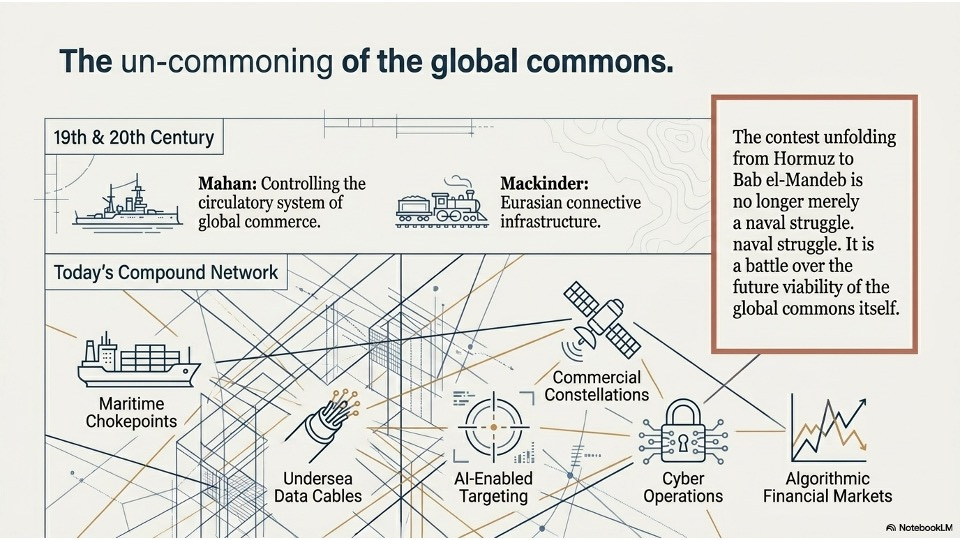
Alfred Thayer Mahan understood that command of the sea was never simply about naval combat; it was about controlling the circulatory system of global commerce itself. Halford Mackinder recognized Eurasia not merely as geography, but as a strategic organism whose connective infrastructure could alter the global balance of power. Nicholas Spykman, Julian Corbett, and others likewise grasped that power ultimately rests in the ability to shape, secure, disrupt, or redirect the flows upon which political order depends.
Today’s competition extends those dynamics into a far denser and more technologically integrated world.
Maritime chokepoints remain central, but they now intersect with undersea data cables, commercial satellite constellations, AI-enabled targeting systems, cyber operations, algorithmically driven financial markets, and digitally networked information ecosystems.
The contest unfolding from Hormuz to Bab el-Mandeb to the South China Sea is therefore not merely a naval struggle. It is increasingly a battle over the stability—and perhaps the future viability—of the global commons itself.
Or more precisely, over the accelerating “un-commoning” of those commons into contested and coercible spaces.
Compound Security Competition
This broader dynamic is what I have elsewhere described as “compound security competition” (CsC): an environment in which geopolitical, geo-economic, technological, informational, environmental, commercial, and societal pressures converge simultaneously and recursively across regions and domains.
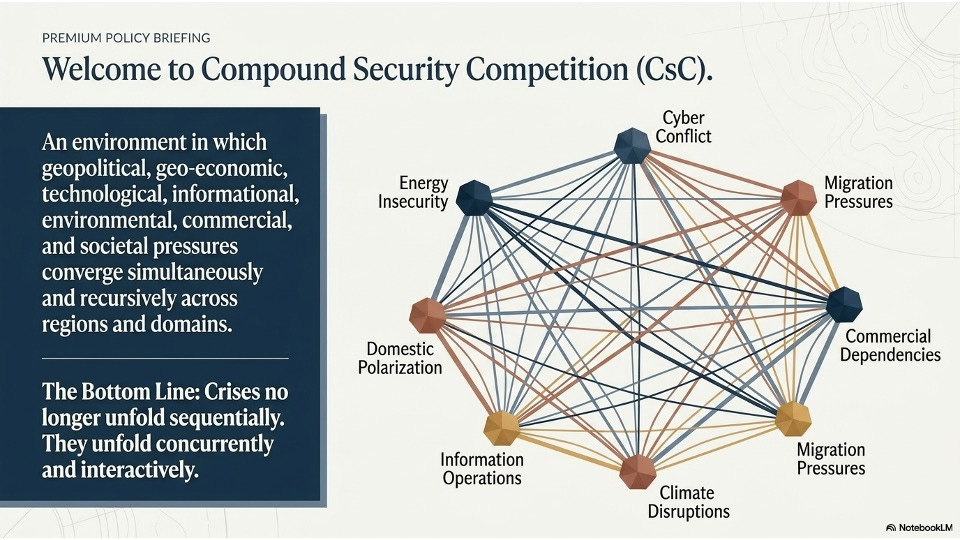
Under such conditions, threats no longer remain compartmentalized.
Energy insecurity intersects with cyber conflict. Migration pressures intersect with political extremism. Commercial dependencies create strategic vulnerabilities. Domestic polarization becomes a national security variable. Information operations alter alliance cohesion. Climate disruptions exacerbate regional instability. Proxy warfare blends into infrastructure sabotage, transnational criminality, and economic coercion.
The result is an environment where crises no longer unfold sequentially, but concurrently and interactively.
This is precisely why conventional strategic frameworks increasingly struggle to produce durable outcomes.
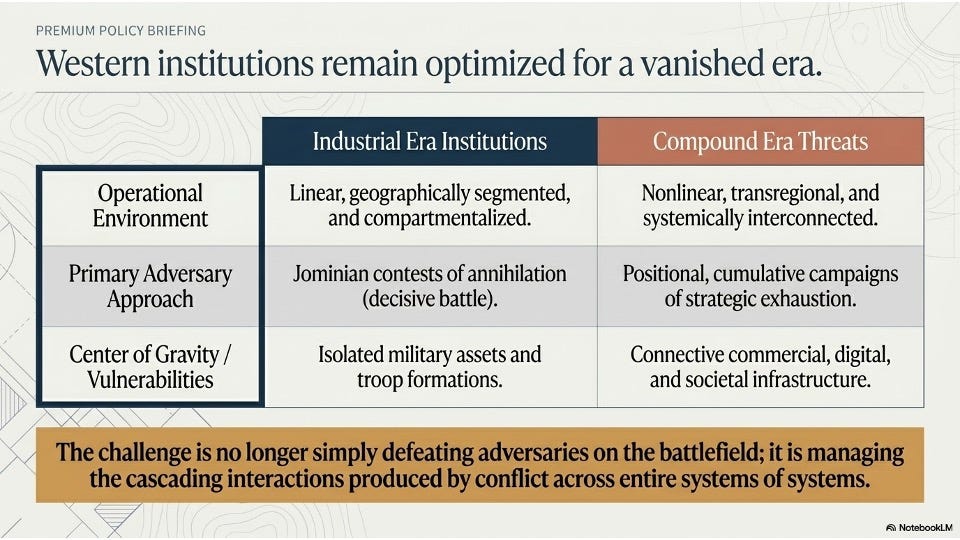
Most Western institutions—including military planning systems—remain optimized for linear, geographically segmented, industrial-age approaches to conflict. Yet the operational environment has become nonlinear, transregional, and systemically interconnected.
The challenge is no longer simply defeating adversaries on the battlefield. It is managing the cascading interactions produced by conflict across entire systems of systems.
Iran, Russia, and increasingly China have become highly adept at operating inside these seams.
Rather than pursuing decisive battlefield victory against superior Western militaries, they increasingly seek positional advantage through distributed, cumulative, and often ambiguous pressure campaigns designed to generate systemic friction, strategic hesitation, alliance fragmentation, and political exhaustion over time. Such approaches are less Jominian contests of annihilation than contests over endurance, adaptability, and the manipulation of interdependence itself.
The Illusion of Restoration
This is where Kagan’s argument, while powerfully descriptive, risks becoming strategically incomplete.
The problem is not simply that American credibility may be weakening. Nor is the answer merely more force, tougher signaling, or restoration of some previous status quo ante.
That world is gone.
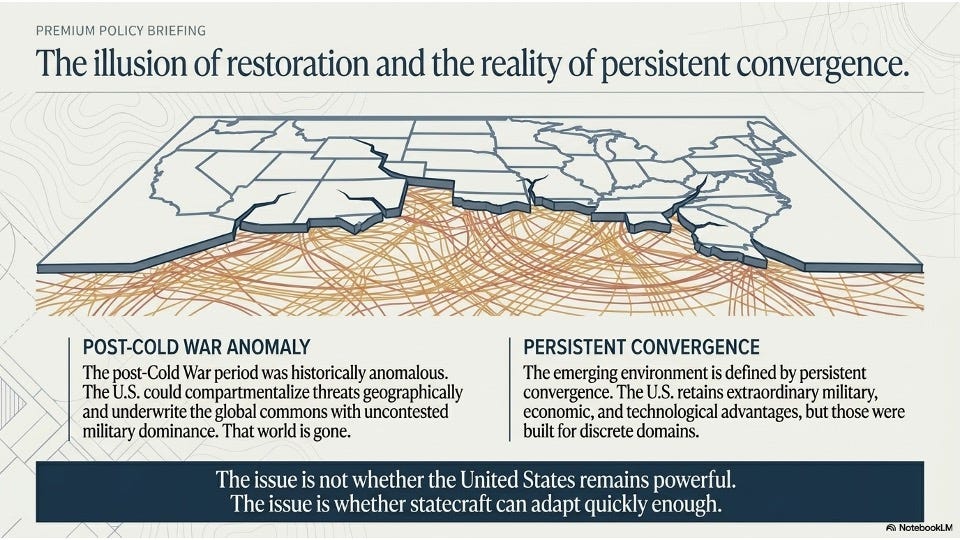
The post–Cold War period was historically anomalous in the degree to which the United States could compartmentalize threats geographically while underwriting the stability of the global commons through largely uncontested military dominance.
The emerging era is different.
Geography matters again—but under radically altered technological, economic, and informational conditions.
The United States retains extraordinary military, economic, and technological advantages. Yet those advantages were largely built for a world in which threats could be isolated, sequenced, and managed within relatively discrete domains. The emerging environment is one of persistent convergence.
Military campaigns now generate immediate economic consequences. Commercial infrastructure has become strategic terrain. Information systems shape battlefield outcomes in real time. Human insecurity migrates across borders with geopolitical consequences. Maritime access, technological standards, energy transitions, and financial systems increasingly function as instruments of strategic competition.
The issue is therefore not whether the United States remains powerful.
The issue is whether American statecraft can adapt quickly enough to compete effectively under these new compound conditions.
Toward an Integrative Strategic Logic
What is required is not simply more military power, but a fundamentally different campaigning logic.
The future likely belongs not to actors possessing the greatest isolated capabilities, but to those most capable of integrating power across domains, scales, geographies, institutions, and time horizons simultaneously. This requires moving beyond segmented approaches toward genuinely integrative statecraft—aligning defense, diplomacy, development, commerce, technological innovation, infrastructure resilience, and alliance management into coherent systems of competitive advantage.
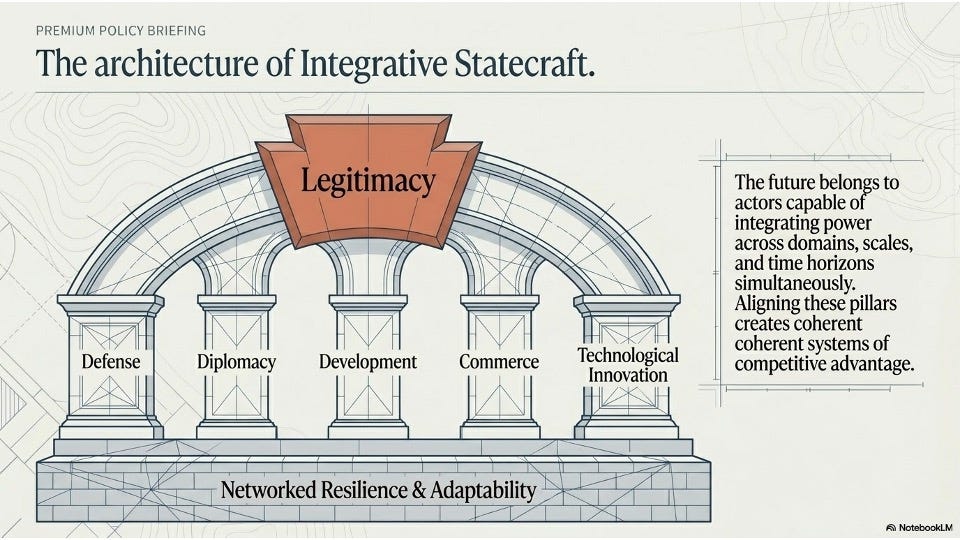
It also requires a deeper appreciation for legitimacy as a strategic variable.
Systems rarely collapse solely because of insufficient force. More often they erode from brittleness, fragmentation, and declining legitimacy—internally and externally. Sustainable influence increasingly depends not simply upon coercive capability, but upon the capacity to build resilient networks of cooperation, trust, adaptability, and shared strategic purpose.
This is why the present confrontation with Iran matters far beyond the Gulf itself.
What is being tested is not merely American deterrence.
It is whether the dominant strategic institutions of the post–Cold War era are intellectually and organizationally prepared for a world in which complexity compounds, systems collide, and geopolitical competition increasingly unfolds across the connective architecture of globalization itself.
The current crisis may ultimately be remembered less as a singular regional confrontation than as an early and revealing threshold moment in the emergence of a new compound era of global competition.
If you value this work, here are three ways you can step into the story with us:
📰 Subscriber (Free)
Stay informed. Receive every new essay, briefing, and analysis straight to your inbox. Join a growing community committed to civic resilience and national security.
🎧 Supporter (Paid Pledge)
Strengthen the signal. Your support sustains both Compound Security, Unlocked and our companion podcast The Civic Brief. Supporters ensure these conversations remain accessible to the wider public while elevating the quality, depth, and reach of the work.
🛡️ Sustainer (Patron Level)
Invest in the mission. Sustainers fuel new research, convenings, and storytelling that enlarge the civic frame of security. This is more than content — it’s a civic project. Your sponsorship helps preserve an independent voice committed to equipping citizens, leaders, and institutions for the compound challenges ahead.