
The "Coming" Contagion Wars
How the U.S.–Israel–Iran Conflict Is Reshaping Global Security.

By Isaiah “Ike” Wilson III
When Speculative Futures Become Reality
A few years ago, I began experimenting with an unusual approach to strategic forecasting. Instead of relying solely on formal models or traditional net assessment, I used fiction-informed speculative scenarios to explore how emerging geopolitical pressures might interact in ways traditional frameworks often overlook.
These exercises were not meant as prediction. They were meant as warning.
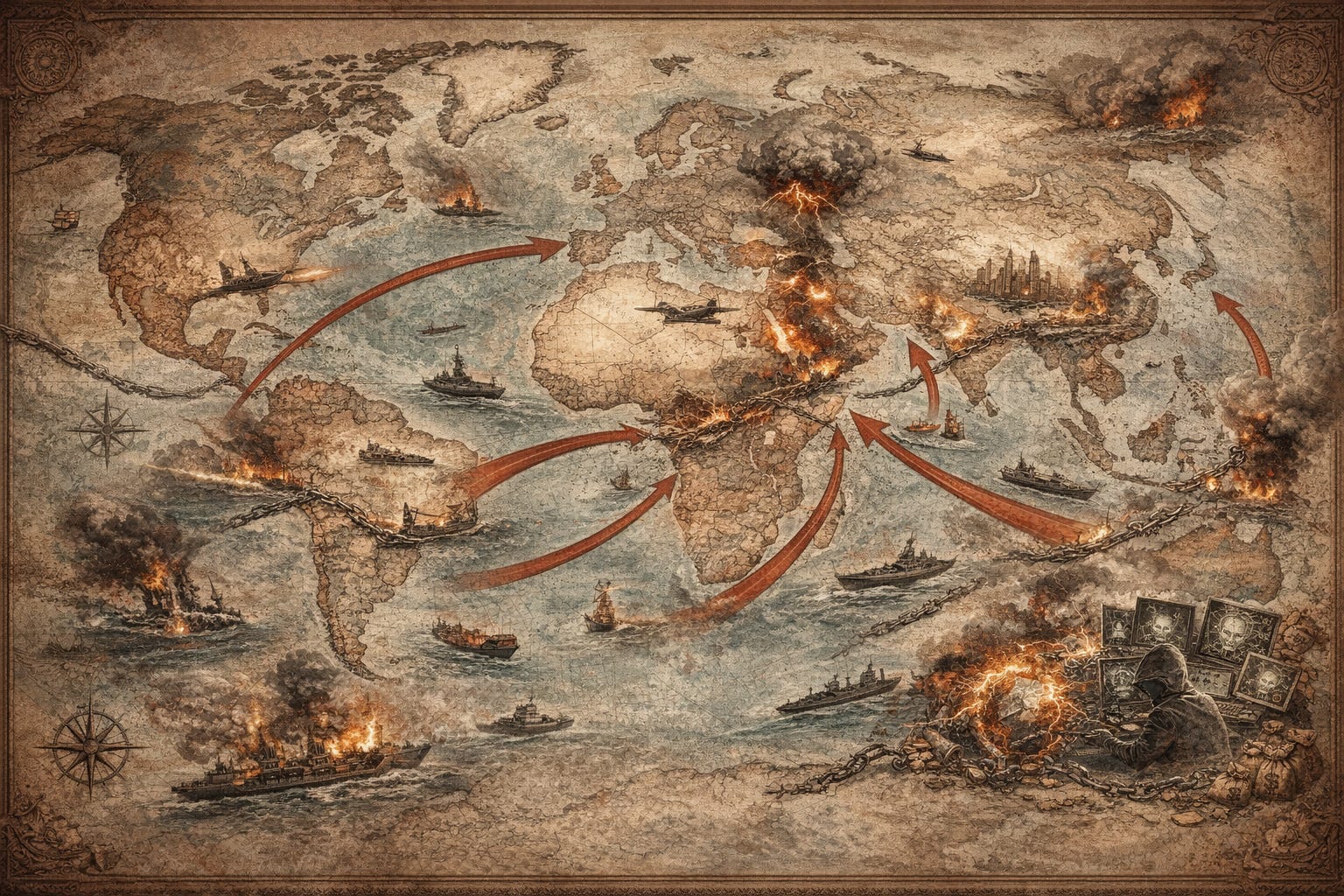
In one scenario, a regional conflict in the Middle East did not remain confined to its initial battlefield. Instead, it propagated outward through maritime chokepoints, energy markets, financial networks, cyber systems, and alliance politics. Military confrontation in one theater triggered cascading disruptions across global systems—the Strait of Hormuz, the Red Sea, Mediterranean supply chains, energy flows to Europe and Asia, and the fragile political balances of several allied states.
At the time, the scenario felt provocative but distant.
Today, it reads less like speculative fiction than like a strategic situation report.
The expanding confrontation involving the United States, Israel, and Iran is not simply another Middle Eastern war. It is something more consequential and potentially more destabilizing: the emergence of what might be called a compound war—a conflict in which military hostilities in one region trigger cascading disruptions across multiple interconnected systems of global order.
What is unfolding is not just war.
It is contagion war.
The Geography of Compound War
Traditional military conflicts are geographically bounded. Armies fight on identifiable battlefields. Naval forces contest specific maritime zones. Wars have front lines.
Compound wars do not behave that way.
In compound conflict environments, the battlefield expands across systems rather than territory. Military operations become only one component of a broader struggle involving economic pressure, maritime disruption, cyber operations, proxy networks, political coercion, and narrative warfare.
The Israel–United States–Iran confrontation illustrates this dynamic clearly. Military exchanges between Israel and Iranian forces—and the expanding American role in maritime protection and regional deterrence—have produced ripple effects across several strategic domains.
The most visible of these is maritime security.
The Persian Gulf, the Strait of Hormuz, the Red Sea, and the Eastern Mediterranean together form one of the most critical corridors of the global economy. Nearly one-fifth of globally traded oil moves through the Strait of Hormuz alone, and disruption there rapidly reverberates through global energy markets, inflation pressures, and political stability across allied economies.
These maritime chokepoints function as the arteries of the global system.
They are also uniquely vulnerable to disruption.
Iran has long invested in asymmetric maritime capabilities precisely designed to exploit these vulnerabilities. Swarm attacks by small fast boats, naval mines, anti-ship missiles deployed along coastal batteries, unmanned systems, and proxy maritime forces provide Tehran with a means of threatening global commerce without confronting the United States Navy directly.
These tools are not meant to defeat American sea power.
They are meant to destabilize the global commons.
The Collapse of Iran’s Proxy Shield
Yet one of the most significant developments in the present conflict has been the systematic dismantling of Iran’s long-standing proxy network.
For decades, Tehran’s regional strategy relied on what might be called distributed deterrence. Hezbollah in Lebanon, Shiite militias in Iraq, the Houthis in Yemen, and affiliated networks across Syria and the Gulf formed a constellation of armed actors capable of projecting Iranian influence without requiring direct Iranian military confrontation with Israel or the United States.
This network allowed Iran to widen conflicts horizontally. A strike against Iranian interests in one theater could trigger retaliation in several others.
But recent Israeli operations—supported directly or indirectly by American intelligence, logistics, and regional force posture—have begun degrading this architecture.
Senior commanders have been eliminated. Weapons pipelines have been disrupted. Infrastructure supporting proxy coordination has been degraded. Maritime interdictions have limited the movement of advanced weapons systems.
The effect is paradoxical.
In the short term, weakening Iran’s proxy network reduces Tehran’s ability to wage distributed warfare. But in the longer term, the erosion of these buffers increases the probability of more direct state-to-state confrontation.
Proxy networks historically functioned as shock absorbers in regional conflict. Their dismantling narrows escalation pathways, concentrating confrontation more directly between Israel, Iran, and increasingly the United States.
The result may be fewer indirect attacks—but higher-risk escalation as confrontation occurs.
War in the Global Commons
The strategic consequences of this conflict extend far beyond the Middle East.
For decades, the United States has served as the de facto guarantor of the global commons—the power responsible for maintaining open sea lanes, stable financial networks, and secure logistics corridors underpinning international trade.
This role formed the backbone of the post-1945 international system. American naval power secured the world’s maritime arteries. American financial institutions anchored global markets. American alliances provided the security architecture through which economic globalization expanded.
But compound wars threaten precisely these structures.
Iran’s strategy does not aim to defeat the United States militarily. It aims to raise the cost of maintaining the global system that underpins American power.
Attacks on shipping in the Red Sea, harassment of vessels in the Persian Gulf, cyber operations against infrastructure, and proxy strikes on energy facilities all serve the same strategic purpose: eroding confidence in the stability of the global commons.
The more unpredictable these systems become, the more difficult it becomes for any single power—even one as capable as the United States—to guarantee their stability.
The Hegemon’s Strategic Identity Crisis
Compounding this challenge is a deeper transformation underway within American strategy itself.
For most of the post–Cold War era, the United States viewed its role as the manager of the international system. American leaders often justified global military presence and alliance commitments as necessary to maintain collective security and economic stability.
But in recent years, Washington’s strategic posture has begun to shift.
Domestic political pressures, fiscal constraints, and growing skepticism about global commitments have pushed U.S. policy toward a more transactional and economically nationalist orientation. Successive administrations have increasingly framed alliances in terms of burden-sharing, economic advantage, and national interest rather than collective system stewardship.
This evolution does not mean the United States has abandoned global leadership. But it has begun to transform the character of that leadership.
A power once seen primarily as system manager increasingly appears—at least to some allies and adversaries—as a system disruptor.
Trade conflicts with allies, conditional security guarantees, industrial policy reshaping global supply chains, and the selective enforcement of international norms all contribute to this perception.
In a world already experiencing compound crises, such shifts carry strategic consequences.
If the guarantor of the system becomes uncertain in its commitment to that role, systemic stability becomes harder to sustain.
The Red Sea Precedent
The cascading nature of compound conflict is already visible in the maritime domain.
Attacks on commercial shipping in the Red Sea have forced several major shipping companies to reroute vessels around the Cape of Good Hope rather than transit the Suez Canal. This detour adds thousands of miles to shipping routes between Europe and Asia, increasing transit times, fuel costs, and insurance premiums.
The economic effects ripple outward.
Shipping delays disrupt supply chains. Energy price volatility feeds inflation. Insurance markets adjust war-risk premiums. Political pressures grow in democratic societies already strained by economic uncertainty.
What begins as a localized security incident becomes a global economic disturbance.
In the contemporary security environment, risk does not accumulate linearly.
It compounds.
The Hegemon’s Dilemma
For the United States, compound wars pose a profound strategic dilemma.
American military doctrine and force structure were designed for wars with identifiable theaters and adversaries. But compound conflicts impose simultaneous demands across multiple regions.
Carrier strike groups surge to the Eastern Mediterranean while maritime patrols expand in the Red Sea and Gulf. At the same time, naval forces must maintain presence in the Western Pacific, where Chinese leaders carefully monitor American force allocation patterns.
Strategic depth becomes thin.
Modern conflict also consumes precision munitions at extraordinary rates. Missile interceptors deployed in the Middle East are drawn from the same industrial base that supplies air defense systems for Ukraine and potential contingencies in the Taiwan Strait.
Industrial production cycles operate on the scale of years.
Conflict consumption operates on the scale of weeks.
The resulting tension is not merely logistical.
It is strategic.
The Return of Contagion Warfare
History offers precedent for conflicts expanding beyond their initial geography.
But today’s world is more interconnected than any previous era. Energy markets, financial systems, logistics corridors, and digital infrastructure bind societies together in ways that transmit shocks rapidly across continents.
In such an environment, war behaves less like a contained event than like a contagion process.
Military confrontation becomes the initial infection.
The systemic disruptions that follow are the pandemic.
A New Strategic Reality
The emerging U.S.–Israel–Iran conflict therefore represents more than another regional war. It is a glimpse of the strategic environment that may define the twenty-first century.
Future conflicts are likely to be compound conflicts—wars that unfold simultaneously across military, economic, technological, and political domains.
In such wars, the decisive question will not simply be who wins on the battlefield.
It will be which political systems can absorb disruption and adapt faster than their rivals.
For the United States, maintaining its role as guarantor of the global commons will require more than military superiority. It will require renewed strategic clarity about the purpose of American power.
If Washington wishes to remain the system’s stabilizing force, it must sustain the alliances, institutions, and industrial capacity that underpin that role.
If it continues drifting toward transactional nationalism, the result may not be American decline in the traditional sense.
It may instead produce something more dangerous: a world without a reliable system manager at precisely the moment global crises are becoming more interconnected.
The Warning
The speculative scenarios that once seemed hypothetical now appear uncomfortably real.
A regional war has begun to radiate outward through the arteries of the global economy. Maritime insecurity is spreading across key trade routes. Proxy networks are being dismantled. Strategic burdens are multiplying across theaters.
This is how contagion wars begin.
The question now facing the United States and its allies is whether they can prevent this one from spreading further—or whether the world is already entering an era in which wars no longer stay where they start.
About the Author
Isaiah “Ike” Wilson III is a retired U.S. Army colonel and former senior civilian defense executive. A combat veteran of operations in Iraq, Afghanistan, and the Balkans, he has served in strategic advisory roles to senior U.S. military and civilian leaders. Wilson holds a Ph.D. in Government from Cornell University and is a Professor of Practice in international affairs and security studies. He is the founder and CEO of Wilson Strategic Enterprises (W.i.S.E.) and the author of Thinking Beyond War. He writes the Substack newsletter Compound Security, Unlocked, where he develops the General Theory of Compound Security and its implications for contemporary strategy.
If you value this work, here are three ways you can step into the story with us:
📰 Subscriber (Free)
Stay informed. Receive every new essay, briefing, and analysis straight to your inbox. Join a growing community committed to civic resilience and national security.
🎧 Supporter (Paid Pledge)
Strengthen the signal. Your support sustains both Compound Security, Unlocked and our companion podcast The Civic Brief. Supporters ensure these conversations remain accessible to the wider public while elevating the quality, depth, and reach of the work.
🛡️ Sustainer (Patron Level)
Invest in the mission. Sustainers fuel new research, convenings, and storytelling that enlarge the civic frame of security. This is more than content — it’s a civic project. Your sponsorship helps preserve an independent voice committed to equipping citizens, leaders, and institutions for the compound challenges ahead.