
The Civilizational Illusion
Dugin, Dystopia, and the Dangerous Geometry of Multipolarity.

By Dr. Isaiah (Ike) Wilson III | Compound Global Affairs Analyst
“In multipolarity, every civilization is a world unto itself. But what happens when those worlds collide?”
What if the most dangerous maps aren’t drawn by generals or diplomats—but by philosophers with empires in their minds?
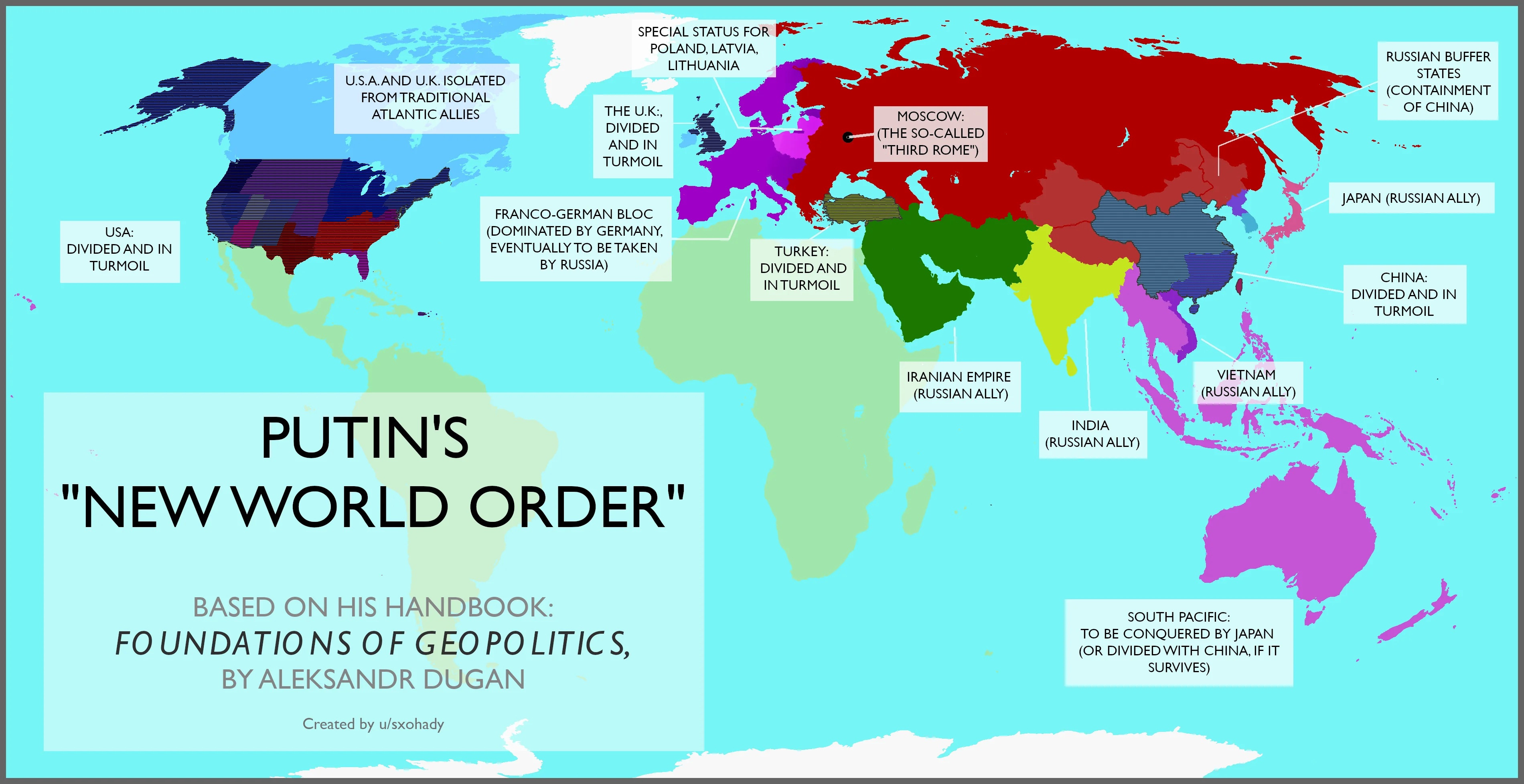
The map above—“Putin’s New World Order”—is not merely a cartographic curiosity. It is an ideological artifact. It is a visual manifestation of the Eurasianist vision articulated by Russian ultranationalist thinker Alexander Dugin in his geopolitical manifesto, Foundations of Geopolitics.
At once seductive and sinister, it proposes a reordered global system where the United States is isolated and fragmented, China is internally shattered, and Russia emerges as the organizing principle of a new multipolar world.
But to call it a “new order” is misleading.
This map is no blueprint for peace—it is a map of weaponized fracture. A geopolitical hallucination masquerading as strategy. A textbook case of what I’ve elsewhere termed a Compound Security Dilemma—one in which the accumulation of insecurity is not a byproduct of competition, but its central logic.
And in the age of compound security competition (CsC)—a period defined not by isolated threats but by converging and reinforcing crises—this vision of world order is not just obsolete. It’s combustible.
I. Dugin’s Dream: Civilizationalism as Geopolitical Technology
At the heart of Dugin’s worldview is a rejection of liberalism as a global organizing logic. He argues for a “multipolar” world, where great civilizational states—not liberal democracies—serve as the poles of order and meaning.
In his view, Russia is not simply a country—it is a “civilization-state”, a metaphysical pole with a messianic mission to resist the nihilism of the West.
In his ideal schema:
Russia absorbs or dominates post-Soviet space, Central Europe, and parts of the Middle East.
China is fragmented, with buffer states created to contain it.
Europe is divided into a German-dominated Franco bloc, with Poland, Latvia, and Lithuania receiving "special status"—read: compromised sovereignty.
The U.S. and U.K. are to be weakened through internal division, rendering the Atlantic alliance system obsolete.
India, Iran, Japan, and Vietnam become "allies" of Russia—a polite way of saying satellites in a Eurasian orbit.
This is not balance. It is civilizational revisionism—a calculated effort to redefine the poles of global power not by values, but by ethno-historical mysticism and coercive geography.
II. The Compounding Crisis: Where Dugin Meets the Real World
Dugin’s geopolitical fantasy collides violently with the conditions of the Compound Security Era—a term we use to describe the interdependent nature of today’s global threats. Dugin’s map is drawn as though we still live in a world of discrete states and clear lines. But we do not.
In today’s global reality:
Insecurity is entangled: Climate instability in the Sahel drives migration that fuels populism in Europe that shapes NATO decision-making that alters Russia’s own risk calculus. Nothing is clean. Everything is converging.
Power is polyphonic: It no longer resides solely in state capitals. It diffuses across platforms, financial flows, diasporas, data servers, insurgent networks, and proxy alliances.
Legitimacy is competitive: The real battleground is not territory but narrative—and the ability to frame events in ways that resonate globally and locally. In that game, coercive revisionism has diminishing returns.
In this context, a vision of world order based on zero-sum spheres of influence—where the solution to insecurity is the erasure of agency in neighboring states—is not strategic. It is self-subverting.
III. The Compound Security Dilemma, Revisited
Let us recall the compound security dilemma framework. It contends that:
Security threats converge across dimensions—political, environmental, military, cognitive.
Responses to these threats, when not coordinated multilaterally, often intensify the very insecurities they aim to suppress.
Actors engage in dual competitions—both military and non-military, traditional and irregular, physical and ideological.
Now apply this to the Duginian vision:
Russia’s pursuit of strategic depth through fragmentation of its neighbors ... actually intensifies NATO’s cohesion, not weakens it.
The projection of “civilizational” identity as geopolitical destiny ... actually accelerates internal dissent in borderlands like Belarus, Chechnya, and Central Asia.
The rejection of liberal order, framed as resistance to Western decadence, ... actually unites liberal and non-aligned actors alike under shared anxieties about neo-imperial domination.
This is the essence of the compound dilemma: In seeking maximal security for itself, the actor generates maximal insecurity for all—including itself.
IV. The Multipolar Mirage: When Poles Don’t Stabilize
Multipolarity is often sold as a panacea to U.S.-centric hegemony. And in theory, a truly pluralistic global order—one where diverse models of governance co-exist under a shared commitment to peace—can be stabilizing.
But the Dugin/Putin variant of multipolarity is not about pluralism. It is about partitioning. It seeks not coexistence but containment. Not detente but domination. Not diversity of values but the homogenization of subordinate states under a new center of gravity.
In such a system:
There are no neutral zones—only buffer states.
There is no diplomacy—only geopolitical engineering.
There is no security—only the illusion of it, imposed at the barrel of a tank or the click of a propaganda machine.
V. Strategic Consequences and Critical Foresight
If this vision is pursued in earnest, what are the implications for U.S. and allied strategy?
Great Power Competition becomes permanent gray zone conflict: The world becomes a battlefield not necessarily or only of armies, but of narratives, sanctions, cyberattacks, and manipulated referenda.
Regional orders fracture further: South Asia, the Caucasus, and the Arctic become zones of chronic instability as multiple poles assert incompatible sovereignty claims.
Nuclear risk re-normalizes: As revisionist powers redraw maps, the threat of escalation—accidental or designed—returns to Cold War levels of omnipresence.
Civil societies erode: The greatest long-term risk is internal—strategies that mirror Dugin’s in structure (even unintentionally) risk creating the very illiberal conditions they claim to oppose.
VII. But Then,... When History Punches Back: Three New Realities That Break the Map
While Dugin’s “New World Order” attempts to preemptively organize the 21st century under a neo-civilizational Eurasian axis, history, agency, and contingency have other ideas.
Three major developments in the mid-2020s reveal the fragility—but not the inevitability—of his model.
1. The Xi Exception: A China Too Big to Fragment
Dugin’s cartographic fantasy treats China as a predictable chapter in the classic Eurasianist playbook: a civilization doomed to internal decay, susceptible to encirclement by “Russian buffer states,” and easily outmaneuvered by a revitalized Moscow-centered pole. But the reality is now irreversibly altered:
Xi Jinping’s China is no longer containable. Its economic and technological ecosystem is increasingly self-sustaining and outward-projecting, its military modernization complete with space, cyber, and blue-water naval reach.
The Belt and Road Initiative (BRI) is not a retreating fantasy—it is a vector for planetary influence, reshaping the Global South in ways that Russia simply cannot match.
Ideologically, Xi has reframed “civilizational statism” in more palatable, pragmatic terms than Dugin’s mystical revanchism. Beijing offers development deals, not destiny myths.
Implication: Dugin's map breaks here first. The idea that China can be fractured and ring-fenced as a subordinate junior partner is no longer plausible. Instead, we face a co-dominion dilemma between Moscow and Beijing—two authoritarian giants with overlapping spheres and diverging strategies, trapped in an uneasy embrace of tactical alignment but strategic mistrust.
In compound security terms, this creates unstable dyads: co-conspirators in narrative warfare, but competitors in economic zones, technological ecosystems, and regional sway. It is not multipolarity—it’s multiplex rivalry.
2. The Return of Trump: An Ally to the Axis?
Perhaps the most shocking geostrategic rupture is internal to the West itself: the voluntary abdication of global leadership by the very system architect.
With Donald J. Trump’s return to the presidency—and his MAGA-Republican base’s realignment toward a nationalism-infused, transactional, and anti-globalist posture—the American strategic compass has pivoted.
NATO is fractured in spirit, if not yet in structure. Signals of abandonment in Ukraine and Taiwan ripple across Warsaw, Vilnius, Seoul, and Manila.
Traditional alliances have become suspect. Loyalty is now measured by tribute, not treaty. Military basing is transactional, not strategic.
Rhetorically, the U.S. is no longer the “leader of the free world,” but a “great power among great powers,” entangled in zero-sum balance sheets; content with being the biggest bully on the block rather than the bodyguard of the neighborhood.
In Dugin’s calculus, this would be victory: the final “moral collapse” of liberalism and the triumph of civilizational pluralism. And yet…
Here’s the twist: The U.S. is not merely withdrawing—it is joining the ideological chorus of anti-globalist statism. Trump’s America increasingly mirrors the very pole it once countered.
Implication: The Dugin map isn’t validated—it’s co-opted! The old Cold War binaries dissolve, replaced by a post-liberal convergence of statist, mercantilist powers. Yet this alignment is shallow. It is performative and paradox-laden. The U.S. may partner with Russia and China rhetorically—but strategically, its interests clash with both.
Compound Security competition intensifies here. A world of power vacuums invites malign actors, proxy wars, and irregular campaigning. But the kicker? The former hegemon has now become one more node in this volatile matrix, no longer the conductor of global order.
3. The Tariff War World: Smoot-Hawley, Reloaded
Finally, the global economy has entered a new mercantilist phase. Not just protectionist—but aggressively weaponized:
Tariffs, embargoes, and sanctions are no longer exceptions—they’re the grammar of economic statecraft.
Global supply chains are decoupling into geopolitical blocs: West vs. BRICS, techno-authoritarians vs. liberal democracies.
New trade corridors (IMEEC, Arctic Silk Road, China-Russia energy alignments) form geopolitical arteries and pressure points.
Dugin’s vision, which from panoramic views we can catch sight of Samuel Huntington’s own ‘Clash of Civilizations’ perceptions, assumes that cultural sovereignty will drive geopolitics.
But in practice, economic warfare is now the principal axis of power. We’re back to spheres of influence—but this time enforced not by tanks, but by tariffs and chips.
Implication: The global system has not become “multipolar.” It has become multi-hostile. Power is expressed through denial, disruption, and decoupling. The liberal trading order is not merely dead—it has been discredited in the eyes of populist electorates across continents.
Compound Security dilemmas now extend to economies. A wheat shortage in the Black Sea causes food riots in Africa, prompting migration to Europe, inflaming xenophobic parties, and weakening NATO resolve.
Every crisis compounds the next.
VIII. The Real End of Duginism: A Future Neither He Nor We Imagined
So, does Dugin’s vision win—or does it unravel?
The answer is neither.
What we face is a convergence crisis: where the liberal order collapses under its own contradictions, and the civilizational order fails to cohere under its own centrifugal tendencies.
The 21st century isn’t shaping up to be unipolar, bipolar, or even multipolar. It is polyfractal—layered, recursive, and unstable.
And in this world, Dugin’s map is worse than wrong—it’s wickedly incomplete. It ignores:
Networked insurgencies
Transboundary climate shocks
Cyber-sovereignties
AI-enabled asymmetric influence
Strategic migration as leverage
Private corporate diplomacy
Decentralized narrative warfare
Compound security isn’t just a theory. It’s the new operational reality. And it demands a new type of thinking: polycentric, cross-domain, and strategically humble.
IX. The W.i.S.E. Strategic Challenge: From Empire to Engagement
We must now ask ourselves:
How do we secure national interests without succumbing to the illusions of isolation or domination?
How do we build coalitions when values diverge but risks converge?
How do we restore legitimacy when our past models are suspect, and our future ones untested?
X. The W.i.S.E. Way Forward
In this moment, strategic imagination matters more than ever. But so does strategic humility.
We must counter this civilizational map not with another of our own—drawn in hubris and hard lines—but with a networked architecture rooted in the principles of compound security competition:
Invest in resilience, not dominance.
Build polycentric alliances, not protectorates.
Win the cognitive domain, not just the kinetic one.
Frame legitimacy as a shared value, not a tool of control.
Anchor in ...
3D+C statecraft (Defense, Diplomacy, Development, Commercial)
Maxi-min positioning at geopolitical chokepoints
Compound-aware planning for simultaneous, cross-domain threats
Strategic narrative warfare, not just strategic deterrence
And perhaps most importantly: do not meet madness with mimicry. Meet it with maturity.
Closing Thought
The Duginist dream was never destiny. It was projection. But the danger is that by accident—or by abdication—we make it real.
To resist that, we must not redraw the world in our image. We must rethink what it means to live, lead, and secure in a world beyond polarity.
Dr. Isaiah “Ike” Wilson III
Founder & CEO, Wilson W.i.S.E. Consulting LLC
Professor of Practice, ASU | President Emeritus, JSOU
Life Member, Council on Foreign Relations
📬 Subscribe to The W.i.S.E. Way for more on compound security, global strategic foresight, and defense innovation thinking.
