

By Isaiah “Ike” Wilson III
The War That Will Not Stay Put
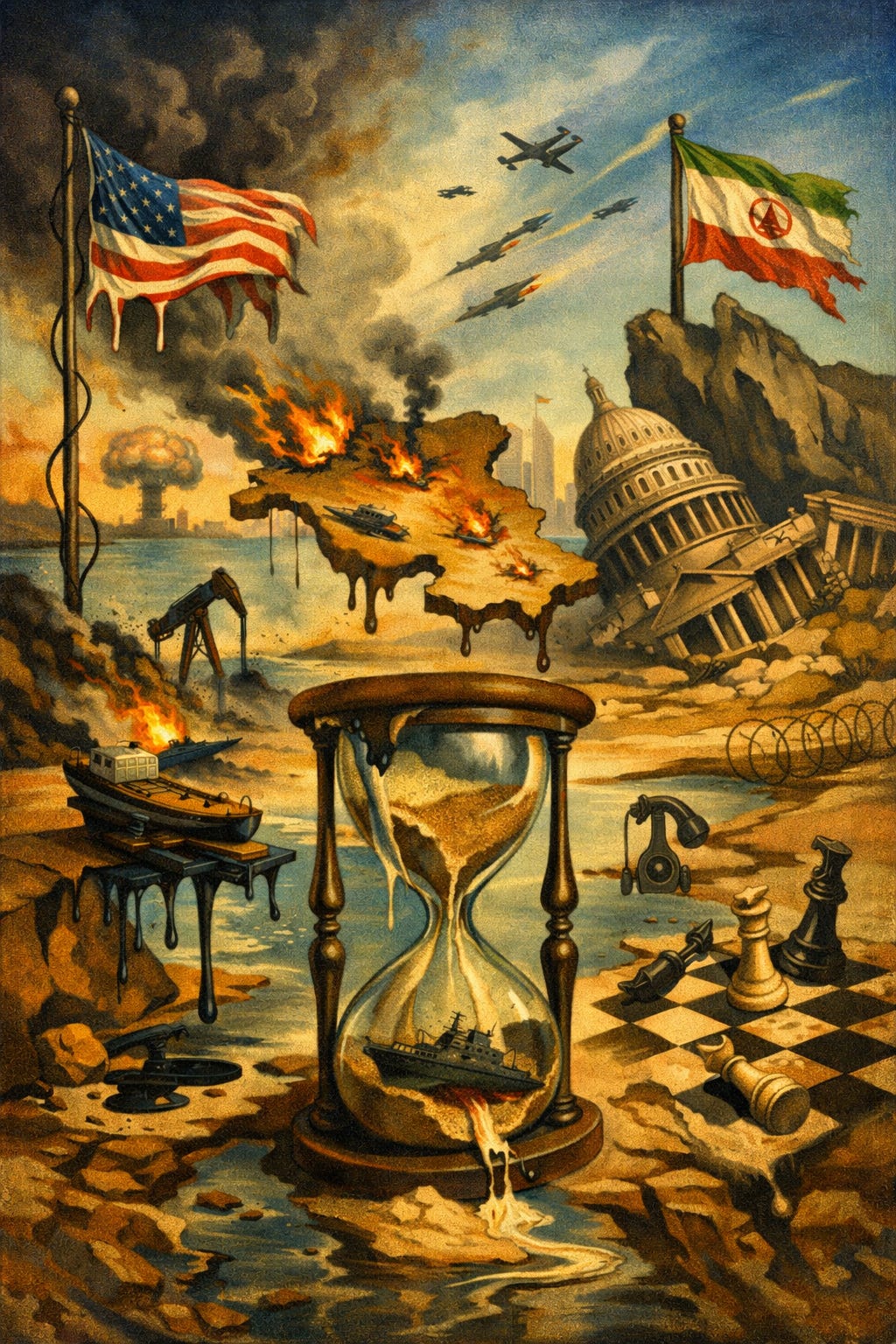
The emerging conflict with Iran will not unfold as a conventional war. It will not proceed in linear phases, nor will it culminate in a decisive battlefield outcome. Instead, it is already behaving as something more complex and more dangerous: a compound contagion war.
Such wars do not spread primarily through territorial conquest. They spread through systems—across energy markets, proxy networks, domestic politics, alliance structures, and information ecosystems. Their defining feature is not escalation alone, but diffusion.
This is not a new insight. It is, in fact, the lesson repeatedly presented—and repeatedly discounted—across the past two decades of American war.
The central analytical error now taking hold in Washington and allied capitals is a familiar one: the belief that tactical success—precision strikes, leadership decapitation, infrastructure disruption—can remain bounded.
It will not.
The conflict with Iran is likely to evolve not as a contained confrontation, but as a cascading system of disruptions whose effects will compound over time. The question is not whether the war will expand, but how—and whether the United States and its partners are prepared for the political consequences of that expansion.
Three Months: The Illusion of Control
In the near term, over the next three months, the conflict will appear manageable.
Iran’s response will likely remain calibrated but persistent. Rather than immediate large-scale retaliation, Tehran will rely on its well-established model as a statist-insurgent: a state that wages war through distributed networks while maintaining formal deniability.
This phase will not look like escalation. It will look like discipline.
Iran understands that time, not shock, is its ally.
Its strategy will center on what might be called a “selective toll road” approach to conflict—leveraging its geographic, maritime, and proxy positioning to impose episodic but cumulative costs on movement, commerce, and military presence without triggering full-scale retaliation.
What is now becoming more apparent—both to observers and, critically, to Tehran itself—is that this “toll road” is not merely coercive. It is discriminatory.
Iran is increasingly positioned to broker quiet, bilateral understandings—formal or tacit—with select states and commercial actors, effectively determining who experiences predictable passage and who faces friction, delay, or disruption. In doing so, it transforms geography into leverage and access into currency.
The implications are significant.
First, such arrangements introduce structured unpredictability into global maritime commerce. Risk is no longer uniform; it is selectively applied. This complicates not only operational planning but also the actuarial foundations of maritime insurance, where pricing depends on stable assumptions about exposure. When access becomes conditional—and politically mediated—risk calculations begin to drift, premiums rise unevenly, and alternative routing decisions reshape flows in ways that are neither efficient nor easily reversible.
Second, this dynamic begins to reorder familiar patterns of alignment. States and firms, faced with differential access, may choose accommodation over resistance—not out of affinity, but out of necessity. The traditional distinction between balancing against and bandwagoning with power becomes blurred, replaced by a more transactional calculus of who can guarantee passage.
Finally, this is where a deeper irony emerges.
A system increasingly defined by beggar-thy-neighbor transactionalism—long a feature of recent U.S. economic and strategic posture—finds itself mirrored and, in some cases, outmaneuvered. As partners hedge, recalibrate, or quietly peel away to secure their own exposure, the cumulative effect is subtle but consequential:
America First risks becoming America—somewhat alone.
This will manifest in several ways:
• Sustained proxy attacks across Iraq, Syria, Lebanon, and the Gulf
• Maritime harassment and selective interdiction in the Strait of Hormuz
• Cyber operations targeting energy, financial, and infrastructure systems
• Information campaigns aimed at fracturing U.S. domestic and allied cohesion
Energy markets will remain volatile but functional. Shipping lanes will be contested but not closed. U.S. forces will demonstrate continued tactical dominance.
From a military perspective, this phase will look like success.
But beneath that surface, structural shifts will already be underway:
Alliance Strain – Gulf partners, now directly exposed to retaliation, will begin recalculating the cost of alignment with U.S. operations.
Market Adaptation – Energy flows and insurance regimes will adjust, embedding risk premiums that advantage alternative suppliers and routes.
Legitimacy Drift – Outside Western narratives, the conflict will increasingly be framed not as deterrence but as provocation.
The United States will still appear in control.
In reality, it will be operating inside a system whose rules are quietly being rewritten.
Six Months: Diffusion, Friction, and Strategic Exposure
By the six-month mark, the conflict will have moved beyond its initial geography.
The defining characteristic of this phase will be diffusion under pressure.
Iran’s strategy will not aim at decisive victory but at strategic exhaustion: raising the costs of U.S. engagement across multiple domains while preserving escalation ambiguity.
Several developments are likely:
• Expanded Proxy Autonomy: Iranian-aligned groups act with increasing independence, producing outcomes that are directionally aligned with Tehran’s interests but operationally deniable.
• Regional Spillover: Iraq, Syria, and potentially the eastern Mediterranean become persistent instability zones rather than secondary theaters.
• Economic Contagion: Energy price volatility begins to transmit into global inflation, supply chain disruption, and domestic political strain across allied states.
• Alliance Decoupling: European and Gulf partners quietly hedge—diversifying security, procurement, and diplomatic alignments.
At this stage, the United States will confront a paradox it has encountered before—but not at this scale:
Its military dominance will remain intact.
Its strategic position will not.
Domestic Cascade: War Abroad, Fracture at Home
By the six- to nine-month mark, the conflict’s contagion effects will no longer be primarily external. They will begin to manifest inside the United States itself—most visibly across the political system during the 2026 midterm election cycle.
This is not incidental timing. It is structurally consequential.
Compound contagion wars do not respect the boundary between foreign and domestic domains. They operate across that boundary—often exploiting it.
As external pressures accumulate—energy price volatility, supply chain disruptions, and persistent low-level military engagement—their political effects are transmitted inward, where they interact with an already polarized and fragile domestic environment.
Three reinforcing dynamics are likely to emerge.
First, economic pressure becomes political acceleration.
Energy market volatility and inflationary spillovers—initially absorbed as background noise—will become focal political issues. Even modest price instability, when sustained, acts as a multiplier of public dissatisfaction. In an election cycle, that dissatisfaction does not remain diffuse; it concentrates.
Campaign narratives will increasingly frame the conflict not in strategic terms, but in immediate economic ones: cost of living, fuel prices, market instability. The war becomes domestic through the wallet before it becomes domestic through policy debate.
Second, information fragmentation becomes strategic terrain.
Iran—and aligned or opportunistic actors—will not need to “win” in the information domain. They will only need to amplify existing fractures.
Disinformation, selective truth, and narrative shaping will converge with domestic partisan messaging, producing an environment in which:
• Strategic coherence becomes difficult to sustain
• Policy debates collapse into binary political signaling
• Public trust in official narratives erodes further
The result is not persuasion, but divergence—multiple, competing realities through which the same external events are interpreted in fundamentally different ways.
Third, alliance politics reverberate domestically.
As partners hedge abroad, those shifts will not go unnoticed at home. Questions of burden-sharing, allied reliability, and U.S. commitments will move from the realm of foreign policy elites into mainstream political discourse.
Calls for retrenchment, selective disengagement, or re-prioritization of commitments will gain traction—not necessarily as coherent strategies, but as politically resonant responses to perceived overextension.
This is where the external and internal dynamics begin to reinforce one another.
As allies hedge, domestic arguments for reduced engagement strengthen.
As domestic pressure for retrenchment grows, allied confidence weakens further.
The system begins to feed on itself.
The cumulative effect is not collapse—but constraint.
By the height of the midterm cycle, U.S. decision-makers will face a narrowed strategic aperture:
• Military options remain available but politically contested
• Diplomatic flexibility is constrained by domestic signaling requirements
• Long-term strategy is subordinated to short-term political survivability
In such conditions, even well-calibrated actions risk misinterpretation—both abroad and at home.
This is the domestic expression of compound contagion.
Not a breakdown of capacity, but a degradation of coherence.
And in a conflict defined by diffusion, coherence is itself a form of power.
Black Swan Pathways: The War’s Nonlinear Risks
What distinguishes a compound contagion war is not simply that it spreads—but that it produces nonlinear shocks capable of rapidly redefining the conflict.
Several low-probability but high-impact scenarios now sit within the realm of plausibility:
1. Loss of a Capital Ship
A successful Iranian or proxy-enabled strike—whether through swarm tactics, anti-ship missiles, or hybrid maritime means—against a U.S. carrier or amphibious capital ship would represent a generational shock.
Even a mission-kill would:
• Shatter assumptions of maritime dominance
• Trigger immediate escalation pressures
• Force a reassessment of forward-deployed naval posture
The political consequences would likely exceed the operational ones.
2. The Strait of Hormuz “Gun Run” Failure
An attempted high-visibility transit—an assertion of freedom of navigation—could be transformed by Iran into a controlled engagement space.
Through layered harassment, mining, drone surveillance, and proxy coordination, Iran could impose cumulative friction on a U.S. ARG-MEU, turning movement into vulnerability.
The risk is not annihilation, but attrition under observation—a slow-motion demonstration that access itself is contested.
3. A “Guadalcanal on Kharg Island” Scenario
Should U.S. or allied forces attempt seizure or denial operations targeting Iranian energy infrastructure—particularly Kharg Island—the risk emerges of localized entrapment.
Iran’s proximity, layered fires, and maritime denial capabilities could create conditions where:
• Initial tactical success is achieved
• Follow-on sustainment becomes untenable
• Extraction becomes politically and militarily costly
The historical echo would be unmistakable: tactical foothold, strategic exposure.
4. Special Operations Catastrophe
A failed or compromised operation targeting Iran’s hardened nuclear infrastructure—particularly buried or dispersed material—could result in:
• Significant loss of U.S. special operations and intelligence personnel
• Exposure of sensitive capabilities and methods
• Strategic embarrassment with cascading political effects
More importantly, it would reinforce a central reality:
not all targets are meaningfully accessible, even when technically reachable.
5. Mass-Casualty Event in Israel and Runaway Escalation
A large-scale, high-casualty attack inside Israel—whether executed by Hezbollah, Iranian proxies, or through a coordinated multi-vector strike—would represent a catalytic shock with immediate and far-reaching consequences.
Such an event would not remain contained within the existing framework of calibrated response.
Domestic political pressures within Israel would almost certainly compel a decisive and expansive retaliatory campaign, potentially extending beyond proxy targets to include direct action against Iranian state infrastructure. In such a scenario, escalation would no longer be managed—it would become self-propelling.
For the United States, the implications are acute.
Alliance commitments, forward-deployed forces, and political alignment would create conditions of rapid entanglement, narrowing decision space at precisely the moment when strategic clarity is most required. What begins as support risks becoming co-belligerency—not by deliberate design, but through the gravitational pull of events.
This is the essence of contagion.
A single shock, operating within an already interconnected and tension-loaded system, triggers not just escalation—but escalation across domains, actors, and timelines simultaneously.
In such conditions, the ladder is not climbed rung by rung.
It is skipped.
Twelve Months and Beyond: Transformation, Not Termination
Beyond twelve months, the conflict will likely undergo a qualitative shift.
It will cease to resemble a discrete war and instead become a persistent condition—a new security environment.
Three trajectories emerge:
1. Managed Disorder
The most likely outcome is a form of unstable equilibrium:
• Periodic escalation
• Persistent proxy conflict
• Chronic economic disruption
No actor wins decisively. All adapt to a degraded order.
2. Escalation Without Resolution
A major shock event triggers broader conflict.
The United States achieves operational success—but inherits an expanded instability problem for which no political framework exists.
The pattern is familiar. Only the scale differs.
3. Legitimacy Reversal
Over time, the conflict reshapes perceptions:
• Iran positions itself as resilient and defiant
• The United States is increasingly viewed as disruptive rather than stabilizing
• Non-aligned states hedge away from U.S.-centric order
This is not defeat in the conventional sense.
It is strategic displacement.
The Strategic Misdiagnosis
Across all timelines, the central risk is not battlefield defeat. It is misdiagnosis.
The United States continues to approach conflict through a framework designed for:
• Discrete wars
• Contained theaters
• Measurable military outcomes
But the conflict it now faces is:
• Distributed
• Persistent
• Politically recursive
The assumption that military superiority can contain such a conflict is not simply optimistic.
It is historically unsupported.
The Real End State
The war with Iran will not end in surrender, collapse, or decisive victory.
It will end—if it can be said to end at all—in transformation:
• A Middle East defined by fragmented authority and adaptive conflict
• A global system shaped increasingly by risk, not rules
• A United States still powerful, but less determinative
Conclusion: The Pattern, Once Again
There is a pattern in modern American warfare that is now difficult to ignore.
Rapid operational success.
Followed by strategic ambiguity.
Followed by prolonged instability.
The conflict with Iran does not break this pattern.
It extends it—into a more interconnected, more volatile, and less forgiving environment.
The danger is not failure in the opening phase.
It is success—misread, overextended, and insufficiently governed.
That, more than any individual strike or escalation, is what turns conflict into contagion.
And that is where this war is already heading.
Final Closing
What makes this moment distinct is not that the warning signs are unclear—they are, in fact, unusually visible.
The dynamics of diffusion, the fragility of alliances under pressure, the weaponization of access, and the accelerating interplay between military action and systemic consequence have all been observed before, in fragments.
What has changed is their convergence.
The question, then, is not whether this conflict will follow a familiar trajectory. It is whether those responsible for shaping it will recognize the pattern early enough to alter its course—or whether, once again, … once again, … recognition will come only after the system has already shifted, and the costs have already compounded.
Author Bio
Isaiah “Ike” Wilson III is a retired U.S. Army colonel and former senior civilian executive in the U.S. Department of Defense. He is a professor of practice at Arizona State University and founder of Wilson W.i.S.E. Consulting. He is the author of Thinking Beyond War: Civil–Military Relations and Why America Fails to Win the Peace and writes on strategy, civil–military relations, and compound security.
If you value this work, here are three ways you can step into the story with us:
📰 Subscriber (Free)
Stay informed. Receive every new essay, briefing, and analysis straight to your inbox. Join a growing community committed to civic resilience and national security.
🎧 Supporter (Paid Pledge)
Strengthen the signal. Your support sustains both Compound Security, Unlocked and our companion podcast The Civic Brief. Supporters ensure these conversations remain accessible to the wider public while elevating the quality, depth, and reach of the work.
🛡️ Sustainer (Patron Level)
Invest in the mission. Sustainers fuel new research, convenings, and storytelling that enlarge the civic frame of security. This is more than content — it’s a civic project. Your sponsorship helps preserve an independent voice committed to equipping citizens, leaders, and institutions for the compound challenges ahead.


