

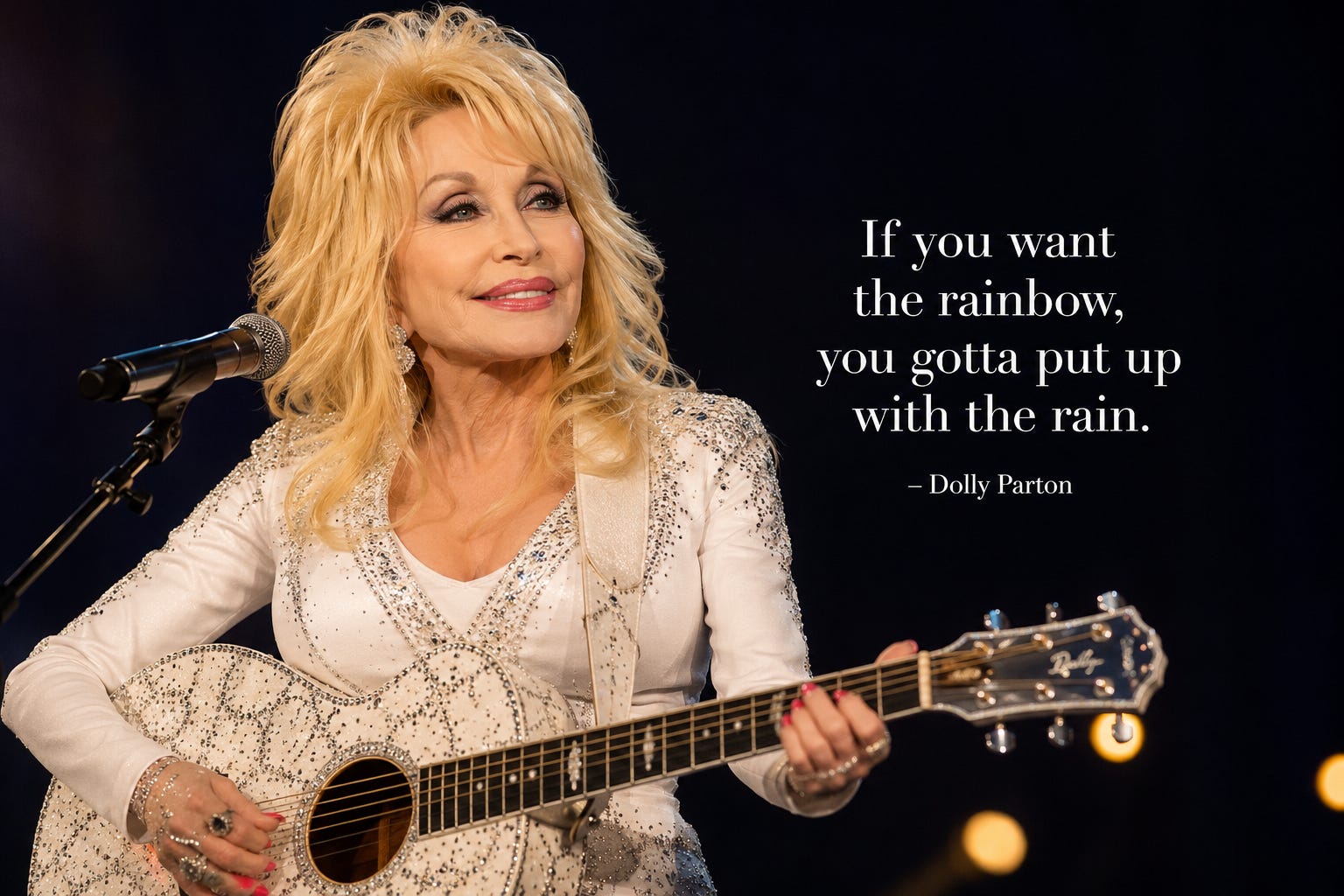
Dolly Parton died today at eighty years old.
Eighty.
There is nothing particularly unnatural about dying at eighty. And yet the news landed with the peculiar force of something that was not supposed to happen.
Dolly?
Our Dolly?
Not her.
That reaction is worth dwelling upon.
Because I do not think what millions of Americans are feeling today is simply grief over the death of a beloved singer, songwriter, actress, entrepreneur, and philanthropist. Nor is it merely the familiar melancholy that comes when another figure from our youth passes into history.
Something more foundational has been disturbed.
We have lost a piece of American common ground.
And perhaps we did not realize how scarce that ground had become until one of the people standing upon it disappeared.
The Woman Who Belonged to Everyone
Consider what Dolly Parton managed to become.
She was profoundly Southern without making Southernness exclusionary. Deeply Appalachian without turning regional identity into grievance. Christian without appearing interested in policing anyone else’s soul. Patriotic without making patriotism a loyalty test.
She became enormously wealthy without concealing that she had once been desperately poor.
She was a working-class icon and a sophisticated businesswoman. A feminist figure who rarely needed to announce herself as one. A woman who cultivated one of the most extravagantly artificial appearances in American popular culture while somehow remaining unmistakably authentic.
She could inhabit Nashville and Hollywood. Church pews and gay bars. Dollywood and the Kennedy Center. Country radio and children’s libraries.
And somehow none of those constituencies seemed to require her to renounce the others.
That is extraordinary in any period of American history.
In ours, it seems almost miraculous.
Because ours is an age of sorting.
Beer has a politics. Cars have a politics. Football has a politics. Universities, vaccines, cities, suburbs, rural counties—even disasters and acts of mourning—are dragged into the machinery of tribal identification.
Before deciding what we think about something, we increasingly ask: Who else thinks this? Which tribe owns it? What does agreeing with it say about me?
Dolly somehow remained standing outside much of that machinery.
Not because she lacked convictions.
Because she declined to make contempt a condition of belonging.
…. I often talk about being a “conditional” American as a Black American in America. Dolly never placed any “conditionality” on any of us. That’s why we all love(d) her.
A Little Piece of Neutral Ground
Every functioning political community requires places where politics stops.
Not permanently. Not completely.
But somewhere.
Nations are not held together by constitutions alone. They are held together by habits, stories, symbols, songs, jokes, grief, heroes, landscapes, and memories—by millions of tiny cultural recognitions through which strangers reassure one another:
You know this too.
You remember that.
This belongs to both of us.
America once possessed considerably more of this civic neutral ground. Much of it has disappeared.
Dolly remained.
She was a little patch of demilitarized America.
And today one of those places is gone.
The Coat of Many Colors
There is another reason this death resonates so deeply at this particular American moment.
Dolly Parton’s life embodied one of the country’s oldest stories about itself.
One of twelve children, raised in poverty in a one-room cabin in the Tennessee mountains, she possessed talent, ambition, discipline, humor, intelligence, and an extraordinary capacity for work. She went to Nashville. She succeeded beyond anything the little girl in that cabin could reasonably have imagined.
The coat of many colors became the rhinestones.
The mountain cabin became Dollywood.
The poor child became an international cultural institution.
But there was something crucial about Dolly’s version of the American Dream.
She did not pull the ladder up behind her.
She reached back down.
The Imagination Library may ultimately be as important to understanding Dolly Parton as “Jolene” or “I Will Always Love You.” She took something she understood intimately—the relationship between poverty and possibility—and did something wonderfully concrete about it.
She gave children books.
Not lectures about personal responsibility.
Books.
Not speeches about opportunity.
Books.
Not admonitions that if she had escaped poverty anyone could.
Books.
Millions upon millions of them.
When fires devastated communities in her native Tennessee, she helped families directly. When COVID arrived, she contributed money to medical research.
Again and again, the ethic was remarkably simple:
I have been fortunate. Someone helped me. I can help someone else.
It was not charity as performance.
It was reciprocity.
Kindness Without Weakness
That ethic feels especially significant in an American moment increasingly fascinated by domination.
Strength is performed through humiliation. Power through submission. Winning increasingly requires someone else to lose publicly.
Compromise becomes surrender. Empathy becomes naïveté. Mercy becomes weakness.
Sometimes the cruelty is not incidental.
It is the point.
Dolly Parton represented another conception of strength:
Kindness without weakness.
That qualification matters.
Dolly was nobody’s fool.
Behind the wigs, jokes, rhinestones, and self-deprecation was a disciplined artist and formidable entrepreneur. She understood ownership, contracts, intellectual property, branding, negotiation, and leverage.
She could write “I Will Always Love You” as an expression of affection while simultaneously insisting upon her independence.
There may be more political philosophy in that posture than in many political manifestos.
A Compound American
I have spent much of my professional life thinking about compound systems—about how seemingly contradictory things interact, adapt, fracture, and sometimes hold together.
Dolly Parton was, in her own wonderful way, a ‘compound American’.
Poor and entrepreneurial.
Traditional and transgressive.
Christian and tolerant.
Southern and universally American.
Working-class and fabulously wealthy.
Feminine and powerful.
Provincial in her roots and cosmopolitan in her reach.
She did not resolve those contradictions.
She inhabited them.
And pluralistic democracy ultimately asks something similar of us.
Not to become identical. Not to surrender tribe, faith, region, or history.
But to become capacious enough to carry several truths simultaneously—to belong deeply somewhere without requiring everyone else to belong there too.
Dolly knew exactly where she came from.
She simply never seemed to require anyone else to come from there.
The People We Mistake for Permanent
There is also something simpler happening today.
Dolly was always there.
For one generation, Porter Wagoner and “Jolene.” For another, 9 to 5 and Steel Magnolias. For still another, an unofficial national grandmother—funny, bawdy, generous, self-aware, rhinestoned, apparently indestructible.
She crossed enough generations that we stopped thinking of her as old.
We began thinking of her as permanent.
Every society has people like this. They slowly cease being celebrities and become landmarks. You don’t wake each morning grateful that the mountain is still there. You simply orient yourself by it. Until one morning it isn’t.
And the horizon looks wrong.
That is what today feels like.
She Was Ours
America is now walking through its 250th birthday year in a profoundly unsettled condition.
We are fighting over the meaning of our founding, the boundaries of citizenship, the legitimacy of institutions, the uses of power, the meaning of equality, and increasingly whether political opponents remain fellow citizens.
We possess enormous power and diminishing trust. Infinite information and vanishing agreement about what is true. More ways of communicating than any civilization in human history and an increasingly impoverished capacity to speak with one another.
We are becoming exceptionally proficient at identifying them.
We are losing fluency in us.
And then Dolly dies.
And across this fractured country—from Tennessee hollows to Manhattan apartments, from church sanctuaries to gay bars, from country stations to college campuses—millions of people who disagree about nearly everything experience approximately the same involuntary thought:
Oh, no.
Not her.
She was ours.
There it is.
Ours.
That may be why this hurts differently.
Not simply because Dolly Parton has died, but because her passing reminds us that the America capable of producing—and collectively loving—a Dolly Parton is itself not guaranteed.
Common ground can disappear.
Civic affection can disappear.
A national we can disappear.
Countries can remain on maps long after their people cease imagining themselves as belonging to one another.
And yet today offers a strange counterpoint to that fear.
Millions of us are mourning the same woman—not because a government instructed us to, not because we share a political party, and not because we worship alike, vote alike, look alike, love alike, or live alike.
Somewhere along the way, a poor girl from the Tennessee mountains became part of the story we told ourselves about ourselves.
She belonged to Appalachia.
She belonged to country music.
She belonged to Tennessee.
She belonged to her family.
She belonged to herself.
And somehow, without diminishing any of those things, she became ours.
All of ours.
Perhaps that is Dolly Parton’s final gift to the country she leaves behind.
At precisely the moment when Americans seem least certain that there remains an American we, her absence reveals one.
We know because today we can feel the empty space where she stood.
So perhaps the proper response is not merely to mourn Dolly Parton.
Perhaps it is to remember forward from her.
To remember that belonging need not require exclusion.
That conviction need not require contempt.
That strength need not require cruelty.
That success creates obligations as well as privileges.
That we can love our own people and places fiercely without requiring someone else’s to become smaller.
And that a republic ultimately depends upon something deeper than winning.
It depends upon enough of us, often enough, still being able to say:
ours.
Rest well, Dolly.
And thank you for reminding us, one last time, that there still is an us.
Bravo. A very thoughtful trubute.
This writing by Dr. Wilson is particularly close to me, for one who was in Country Music Radio for 10 years; having the honor of pushing that CD button to play and hear Dolly Parton singing... anything! Thank you, Dr. Wilson for this honorable tribute to an honorable woman.