
Reverse Robin Hood ....
The American Love Affair with Tax Cuts for the Rich.

By Dr. Isaiah “Ike” Wilson III | Professor of Political & Policy Sciences | Professor Emeritus, Department of Social Sciences at West Point
“They call it trickle-down, but all we ever get is trickled on.” —A cynical bumper sticker, 1983
“No taxation without representation.” —Patriot rallying cry, 1773
“You’re not envious of the rich—you’re just a temporarily embarrassed millionaire.” —(Often attributed to) John Steinbeck

I. Introduction: The Paradox of Political Affection
There may be no more enduring paradox in American political development than the persistent, almost reflexive political support among large swaths of working-class and middle-income Americans for tax cuts that overwhelmingly and unapologetically benefit the ultra-wealthy.
This fascination is not just a product of clever messaging or partisan allegiance. It is the culmination of a multi-century ideological formation—one rooted in exceptionalism, the sacralization of property, racialized populism, and performative democracy.
It is what I call the Reverse Robin Hood Doctrine: the idea that taking from the many to benefit the few is not only permissible, but righteous, patriotic, and inevitable.
This essay charts the evolution of that doctrine—from its postcolonial mythmaking to its New Deal rebalancing, its neoliberal revenge in the Reagan era, and its ultimate coronation under Trumpism. It lays bare who gains, who loses, and why “common folks” have become the most impassioned defenders of their own economic disempowerment. And it does so with a warning: America today finds itself in a moment not unlike the one that sparked its original revolution. Only now, the new tyrants are not kings, but capital. Not Parliament, but private equity. Not taxation without representation, but exploitation without recourse.
II. From Revolution to Reaction: The Original Sin of Unequal Liberty
The American Revolution is often mythologized as a populist uprising against aristocratic taxation and imperial overreach. But the reality is more complex—and less romantic. From the very beginning, American liberty was unequally distributed and tightly tethered to property, whiteness, and patriarchal authority.
The Constitution of 1787 was not a radical document; it was a deeply conservative reaction to insurgent populism, designed in part to insulate the wealthy from the will of the many. The Founders feared democracy nearly as much as they feared monarchy. They structured a government in which taxation was tolerable only to the extent that it protected, not challenged, elite property interests.
Thus, American identity fused liberty with property, and equality with ownership. As the 19th century unfolded, particularly during the Jacksonian and Gilded Ages, wealth was recast as virtue, and taxation of the rich became tantamount to moral heresy. To tax the wealthy, in this emerging ideology, was not to correct injustice but to attack success itself—a narrative that would haunt American fiscal politics to this day.
III. The High-Water Mark of Equity: The New Deal Interregnum
It wasn’t until the cataclysms of the Great Depression and World War II that this mythology was interrupted. Franklin D. Roosevelt’s New Deal reframed the relationship between wealth and democracy, introducing a vision of the state as an active guarantor of economic equity. Under his administration, top marginal tax rates soared to over 90%. Government programs such as Social Security, the GI Bill, and large-scale public investment created the scaffolding for a broad and stable middle class.
This was a rare moment of moral consensus, when taxation was understood as the price of participation in a civilized society. For a brief generation, redistribution became an American virtue. The working class—including a vast swath of white Americans—benefited directly and visibly, making the social contract feel legitimate and alive.
And yet, even this era was exclusionary. Redlining, segregated schools, and racist labor policies ensured that Black and brown Americans were systematically excluded from the full benefits of the postwar boom. The long shadow of unequal liberty persisted, even as the façade of egalitarianism was briefly constructed. Still, for a time, the narrative was aligned: the rich paid more, and the state served the many. But this alignment would not survive the ideological storms of the late 20th century.
IV. The Reagan Realignment: Capital Worship and the Neoliberal Revival
Ronald Reagan’s election in 1980 marked the beginning of a counterrevolution—one that would undo the New Deal’s civic consensus and replace it with a cult of capital.
Against the backdrop of inflation, unemployment, and Cold War fear, Reagan declared government itself the enemy. In 1981, he signed the Economic Recovery Tax Act, slashing top income tax rates from 70% to 50%, and later down to 28%.
But the intellectual rationale of supply-side economics—the theory that cutting taxes on the rich would unleash investment and growth—was less important than the emotional resonance of Reagan’s message. He told Americans that they weren’t being left behind; they were just temporarily embarrassed millionaires. In doing so, he activated what I call the aspirational identification fallacy—the belief that taxing the rich was immoral because one day, you too might be rich.
The impact of this realignment was profound. It redefined billionaires not as beneficiaries of public systems but as their victims—geniuses under siege. Taxation became an act of envy, not equity. And with the rise of think tanks like the Heritage Foundation, ALEC, and Cato Institute, tax resistance evolved into a totalizing ideology—one that pervaded policy, culture, and eventually, political theology.
V. The Coronation of Plutocracy: Trumpism Ascends
This ideology found its purest expression on the evening of January 20, 2025—at the Inauguration celebration of Donald J. Trump. There, beneath golden chandeliers, and marble colonnades, stood a shadow government of oil barons, private equity billionaires, hedge fund magnates, and corporate lobbyists.
It was not a celebration of the people’s victory. It was a coronation of the billionaire caste—a signal to the country and the world that the old myth of “draining the swamp” had given way to a new reality: Reverse Robin Hood, in full power position.
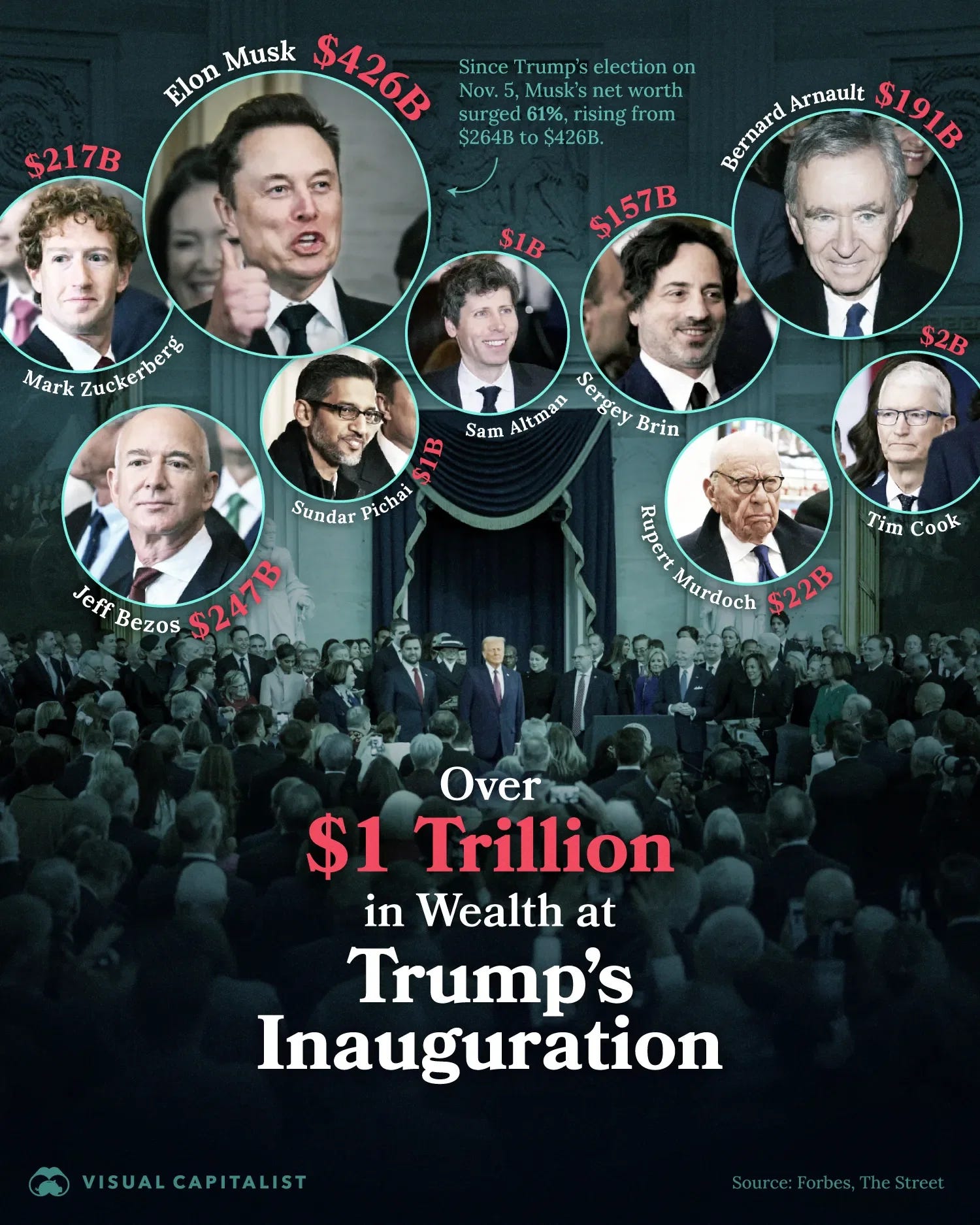
The Trump tax cuts of 2017 had offered grotesque rewards to the wealthiest Americans. The top 0.1% saw historic windfalls, even as rural infrastructure decayed, public schools starved, and health systems crumbled under the weight of inattention.
But the most perverse dimension of this latest moment wasn’t fiscal—it was performative. Trump convinced millions of struggling Americans that cutting taxes on billionaires was a revolutionary act—a strike against the elite, when in fact it was their final consolidation of power.
VI. Grift Disguised as Strategy: The Tariff War and Global Looting
And then came the tariffs—marketed as patriotic protectionism but executed as chaotic grift. Soybean farmers in Iowa at risk of losing their markets. Steel towns in Ohio foreseeing marginal gains offset by downstream job losses. Family farms across the Midwest anticipating filing for bankruptcy in record numbers.
Meanwhile, the real winners have been those with the means to ride the waves: billionaire investors, hedge fund managers, and politically connected elites who timed their trades, restructured portfolios, and exploited regulatory ambiguity for windfall gains.
It was strategic manipulation masquerading as national interest. It was global grifting, dressed in red, white, and blue.
In the end, the common folk lost their shirts—literally. And tragically, they thank their looters for the privilege.
VII. A Revolutionary Mirror: ‘No Taxation Without Representation’—Revisited
Let us recall that the rallying cry of 1773 was “No taxation without representation.” Yet what is America today, if not the empire it once defied?
Billionaires now dictate public policy through lobbyists, dark money, and legal engineering. Tax codes are written in private boardrooms and rubber-stamped by a compliant Congress. Meanwhile, everyday Americans are handed slogans, hashtags, and hollow pageantry.

By the very standard set by the Sons of Liberty, the American people now have more reason to revolt than ever before. The tea is no longer symbolic—it’s been spilled across the balance sheets, the budgets, and the lives of a hollowed-out middle class.
Today’s “Tea Party” isn’t a metaphor. It’s a cry of stolen sovereignty.
VIII. Compound Consequences: Fragility in Place of Resilience
The implications are not just economic—they are strategic.
When wealth concentrates and representation fractures, democracy becomes unstable. Inequality fuels resentment. Underfunded schools incubate extremism. A fragile healthcare system turns a virus into a national crisis. Foreign adversaries exploit our internal disunity. Insecurity becomes systemic.
This is the compound security dilemma made manifest: a nation too stratified to govern itself, too fractured to lead others, and too obsessed with elite preservation to protect the common good.
IX. The W.i.S.E. Way Forward: Blueprint for Civic Renewal
We are well past the point of polite reform.
The challenge ahead is to forge a new civic compact—one grounded not in nostalgia, but in justice, resilience, and shared destiny.
This means embracing equity-linked taxation not just as an economic tool, but as a national security imperative. It means breaking elite capture of our institutions through structural political reform. It means building resilient economies that serve the public good, not private extraction. And it means engaging in narrative warfare—reclaiming patriotism, fairness, and freedom from the jaws of corporate mythmaking.
We do not need to burn down the house. But we must renovate the foundation—before it collapses beneath us.
America cannot lead the world when it cannot even govern itself.
And the world already knows it.
Dr. Isaiah “Ike” Wilson III
Founder & CEO, Wilson W.i.S.E. Consulting LLC
Professor of Practice, Arizona State University (ASU) | President Emeritus, Joint Special Operations University
📍 Coming soon in The W.i.S.E. Way:
“The Next American Revolution: Compound Strategy for Democratic Renewal”
