
Predator Empires
Gene–Culture Coevolution, Systemic Power, and the Tragedy of Hegemonic Decline.

By Isaiah “Ike” Wilson III
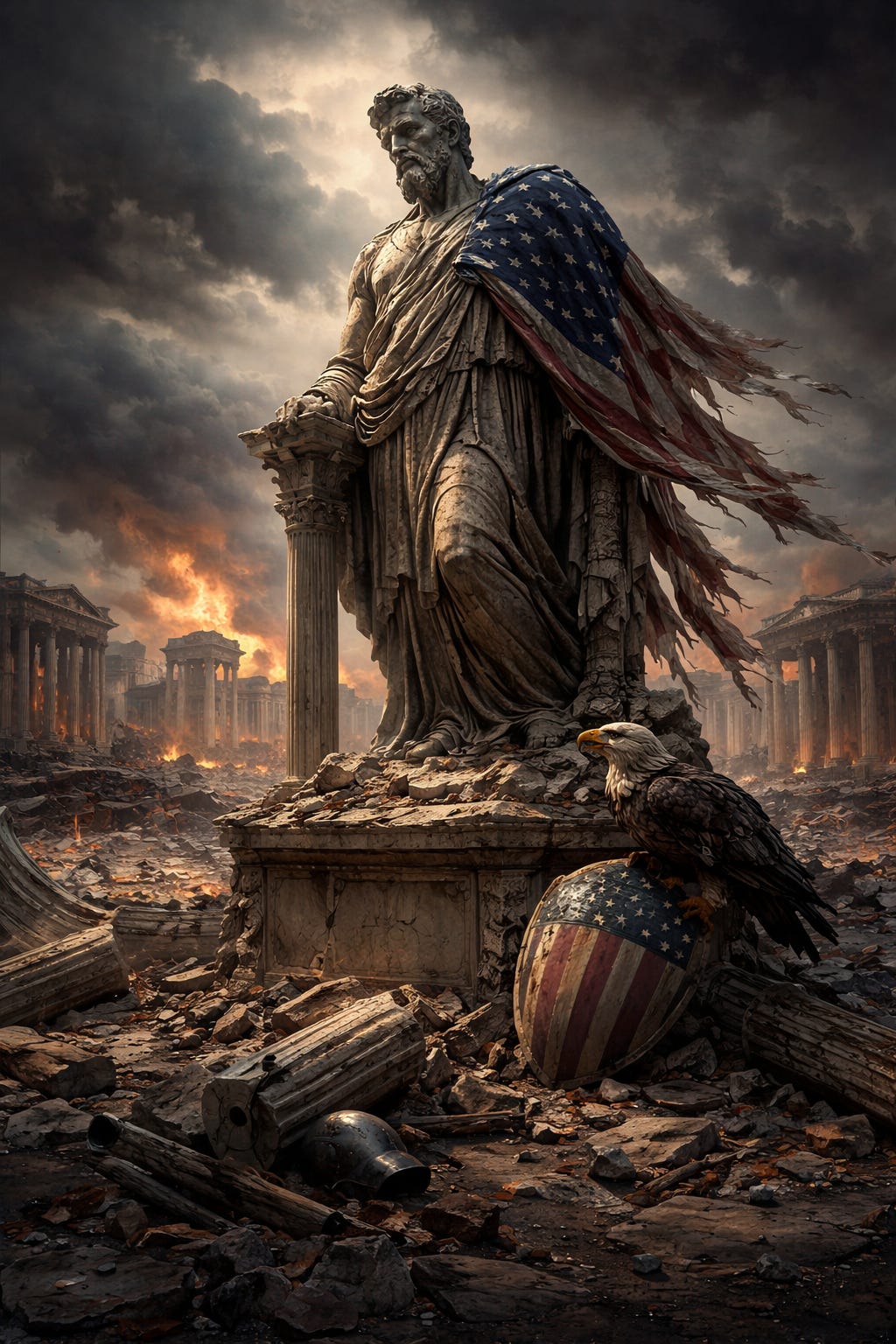
The Predator’s Comfort—and the Fate of Great Powers
Great powers rarely recognize the moment when strength begins to become vulnerability.
Empires seldom collapse suddenly.
More often, they drift—slowly and almost imperceptibly—from vigilance into comfort, from adaptability into rigidity, from republic into imperium. By the time the danger becomes visible, the habits that produced it are already deeply embedded.
The dynamic is not unique to politics. It is visible throughout the natural world.
On a humid morning walk along a Florida pond, I once watched a tableau that felt less like nature and more like a geopolitical parable. A cluster of birds stood together at the water’s edge, rigid and alert, scanning the far bank. Across the pond, half submerged in sunlight, lay a large alligator—motionless, basking.
The birds were vigilant.
The predator was comfortable.
Only those who have been hunted behave like prey. Those who have never had to run often forget what vigilance requires.
That moment crystallized a question I had been wrestling with in another context entirely: about the evolutionary roots of empathy, power, and perception.
In earlier work I explored whether persistent empathy gaps in societies might reflect differences in lived vulnerability across populations.
Drawing on the late biologist Edward O. Wilson’s theory of gene–culture coevolution, I suggested that groups historically insulated from systemic threat may experience a form of empathic atrophy—a structural absence of certain reflexes shaped by experience rather than moral intent.
But that insight, unsettling as it was at the level of social relations, seemed to scale in an even more consequential direction.
What if the same evolutionary logic applies not only to individuals or groups, but to states?
What if great powers themselves—especially those that achieve hegemonic dominance—begin to exhibit the same psychological patterns as the predator at rest?
Comfort.
Insulation.
And eventually, blindness.
Seen through this lens, the rise and fall of great powers may not be merely geopolitical cycles. They may represent evolutionary dynamics within complex political systems—patterns of learning, adaptation, and ultimately maladaptation among states that move from vulnerability to dominance.
The question is unsettling but unavoidable.
What happens when a hegemon forgets what it means to live as prey?
‘Consilience’ and the Evolutionary Logic of Power
Edward O. Wilson’s intellectual project of consilience sought to bridge the natural and social sciences by recognizing that human behavior emerges through gene–culture coevolution—a feedback loop between biological predispositions and cultural environments.¹
Among social mammals, empathy and cooperation evolved because survival demanded them. Research by primatologist Frans de Waal shows that reciprocity, fairness, and social compassion appear widely across primate societies.² These traits are not merely moral virtues; they are evolutionary strategies.
But empathy evolved unevenly.
It tends to operate most strongly within perceived kinship groups and most weakly across perceived boundaries of difference. Neurobiological research by Robert Sapolsky demonstrates that social hierarchies and long-term asymmetries of power reinforce these patterns over time.³
Remove vulnerability long enough, and the system adapts differently.
Comfort changes perception.
Groups insulated from existential threat may develop what might be called “predator cognition”—a worldview defined less by cruelty than by distance. The suffering of others appears abstract because the system has never required deep identification with it.
The result is not necessarily hostility.
It is indifference.
The same evolutionary dynamic appears at the level of political systems.
States, like organisms, are learning systems. Their institutions, strategic doctrines, and political cultures evolve in response to historical pressures.
This insight lies at the heart of what I describe elsewhere as the General Theory of Compound Security (GToCS): the proposition that modern security environments consist of interacting systems—military, economic, technological, ecological, and societal—whose feedback loops shape both vulnerability and power.
Within such environments, strategic behavior evolves.
When a state rises from vulnerability into dominance, the feedback loops shaping its behavior change.
The system stops learning the lessons of prey.
And begins learning the habits of predators.
Athens and the Birth of Imperial Psychology
The earliest recorded case of this transformation appears in Thucydides’ History of the Peloponnesian War.
Fifth-century Athens rose from a vulnerable city-state threatened by Persian invasion into the dominant naval power of the Aegean. Its maritime empire extended across the eastern Mediterranean.
But with power came psychological transformation.
Thucydides captured this shift in the famous Melian Dialogue. When the neutral island of Melos appealed to justice and independence, Athenian envoys dismissed moral arguments outright:
“The strong do what they can, and the weak suffer what they must.”⁴
The statement reflected more than cynical diplomacy.
It revealed a deeper structural change in Athenian strategic culture.
A state once defined by vulnerability had become accustomed to dominance. The evolutionary memory of insecurity faded. Empathy for weaker actors diminished.
Athens had learned the psychology of the predator.
And that shift proved catastrophic. The empire’s confidence produced strategic overreach—the disastrous Sicilian Expedition—and ultimately the collapse of Athenian power.
In Aristotelian terms, the tragedy was inevitable.
The very traits that enabled Athens to rise—confidence, ambition, strategic innovation—became the seeds of its downfall once the system lost the discipline born of vulnerability.
Rome: When a Republic Becomes an Empire
Rome provides perhaps the most instructive historical illustration of how systemic evolution transforms great powers.
The Roman Republic emerged from centuries of vulnerability—wars with neighboring city-states, existential struggle against Carthage, and intense internal political competition.
Yet as Rome expanded across the Mediterranean world, its political system gradually transformed.
Military success generated imperial obligations that the republican constitution was never designed to manage. Political authority increasingly migrated from civic institutions to military commanders who controlled legions rather than senatorial deliberation.
The decisive turning point was not the fall of the Roman Empire but the earlier decline of the Roman Republic itself.⁵
As Rome expanded, the republic hollowed out.
Externally, Rome shifted from flexible alliance systems toward direct imperial administration. Internally, the concentration of military power accelerated the erosion of republican governance.
Over time, Rome confronted the classic dilemma of hegemonic systems: the economy of scale problem.
The geographic scope of imperial commitments eventually exceeded the institutional capacity required to sustain them. Historian Paul Kennedy later described this pattern as imperial overstretch—the condition in which strategic obligations outpace economic and political resources.⁶
By the fourth century, Rome faced simultaneous pressures from external invasion, internal fragmentation, and declining civic cohesion.
The system could no longer adapt effectively.
The predator had grown too large for its ecosystem.
The British Empire: System Manager to Imperial Overstretch
A similar pattern appeared centuries later in the British Empire.
Emerging from centuries of continental rivalry, Britain developed extraordinary institutional adaptability. Naval innovation, financial modernization, and global trade networks allowed the island kingdom to become the dominant maritime power of the nineteenth century.
For much of that period, Britain functioned as a system manager of global commerce.
The Royal Navy secured maritime routes. British financial institutions stabilized global trade. Imperial governance often relied on indirect rule rather than territorial absorption.
But the very success of the imperial system produced structural strain.
By the early twentieth century, the economic and military costs of maintaining global dominance exceeded Britain’s capacity to sustain them. Two world wars accelerated the process.
As Kennedy observed, Britain’s decline reflected the classic tension between economic resources and strategic commitments.
The empire had become too large for its institutional base.
The Cold War United States: The Discipline of Vulnerability
The United States offers a contrasting example during the early Cold War.
Emerging from World War II as the world’s most powerful nation, the United States nonetheless faced a formidable rival in the Soviet Union. That rivalry imposed a form of strategic discipline on American power.
Containment strategy required alliances, institutional cooperation, and long-term economic investment.
The result was a system in which American leadership remained embedded within international institutions—NATO, the Bretton Woods system, and the United Nations.
In evolutionary terms, the presence of a peer competitor preserved a degree of predator humility.
The hegemon still remembered vulnerability.
Predator Comfort in American Strategy
The strategic environment confronting the United States today is fundamentally different.
Without a single rival capable of matching American power across all domains, U.S. strategy has increasingly oscillated between global stewardship and transactional nationalism.
Doctrines such as Manifest Destiny 2.0, Monroe Doctrine 2.0, and America First 3.0 reflect this tension.
Meanwhile, global security challenges have become increasingly compound—interacting across military, economic, technological, and ecological systems.
From the perspective of Compound Security, modern conflict environments resemble complex adaptive systems rather than traditional battlefields.
In such systems, even dominant powers face structural limits.
Compound War and the Limits of Predator Strategy
The emerging confrontation between the United States, Israel, and Iran illustrates the dynamics of compound conflict.
What began as a regional struggle now affects maritime chokepoints, energy markets, cyber networks, and alliance politics across multiple continents.
Iran’s strategy reflects the logic of the prey.
Unable to defeat American military power directly, Tehran exploits vulnerabilities in the global system—shipping lanes, proxy networks, and economic interdependence.
In systems terms, the predator’s advantage diminishes as complexity increases.
The prey adapts.
The ‘Aristotelian Tragedy’ of Hegemonic Power
Aristotle defined tragedy as the downfall of a great figure not because of villainy but because of hamartia—a fatal flaw emerging from strength itself.
Great powers often fall not because they lack capability but because they lose the capacity for strategic empathy.
Athens forgot the perspective of smaller states.
Rome lost the civic foundations of its republic.
The British Empire underestimated the resilience of nationalism.
The United States now faces a similar risk.
A republic that once championed collective security increasingly appears uncertain about its role as system manager.
The danger is not merely geopolitical.
It is evolutionary.
The Republic’s Choice
History rarely repeats itself exactly. But it often rhymes.
And to put it even more soberly, while History does not repeat itself, … but we do. We repeat ‘bad history’ all too often because of our own blinding hubris.
The United States now stands at a pivotal moment in its own systemic evolution. It can continue drifting toward the psychology of hegemonic comfort—viewing the global system primarily through the lens of dominance and transactional advantage.
Or it can rediscover the strategic humility that once underpinned its leadership of the international order.
Empathy in this context is not sentimentality.
It is strategic foresight.
Great powers that remember vulnerability often lead wisely….
… Those that forget it rarely lead for long.
Author Bio
Isaiah (Ike) Wilson III is a retired U.S. Army colonel and former senior civilian defense executive. A combat veteran of operations in Iraq, Afghanistan, and the Balkans, he has served in strategic advisory roles to senior U.S. military and civilian leaders. He holds a PhD in government from Cornell University and is a professor of practice in international affairs and security studies at Arizona State University. He is the founder of Wilson Strategic Enterprises (W.i.S.E.) and the author of Thinking Beyond War. He writes the Substack newsletter Compound Security, Unlocked, where he develops the General Theory of Compound Security and its implications for global strategy.
Endnotes.
Edward O. Wilson, Consilience: The Unity of Knowledge (New York: Knopf, 1998).
Frans de Waal, The Age of Empathy (New York: Harmony Books, 2009).
Robert Sapolsky, Behave: The Biology of Humans at Our Best and Worst (New York: Penguin, 2017).
Thucydides, History of the Peloponnesian War, Book V.
Isaiah Wilson III, “The Demise of Pax Americana? Comparing the Republics and Empires of Rome and the United States.”
Paul Kennedy, The Rise and Fall of the Great Powers (New York: Random House, 1987).
Graham Allison, Destined for War: Can America and China Escape Thucydides’s Trap? (Boston: Houghton Mifflin Harcourt, 2017).
Joseph S. Nye Jr., The Paradox of American Power (Oxford: Oxford University Press, 2002).
If you value this work, here are three ways you can step into the story with us:
📰 Subscriber (Free)
Stay informed. Receive every new essay, briefing, and analysis straight to your inbox. Join a growing community committed to civic resilience and national security.
🎧 Supporter (Paid Pledge)
Strengthen the signal. Your support sustains both Compound Security, Unlocked and our companion podcast The Civic Brief. Supporters ensure these conversations remain accessible to the wider public while elevating the quality, depth, and reach of the work.
🛡️ Sustainer (Patron Level)
Invest in the mission. Sustainers fuel new research, convenings, and storytelling that enlarge the civic frame of security. This is more than content — it’s a civic project. Your sponsorship helps preserve an independent voice committed to equipping citizens, leaders, and institutions for the compound challenges ahead.