
“May the 4th Be With Us.”
A Republic, A Saga, A Warning.

by Dr. Isaiah (Ike) Wilson III
There is a moment—early, almost throwaway—in Star Wars—when a young farm boy stands at the edge of a desert horizon, watching twin suns dissolve into dusk. It is a quiet scene, nearly still.
But inside it lives an entire political philosophy: longing, inheritance, destiny.
What George Lucas built, drawing deeply from the mythic architecture of Joseph Campbell, was never just a space opera. It was a civic story—about republics, about power, about how belief binds the two.
I have come, over years of writing and teaching and watching our own system strain under pressure, to see that scene differently. Not as a beginning—but as a warning.
On May 4th—“May the Fourth Be With You”—we celebrate what began as a pun, an echo of a line from Star Wars.
But rituals endure not because they are clever. They endure because they carry something we recognize, even if we cannot fully articulate it.
This one carries belief.
And belief—more than force, more than power—is what sustains a republic.
Or erodes it.
I. The Republic as Story We Tell Ourselves
Every republic is, first, a story.
Rome had Romulus and Remus. America has its revolution, its Constitution, its “city upon a hill.” These are not fictions—but neither are they complete truths. They are, as Campbell would say, the scaffolding that allows individuals to see themselves inside something larger.
In Star Wars, the Republic is not merely a governing arrangement. It is a moral order—fragile, aspirational, dependent on legitimacy. And when it falls, it does not collapse in spectacle.
It transitions—procedurally, legally—into an Empire.
The Senate votes. The Chancellor assumes emergency powers. The machinery of governance continues to function.
And the system changes.
There is applause.
This is not allegory. It is method.
II. The Slow Conversion
In my own work, I have argued that security is best understood not as a condition, but as a system’s performance under stress.
By that measure, republics do not “fail” in a single moment. They adapt. They compensate. They reconfigure.
Interdependence tightens into brittle coupling.
This means that as different parts of a system or group become more reliant on each other, their connections grow stronger—but also more fragile.
If one part fails or breaks, the whole system can quickly fall apart because everything is so closely linked.
Hybridity becomes opportunistic substitution.
In plain language, this means that when a system is made up of different parts or approaches, those parts can start swapping out what works best for them instead of working together as intended. Instead of blending strengths, each part looks for an advantage and replaces shared methods with whatever benefits itself most.
So, the mix stops being cooperative and turns into everyone grabbing what’s useful for their own needs.
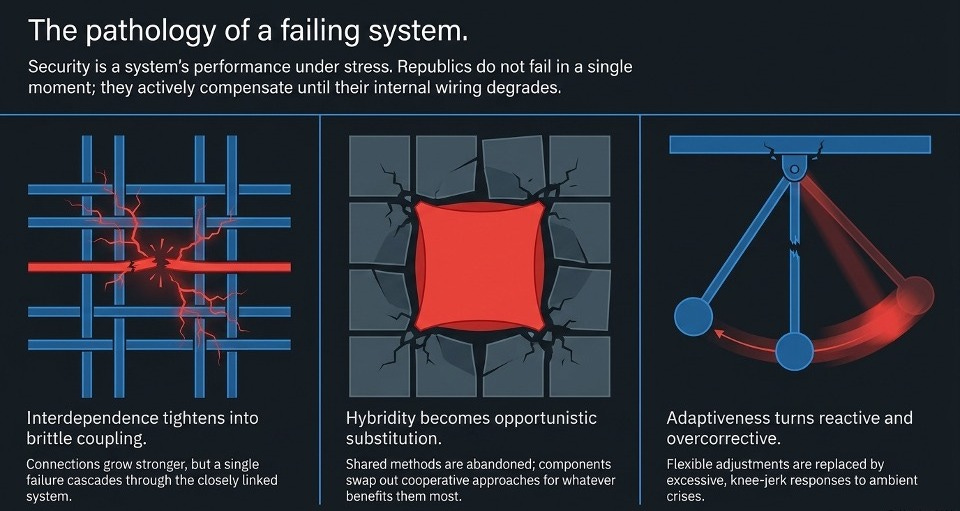
Adaptiveness turns reactive—overcorrective.
Adaptiveness simply means the ability to adjust to new situations, challenges, or changes. It’s how something or someone can change its approach, behavior, or structure when things around it shift, so it keeps working or stays effective.
And legitimacy—the quiet keystone—begins to erode.
Legitimacy means that people accept a system, rule, or authority as rightful and trustworthy. It’s the sense that something is fair, reasonable, and deserves to be followed or respected.
Responsiveness shifts from flexible adjustment to excessive, knee-jerk responses.
The prequel arc of Star Wars is, in this sense, less a tragedy than a diagnosis.
Institutions persist. Elections occur. Procedures remain intact. But belief in those procedures thins. Crisis becomes ambient—no longer episodic, but constant.
And in that environment, the extraordinary becomes ordinary.
This is how republics change form.
III. ‘Andor’: How Systems Actually Turn
If the prequels show us the visible architecture of that transformation, Andor shows us its interior wiring.
There is something almost unsettling in its restraint. No grand speeches about tyranny. No operatic declarations of evil. Instead: meetings. Assessments. Career calculations. The Empire, here, is not theatrical. It is administrative.
It runs on incentives.
One begins to notice how power actually accumulates—not through singular acts of seizure, but through thousands of smaller decisions.
A supervisor tightens a reporting requirement. A security officer reframes a local disturbance as a systemic threat. A mid-level analyst, seeking relevance, connects dots that justify broader authorities.
No one declares the arrival of Empire.
They participate in its construction.
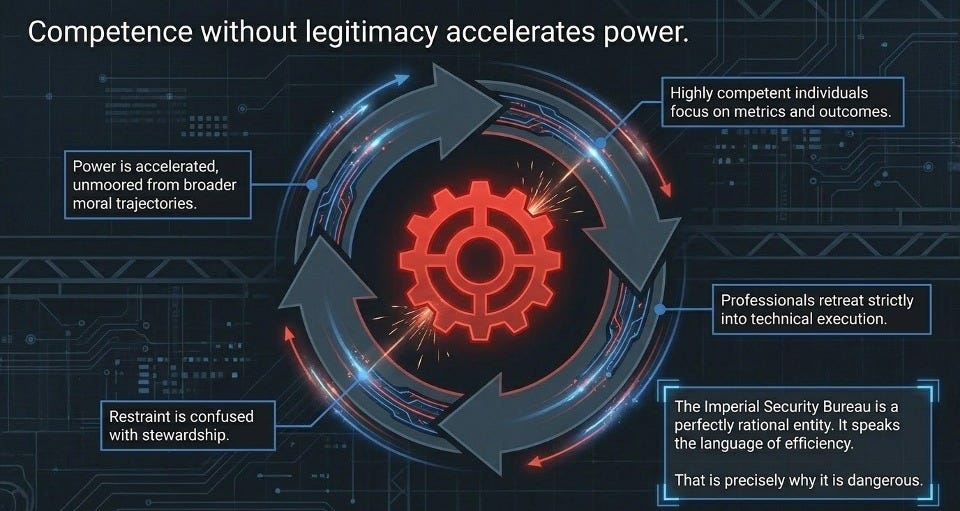
The Imperial Security Bureau, in Andor, is perhaps the most honest depiction of modern power I have seen rendered in fiction. It is not chaotic. It is not irrational. It is composed of highly competent individuals, speaking the language of metrics, outcomes, efficiency.
And that is precisely the problem.
Because competence—unmoored from legitimacy—does not restrain power.
It accelerates it.
In my own profession, we have long valorized what Samuel Huntington termed “objective control”: the disciplined separation of professional military conduct from political judgment.
There is wisdom in that.
But Andor reveals its shadow. When professionals define their role too narrowly—when they retreat entirely into the technical—they risk becoming instruments of a system whose broader trajectory they neither question nor shape.
They confuse restraint with stewardship.
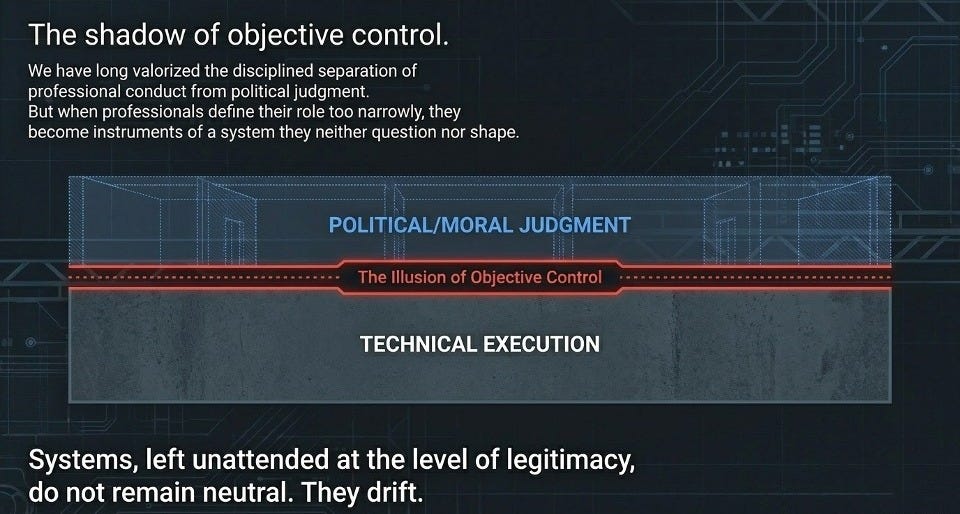
And systems, left unattended at the level of legitimacy, do not remain neutral.
They drift.
IV. ‘Rogue One’: What Resistance Actually Costs
Only after sitting inside Andor’s machinery does Rogue One: A Star Wars Story fully land.
Because Rogue One is not, at its core, a story about heroism. It is a story about cost.
By the time we arrive there, the Republic is long gone. The Empire is not emerging; it is entrenched. Its systems are operational. Its logic is normalized. And resistance—real resistance—is no longer rhetorical. It is existential.
The characters in Rogue One are not chosen. They are not destined. They are, in many cases, compromised, fragmented, uncertain.
What unites them is not belief in victory, but recognition of necessity.
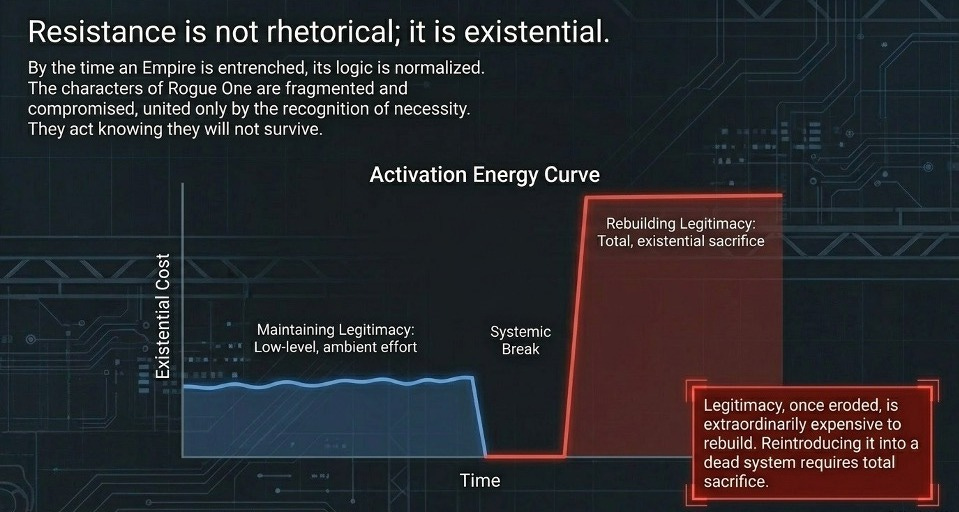
They act knowing they will not survive.
The theft of the Death Star plans is often framed as a turning point—a strategic inflection. And it is.
But what matters more, analytically, is what it represents: the reintroduction of legitimacy into a system that has lost it.
Not through decree. Not through reform.
Through sacrifice.
Every member of that mission dies.
Their success is real—but it is also invisible in the moment. It must be carried forward by others, translated into narrative, into belief.
This is the part we tend to forget: legitimacy, once eroded, is extraordinarily expensive to rebuild.
V. A More Familiar Story Than We Admit
It is here—somewhere between Andor’s bureaucracy and Rogue One’s sacrifice—that the distance between fiction and our own system begins to narrow.
Because the question is not whether America is “becoming an empire.” That framing is too blunt, too binary.
The more precise question—the one I have spent years trying to answer—is:
… what happens to a system when its components continue to function, but belief in the system begins to decay?
We see the indicators.
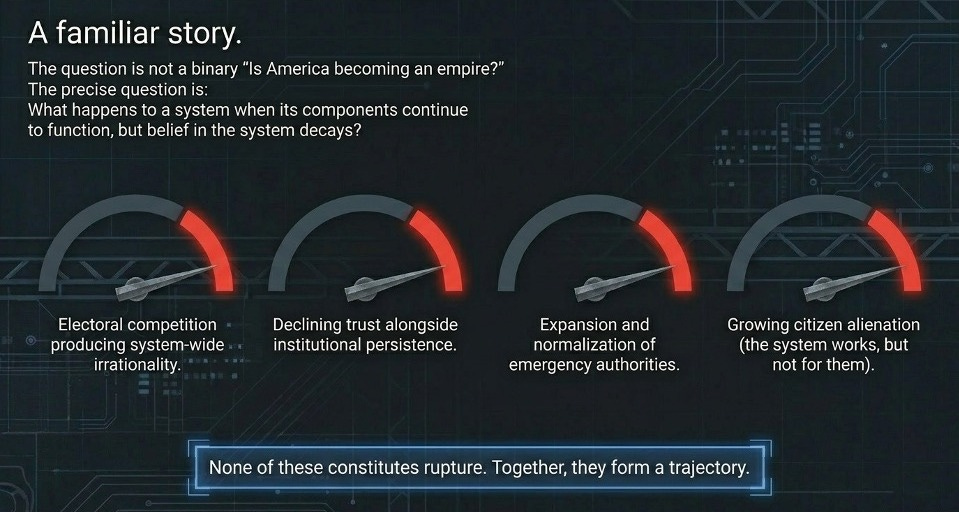
Electoral competition producing system-wide irrationality.
Declining trust alongside institutional persistence.
The expansion—and normalization—of emergency authorities.
A growing sense, among citizens and professionals alike, that the system works, but not for them.
None of these, on their own, constitutes rupture.
Together, they form a trajectory.
VI. Transition: From Diagnosis to Projection
If there is a discipline to all of this—beyond critique, beyond commentary—it is the attempt to see forward. Not predictively, in the narrow sense, but structurally. To ask: given these dynamics, what are the plausible pathways?
In my own work, I have called this “useful fiction”—a form of structured, retro-speculative analysis. Not fantasy, but scenario. Not prophecy, but projection.
And if we follow the logic of Andor—systemic drift—and Rogue One—costly correction—then certain futures begin to suggest themselves.
VII. FICINT Dispatch: May 4th, 2032
Washington, D.C.
The phrase appears first in a policy brief. Then in a speech. Then everywhere.
STABILITY IS SECURITY.
It is not controversial. It is, in fact, widely agreed upon.
After years of overlapping crises—cyber disruptions, contested elections, cascading global conflicts—the public appetite for stability has grown.
The institutions remain. The Senate convenes. The courts rule. Elections occur on schedule.
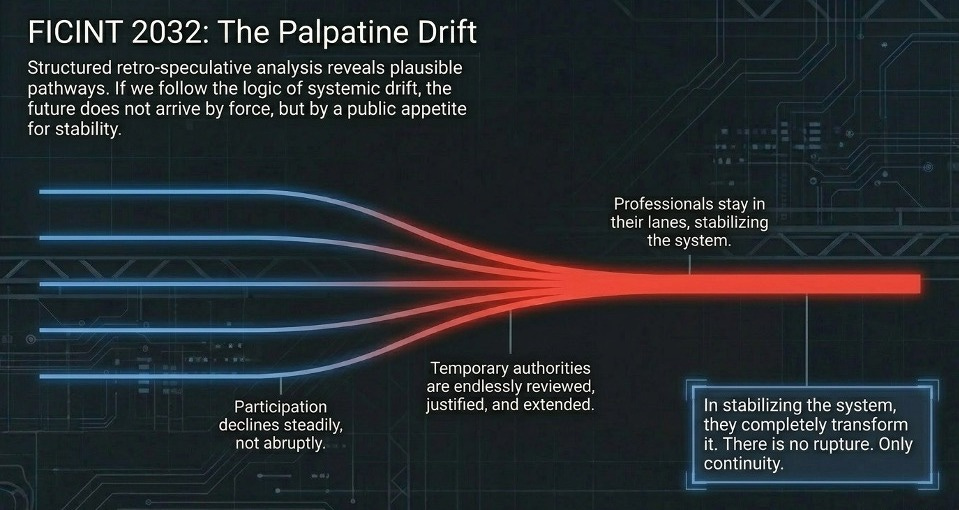
But participation declines—not dramatically, not suddenly, but steadily.
The shift is not coercive. It is adaptive.
Authorities originally granted as temporary are extended—reviewed, debated, reauthorized. Each extension justified. Each justification reasonable. Each step, in isolation, defensible.
Professionals—military, civil service, technical—continue to perform with discipline. They remain within their lanes. They execute.
And in doing so, they help stabilize the system.
And in stabilizing it, they help transform it.
There is no moment of rupture. No declaration.
Only continuity.
In private, among a younger cohort, a phrase circulates—half ironic, half resigned:
“The Palpatine Drift.”
VIII. The Empire’s Quiet Genius
Empires rarely announce themselves. They emerge as solutions.
Order. Stability. Resilience.
They inherit the language, the symbols, the institutions of what came before. They present not as rupture, but as refinement.
This is the quiet genius of the system Lucas imagined—and the one history repeatedly confirms.
By the time most citizens recognize the change, it is no longer a question of transformation.
It is a question of belief.
IX. May the Fourth: Ritual as Reckoning
“May the 4th Be With You” endures because it feels light. Playful. Harmless.
But like all enduring rituals, it carries more than it declares.
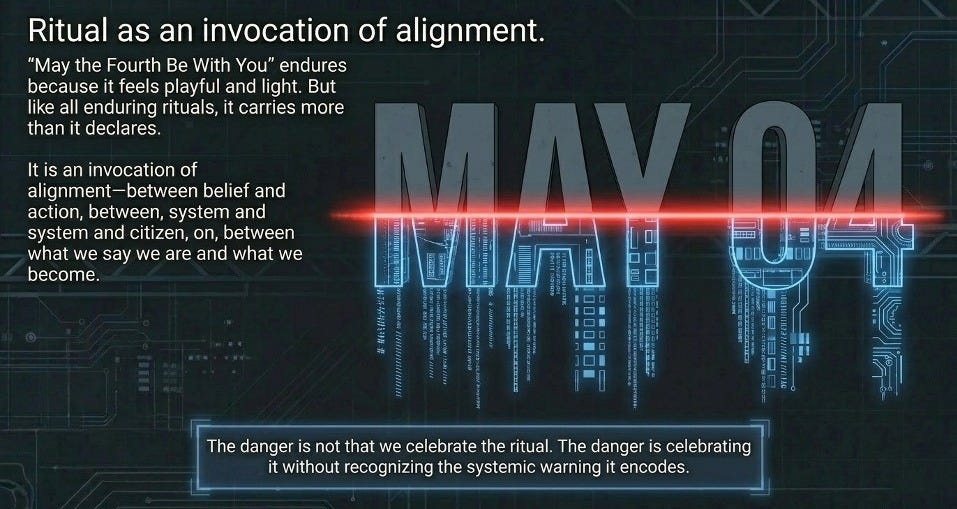
It is, at its core, an invocation—not of force, but of alignment. Between belief and action. Between system and citizen. Between what we say we are and what we become.
The danger is not that we celebrate it.
It is that we celebrate it without recognizing the story it encodes.
X. Coda: The Second Sunset
I return, often, to that image of the twin suns ….
But I see it now not as a beginning, but as a mirror.
A system at the horizon—still intact, still functioning, still recognizable.
And yet, something essential has shifted.
The question is no longer what the system can do.
It is what the system is.
And whether we still believe in the story it tells.
‘May the 4th be with us’—
…. not as nostalgia, but as warning.
And, still, as choice.
If you value this work, here are three ways you can step into the story with us:
📰 Subscriber (Free)
Stay informed. Receive every new essay, briefing, and analysis straight to your inbox. Join a growing community committed to civic resilience and national security.
🎧 Supporter (Paid Pledge)
Strengthen the signal. Your support sustains both Compound Security, Unlocked and our companion podcast The Civic Brief. Supporters ensure these conversations remain accessible to the wider public while elevating the quality, depth, and reach of the work.
🛡️ Sustainer (Patron Level)
Invest in the mission. Sustainers fuel new research, convenings, and storytelling that enlarge the civic frame of security. This is more than content — it’s a civic project. Your sponsorship helps preserve an independent voice committed to equipping citizens, leaders, and institutions for the compound challenges ahead.