
Fire Made Flesh: Dragons, Deterrence, and the Political Logic of Ultimate Weapons
How George R. R. Martin’s Dragons Illuminate the Strategic Dilemmas of the Nuclear and Compound Ages.

“Power resides where men believe it resides.” — Varys
“A dragon is not a slave.” — Daenerys Targaryen
Author’s Note
The most enduring works of fiction do not endure because they accurately predict the future. They endure because they reveal enduring truths about human nature, political order, and power.
Homer teaches strategy through myth. Shakespeare explores sovereignty through tragedy. Tolkien examines industrialization through fantasy. George R. R. Martin, perhaps unintentionally, has given strategists one of the richest laboratories ever created for examining the political consequences of revolutionary military technologies.
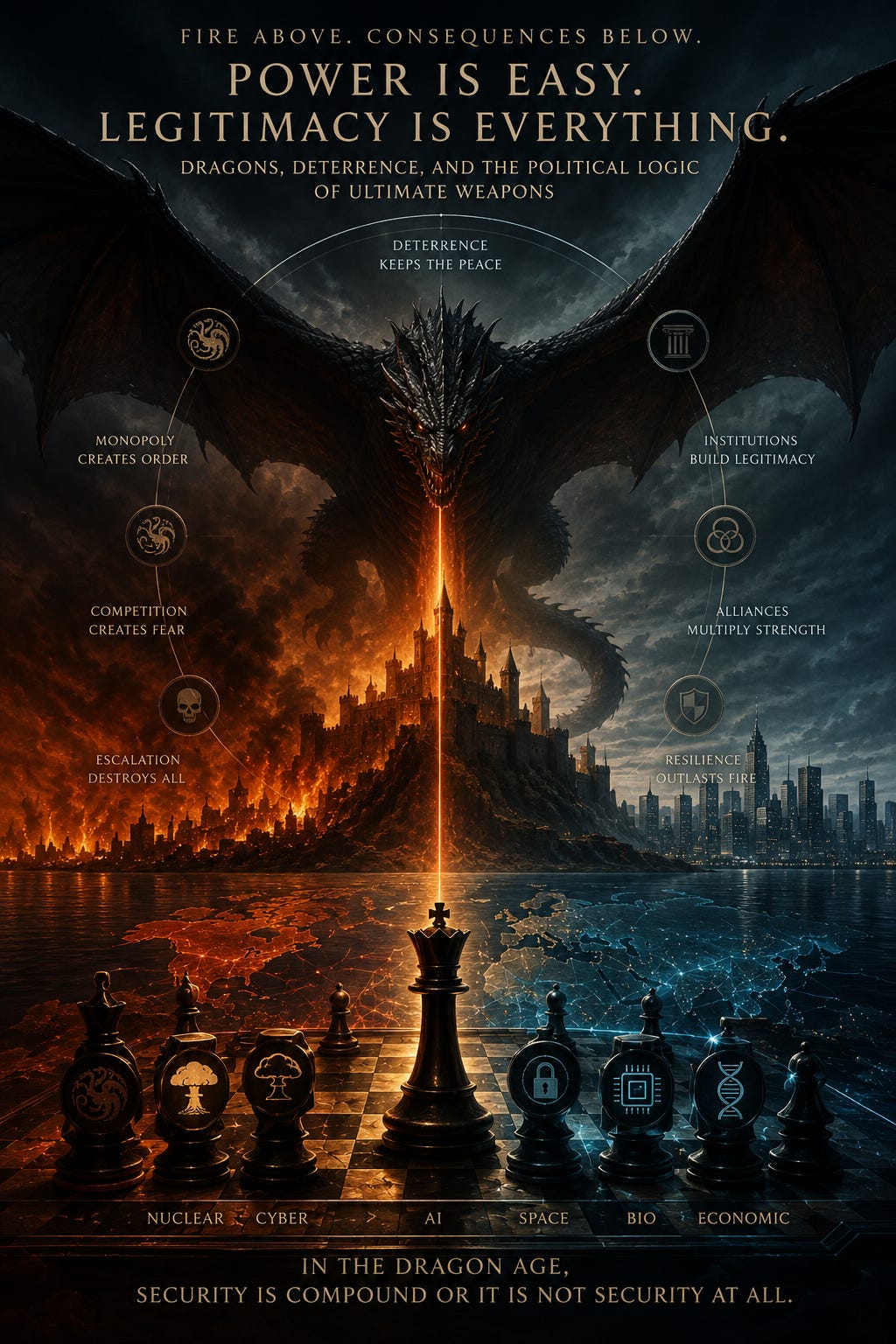
This essay is not an exercise in literary criticism. Nor is it an attempt to reduce dragons to simplistic stand-ins for nuclear weapons. Rather, it treats the world of House of the Dragon and Game of Thrones as a conceptual case study through which to examine deterrence, escalation, legitimacy, technological monopoly, arms racing, and the paradoxes of supreme military advantage. In doing so, it suggests that Martin’s fictional universe offers surprisingly powerful insights into the strategic dilemmas confronting twenty-first-century statecraft.
Fire Changes Everything
History rarely changes gradually.
Most of the time, civilizations evolve through incremental adaptation—new laws, better institutions, improved technologies, and shifting balances of economic and political power. Yet there are rare moments when a single innovation fundamentally alters the rules governing every other aspect of society.
The invention of agriculture transformed humanity from migratory bands into settled civilizations. Gunpowder rendered medieval castles increasingly obsolete. Steam power compressed geography. Aviation collapsed oceans. Nuclear weapons altered the very meaning of war.
The appearance of dragons in Westeros belongs within this small class of civilizational revolutions.
Too often, viewers understand dragons primarily as larger, more destructive versions of conventional military power. They become airborne siege engines—living bombers capable of burning armies and reducing castles to ash.
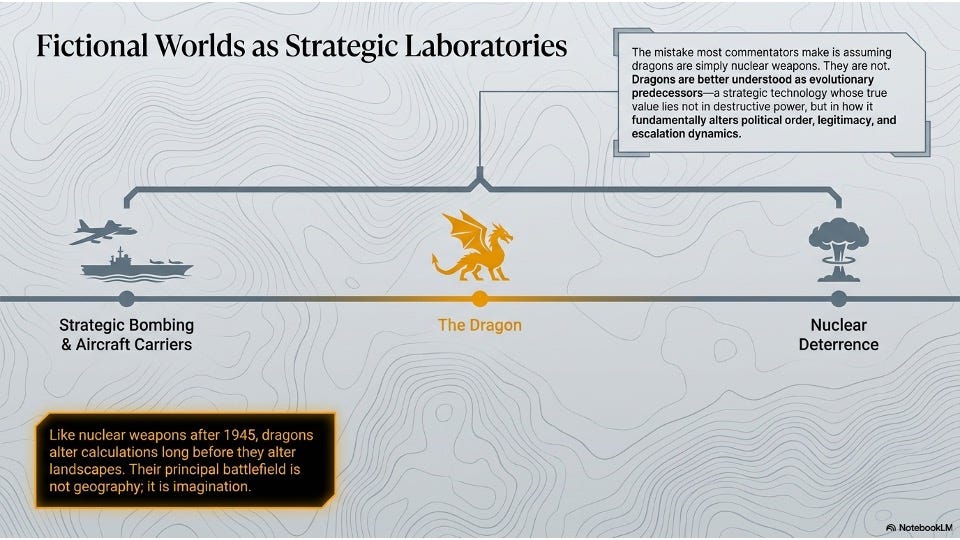
This interpretation, while superficially attractive, misses Martin’s deeper strategic insight.
Dragons matter not because they make battle more destructive. They matter because their existence fundamentally transforms the political logic surrounding the use of force.
The greatest strategic value of dragons lies not in their capacity to destroy enemies, but in their ability to reshape decisions before battles ever occur.
This is the essence of deterrence.
Like nuclear weapons after 1945, dragons alter calculations long before they alter landscapes. They change alliance behavior, succession politics, diplomacy, legitimacy, rebellion, and the psychology of rulers themselves. Their principal battlefield is not geography but imagination. Every lord contemplating rebellion must first imagine dragonfire. Every rival claimant must estimate not only military strength but political resolve. Every alliance becomes a calculation of whose dragons might arrive first—or survive longest.
The strategic revolution, therefore, is cognitive before it is kinetic.
That distinction matters enormously.
Military history often celebrates decisive battles. Strategic history, by contrast, concerns itself with decisions that prevent—or invite—those battles in the first place.
The arrival of dragons shifts the center of gravity from operational excellence toward political calculation. Victory increasingly belongs not to those who maneuver armies most effectively, but to those who manipulate expectations regarding the possible use of overwhelming force.
In this sense, dragons do not merely strengthen military power.
They redefine power itself.
Before Dragons
To appreciate the revolutionary character of dragons, one must first imagine Westeros without them.
Before Aegon’s Conquest, political authority emerged from familiar foundations. Noble houses accumulated wealth through land ownership. Castles provided defensive advantages. Population generated taxation and armies. Geography constrained campaigns. Rivers, mountains, and weather imposed operational limits that every commander understood. Warfare remained expensive, uncertain, and deeply contingent upon logistics, leadership, morale, and coalition management.
No army, regardless of reputation, could simply ignore these realities.
Victory required organization.
Political legitimacy required institutions.
Power required negotiation.
The balance among these elements produced a remarkably recognizable medieval strategic environment. It rewarded patience, coalition building, and incremental accumulation of strength.
Then dragons arrived.
Or, more accurately, dragons returned.
Instantly, centuries of accumulated military assumptions became obsolete.
Castles—once symbols of permanence—became vulnerable. Geographic barriers lost much of their protective value. Concentrated armies became lucrative targets rather than demonstrations of strength. Traditional calculations of offensive and defensive advantage no longer held. Military institutions developed over generations suddenly confronted an adversary operating according to entirely different physical and psychological rules.
Every revolutionary technology produces such moments of institutional bewilderment.
European cavalry struggled to comprehend disciplined firearms formations. Battleships failed to anticipate aircraft carriers. Cavalry officers dismissed tanks before eventually becoming armored commanders themselves.
Likewise, the established houses of Westeros possessed no intellectual framework capable of integrating dragons into their existing theories of war.
Their military doctrines became obsolete before they realized they required replacement.
The consequences extended far beyond tactics.
Political authority itself began migrating toward those capable of controlling the revolutionary technology.
That migration should sound familiar.
The Political Monopoly of Fire
Historians often describe Aegon’s Conquest as a military triumph.
It was something far more consequential.
It represented the establishment of a temporary monopoly over a strategic technology that no competitor could match.
Military superiority and technological monopoly are not identical concepts.
Superior armies may lose battles. Superior economies may decline. Even stronger alliances may fracture under pressure.
A technological monopoly, however, changes the strategic environment itself. It alters what competitors believe to be possible. It reshapes incentives before conflict begins.
For nearly a century, the Targaryens possessed precisely such a monopoly.
Three dragons accomplished what generations of conventional campaigning likely could not. Entire kingdoms surrendered without requiring annihilation because resistance increasingly appeared irrational. Political calculations changed not because every castle had already burned, but because every lord knew it could.
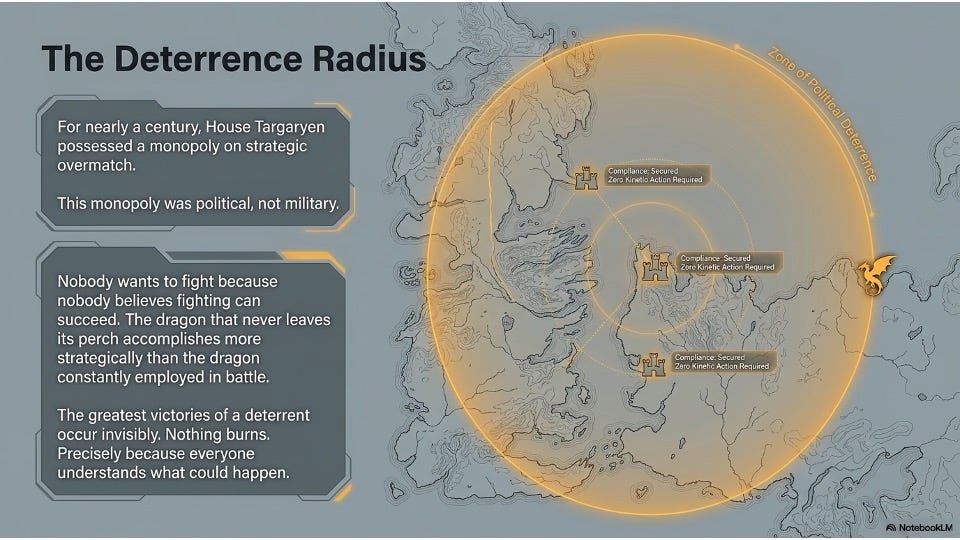
Deterrence succeeds when violence becomes unnecessary.
The dragon that never leaves its perch may accomplish more strategically than the dragon constantly employed in battle.
This lesson echoes throughout modern strategic history.
The United States’ brief monopoly on nuclear weapons after the Second World War did not merely provide military superiority. It fundamentally influenced diplomacy, alliance structures, and perceptions of global leadership. The psychological effects exceeded the immediate military utility of the weapons themselves.
Likewise, Aegon’s dragons generated political effects vastly exceeding the amount of destruction they actually inflicted.
Their existence reordered expectations.
That is the hallmark of every successful deterrent.
Its greatest victories occur invisibly.
Nothing explodes.
Nothing burns.
Nothing happens.
Precisely because everyone understands what could happen.
The Paradox of Absolute Power
Yet every strategic revolution contains the seeds of its own erosion.
The possession of overwhelming force often encourages rulers to confuse military dominance with political legitimacy.
This confusion represents one of the oldest—and most persistent—errors in the history of statecraft.
Military superiority can compel obedience.
It cannot manufacture consent.
It can silence opposition.
It cannot cultivate loyalty.
It can conquer territory.
It cannot guarantee durable political order.
Throughout Martin’s universe, this distinction repeatedly emerges as the central tragedy confronting House Targaryen.
Dragons allow rulers to bypass the slow, frustrating work of coalition building, institutional development, compromise, and negotiated legitimacy. Political problems that might otherwise demand governance instead appear susceptible to coercion.
Fire becomes a substitute for statecraft.
Initially, the substitution appears extraordinarily efficient.
Eventually, it becomes catastrophically expensive.
The irony is profound.
The very technology that enables imperial consolidation simultaneously discourages the political maturation required to sustain empire after that technological advantage inevitably diffuses, declines, or disappears.
Strategic technologies often create institutional complacency.
They encourage civilizations to mistake temporary advantage for permanent order.
The dragons did not merely make House Targaryen powerful.
They altered the incentives governing how House Targaryen learned to rule.
And therein lies the deeper strategic warning—not simply for Westeros, but for every great power that has ever mistaken overwhelming military capability for enduring political legitimacy.
The Dragon Security Dilemma
Every revolutionary military technology follows a remarkably consistent political trajectory.
It begins as monopoly.
It evolves into competition.
It matures into mutual vulnerability.
The same innovation that initially produces extraordinary strategic advantage eventually generates profound strategic insecurity. As competitors learn, adapt, imitate, and innovate, yesterday’s instrument of dominance becomes tomorrow’s source of instability.
This is not merely the history of gunpowder, naval power, aviation, or nuclear weapons. It is one of the recurring patterns of strategic evolution itself.
The dragons of Westeros follow precisely this path.
Aegon’s conquest succeeds because the strategic equation is fundamentally one-sided. The Seven Kingdoms confront a capability against which they possess neither meaningful defense nor credible retaliation.
Deterrence operates almost entirely in one direction. Submission becomes a rational political choice because resistance offers little prospect of success.
Yet strategic monopolies rarely endure.
Over time, dragons multiply. Riders multiply. Potential claimants multiply. What had once been a singular source of imperial cohesion becomes an increasingly fragmented distribution of destructive capability. The problem facing House Targaryen is no longer how to govern subjects without dragons. It is how to govern a dynasty in which multiple members possess dragons of their own.
The center of strategic gravity shifts dramatically.
The greatest threat to the dynasty no longer lies beyond its borders.
It lies within the family itself.
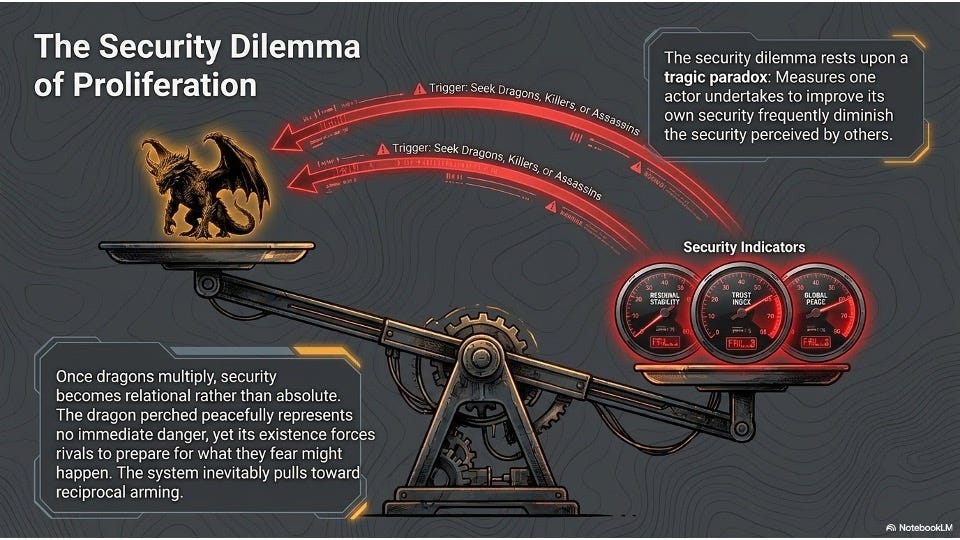
This transformation marks the emergence of what modern strategic studies recognizes as the security dilemma.
The security dilemma rests upon a tragic paradox. Measures one actor undertakes to improve its own security frequently diminish the security perceived by others. Those others then adopt countermeasures that further increase insecurity for everyone involved. No participant necessarily desires conflict. Yet each behaves rationally according to its own perception of risk.
The result is a self-reinforcing spiral.
House Targaryen illustrates this dynamic with remarkable precision.
Each additional dragon strengthens its rider.
Each strengthened rider weakens the confidence of every rival claimant.
Every perceived effort to secure succession simultaneously threatens someone else’s expectations regarding succession.
Security becomes relational rather than absolute.
The dragon itself has not changed.
The political meaning attached to its possession has.
This distinction proves decisive.
Strategic competition is rarely driven by technologies alone. It is driven by how technologies alter relationships among actors.
The dragon perched peacefully upon Dragonstone represents no immediate danger. Yet its existence changes every calculation made by every other claimant. Political imagination begins racing ahead of political reality. Leaders increasingly prepare not for what is happening, but for what they fear might happen.
The possibility of violence begins shaping behavior long before violence occurs.
That is deterrence’s greatest strength.
It is also its greatest danger.
Dragons and the Logic of Mutual Vulnerability
Popular discussions of nuclear deterrence often emphasize mutual assured destruction.
The phrase, while evocative, can be misleading.
The stabilizing feature of nuclear deterrence is not destruction itself. It is mutual vulnerability.
Each side understands that neither can eliminate the other’s capacity to impose catastrophic costs. Consequently, rational leaders become extraordinarily cautious regarding escalation. Victory becomes difficult to define because every conceivable victory carries unacceptable consequences.
“The Dance of the Dragons” presents a remarkably similar strategic environment.
Once rival factions possess mature dragons and experienced riders, decisive victory becomes increasingly elusive. Every offensive action risks reciprocal devastation. Every attempt to eliminate an adversary exposes one’s own irreplaceable strategic assets. Every battlefield success generates opportunities for catastrophic retaliation elsewhere.
The dragons become both sword and hostage.
Each rider knows that committing a dragon to battle exposes that dragon to loss. Unlike castles or armies, dragons cannot be manufactured through taxation, recruitment, or industrial production. They represent accumulated strategic capital requiring years—indeed generations—to develop.
This reality introduces an extraordinary restraint.
A commander may hesitate to employ the very weapon upon which ultimate victory depends.
The paradox resembles that confronting every nuclear-armed state.
The more valuable the weapon becomes strategically, the less attractive its actual employment becomes operationally.
Ultimate weapons are often most useful precisely because they remain unused.
The Failure of Escalation Control
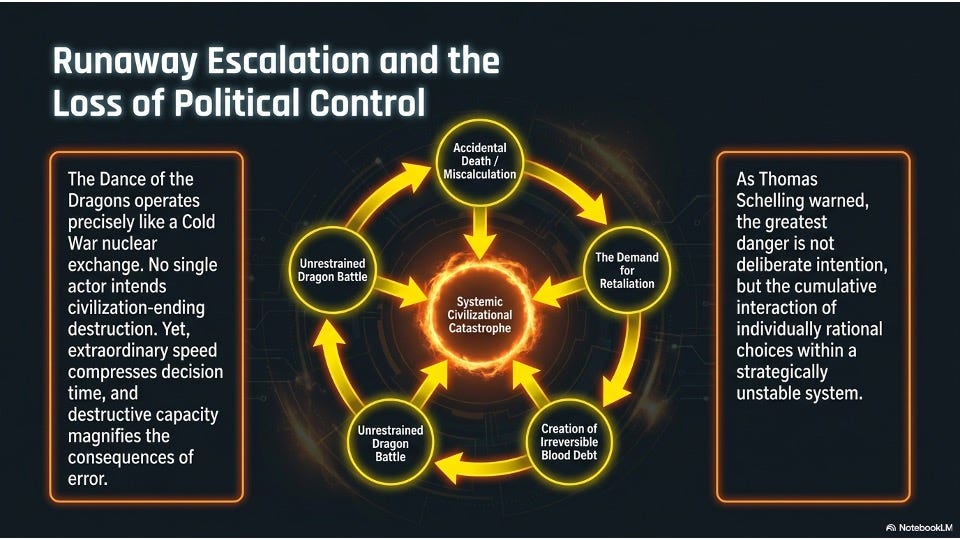
Thomas Schelling famously argued that much of strategy concerns manipulating the risk of events escaping deliberate control.
The “Dance of the Dragons” reads almost as a fictional exploration of this proposition.
Civil wars rarely begin with the intention of destroying civilizations.
Participants generally anticipate limited objectives. They imagine decisive victories, negotiated settlements, or manageable campaigns. They believe themselves capable of controlling both violence and escalation.
History repeatedly demonstrates otherwise.
The assassination at Sarajevo did not require world war.
The July Crisis nevertheless produced one.
Likewise, the Cold War generated numerous confrontations in which leaders recognized that miscalculation rather than deliberate intention posed the greatest danger.
The Cuban Missile Crisis remains frightening not because either superpower desired nuclear exchange, but because both recognized how rapidly reciprocal actions could exceed political control.
Martin constructs similar dynamics with devastating effect.
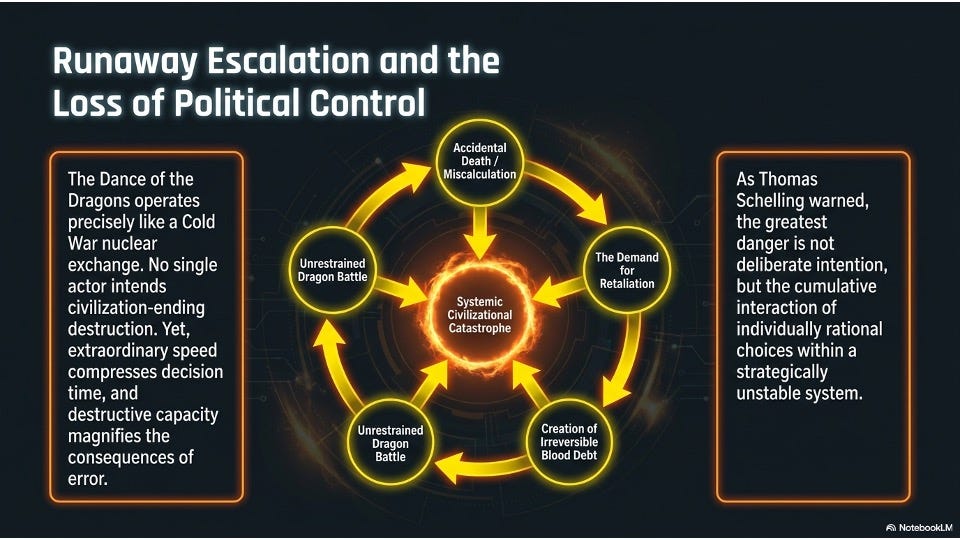
An insult invites retaliation.
Retaliation demands response.
Response creates blood debt.
Blood debt requires vengeance.
Each individual decision appears understandable when viewed in isolation.
Collectively, they produce systemic catastrophe.
No single actor intends the destruction that follows.
Yet each contributes rationally to an increasingly irrational outcome.
This is the essence of runaway escalation.
Not madness.
Not incompetence.
But the cumulative interaction of individually rational choices within a strategically unstable system.
The dragons accelerate every stage of this process.
Their extraordinary speed compresses political decision time. Their destructive capacity magnifies the consequences of error. Their symbolic importance transforms every tactical engagement into a strategic event.
Escalation becomes simultaneously faster, larger, and more emotionally irreversible.
The system begins governing its participants rather than the reverse.
The Fragility of Dynastic Deterrence
Perhaps Martin’s most profound strategic insight concerns the relationship between deterrence and political institutions.
Deterrence is often imagined as a substitute for governance.
In reality, it depends upon governance.
Nuclear weapons did not preserve peace during the Cold War solely because they were destructive. They were embedded within elaborate institutional architectures of command and control, civilian oversight, communications, alliance management, intelligence collection, professional military education, diplomatic signaling, and crisis management.
The weapons alone did not produce stability.
Institutions did.
House Targaryen possesses dragons.
It does not develop comparable political institutions capable of governing their employment across generations.
Succession remains ambiguous.
Decision authority remains personalized.
Rules governing dragon use remain informal.
Strategic signaling remains inconsistent.
Political legitimacy depends overwhelmingly upon personalities rather than resilient constitutional arrangements.
The dragons therefore compensate for institutional weakness while simultaneously discouraging institutional development.
Here Martin inadvertently illustrates a broader principle of complex adaptive systems.
Powerful technologies frequently mask institutional fragility.
Organizations enjoying overwhelming technological advantage often postpone the difficult work of reform because immediate pressures appear manageable. Success generates complacency. Complacency accumulates invisible risk. Invisible risk eventually emerges not gradually but catastrophically.
One might describe this as a strategic success trap.
The very source of present strength becomes the source of future weakness.
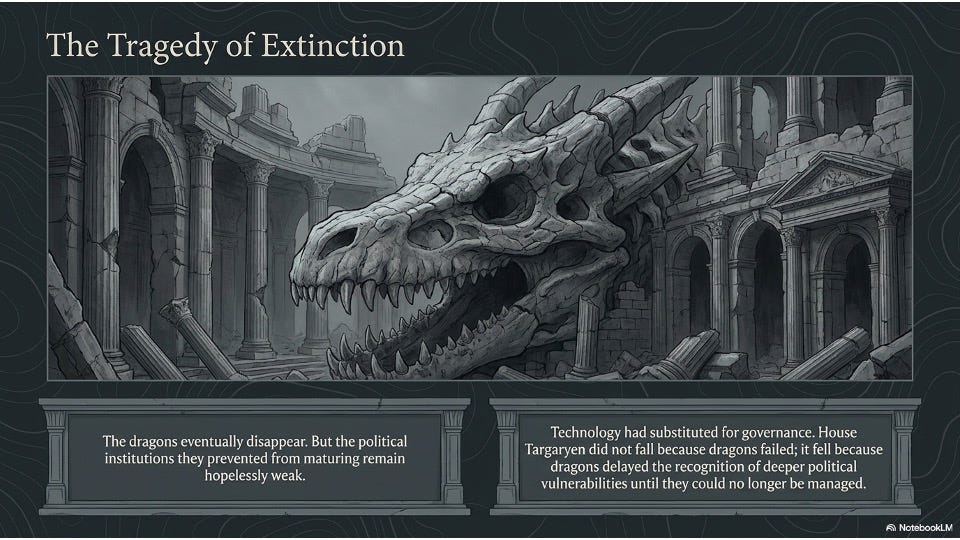
House Targaryen does not fall because dragons fail.
It falls because dragons delay recognition of deeper political vulnerabilities until those vulnerabilities can no longer be managed.
This pattern extends well beyond fantasy.
Great powers repeatedly mistake technological superiority for institutional resilience. History suggests the two are not synonymous. Indeed, they frequently move in opposite directions.
The stronger the shield provided by extraordinary military capability, the weaker becomes the incentive to cultivate the political adaptability upon which long-term security ultimately depends.
Beyond Nuclear: Dragons and the Emergence of Compound Deterrence
There is a temptation, when confronted with revolutionary technologies, to search history for their closest equivalent. Since 1945, that search almost inevitably leads to nuclear weapons.
The comparison is understandable. Dragons, like nuclear arsenals, possess extraordinary destructive power. Their existence alters diplomacy, constrains military planning, and reshapes political calculations long before they are ever employed.
Yet the comparison is ultimately incomplete.
Nuclear weapons are singular instruments. Dragons are adaptive strategic systems.
A nuclear weapon cannot decide when to strike. It cannot patrol independently, adapt to changing circumstances, establish relationships with individual leaders, or exercise judgment. It remains inert until directed by institutions, procedures, and human decision-makers.
A dragon, by contrast, is alive.
It possesses instinct, personality, intelligence, and limits. It can refuse commands, reject riders, become unpredictable, panic, mature, reproduce, and die. It introduces uncertainty not only for one’s adversaries but also for one’s own side. The strategic problem therefore extends beyond command and control. It becomes one of relationship, trust, adaptation, and co-evolution between political authority and strategic capability.
This distinction is more than literary.
It resembles the strategic characteristics of the technologies now emerging around us.
Artificial intelligence learns.
Autonomous systems adapt.
Cyber capabilities evolve continuously.
Biotechnology mutates.
Information ecosystems respond to interaction rather than instruction.
Financial networks propagate shocks beyond anyone’s direct control.
None behave like static weapons.
All resemble living systems.
Perhaps Martin’s dragons are not best viewed as fictional nuclear weapons.
Perhaps they are the first compelling fictional representation of compound strategic technologies—capabilities whose political significance arises from their interaction with other systems rather than from destructive power alone.
If so, Martin’s universe proves remarkably prescient.
From Deterrence to Compound Deterrence
Classical deterrence theory developed within a relatively bounded strategic environment.
Its principal assumptions were straightforward.
A limited number of major actors.
Clearly identifiable military capabilities.
Observable arsenals.
Relatively stable command structures.
Well-understood escalation pathways.
The strategic objective was to prevent military attack by threatening unacceptable military retaliation.
While enormously sophisticated, this framework reflected the realities of the twentieth century.
The twenty-first century increasingly does not.
Today’s strategic competition unfolds simultaneously across military, economic, technological, informational, cybernetic, demographic, legal, environmental, and cognitive domains. Influence flows through supply chains as readily as through armored divisions. Financial sanctions may produce strategic effects once associated only with bombing campaigns. Artificial intelligence shapes public perception before armies ever mobilize. Cyber operations can disable infrastructure without crossing a traditional battlefield.
Deterrence itself has become compound.
States now seek to discourage aggression not through one overwhelming instrument but through an interconnected architecture of capabilities spanning multiple domains. Military retaliation remains important, but it operates alongside economic denial, technological exclusion, diplomatic isolation, cyber resilience, societal cohesion, industrial capacity, alliance credibility, and informational legitimacy.
Security no longer resides primarily within individual capabilities.
It emerges from relationships among capabilities.
This observation lies at the heart of the General Theory of Compound Security.
Security is no longer best understood as the accumulation of power.
It is better understood as the performance of interconnected systems under sustained stress.
The question is no longer simply whether a nation possesses dragons.
The question is whether its dragons strengthen—or inadvertently weaken—the broader system upon which enduring security depends.
The Dragon Is Never Alone
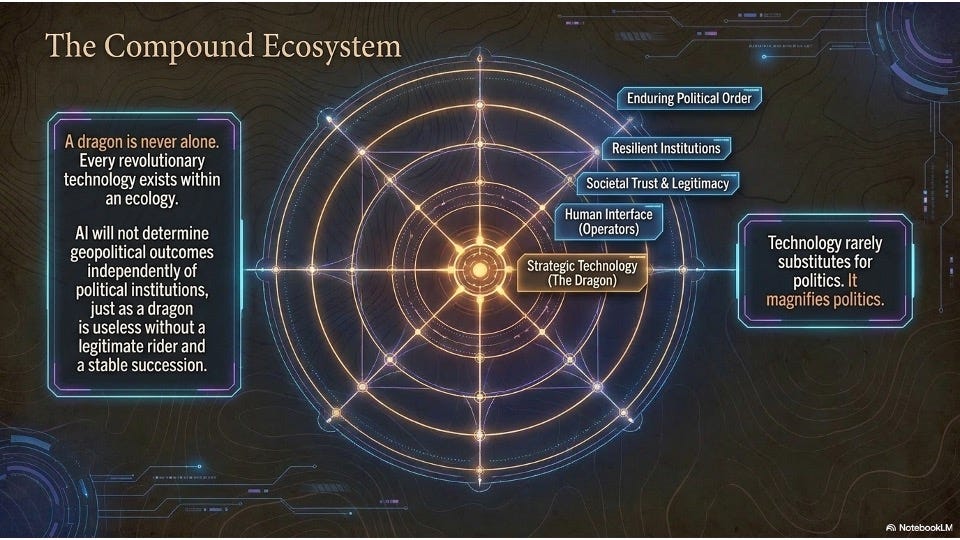
One of the most revealing features of Martin’s world is that dragons never operate in isolation.
Every dragon exists within an ecology.
It depends upon riders.
Riders depend upon legitimacy.
Legitimacy depends upon succession.
Succession depends upon institutions.
Institutions depend upon trust.
Trust depends upon political performance.
The destruction wrought by dragonfire therefore represents only the visible surface of a much larger adaptive system.
When observers ask whether dragons determine political outcomes, they ask the wrong question.
Dragons amplify existing political dynamics.
They do not replace them.
The same observation increasingly characterizes strategic competition today.
Artificial intelligence will not determine geopolitical outcomes independently of political institutions.
Neither will cyber power.
Nor quantum computing.
Nor biotechnology.
Nor economic statecraft.
Their effects emerge through interaction with governance, public trust, industrial resilience, alliance cohesion, legal legitimacy, education, and adaptive capacity.
This is precisely why predictions based upon technological superiority alone so often disappoint.
Technology rarely substitutes for politics.
It magnifies politics.
The same dragon placed within two different political systems will produce two different strategic outcomes.
Likewise, identical technologies adopted by different societies generate profoundly different trajectories depending upon institutional quality, strategic culture, legitimacy, and adaptability.
The dragon, in other words, is never the whole story.
It is one node within a larger adaptive system.
The Illusion of Absolute Superiority
Modern strategy remains haunted by an enduring illusion.
It is the belief that sufficiently advanced technology can eliminate uncertainty itself.
Every generation rediscovers this hope.
Machine guns were expected to make maneuver obsolete.
Strategic bombing promised decisive victory from the air.
Precision-guided munitions would supposedly remove the fog of war.
Network-centric warfare would deliver perfect information.
Artificial intelligence is now frequently described in similarly transformative terms.
Martin quietly dismantles this illusion.
No weapon, however extraordinary, abolishes politics.
Dragons create uncertainty as readily as they resolve it.
They produce deterrence.
They also produce fear.
They consolidate kingdoms.
They also fracture dynasties.
They suppress rebellion.
They also encourage conspiracies.
Their overwhelming military utility coexists with profound political ambiguity.
The paradox is timeless.
The more powerful the strategic instrument, the greater the temptation to overestimate its capacity to solve fundamentally political problems.
History repeatedly demonstrates the consequences.
The United States possessed overwhelming military superiority in Vietnam.
The Soviet Union possessed overwhelming military superiority in Afghanistan.
Coalition forces rapidly defeated Saddam Hussein’s army in 2003.
In each case, battlefield dominance proved insufficient to secure durable political outcomes.
Military capability achieved operational success.
Political systems failed to convert that success into lasting strategic advantage.
The dragons of Westeros reveal precisely the same dilemma.
They excel at conquest.
They are far less effective at governance.
And governance—not conquest—is ultimately what determines whether political order endures.
The Strategic Center of Gravity: Legitimacy
Perhaps the deepest lesson hidden within Martin’s work is that legitimacy behaves much like an invisible strategic reserve.
It cannot be mobilized overnight.
It cannot be manufactured through coercion.
It cannot be seized by force alone.
Yet when crises emerge, legitimacy frequently determines whether institutions bend, adapt, or break.
Dragons influence legitimacy.
They do not create it.
Indeed, overreliance upon dragons often corrodes it.
A ruler who repeatedly reaches for overwhelming coercive power gradually teaches subjects that obedience arises from fear rather than consent. Compliance may increase in the short term, but resilience diminishes over time. Political systems become brittle precisely because coercion displaces trust.
The same danger confronts contemporary great powers.
States capable of projecting extraordinary military, technological, or economic force may become increasingly dependent upon those instruments precisely as their reservoirs of domestic and international legitimacy begin to erode. They continue appearing powerful while becoming progressively less adaptive.
From a systems perspective, this represents one of the most dangerous forms of strategic decay.
Performance remains high.
Resilience quietly declines.
Success obscures fragility.
The system appears strongest immediately before its underlying weaknesses become impossible to conceal.
Martin’s dragons illuminate this uncomfortable truth with remarkable elegance.
Their fire burns brightest at precisely the moment the political foundations beneath House Targaryen begin quietly cracking.
The tragedy is not that the dragons eventually disappear.
The tragedy is that their extraordinary power delayed recognition that the kingdom had become increasingly dependent upon them.
The Dragon Paradox
Every civilization develops a story about the source of its strength.
Some attribute it to geography.
Others to wealth.
Others to military superiority, technological innovation, divine favor, ideology, or exceptional leadership.
These stories matter because they shape how societies understand both success and security. Yet history suggests that civilizations are often mistaken about what truly sustains them. They confuse the instruments through which power is exercised with the institutions through which power endures.
This is the Dragon Paradox.
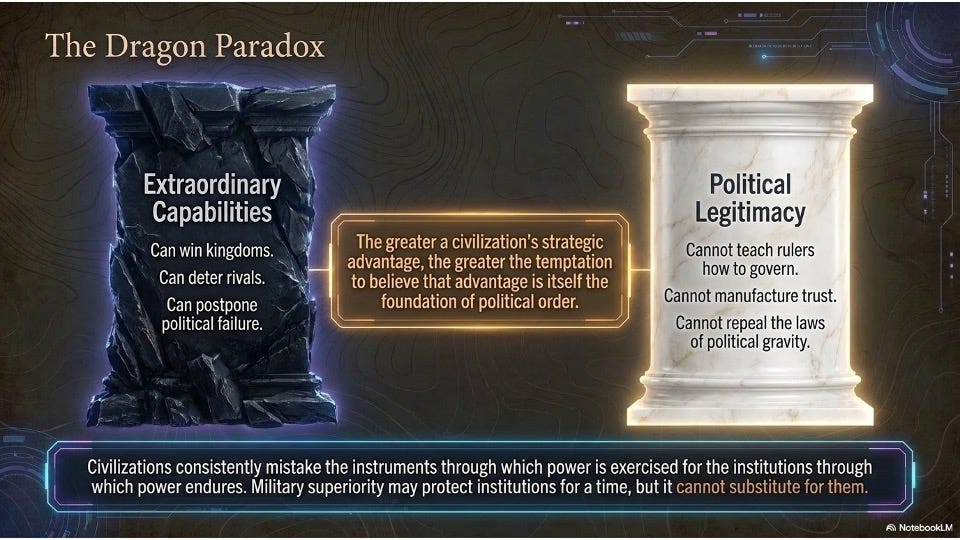
The greater a civilization’s strategic advantage, the greater the temptation to believe that advantage is itself the foundation of political order.
In reality, extraordinary capabilities frequently obscure the quieter sources of resilience that ultimately determine whether political communities survive periods of stress. Military superiority may protect institutions for a time, but it cannot substitute for them. Technology may amplify state power, but it cannot manufacture legitimacy. Fear may compel obedience, but it rarely cultivates durable loyalty.
House Targaryen ultimately falls victim not to the weakness of dragons, but to the illusion that dragons alone could preserve the realm.
The tragedy is subtle.
The dragons become so central to Targaryen identity that the dynasty gradually mistakes possession of dragons for possession of legitimacy. Political stewardship yields to dynastic entitlement. Institutional development yields to personal authority. The kingdom increasingly depends upon the continued existence of an extraordinary strategic capability rather than upon the steady cultivation of resilient political foundations.
When that capability inevitably declines, the weakness of those foundations is suddenly exposed.
The dragons did not fail the kingdom.
The kingdom failed to prepare for a future in which dragons alone would no longer suffice.
History offers remarkably similar lessons.
Spain’s imperial wealth did not preserve imperial Spain.
Britain’s unmatched navy did not indefinitely sustain the British Empire.
The Soviet Union’s enormous military establishment could not compensate for mounting economic and political sclerosis.
Nor has overwhelming conventional military superiority consistently translated into durable strategic success for modern great powers confronting insurgencies, fragile states, or crises of political legitimacy.
Again and again, civilizations discover that strategic dominance delays—not abolishes—the need for effective governance.
The lesson is neither cynical nor anti-technology.
It is profoundly hopeful.
Political institutions remain humanity’s most important strategic technology.
⸻
Entering a New Age of Dragons
The world now emerging bears striking resemblance to the strategic environment Martin imagined.
Not because dragons exist.
But because no single capability any longer defines power.
Artificial intelligence is reshaping decision-making.
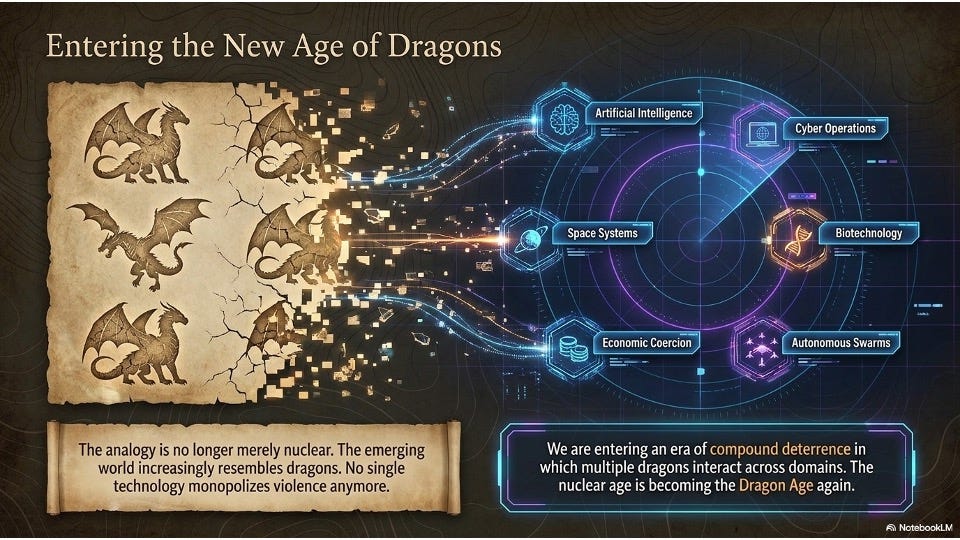
Cyber operations can disrupt societies without firing a shot.
Space systems underpin military, economic, and civilian life.
Biotechnology promises extraordinary advances while introducing unprecedented risks.
Global financial systems have become instruments of strategic coercion.
Information ecosystems influence political legitimacy at extraordinary speed and scale.
Autonomous systems increasingly compress the time available for human judgment.
None of these capabilities alone resembles nuclear weapons.
Collectively, however, they resemble Martin’s dragons.
Each is powerful.
Each is adaptive.
Each interacts with every other.
Each produces opportunities for deterrence while simultaneously creating new avenues for instability, miscalculation, and escalation.
Most importantly, none operates independently of politics.
Their strategic significance emerges through interaction with institutions, alliances, public trust, industrial resilience, legal frameworks, and the adaptive capacity of societies themselves.
This is the defining characteristic of compound security.
Security is no longer adequately measured by inventories of weapons or assessments of gross national power. It is increasingly measured by the ability of political systems to absorb shocks, adapt under pressure, coordinate across domains, maintain legitimacy, and recover faster than competitors.
In such a world, deterrence itself becomes compound.
A nation deters not only because it can retaliate militarily, but because it can preserve societal cohesion, protect critical infrastructure, sustain economic vitality, reassure allies, maintain credible institutions, and adapt more rapidly than adversaries expect.
The dragon is no longer one weapon.
It is an ecosystem of strategic capabilities.
⸻
Fire and Stewardship
Martin’s greatest strategic insight may ultimately be ethical rather than military.
The central question is never whether dragons should exist.
The central question is whether those entrusted with extraordinary power possess the wisdom, restraint, humility, and institutions necessary to govern that power responsibly.
Every generation confronts this challenge in different forms.
Yesterday it was gunpowder.
Then battleships.
Then aircraft.
Then nuclear weapons.
Today it is artificial intelligence, biotechnology, cyber capabilities, autonomous systems, and the interconnected infrastructures upon which modern civilization depends.
Tomorrow it will be something else.
The technologies change.
The political dilemma endures.
Power consistently outruns wisdom.
Innovation consistently outpaces governance.
Institutions consistently struggle to adapt as rapidly as the capabilities they are expected to regulate.
That is not a uniquely modern problem.
It is the recurring condition of history itself.
⸻
Coda: After the Fire
George R. R. Martin did not write a treatise on deterrence theory.
He wrote a story about families, ambition, loyalty, fear, memory, and the corrupting allure of power.
Yet, like the finest works of literature, his story illuminates truths extending far beyond its fictional setting.
The dragons of Westeros remind us that ultimate weapons rarely determine history by themselves. They shape incentives, alter perceptions, and transform political possibilities, but they do not relieve leaders of the burden of judgment. Indeed, they increase it. The more extraordinary the instrument, the greater the consequences of wisdom—or its absence.
That may be the enduring strategic lesson.
Civilizations are not ultimately remembered for the weapons they forged. They are remembered for the political orders they built, the institutions they sustained, and the values they preserved while wielding extraordinary power.
Dragons can win kingdoms.
They cannot teach rulers how to govern them.
They can deter enemies.
They cannot create legitimacy.
They can postpone political failure.
They cannot repeal the laws of political gravity.
Every age inherits its own dragons.
The challenge has never been merely learning how to command them.
It has always been learning how to remain worthy of commanding them at all.

If you value this work, here are three ways you can step into the story with us:
📰 Subscriber (Free)
Stay informed. Receive every new essay, briefing, and analysis straight to your inbox. Join a growing community committed to civic resilience and national security.
🎧 Supporter (Paid Pledge)
Strengthen the signal. Your support sustains both Compound Security, Unlocked and our companion podcast The Civic Brief. Supporters ensure these conversations remain accessible to the wider public while elevating the quality, depth, and reach of the work.
🛡️ Sustainer (Patron Level)
Invest in the mission. Sustainers fuel new research, convenings, and storytelling that enlarge the civic frame of security. This is more than content — it’s a civic project. Your sponsorship helps preserve an independent voice committed to equipping citizens, leaders, and institutions for the compound challenges ahead.