
Fairness Is Not Sameness
Equity, Equality, and the Future of Civic Pluralism.

“Justice is not derived from uniformity but from attending to difference with integrity.”
— Adapted from Iris Marion Young
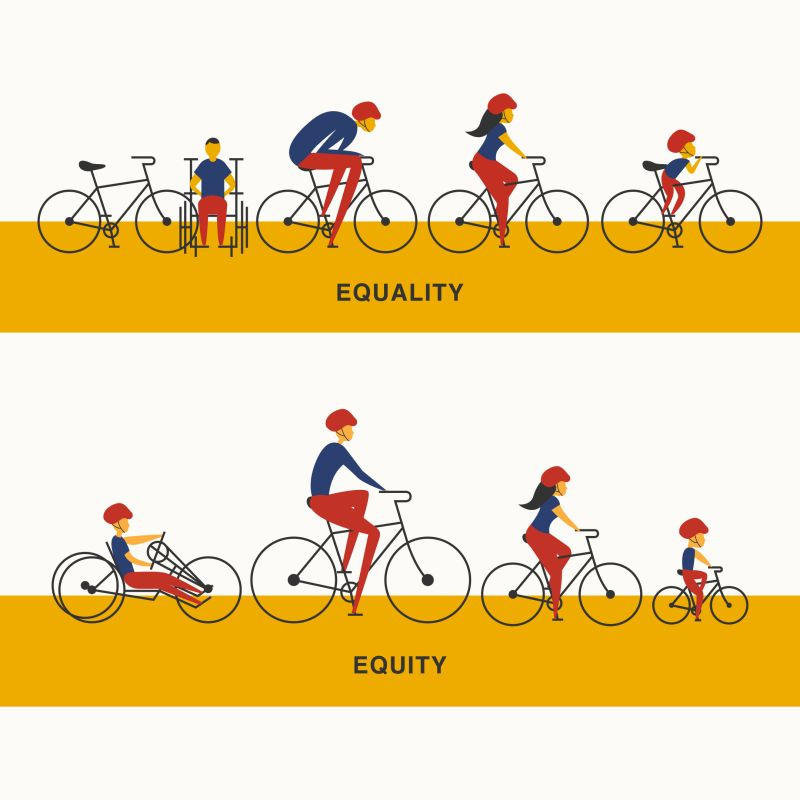
In today’s polarized debates about fairness, opportunity, and justice, few terms are more contested—or more confused and manipulatively abused—than equality and equity.
These words are often used interchangeably, but their differences are not just semantic. They are foundational to how we understand justice in the public square, and how we build—or fail to build—a genuinely inclusive society.
In its simplest form, equality means treating everyone the same. In contrast, equity means treating people justly, according to their needs, histories, and circumstances.
If equality is about giving everyone the same starting point, equity is about recognizing that we do not all begin from the same place—and adjusting accordingly to ensure that everyone has a fair chance at meaningful outcomes.
This distinction may seem straightforward, even intuitive, but it becomes complex—and politically charged—in practice.
It is especially important to clarify the difference in the context of DEI (Diversity, Equity, and Inclusion) initiatives, which are increasingly under attack by those who claim that efforts toward equity are themselves unfair or discriminatory.
But this confusion misses the point entirely.
Equality vs. Equity: The Structural Stakes
To illustrate: imagine a public school where every student is given the same textbook and the same number of hours with a teacher. On paper, this looks like equality.
But what if some students come from homes where English isn’t the primary language, where parents work multiple jobs and can’t help with homework, or where access to stable housing is inconsistent? For those students, the “equal” provision of education does little to ensure a fair outcome.
That’s where equity steps in.
Equity asks: What does each student need in order to succeed? That might mean tutoring for some, language support for others, or breakfast before class. It means more than leveling the playing field—it means actually enabling everyone to play.
In the public imagination, equity often gets mischaracterized as preferential treatment.
But in truth, it’s a corrective: a way of acknowledging the uneven terrain of lived experience.
Equity doesn’t guarantee identical outcomes, but it aims to remove artificial barriers that make opportunity a fiction rather than a right.
In the DEI Arena: Beyond Optics
Within DEI efforts, equality tends to be associated with formal, procedural fairness—everyone has the same access to jobs, to voting, to safety.
But equity pushes further, asking whether the systems and structures that govern access and outcomes are themselves just.
The “E” in DEI is not about charity. It is about systemic repair.
It’s about access, process, quality, and outcomes—not merely intentions.
Without equity, DEI devolves into performance. With equity, DEI becomes a framework for institutional transformation.
For example:
In hiring: Equality might post the same job to all applicants. Equity would ensure outreach reaches communities historically underrepresented.
In healthcare: Equality might mean equal appointment times. Equity ensures language translation, cultural competence, and access to transportation.
Equity recognizes that fairness sometimes requires treating people differently to account for historical and structural imbalances.
That may offend a simplistic view of fairness—but it is essential to any serious pursuit of justice.
The Political Backlash: A Case of Historical Amnesia
The rise of anti-equity rhetoric in the U.S.—particularly among those seeking to dismantle DEI programs—rests on a flattening of history.
It presumes that all groups now compete on a level playing field, that past injustices have no bearing on present conditions, and that justice is best served by pretending everyone’s shoes fit the same.
But pluralism requires more than a fantasy of sameness. It demands a commitment to equal dignity—which cannot be achieved without equitable means.
As we’ve seen before—in everything from post-Civil War Reconstruction to the Civil Rights Movement—equality without equity is a broken promise. It preserves the façade of fairness while entrenching disparities beneath it.
Equity as a Commitment to Compound Security
In the spirit of compound security, equity must be understood as more than a social justice term. It is a matter of civic durability.
A system that insists on equality without equity builds friction into its own future. It undermines legitimacy. It sows grievance. And it accelerates disaffection—especially among those already excluded from full participation in the civic covenant.
To serve the Republic—and to sustain its democratic experiment—we must commit not just to sameness of treatment, but to fairness of opportunity and pursuit of outcome.
That is the logic of equity. And it is the only logic that secures the future of pluralism against the rising tide of resentment and authoritarian backlash.
Closing Thought: Equity Is the Strategy of a Just Republic
Equality may be the ideal etched into our founding documents. But equity is the necessary means of fulfilling that ideal in the real world.
Justice is not achieved by pretending difference doesn’t exist. It is achieved by designing systems that reckon with difference, and respond with integrity, humility, and purpose.
That is the work. Not of special treatment—but of secure belonging.
The bike imagery is appropriate. I use the metaphor of a lap around a 440-yard track where the competitions are the 440-yard dash, hurdles, and steeplechase.
Even with the same starting point (conditions), the outcomes will be inherently different if the standard is solely who crosses the finish line first.