
"Differential Liberty"
Civil Rights Risk in the Second Trump Administration

“Justice too long delayed is justice denied.”
— Martin Luther King Jr.
The Quiet Way Rights Erode
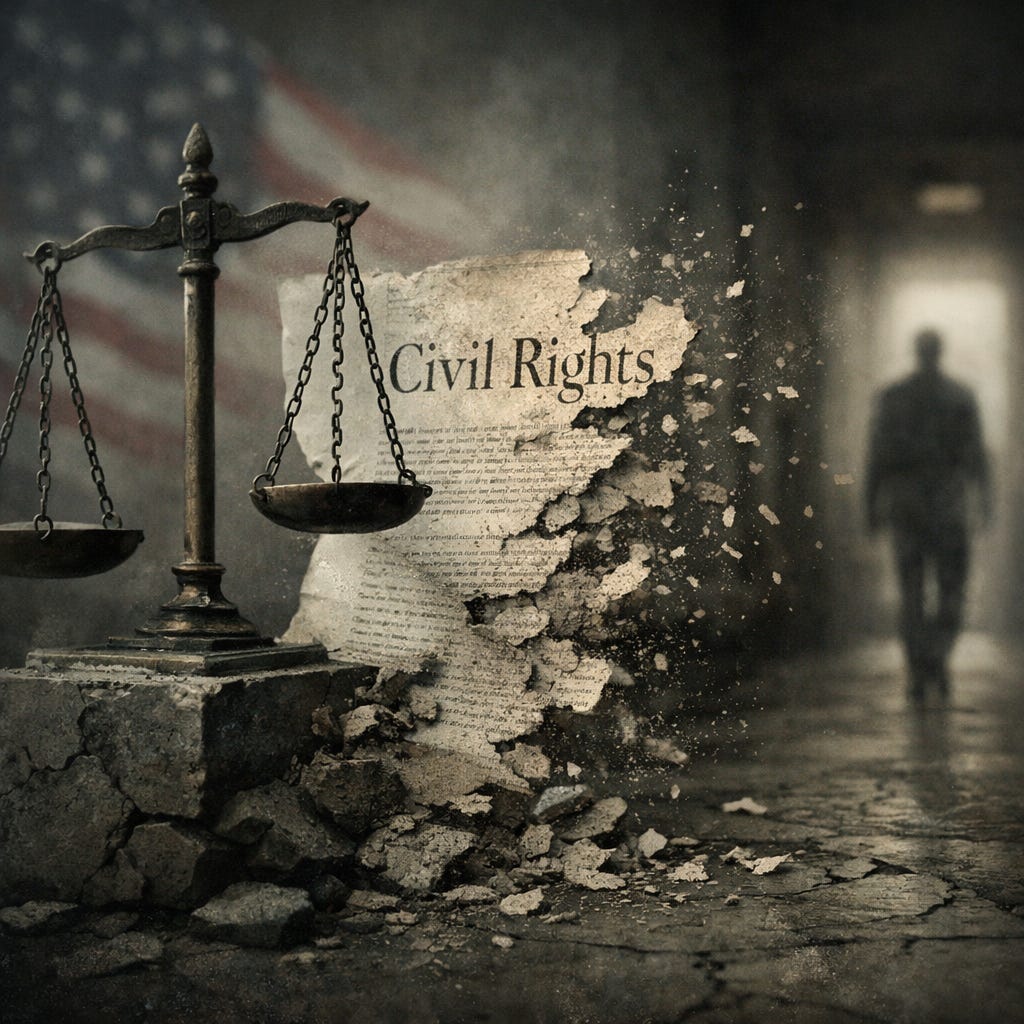
Civil rights rarely disappear all at once.
They do not usually vanish through a single dramatic decree or a constitutional amendment repealed in plain sight.
More often, they erode through quieter mechanisms: a change in definitions here, a dismantled oversight office there, a directive that alters how institutions remember themselves or what ideas they allow to circulate within their walls.
The legal architecture of rights may remain intact. The Constitution still stands. Courts still function. Elections still occur.
But the institutional machinery that translates constitutional promises into lived equality begins to shift.
And when that machinery changes, the question that matters most is not whether every American retains formal rights.
The question is simpler and more sobering:
Who bears the greatest risk when the mechanisms that enforce equality begin to disappear?
Across American history, the answer has rarely been evenly distributed.
Rights on Paper vs. Rights in Practice
The United States Constitution promises equal protection of the laws.
But American history demonstrates repeatedly that rights written on paper do not automatically produce equality in practice. Enforcement matters. Institutional oversight matters. Administrative structures matter.
For much of the nation’s history, civil-rights protections have existed precisely because equal treatment did not arise naturally from social consensus.
Federal agencies created compliance offices. Courts established enforcement doctrines. Institutions developed procedures designed to identify discrimination and correct it before it became systemic.
These systems were not ornamental.
They were the mechanisms through which abstract legal principles became real protections in daily life.
Remove those mechanisms, and the law remains—but its power to function weakens.
The Power of Definition
One of the least visible but most powerful tools available to government is definitional authority.
Federal executive action redefining how agencies recognize sex and gender illustrates this dynamic. By directing agencies to treat sex as strictly binary within federal policy, the administration has reshaped the categories through which the federal government delivers services, regulates access to facilities, and enforces anti-discrimination protections.
Legal definitions determine eligibility.
Eligibility determines who can claim protections when discrimination occurs.
For citizens whose identity aligns with long-established legal categories, these definitional shifts may appear largely symbolic.
But for transgender Americans and others whose identities fall outside those majoritarian categories, the consequences are practical and immediate.
Recognition determines standing.
Standing determines rights.
The Architecture of Enforcement
Civil-rights protections do not enforce themselves.
Over the past half-century, federal agencies developed compliance structures—often described under the umbrella of diversity, equity, and inclusion programs—to monitor disparities, train officials in anti-discrimination law, and provide mechanisms for addressing grievances.
Recent executive actions eliminating or restricting these programs across federal agencies have been rhetorically ‘justified’ as efforts to restore neutrality and eliminate preferential treatment.
Yet historically these systems functioned less as ideological instruments than as institutional early-warning systems.
They generated data on workplace disparities.
They ensured compliance with anti-discrimination statutes.
They provided structured pathways for addressing complaints.
Removing them does not automatically create discrimination.
But it does remove the infrastructure designed to detect and correct it.
Without those mechanisms, equal protection increasingly depends on individuals having the resources, knowledge, and institutional leverage to challenge violations on their own.
Historically, that burden has rarely fallen evenly across society.
When enforcement disappears, equality does not automatically follow.
More often, inequality simply becomes harder to prove.
Conditional Citizenship in the Military
Few institutions in American life symbolize belonging more powerfully than the military.
Military service has long functioned not only as national defense but as a pathway to civic recognition.
The desegregation of the armed forces in 1948 preceded broader civil-rights gains. The integration of women and openly gay service members reflected evolving definitions of citizenship and national identity.
Policies implementing separation procedures for service members diagnosed with gender dysphoria therefore represent more than administrative adjustments.
They represent categorical exclusion from participation in one of the nation’s most central civic institutions.
Supporters frame these policies as necessary for military readiness.
Critics see them as discrimination.
But regardless of rationale, the outcome remains clear: a defined category of citizens is denied participation in an institution historically tied to the full expression of national belonging.
Institutional Memory and Narrative Power
Government institutions shape national identity not only through policy but through narrative.
Pentagon directives ordering the removal of diversity-related digital content from official platforms illustrate how narrative governance operates.
By eliminating (i.e., “whitewashing;” “male-washing;” “cis-washing”) references to diversity initiatives, minority service, and historical struggles over equality, institutions subtly reshape the story they tell about themselves.
Narratives signal belonging.
When institutions publicly acknowledge the contributions of marginalized groups, they affirm those groups as integral to the national story.
When those narratives disappear, the message changes.
The history itself may remain true, but it is no longer considered central to institutional identity.
Intellectual Boundaries in Professional Education
Professional military education has traditionally emphasized intellectual openness.
Officers are expected to study the political, social, and cultural dynamics that shape conflict and governance around the world.
Directives requiring the review or removal of diversity-related materials from military libraries introduce a new constraint into that environment.
The issue is not simply ideological disagreement.
It is the precedent that government institutions may determine which perspectives are legitimate subjects of professional inquiry.
Effective leadership requires confronting difficult questions about race, culture, identity, and social conflict.
Restricting those conversations narrows the intellectual space in which future leaders learn to think.
The Historical Pattern
The dynamics unfolding today echo earlier moments in American history.
After Reconstruction, federal enforcement mechanisms designed to protect the rights of newly freed Black Americans were gradually dismantled. The constitutional amendments guaranteeing equality remained intact.
But without federal enforcement, those guarantees proved insufficient.
Jim Crow emerged not through the repeal of rights, but through the collapse of the institutions designed to enforce them.
A similar logic appeared during the McCarthy era, when ideological investigations and loyalty tests reshaped the boundaries of acceptable political expression within government institutions.
In both cases, the state did not abolish constitutional rights outright.
Instead, it altered the institutional environment in which those rights operated.
The consequences fell disproportionately on those whose rights depended most heavily on active enforcement.
Differential Liberty
The concept that best describes this dynamic might be called ‘differential liberty.’
Not all citizens experience the withdrawal of protections in the same way.
When enforcement systems weaken and recognition frameworks narrow, the groups most affected are those whose equal standing required those systems in the first place.
Those historically secure in their social and institutional position often experience little immediate change.
Those whose rights required active enforcement face increased vulnerability.
The issue, therefore, is not universal repression.
It is unequal exposure to risk.
The Legitimacy Question
The durability of democratic systems depends not only on constitutional design but on institutional legitimacy.
Citizens must believe that public institutions treat them fairly, recognize their membership in the political community, and provide mechanisms through which grievances can be addressed.
When institutions narrow recognition, dismantle oversight systems, or restrict intellectual inquiry, they risk weakening that legitimacy.
And legitimacy, once lost, is difficult to restore.
“Power concedes nothing without a demand. It never did and it never will.”
— Frederick Douglass
The Long Arc
American civil rights have never followed a straight line.
Periods of expansion have repeatedly been followed by periods of retrenchment. Progress has often been contested, reversed, and rebuilt.
The current moment represent another turn in that cycle.
The Constitution still stands. The language of equal protection remains unchanged.
But the institutional landscape in which those guarantees operate is shifting.
And history suggests that when such shifts occur, the first citizens to feel the consequences are rarely those who have always stood at the center of the nation’s political life.
They are those whose equality required the law not merely to exist—but to be actively enforced.
If you value this work, here are three ways you can step into the story with us:
📰 Subscriber (Free)
Stay informed. Receive every new essay, briefing, and analysis straight to your inbox. Join a growing community committed to civic resilience and national security.
🎧 Supporter (Paid Pledge)
Strengthen the signal. Your support sustains both Compound Security, Unlocked and our companion podcast The Civic Brief. Supporters ensure these conversations remain accessible to the wider public while elevating the quality, depth, and reach of the work.
🛡️ Sustainer (Patron Level)
Invest in the mission. Sustainers fuel new research, convenings, and storytelling that enlarge the civic frame of security. This is more than content — it’s a civic project. Your sponsorship helps preserve an independent voice committed to equipping citizens, leaders, and institutions for the compound challenges ahead.