
“Democracy’s Mirror"
How America’s Founding Paradox—and the Hidden Logic of Liberal Power—Became the World’s Operating System.

By Dr. Isaiah (Ike) Wilson III
Founder & CEO, Wilson W.i.S.E. Consulting | Professor of Practice, ASU | Author, Compound Security, Unlocked
“Every empire tells itself it’s a democracy—until the mirror cracks, and it sees the cost of its own reflection.”
—Dr. Ike Wilson
I. Prologue: A Thought I Couldn’t Shake-- What If the System Was Designed This Way?
Let me begin by being honest with you.
This isn’t the essay I wanted to write.
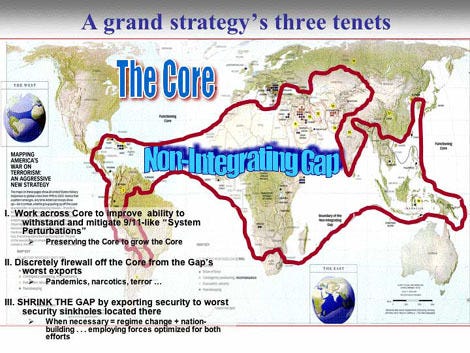
I had something else in mind—something more technical, more academic, perhaps even more detached. But a few weeks ago, I found myself staring again at a map. Not just any map, but that map—Thomas P.M. Barnett’s now-famous Pentagon map. The one that divides the world into the “Functioning Core” and the “Non-Integrating Gap.”
If you’re familiar with Barnett’s work, you know what I’m talking about: it’s the geopolitical blueprint that’s guided a generation of national security planners. It’s clean, elegant even—too elegant. The lines on that map suggest clarity. Strategy. Purpose. Integration. Stability.
But something about it wouldn’t let me go.
That same night, I’d just finished rereading Heather Cox Richardson’s How the South Won the Civil War—a book about the deeper contradictions inside the American democratic experiment.
Her argument hit me harder this time around: that the promise of American equality has always required, or at least depended upon, a system of inequality. A democracy for some, predicated on the exclusion of others.
And suddenly the map in my hand and the paradox in my mind began to merge.
What if, I wondered, the inequality that haunts American democracy at home is the very logic that governs its posture abroad?
What if the same mythologies that fueled westward expansion—liberty, self-reliance, “taming the frontier”—are the ones that undergird our global interventions today?
What if our democracy’s survival, in its current form, has always required someone else’s exclusion—first within, and now without?
It wasn’t a comfortable thought. It still isn’t.
But I’ve learned over time that the questions we most want to avoid are often the ones most worth asking. And I realized then, with a kind of pit-in-the-stomach clarity: I couldn’t just move on. I had to follow this thread.
So that’s what this essay is.
It’s not a polemic. It’s not a lecture. It’s not a eulogy, though some parts may feel elegiac.
It’s a walk—through maps and myths, through paradoxes that connect the plantation to the Pentagon, the cowboy to the corridor, the illusion of equality to the infrastructure of exclusion.
I’ll pose some uncomfortable hypotheses. I’ll ask “what ifs” that some might find unsettling. And at every step, I’ll keep coming back to this direct conversation with you—because this isn’t just about systems and structures. It’s about us. What we’ve inherited. What we’ve ignored. What we might yet change.
Let’s begin—with a question I can’t shake, and maybe you won’t be able to either:
What if the American way of democracy only ever worked—because it didn’t work for everyone? And what if that same condition is now written into the global order we claim to lead?
Let’s ask it together.
🧠 Central Research Question:
What if the contradiction at the core of American democracy—that the promise of equality depends on a foundation of inequality—is not only unresolved, but has been systemically reproduced in the very architecture of U.S. global power?
🧪 Working Hypotheses:
Domestic Hypothesis (H1): The American democratic project has historically relied on a tiered conception of citizenship—full participation for some, conditional belonging for others—as a structural feature, not a bug.
Global Hypothesis (H2): The U.S.-led liberal international order replicates this domestic model by sustaining a division between a “Functioning Core” of integrated states and a “Non-Integrating Gap” ripe for extraction, intervention, and managed instability.
Synthesis Hypothesis (H3): The U.S. functions as both the epicenter and exporter of this paradox—deploying democratic language and capitalist logic while managing a global hierarchy that secures its own position atop a stratified system.
A Step Deeper: Walk With Me Here
All right—still with me?
If those hypotheses felt heavy, that’s because they are. I know this isn’t easy reading.
It’s not meant to be.
But I promise, I’m not dropping us into the deep end to drown. I’m doing it because we’re strong enough—and curious enough—to swim.
Maybe you’ve felt it, too. That tension. That nagging sense that something doesn’t add up.
Maybe it hit you in a college lecture on American history that skipped over the genocide it was built on. Or in a news story about the “rules-based international order” being enforced by drone strikes.
Or maybe it hit closer to home—like seeing your community praised for its “resilience,” while the systems that demand that resilience never change.
Whatever brought you here, I’m glad you stayed.
Because now we get to do the real work—not of assigning blame, but of tracing patterns. Of seeing how the internal contradictions of a nation can become the operating code for an entire world system.
In a moment, we’ll examine the domestic paradox that Heather Cox Richardson outlines so powerfully. We’ll follow the story from the American founding, through the Civil War, into the western frontier, and beyond—watching how the idea of liberty was leveraged to maintain hierarchy.
But as we move forward, I want to ask something of you—not as a reader, but as a fellow traveler:
Don’t just look at the facts. Listen for the echoes.
The echoes between “states’ rights” and “sovereignty.” The echoes between “frontier freedom” and “intervention for democracy.” The echoes between who counts as a citizen—and who gets counted as collateral.
This isn’t just history.
It’s a mirror.
And if we’re brave enough to look into it, we just might catch a glimpse—not only of what has been, but of what could still be.
Ready?
Let’s begin with where it all starts: the American contradiction.
II. The Domestic Layer: Richardson’s “Equality Through Inequality” Paradox
Heather Cox Richardson, in How the South Won the Civil War, proposes that America’s founding ideal of liberty was accompanied from the outset by a hidden cost: the exclusion of many to enable the full empowerment of a few.
The original “We the People” was never universal—it was always conditional.
The myth of the cowboy and frontier liberty obscured the settler colonial violence and racial subjugation required to sustain it.
Post-Civil War Reconstruction didn’t erase these dynamics—it relocated and re-inscribed them through western expansion, property systems, and the rise of industrial capitalism.
📍Test Case A: The Modern Cowboy as Political Archetype
What if the “small-government,” anti-regulation West was not simply a geographic region but a legacy political model of oligarchic rule by those who define themselves through exclusion?
Before We Go Global—Let’s Catch Our Breath
Let’s pause here for a second.
We’ve just traced a hard, unflinching line—from the founding paradox of American democracy to the post-Civil War frontier, where the myth of freedom rode side-saddle with the machinery of subjugation. We’ve seen how equality for some was made possible only through inequality for others. Not accidentally. Structurally. Intentionally.
That’s a lot to take in.
And if you're feeling a bit uneasy—good. That means you're paying attention.
Because here’s the thing: history isn’t just about what happened. It’s about what patterns were set. What defaults were coded into the system. What assumptions we’ve inherited without ever questioning their architecture.
So now I want to ask you something—gently, but directly:
If that logic—the logic of inclusion through exclusion—built American democracy from within, what makes us think it stopped at the water’s edge?
What if we didn’t just export our ideals of liberty and opportunity?
What if we also exported our own internal paradox?
What if the same operating system that underpinned the western frontier is now embedded in the global financial system… in the security architecture… in the international order we claim to uphold?
That’s where we’re headed next.
We’re going to follow that logic outward—into the Pentagon’s map, into the Functioning Core and the Non-Integrat-“ed” Gap, into the managed instability that makes “integration” possible but only for some.
And as we do, I want you to keep something in mind: this is not about indicting a country. It’s about interrogating a structure.
Because maybe, just maybe, the global order we’ve built looks the way it does—not in spite of our ideals, but because of the paradoxes we never resolved.
Let’s flip the map now.
Let’s go global.
III. The Global Layer: Barnett’s “Functioning Core” vs. “Non-Integrating Gap”
In The Pentagon’s New Map, Thomas P.M. Barnett asserts that global stability depends on maintaining and expanding the “Functioning Core” of globalized, rule-abiding nations—and managing the “Non-Integrating Gap” of unstable, disconnected zones.
But what if this division isn’t an unfortunate reality to be remedied—but a necessary feature of the system?
The Functioning Core requires the Gap to exist—as a reservoir for cheap labor, extractive industries, and strategic depth.
“Integration” often means coercion, surveillance, or regime change—sold as development.
American global power is maintained not through universal uplift, but through strategic asymmetry.
📍Test Case B: Iraq, Afghanistan, and the Faustian Bargain of Integration
What if the invasions of Iraq and Afghanistan were not failed democracy projects—but successful exercises in power projection and order maintenance, designed to perpetuate the Gap rather than eliminate it? Maybe both? ... an outcome of the former, because of investment in the latter?
IV. Parallel Logics: Domestic Inequality as Foreign Policy Template
H1 + H2 = H3:
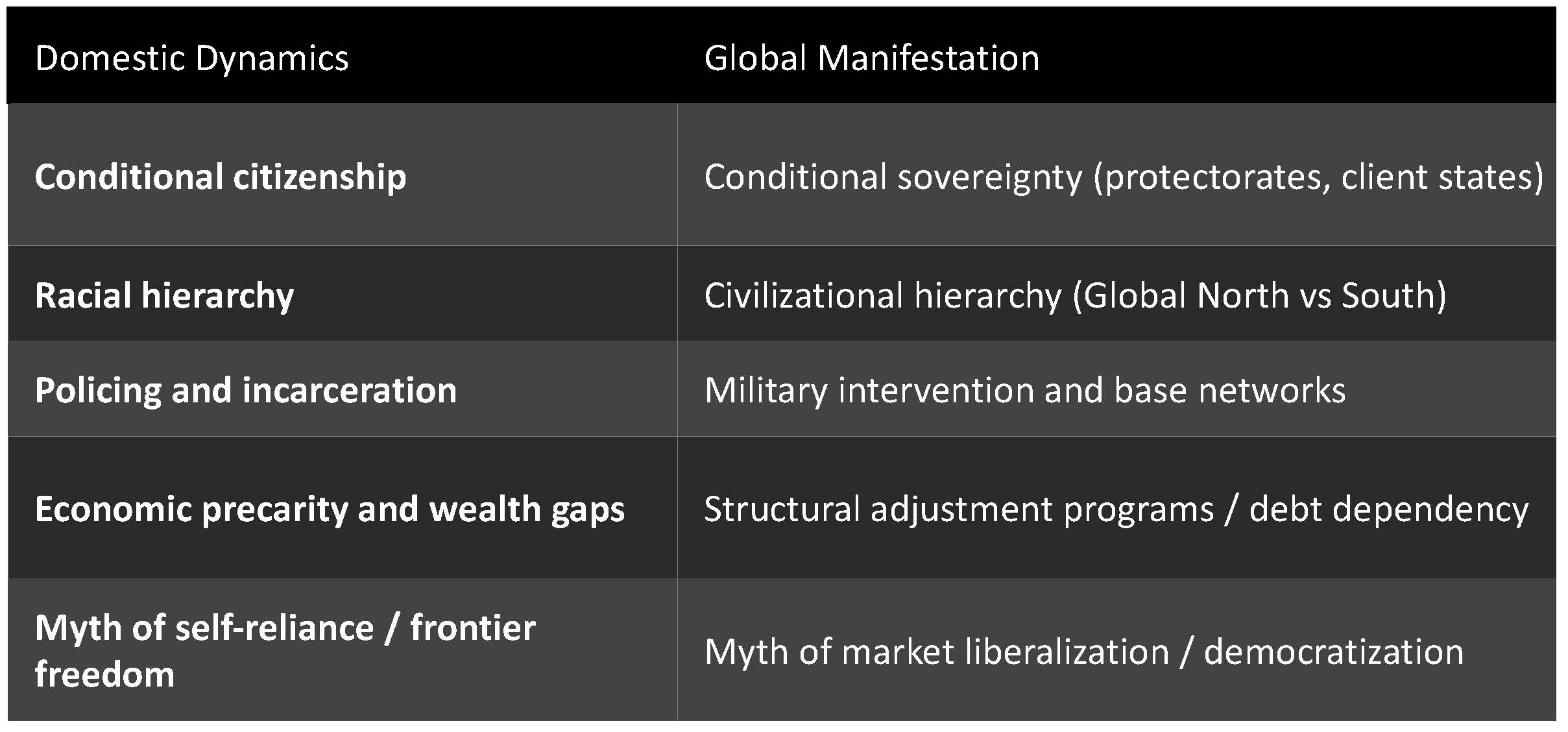
The same model of managed inequality deployed internally becomes the operating system for external engagement.
🧭 Key Parallels:
📍Test Case C: Structural Adjustment and the "Market Civilizing Mission"
What if the IMF and World Bank model of neoliberal reform is just the globalized version of America’s own internal stratification strategy—opening markets while closing possibilities?
You Seeing It Too?
Okay—let’s sit with this.
You’ve seen the table. You’ve traced the parallels. From disenfranchised citizens to destabilized nations, from redlined neighborhoods to red-zoned countries. From frontier expansion to regime change. From plantation economy to perpetual extraction.
You tell me: does that feel like coincidence?
Or is there something deeper here—some foundational logic that keeps surfacing, like a watermark that bleeds through every page?
What’s more unsettling to you—that these patterns exist? Or that we’ve grown so used to them, we hardly see them as patterns at all?
We’re trained—especially in the West—to think in binaries. Foreign vs. domestic. Civil vs. military. Democracy vs. dictatorship. But what if the truth cuts across those lines?
What if the system is a mirror of itself—inside and out?
It doesn’t mean there’s some vast conspiracy; not necessarily. It doesn’t even mean all of this was plotted in smoke-filled rooms. Perhaps ...
Often, it’s more insidious than that. It’s normalization. It’s structural convenience. Its inertia dressed up as inevitability.
But if the logic of “exclusion-through-inclusion” is the system—then its persistence makes perfect sense.
And if we’re honest with ourselves, we have to admit: America has always been a contradiction it never resolved.
A republic built on revolution and slavery.
A beacon of democracy with voter suppression in its bones.
A global leader in human rights that cherry-picks which humans, and which rights, count.
So let me ask you again—not rhetorically, but sincerely:
If we can’t—or won’t—resolve that contradiction at home, why would we expect the global system we lead to be any different?
Let that question hang. Let it linger.
Because what comes next isn't just history or strategy.
It’s the moral weight of the mirror.
Let’s keep going.
V. The Narrative Layer: How Myths Mask Mechanisms
The myth of the cowboy is America’s self-image: independent, virtuous, sovereign. It displaces the reality of settler colonialism, forced labor, and systemic inequality.
The myth of the liberal international order is the global mirror: benevolent hegemony, peace through rules, rising tides lifting all boats.
But what if both are narrative architecture over extractive scaffolding?
📍Test Case D: Ukraine and the Conditionality of Western Support
What if U.S. support for Ukrainian sovereignty is not about a rules-based order, but about maintaining boundary conditions for integration—support that may disappear when costs rise or narratives shift? Folks, we see both happening now ...
📍Test Case E: Sub-Saharan Africa and the Perpetual Marginalization Loop
What if the persistence of food insecurity, climate vulnerability, and governance "fragility" isn’t due to lack of effort—but a strategically maintained developmental ceiling?
Let’s Pause Here. Sit With the Word: “Integration.”
We need to talk about this word—integration.
It sounds so benign, doesn’t it? Almost noble.
In school, we learn about integration as a victory—Brown v. Board, Civil Rights, bringing people together. In geopolitics, it’s the language of modernization, globalization, stability. “Integrating the periphery into the global system.”
But tell me…
When Iraq was “integrated,” what did that look like?
When Afghanistan was “stabilized,” who wrote the terms of peace?
When African nations are offered loans with strings—and surveillance—attached, what kind of partnership is that?
When resource-rich countries are “brought online” but never own the infrastructure, whose future is that really securing?
What we’ve too often called integration—whether domestically through redlining and carceral “inclusion,” or globally through debt, dependency, and drone diplomacy—hasn’t been a process of mutual uplift.
It’s been a strategy of “managed access.”
A system where some get a seat at the table—and others are asked to bring the meal, clear the plates, and stay quiet.
Let me ask you something personal:
When was the last time you questioned the language of “development”?
Of “security assistance”?
Of “democratic partnerships”?
Because behind every buzzword is a blueprint. And behind every blueprint, a set of assumptions—about who deserves, who decides, and who defines what “progress” means.
So, if you’re feeling a bit of discomfort right now, you’re exactly where you need to be.
Because from here, we’re going to look inward again—and ask a final, pressing question:
…. What would it take to break the pattern?
Not to burn it down. Not to swap one empire for another.
But to imagine a different architecture—of real democracy, of real power, of real belonging.
One that doesn’t rely on someone else’s exclusion for our sense of inclusion.
You ready?
Let’s step forward—eyes open, map in hand, myths on the table.
VI. Implications: The Compound Security Dilemma Revisited
If inequality is not incidental but structural—if domestic and global governance both depend on managed exclusion—then we face a compound legitimacy crisis:
Domestically: Rising illiberalism, democratic disenchantment, and internal insurgency.
Globally: Declining U.S. credibility, fractured alliances, and narrative defeat in the Global South.
In compound security terms, every domestic fracture becomes a foreign policy vulnerability—and vice versa.
VII. Towards a Strategic Reckoning: What If We Told the Truth?
🧭 What if instead of claiming the system is broken, we admitted it works exactly as designed?
🧭 What if we stopped insisting democracy must be restored, and instead reimagined what democracy must be(come)?
🧭 What if a new generation of ‘Sentinel Leaders’—strategic actors who navigate truth, power, and narrative terrain—took up the work of rewriting both the domestic compact and the global contract?
VIII. Conclusion: From Hypothesis to Strategic Imperative
We’ve tested the hypotheses—and the pattern is hard to ignore. The paradox of equality-through-inequality is not limited to America’s inner life. It animates its external posture.
If we want to rescue the promise of democracy—here and abroad—we must:
Acknowledge the paradox, not obscure it.
Dismantle the narrative myths that justify stratification.
Rebuild a global and domestic order grounded in reciprocal dignity—not managed dependency.
Because if the world America built mimics the flaws of its own founding logic, then redemption must come through reconstruction—not just reform.
So... What Do We Do With All This?
You’ve walked with me this far. Thank you.
I know this hasn’t been light reading.
We’ve wandered through hard truths, historical contradictions, maps layered with myth, and systems propped up by patterns we don’t always want to see.
We’ve looked at the paradox of American democracy—not just as an internal flaw, but as a global formula. A way of organizing power that dresses itself in freedom, while requiring someone, somewhere, to be outside its circle.
So now we face the hardest question of all:
What do we do with this knowledge?
Do we shrug it off? Say, “That’s just the way of the world”?
Do we double down—make the system more efficient, more managed, more “secure”?
Or do we allow this discomfort to become something more—a threshold?
Let me tell you what I believe:
· I believe maps can be redrawn.
· I believe paradoxes can be named, held, and eventually transcended.
· I believe the patterns we’ve inherited don’t have to define the future we build.
But only if we step outside the roles we’ve been given.
We don’t need more sheep—following scripts of quiet complicity.
We don’t need more wolves—gaming the system for private gain.
And even shepherds—those noble caretakers of the old order—can’t help us anymore if they’re still guarding a field built on someone else’s exclusion.
What we need now are Sentinels.
Not just policymakers or protesters.
Not just scholars or strategists.
But human beings brave enough to hold complexity without retreating into cynicism.
Leaders humble enough to ask: Whose safety is this securing? Whose dignity is this denying?
Citizens willing to step into the story—not as spectators, but as co-authors of a new plotline.
One where democracy doesn’t require a gap to exist.
Where freedom isn’t a zero-sum game.
Where integration means shared authorship—not enforced assimilation.
And maybe—just maybe—where the republic, both domestic and global, becomes something more than a contradiction barely held together by myth.
It becomes a promise made real.
That’s up to us.
So, let’s keep asking.
Keep listening.
Keep imagining.
And when we’re ready…
Let’s redraw the map.
Together.
—
Dr. Isaiah (Ike) Wilson III
Strategic Sentinel | Founder, Wilson W.i.S.E. Consulting
Professor of Practice, ASU | Author, Compound Security, Unlocked
📬 Subscribe to Compound Security, Unlocked for more strategic essays exploring democracy, legitimacy, and the intersections of identity and power.