

Compound Security, Unlocked Enters Its Third Year — and This Is Essay No. 745
Today, September 30, Compound Security, Unlocked crosses a threshold.
Two years ago, inspired by and at the request of ‘others’, I opened this space with a proposition that was at once analytical, professional, civic, and deeply personal:
We cannot secure what we do not understand. And we cannot adequately understand the world we now inhabit by continuing to divide it into categories that the world itself no longer respects.
Today, as this learning laboratory enters its third year, I find myself publishing another threshold marker as well:
This is our 745th published essay.
I say our deliberately.
Because while I may sit at the keyboard and place my name beneath these essays, Compound Security, Unlocked has never really been a solitary undertaking.
It has become a community of inquiry.
A running learning laboratory.
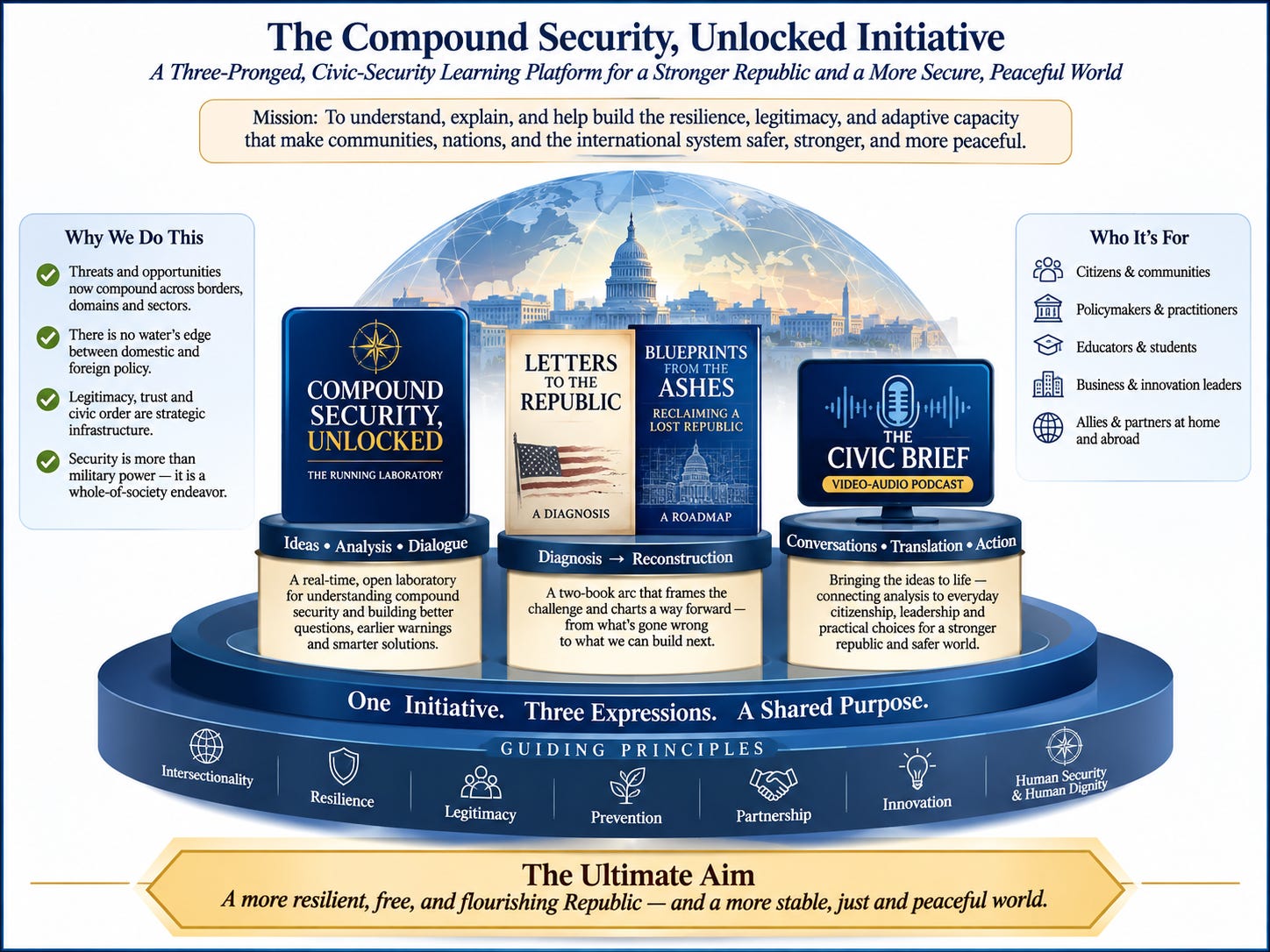
And, increasingly, a civic project.
745 Essays—and Still Learning
Seven hundred and forty-five essays in twenty-four months is, admittedly, a lot of writing.
And there are already a healthy number of pre-drafts waiting in reserve—questions not yet sufficiently answered, propositions not yet sufficiently tested, connections not yet fully made.
But I do not regard 745 primarily as a measure of production.
I regard it as a record of inquiry.
Across these first two years, we have examined war and peace, geopolitics and geoeconomics, Ukraine and Russia, China and Iran, artificial intelligence and human agency, climate and migration, maritime chokepoints and global supply chains, race and constitutionalism, civil-military relations, leadership and legitimacy, education, public health, institutional brittleness, resilience, citizenship, and the condition of the American republic.
That range was not accidental.
It was the experiment.
Compound Security, Unlocked began from the recognition that the world itself does not organize its problems according to our bureaucratic jurisdictions, academic departments, ideological preferences, organizational charts, or familiar distinctions between “foreign” and “domestic.”
Security has no water’s edge.
Economic insecurity can become political insecurity. Political insecurity can become institutional insecurity. Institutional weakness can become strategic vulnerability. Technology can strengthen human agency or accelerate its manipulation. Climate pressure can become resource pressure; resource pressure can become migration pressure; migration can become a matter of domestic politics, interstate relations, human security, and national security simultaneously.
The point has never been that “everything causes everything.”
It is that consequential things interact.
And if we fail to see those interactions early enough, we surrender choices we might otherwise have preserved.
That has been the work of this laboratory.
But two years into the experiment, I have become convinced of something else.
The experiment was always about ‘peace’.
What Kind of Peace?
Not an imaginary peace without disagreement.
Not a politics without contestation.
Not a world without competition.
Human beings disagree. Citizens contest values and interests. Nations compete for security, markets, technology, resources, influence, and status. Political communities wrestle continuously over questions of authority, identity, justice, obligation, rights, and belonging.
Trying to abolish those disagreements does not produce peace.
More often, it produces domination.
The peace that interests me—and that increasingly organizes the work of Compound Security, Unlocked—is therefore what I call relative peace:
… the political and social condition in which our inevitable disagreements remain sufficiently governable that persuasion, bargaining, legitimate competition, accommodation, correction, and institutional adaptation remain preferable to escalating coercion and organized violence.
That is not passive peace.
It must be made.
Maintained.
Repaired.
And sometimes recovered.
That makes peace a strategic achievement.
And it makes the institutions, habits, relationships, norms, infrastructure, legitimacy, trust, resilience, and human judgment that sustain it matters of security in the fullest meaning of that word.
This Community of ‘Ours’
Which brings me to the most important part of this anniversary message.
Thank you.
To every person who has subscribed: thank you.
To those who read regularly, and those who drop in when a particular subject catches your attention: thank you.
To those who forward an essay to a colleague, student, friend, family member, commander, policymaker, professor, CEO, teacher, diplomat, technologist, or neighbor: thank you.
To those who agree with me—and to those who most certainly do not—thank you.
Some of the most useful moments in this experiment have come when a reader has challenged an assumption, introduced evidence I had not considered, carried an argument into another professional community, or simply caused me to reconsider something I thought I understood.
That is what a learning laboratory is supposed to do.
It is why I have never wanted this space to become a doctrinal pulpit.
I am especially grateful to those of you who have pledged financial support to Compound Security, Unlocked.
I want to say something quite specific about those pledges.
I don’t regard them simply as prospective subscriptions or financial transactions.
I regard every pledge as an investment of trust.
Trust in the value of this work.
Trust in the seriousness of the inquiry.
Trust that independent, sustained, non-performative thinking about security, citizenship, leadership, institutions, war, and peace remains worthwhile.
And, inevitably, trust in me as a steward of that work.
I do not take that trust lightly.
Nor do I regard it as something permanently earned.
Trust and fidelity require renewal.
They must be demonstrated again in the next essay, the next argument, the next correction, the next difficult question—and in the willingness to say I was wrong when evidence requires it.
So, to everyone who has pledged support: thank you for that investment of confidence.
I remain committed to re-earning it every day.
That is part of the civic obligation I believe accompanies this work.
A State of the Substack
Attached to this anniversary essay is something considerably longer.
I have titled it:
“The Experiment Was Always About Peace: What Two Years in the “Compound Security, Unlocked Learning Lab” Taught Me About Security, Republican Government, and the Possibilities—and Limits—of Keeping a Relative Peace.”
Think of it as something between an annual report, an intellectual ledger, and a State of the Substack address to this community of ours.
It looks backward—but mainly so that we can look forward more intelligently.
It asks what these first twenty-four months have actually taught us.
Which propositions have become stronger?
Which require qualification?
Where has the Compound Security framework proved useful?
Where must it still be tested?
What have we learned about resilience, legitimacy, republican government, institutions, interdependence, technology, competition, prevention—and peace?
And, most importantly:
What should we do with what we have learned?
I hope you will read it.
But I hope you will do something more than read it.
Mark it up. Challenge it. Question it. Extend it.
Tell me where you think the argument holds.
Tell me where you believe it breaks.
Tell me what the laboratory has missed.
Bring evidence from your own profession, community, country, classroom, command, company, household, or lived experience.
I would like the anniversary essay to become the beginning of a running commentary—a conversation on and around the findings, propositions, uncertainties, and questions contained within it.
Because Year Three should not simply be another year of publishing.
It should be another stage of the experiment.
From Seeing the System to Strengthening It
The first two years have been largely about “learning to see.”
Seeing connections.
Seeing convergence.
Seeing vulnerabilities hidden inside efficiencies.
Seeing how foreign and domestic security increasingly bleed into one another.
Seeing how policies intended to solve one problem can unintentionally metastasize another.
Seeing legitimacy and trust not as soft variables but as essential infrastructure.
Seeing citizens, communities, businesses, universities, cities, families, allies, institutions, and governments as participants in a shared security ecosystem.
Year Three needs to push us further.
From diagnosis toward treatment.
From identifying compound threats toward discovering compound security dividends.
From describing brittleness toward building resilience.
From reacting more effectively to crises toward becoming better at preventing the conditions that produce them.
From asking only how we deter wars toward asking how we deliberately construct the conditions that make war less necessary.
And from thinking about security as something governments provide to people toward understanding security as something legitimate political communities co-produce.
That is harder work.
Good.
A learning laboratory should become more demanding as it learns.
Everything Is Connected. That Does Not Mean Everything Must Be Fragile.
Perhaps the most important finding of these first twenty-four months can be expressed simply:
Everything is connected—but “connected” does not have to mean fragile.
Interdependence can transmit shocks.
It can transmit fear.
It can transmit coercion, misinformation, financial disruption, disease, conflict, and cascading failure.
But interdependence—properly understood, diversified, governed, reinforced, and sustained—can also transmit resilience.
Knowledge.
Trust.
Warning.
Adaptation.
Mutual assistance.
Opportunity.
And peace.
That’s the possibility I want Year Three to investigate much more deliberately.
So, as Compound Security, Unlocked crosses this threshold—twenty-four months behind us, 745 published essays now entered into the ledger, more already waiting in draft, and an extraordinary amount still left to learn—I want to return to where this experiment began.
Not with certainty.
With a question.
Actually, with our next question:
How do we make the systems upon which our security depends stronger—together—and make peace not simply what remains when violence stops, but the strategic condition we deliberately build before violence begins?
That was the experiment from the beginning.
Twenty-four months in, it remains the work ahead.
And if you are reading this, you are already part of it.
Welcome to Year Three.
And, sincerely—
thank you for helping make this learning laboratory ours.
—Ike.

If you value this work, here are three ways you can step into the story with us:
📰 Subscriber (Free)
Stay informed. Receive every new essay, briefing, and analysis straight to your inbox. Join a growing community committed to civic resilience and national security.
🎧 Supporter (Paid Pledge)
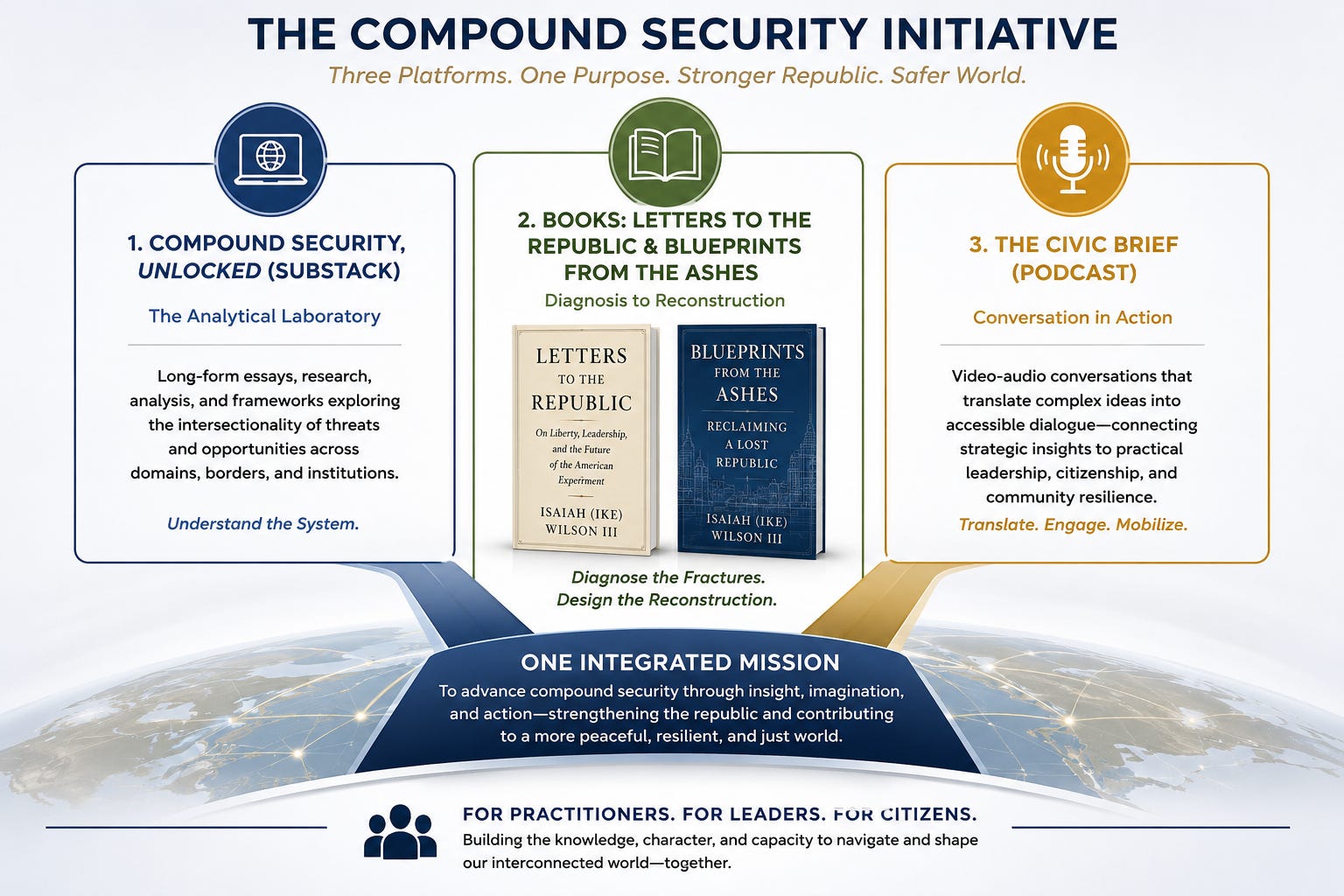
Strengthen the signal. Your support sustains both Compound Security, Unlocked and our companion podcast The Civic Brief. Supporters ensure these conversations remain accessible to the wider public while elevating the quality, depth, and reach of the work.
🛡️ Sustainer (Patron Level)
Invest in the mission. Sustainers fuel new research, convenings, and storytelling that enlarge the civic frame of security. This is more than content — it’s a civic project. Your sponsorship helps preserve an independent voice committed to equipping citizens, leaders, and institutions for the compound challenges ahead.
Where is your list?
https://substack.com/home/post/p-165058158