
Continuing Clausewitz...
On War, Legitimacy, and the Unfinished Project of Strategy.

“Theory becomes infinitely more difficult as soon as it touches the realm of politics.”
— Carl von Clausewitz
“The dead theorists are never truly dead. The best of them leave behind unfinished conversations.”
— Adapted from Theodore J. Lowi
Introduction: The Long Shadow of a Prussian
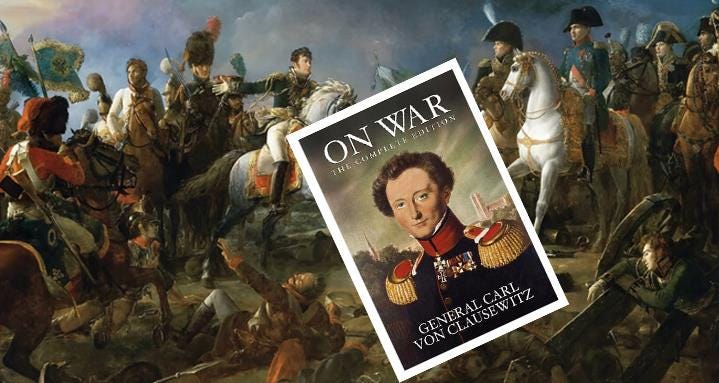
If there is a single intellectual figure whose shadow stretches across nearly everything I have written over the past four decades, it is Carl von Clausewitz.
That statement may seem odd to those who know my work primarily through American Political Development, compound security, futures studies, civil-military relations, legitimacy, governance, institutional resilience, or the future of American democracy. After all, Clausewitz is conventionally understood as a military theorist. A strategist. A student of battle and campaigns.
Yet the older I become and the more I study war, politics, institutions, and societies, the more convinced I am that Clausewitz was never principally interested in war itself.
He was interested in politics.
War was simply the doorway through which he entered the larger question.
The tragedy of modern strategic thought is that generations of readers entered the doorway and never bothered to explore the house.
For much of the twentieth century, particularly within the American military profession, Clausewitz was reduced into a theorist of force. Centers of gravity. Decisive engagements. Campaign design. Escalation. Operational art.
Useful concepts all.
Yet they are merely fragments.
The Clausewitz I encounter in the pages of On War is not primarily a theorist of military victory. He is a theorist of political purpose, institutional coherence, social mobilization, and the uncertain relationship between power and outcomes.
That distinction matters.
It may be the distinction that defines the strategic challenges of our century.
The Great Misreading
The most famous line in strategic studies is perhaps the most misunderstood:
“War is merely the continuation of politics by other means.”
For generations, this phrase has been interpreted as a justification for military force.
It is precisely the opposite.
Clausewitz was not elevating war.
He was subordinating war.
The political object remained supreme.
Military action derived its meaning from political purpose.
The battlefield existed to serve the political community.
Not the reverse.
This seemingly simple observation contains a devastating implication.
A military victory that fails politically is not a victory.
A campaign that destroys an enemy army but produces an ungovernable aftermath has failed.
A state can win every battle and lose the war.
History repeatedly demonstrates this truth.
Napoleon discovered it in Spain.
The United States discovered it in Vietnam.
Again in Iraq.
Again in Afghanistan.
Again and again we mastered the grammar of war while neglecting the logic of war.
Clausewitz warned us.
We simply preferred not to listen.
The American Problem: Superpower or Superforce?
For much of my professional life I have wrestled with a recurring puzzle.
How can a nation so extraordinarily successful in the application of force prove so uneven in the achievement of political outcomes?
The answer eventually emerged through what I later described as the distinction between a superpower and a superforce.
A superpower converts force into durable political outcomes.
A superforce converts resources into extraordinary military capability as an end in and of itself.
These are not the same thing.
Indeed, they may be increasingly different things.
America possesses unmatched military capacity.
Yet over the past half-century it has repeatedly struggled to translate battlefield dominance into sustainable political settlements.
The paradox is not that America lacks power.
The paradox is that America often confuses force with power.
Clausewitz would have recognized the problem immediately.
Force is an instrument.
Power is an outcome.
The two are related.
They are not identical.
Legitimacy: The Missing Strategic Variable
The older I become, the more convinced I am that the central strategic resource of the twenty-first century is neither territory nor industrial capacity nor even military force.
It is legitimacy.
Legitimacy is what transforms authority into compliance.
Compliance into cooperation.
Cooperation into resilience.
Resilience into power.
When legitimacy erodes, institutions become brittle.
States become fragile.
Allies become uncertain.
Citizens become detached.
Strategic capacity begins to decay long before military capability visibly declines.
This realization early on became a cornerstone of my own work on compound security.
It is also where I believe Clausewitz was headed before his death.
Not because he used the term ‘legitimacy’ in modern political-science language.
But because the entire architecture of his thought points in that direction.
The remarkable insight of the Clausewitzian Trinity is not military.
It is political.
Government.
Military.
People.
Not separate entities.
A dynamic system.
A living ecology.
Each dependent upon the others.
When the relationships among them deteriorate, strategic power deteriorates.
Regardless of how many divisions remain in the field.
Beyond Clausewitz: The Age of Compound Security
Yet if Clausewitz remains indispensable, he is no longer sufficient.
The world he inhabited has disappeared.
The nineteenth century was organized around states, armies, and industrial power.
The twenty-first century is organized around networks, infrastructures, information systems, financial architectures, supply chains, digital ecosystems, and transnational dependencies.
War remains.
Politics remains.
Human nature remains.
But the systems through which they operate have transformed.
This realization led me toward what I have termed the General Theory of Compound Security.
Security is not merely the absence of threat.
Security is ‘the performance of systems under stress’.
The central questions become:
How adaptive is a society?
How resilient are its institutions?
How quickly can it learn?
How effectively can it absorb shocks?
How legitimate are its governing arrangements?
How rapidly can it translate information into adaptation?
These are strategic questions.
Indeed, they may be the defining strategic questions of our era.
Clausewitz glimpsed portions of this reality.
He understood friction.
Chance.
Complexity.
Human uncertainty.
But he lacked the conceptual vocabulary available to us today.
His world was only beginning to experience industrialization.
He could not fully anticipate the interconnected systems that now define modern civilization.
Our task is therefore not to discard Clausewitz.
It is to extend him.
The ‘Day After Next’
Perhaps the most important lesson I have drawn from Clausewitz concerns a question that rarely appears in military planning.
What happens next?
Not tomorrow.
Not the day after.
The day after next.
The aftermath.
The inheritance.
The political condition produced by military success.
Again and again, strategists focus on defeating enemies.
Far fewer focus on governing consequences.
This failure haunted Iraq.
Afghanistan.
Libya.
And increasingly shapes contemporary discussions about Iran, Taiwan, Ukraine, and even domestic American politics.
Victory itself is never the end state.
Victory merely creates a new beginning.
The true measure of strategy lies not in what is destroyed.
It lies in what emerges afterward.
This may be where my own work diverges most significantly from conventional Clausewitzian thought.
Or perhaps it is where I have simply followed one of Clausewitz’s unfinished pathways further than most.
The Clausewitz Who Never Finished His Book
Historians have long noted that near the end of his life Clausewitz expressed dissatisfaction with portions of On War.
He intended substantial revisions.
Then he died.
His beloved wife Marie preserved and published the manuscript.
For that we remain profoundly grateful.
Yet one cannot help but wonder….
What was he planning to change?
What would a completed Clausewitz have looked like?
Would he have moved even further away from battle and toward politics?
Further away from campaigns and toward societies?
Further away from military operations and toward legitimacy, governance, and statecraft?
We cannot know.
But I suspect the trajectory of his thought points in that direction.
The later Clausewitz appears increasingly interested in war as a social and political phenomenon rather than merely a military one.
If so, the most faithful reading of Clausewitz may not be the one that freezes him in 1832.
It may be the one that continues the intellectual journey he never finished.
Conclusion: Continuing the Conversation
I have spent much of my professional life wrestling with questions of war, power, governance, legitimacy, resilience, and national purpose.
Along the way I have discovered that nearly every path eventually leads back to Clausewitz.
Not because he possessed all the answers.
But because he asked the right questions.
The enduring value of Clausewitz lies not in specific prescriptions.
It lies in his insistence that force, politics, society, and uncertainty cannot be separated.
His genius was recognizing their interconnectedness.
Our challenge today is to recognize that the same interconnectedness now extends across institutions, economies, information systems, infrastructures, and legitimacy itself.
The task before modern strategists is therefore not to worship Clausewitz.
Nor to abandon him.
It is to … continue him.
To treat On War not as a finished doctrine but as an unfinished project.
A conversation interrupted by death.
A manuscript awaiting further chapters.
And perhaps, in our own small way, an invitation to write them.
If you value this work, here are three ways you can step into the story with us:
📰 Subscriber (Free)
Stay informed. Receive every new essay, briefing, and analysis straight to your inbox. Join a growing community committed to civic resilience and national security.
🎧 Supporter (Paid Pledge)
Strengthen the signal. Your support sustains both Compound Security, Unlocked and our companion podcast The Civic Brief. Supporters ensure these conversations remain accessible to the wider public while elevating the quality, depth, and reach of the work.
🛡️ Sustainer (Patron Level)
Invest in the mission. Sustainers fuel new research, convenings, and storytelling that enlarge the civic frame of security. This is more than content — it’s a civic project. Your sponsorship helps preserve an independent voice committed to equipping citizens, leaders, and institutions for the compound challenges ahead.