
Beyond Transactionalism ...
Toward a "Relational Geopolitics."

By Dr. Isaiah “Ike” Wilson III
Founder, Wilson W.i.S.E. Consulting | Strategist of Civic Resilience & Compound Security

The Return of the Dealmakers
Across capitals and crisis zones, diplomacy has become a marketplace.
Alliances are framed as cost-benefit calculations.
International institutions are dismissed as bureaucratic overhead.
States bargain not as partners, but as competitors trading concessions.
This is the age of transactional geopolitics—a worldview that sees the international system as a series of temporary exchanges rather than an evolving web of relationships.
Transactionalism, in its pure form, is the geopolitics of the spreadsheet. It assumes that order can be engineered through leverage, not legitimacy; that coercion, rather than connection, produces compliance.
From the United States’ “America First” retrenchment to China’s “dual circulation” strategy and Russia’s coercive energy diplomacy, the transactional impulse has gone global.
But what if the problem is not simply who makes the deals, but how the world has come to think in deals at all?
The Logic of the Transactional Turn
Transactionalism is not new.
It echoes the 19th-century realpolitik of Bismarck and the Cold War “linkage” strategies of Kissinger.
But today’s version is stripped of strategic patience. It mistakes exchange for order, and in doing so, erodes the very trust that makes durable order possible.
At its core, transactionalism is a short-term survival strategy for an era of uncertainty.
It appeals to leaders facing domestic polarization, fragile economies, and diffused global power. “Win now, deal later” becomes both policy and posture.
Yet this mindset cannot scale beyond the immediate. It produces what Isaiah Berlin once called “the hedgehog’s illusion”—a single, self-reinforcing logic that blinds itself to system effects.
In compound global systems—where financial flows, information networks, and climate shocks intertwine—transactionalism is not just unsustainable.
It is self-defeating.
The more a state pursues leverage through unilateral deals, the more it exposes itself to systemic fragility.
The Alternative: Relational Geopolitics
The antidote to transactionalism is not naïve idealism, but relational geopolitics: a strategic worldview that values connection as a form of power and legitimacy as an instrument of influence.
Relational geopolitics begins with a simple but radical premise: that the relationships themselves—built on predictability, reciprocity, and shared legitimacy—constitute the infrastructure of global stability.
This idea draws on intellectual lineages often siloed from one another.
In constructivist theory, it reflects Alexander Wendt’s (1999) claim that “anarchy is what states make of it”—that shared identities and expectations shape systemic outcomes.
In liberal institutionalism, it echoes Robert Keohane’s (1986) insight that regimes and norms reduce uncertainty and transaction costs.
In Elinor Ostrom’s (2010) work on polycentric governance, it aligns with the notion that complex systems achieve resilience through distributed, overlapping centers of authority.
And in my own General Theory of Compound Security (GToCS), relational geopolitics represents the shift from dominance to coherence—from zero-sum balancing to adaptive legitimacy.
Comparative Framing
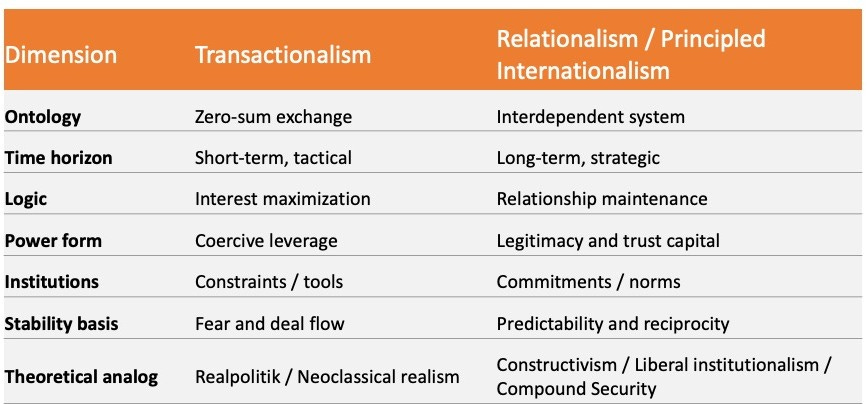
Power, Reconsidered
Transactionalism conceives of power as possession: the ability to compel others.
Relational geopolitics treats power as connection: the capacity to coordinate, to persuade, and to generate outcomes others deem legitimate.
This does not mean abandoning hard power.
It means understanding that coercive capacity without credibility is brittle.
True strategic advantage in the 21st century lies in what might be called “compound power”—the synthesis of material capability, institutional reliability, and normative appeal.
Where transactional logic rewards narrow victories, relational logic prizes system health.
In practice, this means measuring influence not by the number of deals signed, but by the resilience of the networks sustained.
Relational Statecraft in Action
Several recent examples illustrate the divergence of these logics.
During the COVID-19 pandemic, vaccine diplomacy exposed the limits of transactionalism.
States that treated vaccine access as a bargaining chip gained short-term influence but long-term mistrust.
By contrast, the European Union’s coordination with COVAX—however bureaucratic—demonstrated that legitimacy and transparency generate enduring leverage.
In the realm of digital governance, the G7’s Global Partnership on AI and the OECD’s Framework for Responsible AI exemplify relational strategies: aligning standards through dialogue and reciprocity rather than coercion or exclusion.
Even in defense, the emerging AUKUS and Quad frameworks succeed not because they are transactional pacts, but because they fuse shared capability with shared legitimacy—a polycentric deterrence network grounded in trust.
Why Transactionalism Fails in Compound Systems
The modern geopolitical landscape is not a chessboard but a living ecosystem—complex, adaptive, and deeply coupled.
Transactional statecraft, by isolating interactions into discrete bargains, fails to see the feedback loops it triggers. A tariff to protect domestic steel may weaken climate cooperation. A cyber retaliation against one actor may cascade across neutral networks.
Wilson’s General Theory of Compound Security reframes this problem: security today is not a matter of control, but of systemic integrity. The task is to manage interdependence, not deny it.
Transactionalism narrows horizons to immediate exchange; relational geopolitics expands them to compound stewardship—maintaining balance across economic, technological, and ecological domains.
The Ethics of Relationship
Relational geopolitics is not just a strategy; it is an ethic.
It assumes that legitimacy is both a moral and a strategic asset.
States that cultivate trust and transparency create “public goods” of predictability that benefit even rivals. As Hedley Bull (1977) argued, order in world politics depends less on coercion than on the shared sense that certain practices are right and proper.
This ethic does not preclude competition. It redefines it.
Great-power rivalry becomes not a race for dominance, but a contest over who can maintain the most adaptive and legitimate system.
Building the ‘Relational Republic’
For the United States, reclaiming relational geopolitics means re-centering its foreign policy around institutions, not transactions. It means treating democracy not as an export commodity, but as an ecosystem of trust that must be renewed at home and abroad.
An “America coherent” is far stronger than an “America first.”
In practical terms, this implies a dual strategy:
Reinvest in compound alliances—the connective tissue linking defense, technology, and governance.
Anchor power in legitimacy—aligning economic and digital statecraft with transparent, rules-based conduct.
This is not nostalgia for postwar multilateralism. It is a necessary adaptation for an age when power is diffuse, and stability is systemic.
Conclusion: From ‘Deals’ to ‘Design’
Transactionalism was the logic of the industrial era: centralized, extractive, and short-term.
Relational geopolitics is the logic of the compound era: distributed, integrative, and long-term.
In the end, the choice facing states is not between realism and idealism, but between two realisms: the realism of deals or the realism of systems.
The former can win battles; the latter sustains peace.
As the world confronts new compound crises—climate shocks, digital fragmentation, and renewed authoritarianism—those who understand that relationships are strategy will inherit the future.
The rest will keep making deals until the system breaks beneath them.
In geopolitical theory, the opposite of transactionalism is best described as relationalism or principled internationalism, depending on emphasis.
If you value this work, here are three ways you can step into the story with us:
📰 Subscriber (Free)
Stay informed. Receive every new essay, briefing, and analysis straight to your inbox. Join a growing community committed to civic resilience and national security.
🎧 Supporter (Paid Pledge)
Strengthen the signal. Your support sustains both Compound Security, Unlocked and our companion podcast The Civic Brief. Supporters ensure these conversations remain accessible to the wider public while elevating the quality, depth, and reach of the work.
🛡️ Sustainer (Patron Level)
Invest in the mission. Sustainers fuel new research, convenings, and storytelling that enlarge the civic frame of security. This is more than content — it’s a civic project. Your sponsorship helps preserve an independent voice committed to equipping citizens, leaders, and institutions for the compound challenges ahead.
It's interesting how precisely you've articulated this transactional turn in global politcs. The 'geopolitics of the spreadsheet' is such an insightful and unfortunately accurate observation. Truly resonates.