
Beyond Prejudice
Power, Institutions, and the Political Development of Racism in America.

“The question is not simply whether people hate. The deeper question is who possesses the power to transform private prejudice into public (dis)order.”
By Isaiah Wilson III
Epilogue As Prologue —
“The Day After Next” ….
For the better part of a year – and, truly, for 40 years of public service, I have been bearing a witness to (by ‘pen’ and ‘practice’) this “America @ 250 series” as an old soldier, a political scientist, and an American trying to make sense of the republic I inherited and the one I will leave behind.
Anniversaries invite remembrance. Fireworks encourage celebration. Speeches often reassure us that the American story is already complete.
I have never believed that.
The Fourth of July celebrated the birth of an idea.
The “Day After Next” asks whether we remain worthy of it.
That has always been the harder question.
Throughout this ‘longer series’ I’ve written about institutions, trust, constitutional development, war, citizenship, legitimacy, race, democracy, power, and the quiet erosion of civic confidence. Readers have sometimes assumed these were separate essays.
They were not.
They were chapters of the same argument.
Every one of them has been asking a single question.
Who counts?
Not merely in law.
Not merely in politics.
But in the lived experience of belonging to the American constitutional community.
This essay is therefore not the conclusion of the America @ 250 series.
It is its epilogue.
And I hope, perhaps, its prologue.
Because republics are never finished.
Neither is citizenship.
Neither is stewardship.
The fireworks are over.
The commemorations are ending.
The “Day After Next” has arrived.
Now the real work begins.
⸻
Isaiah Wilson III
July 6, 2026
Nearly every contemporary conversation about race in America eventually arrives at the same impasse.
Someone insists that racism means treating another person differently because of race.
Someone else replies that racism requires power.
The discussion quickly deteriorates into competing accusations, semantic disagreements, and ideological tribalism. Little illumination follows. Everyone leaves believing the other side has intentionally misunderstood them.
Having spent more than three decades studying and teaching American Political Development—as both scholar and practitioner—I have come to believe that both sides are often answering different questions while assuming they are debating the same one.
The first asks a moral question.
The second asks a political one.
Both matter.
But they are not identical.
That distinction changes everything.
Political scientists, particularly those working within the American Political Development tradition, rarely begin with individual attitudes. They begin with institutions. They ask how governments distribute authority, how laws create incentives, how organizations reinforce norms, how administrative systems accumulate power, and how those arrangements evolve over generations.
Governments, after all, cannot legislate emotions.
They legislate structures.
They regulate incentives.
They allocate resources.
They define citizenship.
They establish legitimacy.
They determine who enjoys protection under law and whose claims may be ignored.
That is where racism, understood politically rather than psychologically, becomes something altogether different.
The Problem with Beginning and Ending with Individual Prejudice
Few propositions are less controversial than this:
Human beings are capable of prejudice.
Every civilization has produced prejudice.
Every ethnic community has produced prejudice.
Every religion has produced prejudice.
Every race has produced prejudice.
Every political ideology has produced prejudice.
Prejudice appears to be one of humanity’s oldest adaptive failures.
It requires no particular ideology.
No special education.
No constitutional framework.
No institutional authority.
One simply decides another group is somehow inferior, dangerous, immoral, or less deserving.
History is tragically filled with such examples.
Bigotry, discrimination, stereotyping, and hatred are therefore not uniquely American problems.
They are human problems.
If racism were merely another word for prejudice, the analytical task would end here.
But it does not.
Because history demonstrates something far more consequential.
Prejudice does not become civilization-shaping merely because many individuals hold it.
It becomes civilization-shaping when institutions organize themselves around it.
That is where politics enters.
Politics Is the Organization of Power
One of Theodore Lowi’s enduring contributions to political science was his insistence that politics should be understood through institutions rather than personalities.
Policies create politics.
Institutions generate incentives.
Administrative arrangements outlive individual officeholders.
Political development is therefore not simply the story of elections.
It is the story of how authority becomes organized.
American Political Development asks different questions than ordinary political commentary.
Who governs?
How?
Through what institutions?
Toward whose benefit?
At whose expense?
Who is recognized?
Who is excluded?
Who counts?
These questions immediately transform the discussion of racism.
Because they relocate the analysis from emotion to governance.
One racist neighbor may poison a community.
One racist employer may deny opportunity.
One racist police officer may violate justice.
These acts matter profoundly.
But none of them alone reorganizes a republic.
Institutions do.
Only institutions can redefine citizenship.
Only institutions can establish voting qualifications.
Only institutions can determine housing policy.
Only institutions can organize public education.
Only institutions can decide who receives legal protection.
Only institutions can criminalize or normalize racial hierarchy.
The history of race in America is therefore not principally the history of prejudice.
It is the history of institutionalized power.
Racism as Political Architecture
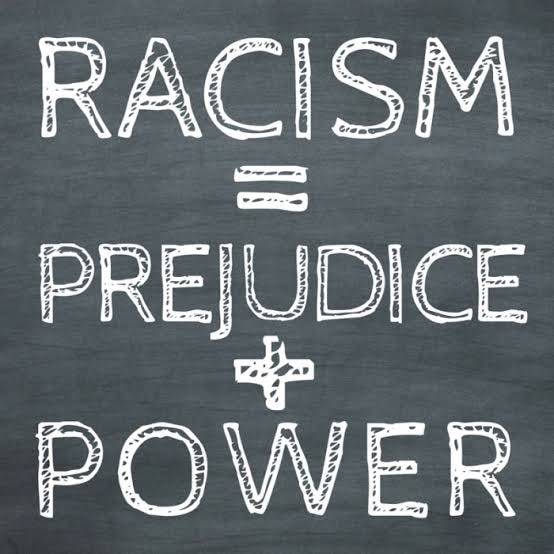
This distinction has often been summarized within sociology and critical race scholarship as “prejudice plus power.”
The phrase has become politically polarizing.
Unfortunately, both its advocates and critics frequently flatten its meaning.
Advocates sometimes wield it as a moral slogan.
Critics often dismiss it as linguistic manipulation.
Neither response is especially illuminating.
A more analytically useful formulation might be this:
Racism is prejudice that acquires institutional capacity.
That capacity may be legislative.
Administrative.
Judicial.
Economic.
Educational.
Military.
Financial.
Or cultural.
What distinguishes racism from prejudice is not simply intensity.
It is authority.
Prejudice may wound.
Institutionalized prejudice governs.
It allocates.
It excludes.
It protects.
It punishes.
It reproduces itself across generations.
That is what transforms private bias into public order.
Why Majorities Usually—but Not Always—Possess This Power
One refinement is important.
It is often argued that racism belongs exclusively to majority populations.
History does not sustain that claim.
Apartheid South Africa was maintained by a numerical minority.
European colonial administrations governed enormous indigenous populations.
Slave-owning elites frequently ruled societies in which they were vastly outnumbered.
Power does not always follow demographics.
It follows institutions.
Majorities frequently possess institutional power.
But institutional power—not numerical superiority—is the decisive variable.
The better formulation is therefore not that racism belongs to majorities.
It belongs to those capable of organizing society according to racial hierarchy.
Numbers matter.
Institutions matter more.
A Compound Systems Understanding of Racism
My work has increasingly examined security not as the absence of threats but as the adaptive performance of interconnected systems under stress.
Viewed through this lens, racism appears less as an attitude than as an emergent property.
Individual prejudice represents only one node.
Political institutions amplify or dampen it.
Economic systems reinforce or weaken it.
Educational systems normalize or challenge it.
Media ecosystems legitimize or delegitimize it.
Legal systems either constrain or reproduce it.
The resulting phenomenon becomes something no single individual intended but many institutions collectively sustain.
This is precisely how complex adaptive systems behave.
The whole becomes larger than the sum of its parts.
Racism, then, is not simply located within people.
It becomes embedded within relationships among institutions.
That distinction matters because systems are rarely transformed merely by changing hearts.
They change by altering incentives, feedback loops, accountability structures, legitimacy, and patterns of governance.
The Cost to the Republic
Perhaps the greatest mistake Americans make is believing racism is principally a moral failure.
It is certainly that.
But it is also a strategic failure.
Every society that systematically discounts portions of its own population degrades its own capacity.
Innovation declines.
Trust erodes.
Institutional legitimacy weakens.
Social resilience diminishes.
Talent is wasted.
Polarization accelerates.
National cohesion fractures.
The republic becomes progressively less adaptive.
What appears to be a racial problem gradually becomes a governance problem.
Eventually it becomes a security problem.
History repeatedly demonstrates that nations seldom collapse because they possess diversity.
They weaken because they fail to govern diversity legitimately.
America at 250
As America has now marked two hundred and fifty years since Jefferson penned the Declaration of Independence, our national debate continues to revolve around an argument we have never fully resolved.
Who belongs?
Whose rights are unconditional?
Whose citizenship is complete?
Who counts?
The genius of the American experiment has never been that it answered these questions once and for all in 1776.
It certainly did not.
The genius lay in creating institutions capable of expanding the circle of constitutional belonging over time.
That expansion has never been automatic.
It has always required struggle.
Sometimes war.
Sometimes protest.
Sometimes constitutional amendment.
Sometimes courageous acts of institutional reform.
Sometimes simply the willingness to recognize that yesterday’s political architecture no longer reflected today’s democratic promise.
The true danger facing America is therefore not disagreement over definitions.
It is forgetting that institutions—not merely individuals—shape the moral trajectory of republics.
Prejudice has always existed.
The defining question is whether a nation permits prejudice to remain a private failing or empowers it to become a public system.
That is the distinction between bias and governance.
Between hatred and hierarchy.
Between discrimination and development.
Between individual vice and institutionalized bias-by-design.
And ultimately, between a democracy that merely proclaims equality and one that continuously reconstructs itself in pursuit of it.
For two and a half centuries, America has wrestled with that unfinished work. The question before us is not whether prejudice still exists. It surely does. The question is whether our institutions continue to bend toward a more expansive constitutional community—or whether they are once again being enlisted to narrow it.
That, more than any semantic dispute over the meaning of racism, is the question worthy of a republic at 250.
If you value this work, here are three ways you can step into the story with us:
📰 Subscriber (Free)
Stay informed. Receive every new essay, briefing, and analysis straight to your inbox. Join a growing community committed to civic resilience and national security.
🎧 Supporter (Paid Pledge)
Strengthen the signal. Your support sustains both Compound Security, Unlocked and our companion podcast The Civic Brief. Supporters ensure these conversations remain accessible to the wider public while elevating the quality, depth, and reach of the work.
🛡️ Sustainer (Patron Level)
Invest in the mission. Sustainers fuel new research, convenings, and storytelling that enlarge the civic frame of security. This is more than content — it’s a civic project. Your sponsorship helps preserve an independent voice committed to equipping citizens, leaders, and institutions for the compound challenges ahead.