

When Dwight D. Eisenhower warned Americans in 1961 to guard against the “acquisition of unwarranted influence” by the military-industrial complex, he was not warning against military power itself. The former supreme allied commander understood better than almost anyone why a powerful military, an advanced industrial base and sustained scientific innovation were necessary to American security.
His concern was constitutional.
Eisenhower understood that the institutions created to protect a republic could, through their permanence, scale and accumulated influence, begin reshaping the republic they existed to defend. The military-industrial complex was therefore more than an economic relationship among the Pentagon, Congress and defense contractors. It represented the political economy through which the United States had learned to produce security in an industrial age.
Sixty-five years later, Eisenhower’s warning remains relevant.
But the system he warned about has changed.
America’s recent difficulties replenishing critical munitions offer a revealing example. After years of supplying Ukraine, conducting and supporting operations across the Middle East, and simultaneously preparing for a potential Indo-Pacific contingency, Washington has been forced to confront an uncomfortable reality: Political will and defense spending do not automatically translate into usable military capability.
Appropriating money is relatively easy. Producing Patriot interceptors, advanced missiles and other sophisticated weapons at scale is not.
The bottlenecks lie throughout a productive ecosystem involving specialized manufacturing, semiconductors, energetics, critical minerals, skilled labor, transportation, electricity, financing and globally distributed supply chains.
The problem is not simply that America needs more factories.
The factory is now part of a system.
And that distinction points toward a much larger transformation in the political economy of national security.
The United States still has a military-industrial complex. But it now exists inside something much larger: what might be called the ‘Security Production Complex’.
Understanding that change may be essential to understanding both the vulnerabilities of American power and the institutional reforms necessary to address them.
When the Arsenal Became an Ecosystem
For much of the 20th century, the production of military power possessed a reassuring physicality.
The “Arsenal of Democracy” was Detroit, Pittsburgh and Newport News. It was aircraft factories, shipyards, steel mills, machine shops, railroads and the millions of workers who transformed raw materials into military capability.
World War II demonstrated that factories could be as strategically consequential as armies. Production became an instrument of grand strategy.
The postwar national security system reflected that experience. Congress appropriated. Industry manufactured. Universities and laboratories conducted research. The military integrated those outputs into operational capability.
This was the political economy Eisenhower understood—and feared might acquire excessive influence over democratic government.
But the arsenal subsequently changed.
The Cold War ended. Defense production consolidated. Global supply chains expanded in pursuit of efficiency. The internet dissolved distinctions between commercial and military information infrastructure. Venture capital became increasingly important to technological innovation. Software became infrastructure. Commercial markets began developing capabilities once produced largely within government laboratories.
Then artificial intelligence, cloud computing and advanced semiconductors accelerated the transformation.
Today, an advanced semiconductor embodies the performance of an extraordinary network: universities educating engineers, companies designing chips, highly specialized firms manufacturing lithography equipment, miners extracting critical materials, chemical producers refining them, utilities supplying reliable electricity, water systems supporting fabrication, logistics firms coordinating transportation and governments protecting intellectual property and international trade.
No single institution controls that process.
Yet failure at a sufficiently important node can compromise the whole.
Artificial intelligence is even more revealing. What appears on a computer screen as software rests upon hyperscale data centers, semiconductor fabrication, cloud architecture, electrical generation, transmission infrastructure, cooling systems, optical networking, specialized engineering talent, enormous amounts of private capital and local political decisions about land, water and electricity.
The arsenal has not disappeared. It has dissolved into relationships. That is the defining characteristic of the Security Production Complex.
The military-industrial complex principally produced military capabilities. The Security Production Complex produces the conditions under which a society can continuously generate and regenerate security.
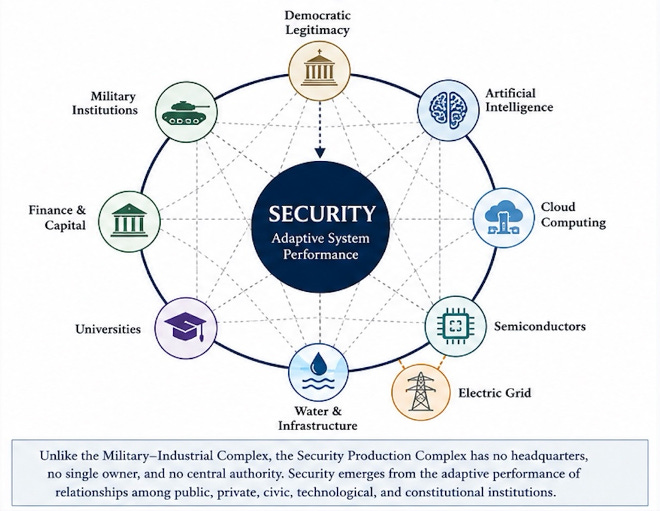
That includes weapons. But it also includes electricity, computing capacity, scientific knowledge, industrial resilience, financial depth, logistical capacity, human capital, trusted institutions and the political legitimacy necessary to mobilize all of them when circumstances demand it.
Security has become an ecosystem.
The New Commanding Heights
This transformation also changes the geography of national power.
Strategists have traditionally thought geographically. Alfred Thayer Mahan taught generations to think about maritime power and strategic waterways. Halford Mackinder emphasized the Eurasian heartland. Nicholas Spykman focused attention on the rimland. Cold War strategists mapped alliances, nuclear forces, buffer states and chokepoints.
Those geographies still matter.
But another strategic geography increasingly lies beneath them.
Its commanding heights are semiconductor foundries, electrical transmission corridors, cloud-computing regions, AI training clusters, undersea cable landing points, rare-earth processing facilities, logistics hubs, satellite constellations, financial clearing systems, universities and scientific research networks.
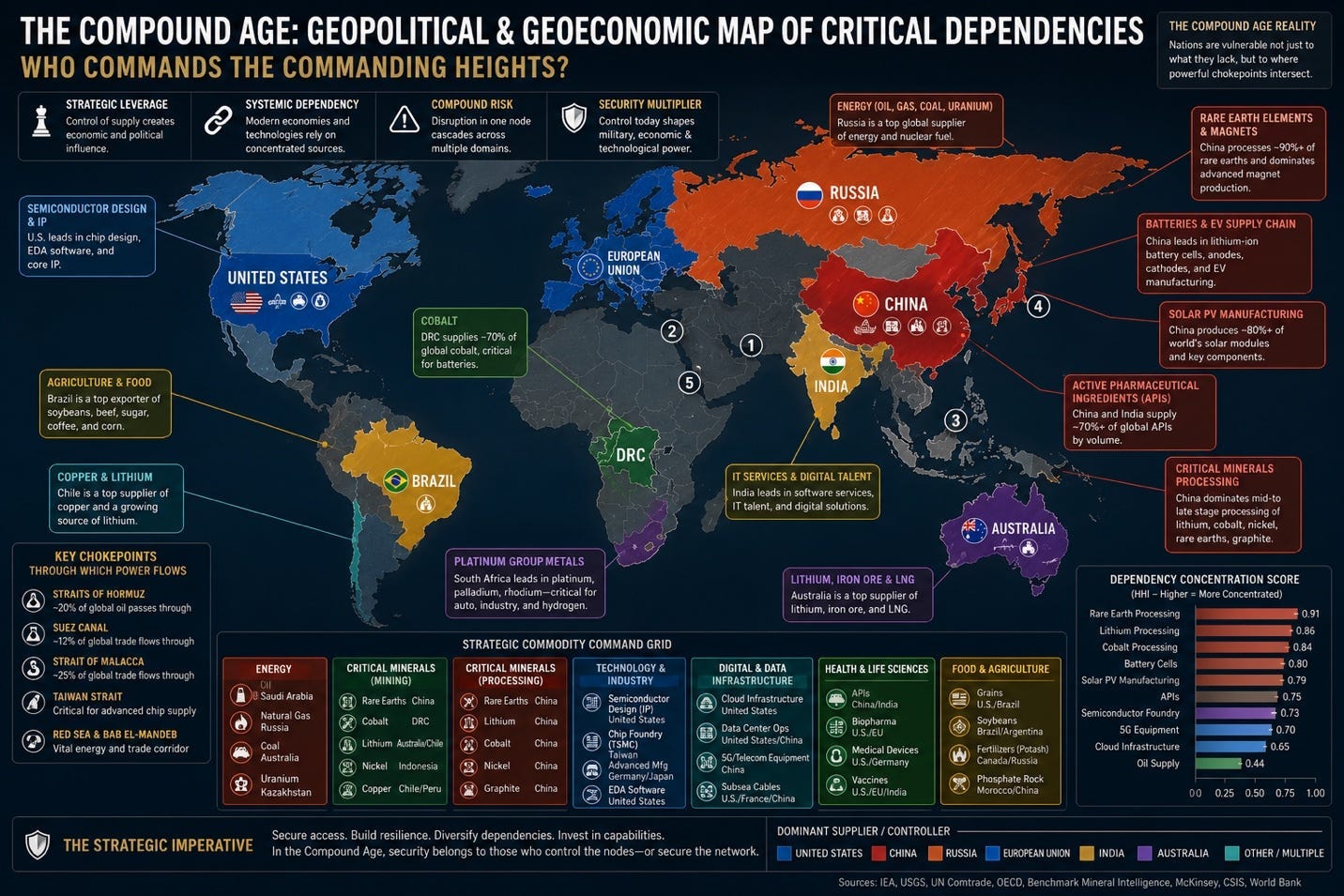
What matters in this geography is not simply where something is located, but how indispensable it is to everything connected to it.
The strategic map is becoming less purely territorial and increasingly topological.
This helps explain why interdependence, long understood primarily as an economic virtue, increasingly appears as a source of strategic vulnerability.
The logic is straightforward:
Interdependence creates leverage. Efficiency creates dependency. Dependency creates opportunities for coercion.
Russia demonstrated this with energy. China’s position in critical-mineral processing and manufacturing has generated substantial strategic leverage. The COVID-19 pandemic exposed vulnerabilities embedded within globally optimized supply chains. Semiconductor shortages disrupted industries far removed from chip fabrication. Attacks on Red Sea shipping imposed costs thousands of miles from the fighting. Export controls on advanced semiconductors have become instruments of geopolitical competition.
The commodity itself is often less important than the dependency chain surrounding it.
Lithium deposits mean relatively little without refining capacity. Advanced chip designs accomplish little without fabrication. Fabrication requires lithography equipment, chemicals, electricity, water and engineering talent. Artificial intelligence requires not simply algorithms but chips, data centers, electrical power, cooling, fiber networks and capital.
This is why apparently mundane domestic policy disputes increasingly carry geopolitical consequences.
Consider the hyperscale data center.
A county commission considering one may believe it is deciding a local zoning issue. Residents understandably worry about water, electricity, traffic, noise, land use and property values. Utilities worry about generation and transmission. Technology firms negotiate tax incentives. Environmental groups question sustainability.
None of this initially looks like national security policy. Yet, increasingly, all of it is.
A data center is simultaneously a commercial investment, an energy consumer, an industrial facility, a node of computational infrastructure and potentially part of the productive foundation for future military and economic power.
Planning commissions are not becoming branches of the Pentagon.
But national security is becoming locally produced.
And that creates a problem for democratic governance.
The Constitutional Gap
America’s governing institutions remain organized principally around jurisdictions.
Defense is defense. Energy is energy. Education is education. Commerce is commerce. Environmental policy is environmental policy.
The systems generating national power increasingly recognize no such boundaries.
Electricity is now technology policy because computation requires enormous power. Technology is industrial policy because semiconductors and AI increasingly determine productivity. Industrial policy is national security policy because military capabilities depend upon commercial innovation. Education is security policy because scientific talent has become strategic capital. Water policy can become AI policy when cooling requirements constrain data-center construction.
Even public trust matters strategically. Governments incapable of generating legitimacy cannot easily sustain infrastructure investment, mobilize resources or maintain political support during prolonged crises.
The underlying system has become integrated.
Governance remains fragmented.
This creates what may be the central constitutional problem of the Security Production Complex: Responsibility remains concentrated while productive authority has become dispersed.
Americans hold presidents and Congress responsible for national security, economic resilience and technological competitiveness. Yet neither possesses direct authority over many of the systems producing those outcomes.
Congress can appropriate money for defense but cannot simply order a semiconductor ecosystem into existence. The Pentagon can purchase AI capabilities but cannot manufacture the scientists who create them. Presidents cannot command electrical grids, venture capital, universities, local permitting authorities, cloud providers and private supply chains as though they were components of a military hierarchy.
The constitutional map of authority no longer corresponds neatly to the productive map of security.
The obvious temptation is centralization. It would also be a mistake.
Recognizing that universities, technology companies, utilities, financial institutions and local governments possess strategic importance does not mean converting them into instruments of a national security state.
That would sacrifice precisely the qualities that make democratic systems productive.
Universities generate knowledge partly because intellectual inquiry remains relatively free. Markets innovate because entrepreneurs can experiment. Federalism allows different jurisdictions to try different solutions. Independent journalism exposes institutional failure. Courts create predictable rules. Civil society generates social trust. Competitive politics allows failing policies—and occasionally failing leaders—to be replaced.
These are not merely liberal democratic values.
In a period defined by rapid technological and geopolitical change, they are strategic assets.
The democratic advantage is not command.
It is adaptation.
From Management to Orchestration
This suggests that the familiar argument over whether America needs “more government” or “less government” misses the central issue.
The more important question is what government must become capable of doing.
Markets remain extraordinarily effective mechanisms for innovation and resource allocation. But markets optimized for efficiency do not automatically produce resilience. Redundancy looks wasteful until disruption occurs. Spare production capacity appears inefficient until demand suddenly surges. Diverse suppliers cost more than a single optimized source—until that source disappears.
Government, meanwhile, cannot centrally administer an ecosystem this complex without destroying much of the autonomy that makes it adaptive.
The task is therefore neither laissez-faire nor command-and-control.
It is orchestration.
Management assumes hierarchy. Orchestration assumes institutional plurality.
A government capable of operating in the Security Production Complex must become better at identifying critical dependencies, aligning incentives, convening independent actors, encouraging redundancy where systemic risk warrants it, investing in foundational infrastructure and creating mechanisms through which institutions can share information and adapt before crises occur.
That means thinking about industrial policy and defense policy together without making every factory a defense contractor.
It means treating grid modernization as strategic infrastructure without militarizing energy policy. It means investing in universities as sources of national scientific capacity while protecting their intellectual independence. It means recognizing that allied supply chains are not simply vulnerabilities but potential sources of distributed resilience. And it means treating civic legitimacy not as a public-relations concern but as infrastructure upon which collective action depends.
The objective should not be a larger national security state.
It should be a more constitutionally intelligent state.
Such a state coordinates rather than simply commands. It convenes as well as regulates. It invests rather than merely subsidizes. It measures resilience alongside efficiency. And above all, it learns.
The Democratic Advantage
This matters particularly in the intensifying competition between the United States and China.
Authoritarian systems often appear to possess an inherent advantage in mobilizing national resources. Centralized governments can direct investment, subsidize strategic industries and coordinate infrastructure at speeds that pluralistic democracies struggle to match.
Trying to imitate that model would misunderstand the source of democratic strength. Open societies possess something centralized systems have historically struggled to reproduce at comparable scale: distributed intelligence.
Scientists discover independently. Entrepreneurs experiment. Markets test ideas. Journalists uncover failures. Universities challenge orthodoxies. Courts constrain arbitrary action. States and municipalities experiment with policy. Elections create mechanisms—however imperfect—for political correction.
The apparent messiness of democracy can therefore become a mechanism of adaptation.
That may prove increasingly consequential because the central strategic competition of the 21st century will not simply be about which country possesses the largest military, the most advanced AI model or the greatest industrial output.
It may ultimately be about which political system learns faster.
Which society recognizes dependencies before they become vulnerabilities? Which political economy can reorganize after disruption? Which institutions can absorb failure without systemic collapse? Which society can integrate technological innovation, economic dynamism, military capability and political legitimacy without destroying the freedoms that generate those advantages in the first place?
Those are questions of national security. They are also questions of constitutional government.
Beyond Eisenhower
Eisenhower never intended to solve the strategic problems of the 21st century. He taught future generations how to recognize them. His warning was ultimately about the relationship between organized power and constitutional government. Institutions created to protect a republic can accumulate influence faster than constitutional arrangements adapt to govern them.
That problem has not disappeared. It has expanded.
The Military-Industrial Complex remains real. But it now operates within a far larger Security Production Complex encompassing military institutions, industry, artificial intelligence, cloud computing, semiconductors, electricity, water, logistics, universities, finance, critical minerals, infrastructure and democratic legitimacy.
These systems cannot be governed effectively through the institutional categories inherited from the industrial age. Nor should they be centralized into some new super-ministry of national power.
The task is subtler and considerably harder: to cultivate adaptive resilience across institutions that must cooperate strategically while remaining constitutionally autonomous.
That requires a different conception of security itself.
Security is not simply the accumulation of capabilities. It is the sustained performance of interconnected systems under compound stress.
Power, viewed this way, becomes less a possession than a capacity—the ability of a society to continuously reproduce the technological, economic, military, institutional and civic foundations upon which its freedom of action depends.
And that returns us to Eisenhower.
The challenge he identified was never merely how to constrain military power. It was how a free society could govern the institutions producing its security without allowing those institutions to overwhelm the constitutional order they existed to defend.
Our generation has inherited the same question in a different form.
We must build resilient grids, expand industrial capacity, secure critical supply chains, produce more munitions, sustain scientific leadership and compete successfully in artificial intelligence. But we must do so without converting universities into government laboratories, markets into instruments of command, local governments into national-security agencies or citizens into subjects of permanent mobilization. Your longer manuscript explicitly makes this caution central: recognizing the strategic importance of civic and commercial institutions must not become an excuse for subordinating them to the state.
That balance may become one of the defining tests of democratic statecraft.
The great strategic advantage of constitutional democracy has never been that it commands society more efficiently than authoritarian competitors.
It is that, at its best, it learns, adapts and self-corrects without surrendering liberty in the process.
Eisenhower taught Americans to guard the institutions through which security was produced.
The task now is larger.
We must learn how to govern the system through which security itself has come to be produced—without destroying the freedom that makes that system worth securing.

If you value this work, here are three ways you can step into the story with us:
📰 Subscriber (Free)
Stay informed. Receive every new essay, briefing, and analysis straight to your inbox. Join a growing community committed to civic resilience and national security.
🎧 Supporter (Paid Pledge)
Strengthen the signal. Your support sustains both Compound Security, Unlocked and our companion podcast The Civic Brief. Supporters ensure these conversations remain accessible to the wider public while elevating the quality, depth, and reach of the work.
🛡️ Sustainer (Patron Level)
Invest in the mission. Sustainers fuel new research, convenings, and storytelling that enlarge the civic frame of security. This is more than content — it’s a civic project. Your sponsorship helps preserve an independent voice committed to equipping citizens, leaders, and institutions for the compound challenges ahead.
Every two-bit, banana-republic, Qaddafi-wannabe dictator knows Rule #1: the greatest threat to any country isn't always the foreign army at its borders—it’s the army inside its own borders. Give the military enough power to defend the state, and you’d better make sure it never decides it owns the state. The U.S. defense budget is strangling the life out of America like a giant anaconda wrapped around its prey—tightening its grip year after year until there’s barely any oxygen left for everything else the country needs.