
Beyond Defense: Commercial Deterrence and the Strategic Art of Shaping Decisions
Why the Most Successful Companies Win Before They Ever Have to Fight.

“The greatest victory is that which requires no battle.” — Sun Tzu
I. The Great Misunderstanding
For nearly a century, deterrence has been treated as a uniquely military concept.
Nations deter invasions.
Armies deter aggression.
Nuclear weapons deter war.
Business, meanwhile, is said to compete.
The distinction appears obvious. It is also profoundly mistaken.
At its core, deterrence has never been about bombs, missiles, or armies. Those are merely instruments. The true object of deterrence is something far more fundamental: human decision-making.
Every strategy of deterrence seeks to influence another actor’s calculus before action is taken. It alters perceptions of cost, benefit, risk, opportunity, legitimacy, credibility, and uncertainty so that another party voluntarily chooses a different course of action.
Viewed this way, deterrence is not a military doctrine.
It is a universal strategic phenomenon.
Once this broader understanding is recognized, the boundaries between national security, commerce, politics, public policy, and organizational leadership begin to dissolve. They become different expressions of the same underlying systems dynamic: shaping decisions before they become actions.
II. Deterrence Is Decision Architecture
Traditional military doctrine often defines deterrence as convincing an adversary that the costs of aggression outweigh the benefits.
This definition is correct.
It is also incomplete.
The deeper principle is that deterrence shapes how another actor perceives reality.
Every decision-maker continuously evaluates questions such as:
Can I succeed?
What will it cost?
How certain is success?
What alternatives exist?
What happens afterward?
What risks am I overlooking?
Deterrence modifies these answers.
Military strategists accomplish this through visible capability, credible commitment, alliances, resilience, and demonstrated resolve.
Businesses accomplish precisely the same thing—although they rarely describe it this way.
III. The Marketplace Is a Decision Ecosystem
Markets are frequently portrayed as arenas of competition.
They are better understood as ecosystems of continuous decision-making.
Customers choose.
Employees choose.
Investors choose.
Partners choose.
Suppliers choose.
Regulators choose.
Competitors choose.
Every strategic advantage ultimately emerges from influencing these countless independent decisions.
This is deterrence.
Not coercion.
Not manipulation.
Not force.
Decision shaping.
The most successful organizations are not those that simply outperform competitors after a contest begins.
They are those that continually shape conditions so that many competitive contests never occur in the first place.
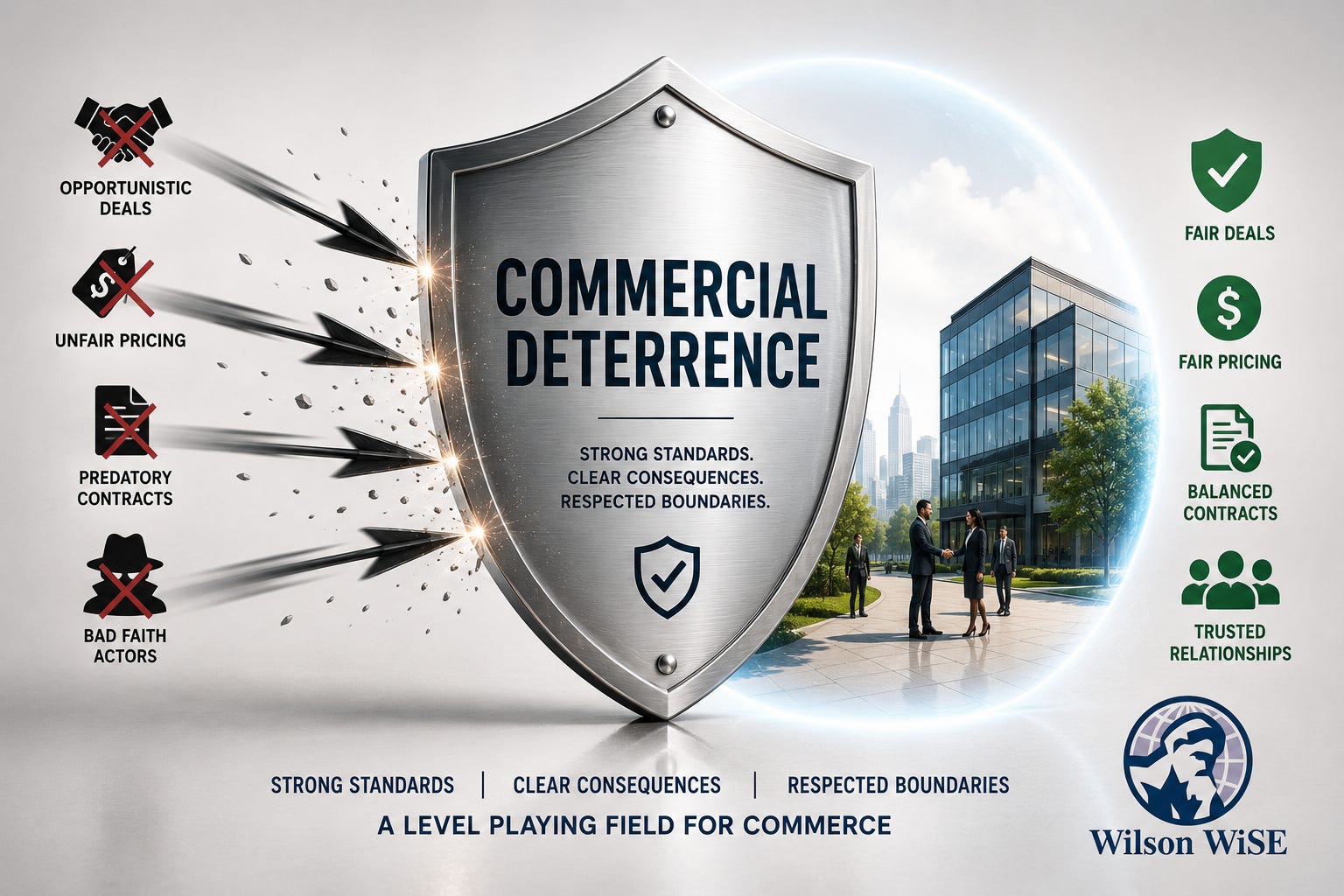
IV. Commercial Deterrence
I therefore propose the following definition:
Commercial Deterrence is the intentional shaping of a market ecosystem so that stakeholders consistently choose behaviors that reinforce rather than undermine an organization’s long-term strategic position.
Notice what this definition excludes.
It says nothing about punishment.
Nothing about threats.
Nothing about fear.
Instead, deterrence becomes an exercise in strategic design.
The objective is not defeating competitors.
The objective is influencing the entire ecosystem’s decision calculus.
V. The Seven Pillars of Commercial Deterrence
Just as military deterrence rests upon multiple reinforcing elements, commercial deterrence emerges from several mutually reinforcing sources.
Capability
Can the organization consistently deliver superior value?
Credibility
Will customers believe future promises?
Reputation
Does past performance reduce uncertainty?
Resilience
Can the enterprise absorb shocks while competitors struggle?
Innovation
Will competitors quickly become obsolete if they imitate today’s offerings?
Relationships
Do partners become stronger by remaining inside the ecosystem than outside it?
Adaptability
Can the organization continuously reshape itself faster than external conditions change?
These are not simply business strengths.
Together they alter everyone else’s decision-making.
VI. Deterrence Without Threats
Perhaps the most important insight is this:
The strongest deterrence often contains no explicit threat whatsoever.
Apple rarely threatens competitors.
Amazon seldom threatens retailers.
Costco does not threaten grocery stores.
Their existence changes calculations.
Customers choose differently.
Suppliers negotiate differently.
Investors allocate capital differently.
Competitors innovate differently.
The market reorganizes itself.
This is deterrence operating through system effects rather than coercion.
VII. From Competitive Advantage to Competitive Influence
Michael Porter taught generations of executives to seek competitive advantage.
That remains essential.
But advantage alone is increasingly insufficient in what I have elsewhere called the Compound Age.
Today’s organizations must shape not only their own capabilities but the behavior of the surrounding system.
Competitive advantage concerns performance.
Commercial deterrence concerns influence.
One asks:
“How do we win?”
The other asks:
“How do we shape everyone else’s decisions before the contest begins?”
The latter is ultimately the more powerful strategic question.
VIII. A Compound Systems Perspective
Within the General Theory of Compound Security, deterrence is not an isolated activity.
It is an emergent property of healthy systems.
Organizations possessing legitimacy, resilience, adaptive capacity, trusted relationships, informational credibility, and innovation naturally discourage behaviors that threaten their continued success.
This represents an important departure from classical deterrence theory.
Traditional deterrence focuses upon preventing attacks.
Compound deterrence focuses upon continuously shaping the entire system.
Instead of asking:
“How do we stop competitors?”
leaders ask:
“How do we continuously reshape the ecosystem so that undesirable behaviors become progressively less attractive while mutually beneficial behaviors become progressively more rewarding?”
This is no longer a theory of confrontation.
It becomes a theory of ecosystem design.
IX. The WiSE Way
Within the WiSE Way, commercial deterrence is therefore not a defensive activity.
It is a design discipline.
Every strategic initiative should ask:
What decisions are we trying to influence?
Whose decisions matter most?
What perceptions shape those decisions?
Which elements of our system influence those perceptions?
How can we redesign those conditions before competition ever occurs?
Notice that none of these questions concern defeating an opponent.
They concern shaping a system.
That distinction changes everything.
X. Conclusion: Winning Before the Market Competes
For decades, executives have spoken of competing, disrupting, outperforming, dominating, and winning.
These remain useful ideas.
But they begin too late.
The highest form of strategy has never been winning the contest.
It has been shaping the conditions under which the contest unfolds.
That has always been the essence of deterrence.
Military strategists have understood this for generations.
It is time for business leaders to recognize that the same logic governs markets, organizations, and institutions.
The companies that define the next era will not simply build better products or execute better strategies. They will become architects of decision environments. They will shape incentives, expectations, relationships, legitimacy, and trust so effectively that customers, partners, investors, regulators, and even competitors increasingly make choices that reinforce the enterprise’s strategic position.
In the end, deterrence is not about preventing conflict. It is about designing systems in which the most desirable decisions become the most natural decisions.
That is why deterrence should no longer be understood as merely a defense concept. It should be recognized as one of the foundational principles of strategy itself. And in an age defined by interdependence, accelerating complexity, and compound competition, the organizations that master the strategic art of decision shaping will increasingly find that their greatest victories are achieved long before anyone realizes a contest has begun.
If you value this work, here are three ways you can step into the story with us:
📰 Subscriber (Free)
Stay informed. Receive every new essay, briefing, and analysis straight to your inbox. Join a growing community committed to civic resilience and national security.
🎧 Supporter (Paid Pledge)
Strengthen the signal. Your support sustains both Compound Security, Unlocked and our companion podcast The Civic Brief. Supporters ensure these conversations remain accessible to the wider public while elevating the quality, depth, and reach of the work.
🛡️ Sustainer (Patron Level)
Invest in the mission. Sustainers fuel new research, convenings, and storytelling that enlarge the civic frame of security. This is more than content — it’s a civic project. Your sponsorship helps preserve an independent voice committed to equipping citizens, leaders, and institutions for the compound challenges ahead.
I would suggest a few book reviews. I am always curious what is on peoples shelves. Thoughts on the new Nuremberg movie? I didn't realize Martha Gelhorn had covered the trials. She was dashingly cool.