
“An Unfinished Declaration ....”
Jefferson’s Original Draft, the Edited Final Text, and the Long Arc of American Political Development.

“Nations are born of what they declare; they grow according to (into) what they omit.”
I. Introduction: Two Declarations, Two Americas
Most Americans assume there is one Declaration of Independence—an immaculate political scripture drafted by Thomas Jefferson and approved on the Fourth of July, a perfect crystallization of national purpose.
The reality is messier, more revealing, and far more instructive.
There are two Declarations:
Jefferson’s original draft—angrier, more radical, more expansive in its critique of power, and far more morally explicit about the imperial foundations of slavery.
The version adopted by Congress—pruned, polished, and politically diluted to maintain fragile colonial unity.
The divergences between these two texts illuminate not only the compromises of 1776 but the foundations of American political development (APD)—the durable patterns of institutions, ideas, and power that shape the nation’s trajectory.
This essay conducts a critical, ‘most-similar, structured-focused comparative’ side-by-side appraisal, showing how the edits from Jefferson’s draft to the final text created enduring silences and absorptive ambiguities that still constrain the American project.
II. Jefferson’s Original Draft: The ‘Declaration’ America Did Not Choose
Jefferson’s draft is remarkable for several features that the final text either softened or excised entirely:
1. The Anti-Slavery Clause
Jefferson condemned King George III for “waging cruel war against human nature itself,” and for “violating its most sacred rights of life & liberty” by supporting the transatlantic slave trade.
This clause:
Identified slavery as a moral atrocity incompatible with human liberty.
Assigned culpability to the Crown, attempting to absolve colonists while still naming the institution.
Positioned slavery as a structural evil—one that threatened the entire republican experiment.
2. The Attack on the English People
Jefferson’s draft accused the British population—not just the King—of complicity:
He charged the British with failing to restrain Parliament and the Crown.
He described them as “deaf to the voice of justice and consanguinity.”
This accusation framed revolution as a failure of the entire British polity, not merely its monarch.
3. Sharper Language About Rebellion and Renewal
Jefferson’s tone is closer to that of a revolutionary manifesto:
He warns of the dangers of “sufferance” under tyranny.
He depicts resistance as not just justified but necessary for human flourishing.
The draft Declaration sought not only independence but also moral clarity.
III. The Final Text: Consensus Over Conscience
The Continental Congress edited aggressively. Two changes mattered most:
1. Removal of the Anti-Slavery Clause
The deletion muted the moral logic of the Declaration. By removing an explicit denunciation of slavery:
The founders avoided alienating South Carolina and Georgia.
They maintained the unity required for military survival.
They codified a strategic silence on the central contradiction of American liberty.
This silence would calcify into a durable institutional paradox—the coexistence of universalist political ideals and exclusionary political practices.
2. Removal of the Attacks on the British People
Congress limited blame to the King and his ministers. This allowed:
A cleaner narrative about constitutional order.
Preservation of potential future reconciliation.
A narrowing of the moral indictment—from systemic complicity to personal monarchy.
The final text thus softened the revolution’s intellectual boldness in the service of political cohesion.
IV. Side-by-Side Comparative Analysis: A Critical Theory Lens
Using a critical theory framing—drawing on materialism, narrative construction, and structural silence—we can categorize the differences under three themes:
**A. The Politics of Omission: How Silence Shapes Power
Jefferson’s Draft:
Explicit naming of slavery as a structural evil; identification of the enslaved as victims of tyranny equal to the colonists.
Final Text:
Universalist language (“all men are created equal”) abstracted from the actual, embodied inequities of the colonial system.
Consequences:
A formative constitutional silence around race and slavery.
The creation of what Rogers Smith calls “ascriptive hierarchies”—non-liberal racial orders nested inside American liberalism.
The basis for both the Civil War and the ongoing debate over whether America’s founding was fundamentally liberal or fundamentally exclusionary.
The deletion becomes a founding act of structural forgetting.
**B. From Radicalism to Respectability: The Moderation of Revolutionary Rhetoric
Jefferson’s Draft:
Frames revolution as a human struggle against all forms of tyranny—monarchical, legislative, economic, and social.
Final Text:
Restricts grievances to political misrule, emphasizing procedural abuses over social or moral ones.
Consequences:
Limits the Declaration’s potential as a living charter of social transformation.
Narrows its applicability to issues of governance rather than issues of human dignity.
Preconfigures American political development toward a focus on institutional design over moral evolution.
This is the seed of the American pattern: reform institutions, avoid confronting their moral foundations.
**C. The Narrative of Innocence: Centering Colonists, Marginalizing Others
Jefferson’s Draft:
Acknowledges the colonists’ hypocrisy—participation in slavery while denouncing tyranny.
Final Text:
Constructs the colonists as perfectly virtuous victims.
Consequences:
Establishes a national tradition of innocence narratives—framing American actions as inherently just, even when contradictory.
Justifies expansions (westward, economic, geopolitical) under the belief that American power is uniquely moral.
Creates a political culture that often denies structural wrongdoing until crises force acknowledgment.
This pattern repeats from Manifest Destiny to Vietnam to January 6th.
V. APD Analysis: How These Edits Shaped the Trajectory of the United States
From an American Political Development perspective, the differences between Jefferson’s draft and the final Declaration set three deep developmental pathways:
**1. Path Dependency of Racial Exceptionalism
By removing the anti-slavery clause, Congress ensured that:
Slavery remained institutionally entrenched.
Racial exclusion became a durable feature of American governance.
Political coalitions would form around the protection of racialized hierarchy (from the Three-Fifths Compromise to Jim Crow to modern partisan realignments).
The omission did not merely silence an issue—it shaped the nation’s institutional DNA.
**2. The Bifurcation of American Liberalism
The final Declaration produced a dual system:
Ideational Liberalism (the language of rights, equality, and consent).
Operational Illiberalism (the practice of exclusion, racial ordering, and asymmetrical access to liberty).
This bifurcation defines:
The persistent gap between America’s promises and its realities.
The recurrent cycles of reform, backlash, and retrenchment.
The modern culture war over whether America is “exceptionally good” or “exceptionally hypocritical.”
The contradiction is not incidental—it is foundational.
**3. The Emergence of an Avoidance Regime
Congress’s edits set a political pattern of:
Avoiding structural moral conflicts.
Postponing reckoning in favor of temporary cohesion.
Treating unity as a higher priority than justice.
This avoidance regime is visible in:
The failure to resolve slavery in 1776 → Civil War in 1861.
The failure to enforce Reconstruction → Jim Crow.
The failure to address racial inequality → modern polarization and democratic erosion.
America repeatedly chooses stability over justice, only to face crises that demand both.
VI. Contemporary Implications: Why the Deleted Lines Still Haunt Us
The Jefferson draft matters today because its omissions created unresolved tensions that still define American political life:
Race remains the most potent and destabilizing axis of American politics because the founding charter refused to confront it.
Institutional design remains procedural and minimalist because the Declaration shifted away from moral reconstruction.
National narratives remain tethered to myths of innocence, making acknowledgment of wrongdoing politically dangerous.
Declining democratic resilience reflects the cumulative costs of centuries of unresolved founding contradictions.
APD teaches that early choices harden into long-term trajectories. The Declaration’s edits were not cosmetic—they were “constitutional” in the deepest sense.
VII. Conclusion: The Declaration We Live With, and the Declaration We Still Need
Jefferson’s original draft and the final Declaration represent two competing visions of America:
One sought a universal moral reckoning.
The other sought a politically viable revolution.
We inherited the latter. And while it gave birth to a nation, it also ensured that America would spend centuries struggling against the consequences of what it chose not to say.
As we confront democratic backsliding, civic fragmentation, racial division, and geopolitical uncertainty, we must recognize that America has never fully written the Declaration it needs—one that aligns its ideals with its practices, its universal promises with universal inclusion.
The work remains unfinished.
Thomas Jefferson’s Original Draft of the Declaration of Independence (Verbatim Transcription)
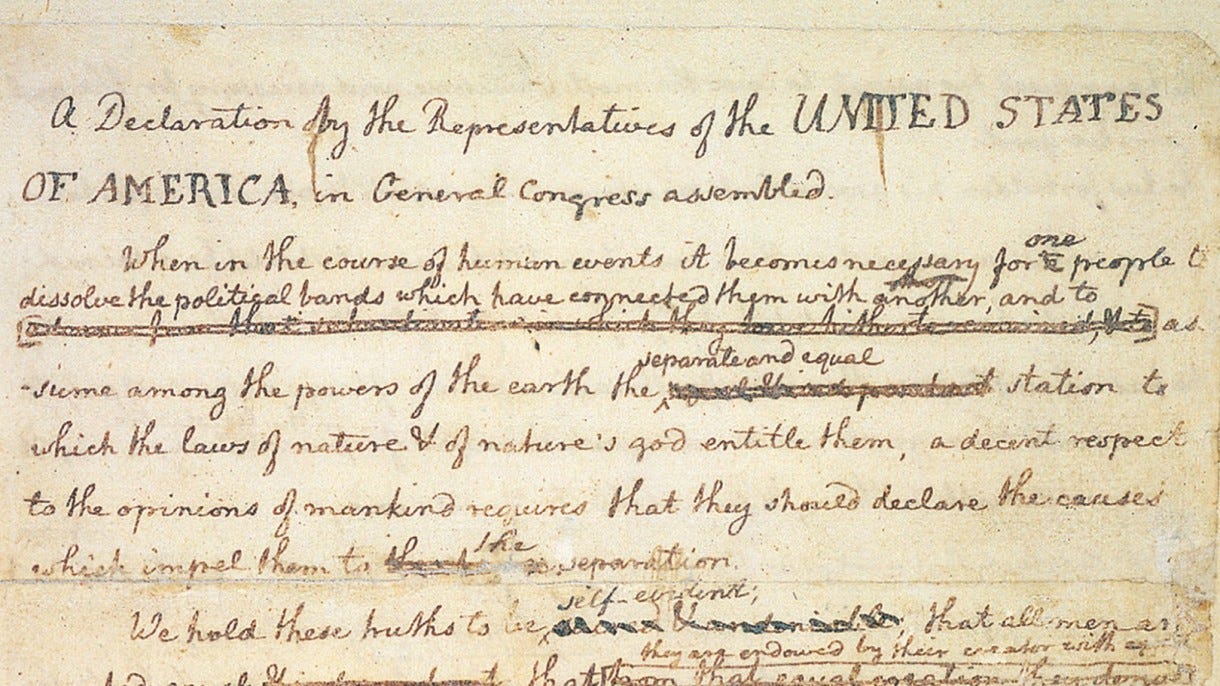
A Declaration by the Representatives of the United States of America, in General Congress assembled.
When in the Course of human events, it becomes necessary for one people to dissolve the political bands which have connected them with another, and to assume among the powers of the earth, the separate and equal station to which the Laws of Nature and of Nature’s God entitle them, a decent respect to the opinions of mankind requires that they should declare the causes which impel them to the separation.
We hold these truths to be self-evident: that all men are created equal & independent; that from that equal creation they derive rights inherent & inalienable, among which are the preservation of life, & liberty, & the pursuit of happiness: that to secure these rights, governments are instituted among men, deriving their just powers from the consent of the governed; that whenever any form of government shall become destructive of these ends, it is the Right of the People to alter or to abolish it, & to institute new government, laying its foundation on such principles & organizing its powers in such form, as to them shall seem most likely to effect their safety & happiness. Prudence indeed will dictate that governments long established should not be changed for light & transient causes; & accordingly all experience hath shewn, that mankind are more disposed to suffer, while evils are sufferable, than to right themselves by abolishing the forms to which they are accustomed. But when a long train of abuses & usurpations, begun at a distinguished period, & pursuing invariably the same object, evinces a design to reduce them under absolute despotism, it is their right, it is their duty to throw off such government, & to provide new guards for their future security. Such has been the patient sufferance of these colonies; & such is now the necessity which constrains them to expunge their former systems of government. The history of the present King of Great Britain is a history of unremitting injuries & usurpations, among which no one fact stands single or solitary to contradict the uniform tenor of the rest, but all have in direct object the establishment of an absolute tyranny over these states. To prove this, let facts be submitted to a candid world.
He has refused his assent to laws, the most wholesome & necessary for the public good.
He has forbidden his governors to pass laws of immediate & pressing importance, unless suspended in their operation till his assent should be obtained; & when so suspended, he has utterly neglected to attend to them.
He has refused to pass other laws for the accommodation of large districts of people, unless those people would relinquish the right of Representation in the legislature, a right inestimable to them & formidable to tyrants only.
He has called together legislative bodies at places unusual, uncomfortable, & distant from the repository of their public Records, for the sole purpose of fatiguing them into compliance with his measures.
He has dissolved Representative Houses repeatedly & continually, for opposing with manly firmness his invasions on the rights of the people.
He has refused for a long time after such dissolutions to cause others to be elected, whereby the legislative powers, incapable of annihilation, have returned to the people at large for their exercise; the state remaining in the meantime exposed to all the dangers of invasion from without, & convulsions within.
He has endeavored to prevent the population of these States; for that purpose obstructing the laws for naturalization of foreigners; refusing to pass others to encourage their migrations hither, & raising the conditions of new appropriations of lands.
He has obstructed the Administration of Justice by refusing his assent to laws for establishing judiciary powers.
He has made our judges dependent on his will alone, for the tenure of their offices, & the amount & payment of their salaries.
He has erected a multitude of new offices by a self-assumed power, & sent hither swarms of officers to harrass our people & eat out their substance.
He has kept among us, in times of peace, Standing Armies & ships of war without the consent of our legislatures.
He has affected to render the Military independent of, & superior to the Civil power.
He has combined with others to subject us to a jurisdiction foreign to our constitutions & unacknowledged by our laws; giving his assent to their acts of pretended legislation:
For quartering large bodies of armed troops among us;
For protecting them, by a mock trial, from punishment for any murders which they should commit on the inhabitants of these States;
For cutting off our trade with all parts of the world;
For imposing taxes on us without our consent;
For depriving us in many cases of the benefits of Trial by Jury;
For transporting us beyond Seas to be tried for pretended offences;
For abolishing the free system of English laws in a neighboring province, establishing therein an arbitrary government, & enlarging its Boundaries so as to render it at once an example & fit instrument for introducing the same absolute rule into these Colonies;
For taking away our Charters, abolishing our most valuable Laws, & altering fundamentally the forms of our Governments;
For suspending our own Legislatures, & declaring themselves invested with power to legislate for us in all cases whatsoever.
He has abdicated government here withdrawing his governors, and declaring us out of his allegiance & protection.
He has plundered our seas, ravaged our Coasts, burnt our towns, & destroyed the lives of our people.
He is at this time transporting large armies of foreign mercenaries to complete the works of death, desolation, & tyranny, already begun with circumstances of cruelty & perfidy scarcely paralleled in the most barbarous ages, & totally unworthy the head of a civilized nation.
He has constrained our fellow citizens taken Captive on the high seas to bear arms against their country, to become the executioners of their friends & Brethren, or to fall themselves by their hands.
He has endeavoured to bring on the inhabitants of our Frontiers the merciless Indian Savages whose known rule of warfare is an undistinguished destruction of all ages, sexes, & conditions of existence.
He has waged cruel war against human nature itself, violating its most sacred rights of life & liberty in the persons of a distant people who never offended him, captivating & carrying them into slavery in another hemisphere, or to incur miserable death in their transportation thither.
This piratical warfare, the opprobrium of infidel powers, is the warfare of the Christian king of Great Britain.
Determined to keep open a market where men should be bought & sold, he has prostituted his negative for suppressing every legislative attempt to prohibit or to restrain this execrable commerce.
And that this assemblage of horrors might want no fact of distinguished die, he is now exciting those very people to rise in arms among us, & to purchase that liberty of which he has deprived them, by murdering the people upon whom he also obtruded them: thus paying off former crimes committed against the liberties of one people, with crimes which he urges them to commit against the lives of another.
In every stage of these oppressions we have petitioned for redress in the most humble terms: our repeated petitions have been answered only by repeated injuries. A prince whose character is thus marked by every act which may define a tyrant, is unfit to be the ruler of a people who mean to be free.
Nor have we been wanting in attentions to our British Brethren. We have warned them, from time to time, of attempts by their legislature to extend an unwarrantable jurisdiction over us. We reminded them of the circumstances of our emigration & settlement here, no one of which could warrant so strange a pretension. That these were effected at the expence of our own blood & treasure; unassisted by the wealth or strength of Great Britain; that in constituting indeed our several forms of government, we had adopted one common king, thereby laying a foundation for perpetual league & amity with them; but that submission to their Parliament was no part of our constitution, nor ever in idea, if history may be credited. We have appealed to their native justice & magnanimity, as well as to the ties of our common kindred to disavow these usurpations, which were likely to interrupt our connection & correspondence. They too have been deaf to the voice of justice & of consanguinity, & when occasions have been given them, by the regular course of their laws, of removing from their councils the disturbers of our harmony, they have, by their free election, re-established them in power. At this very time too they are permitting their chief magistrate to send over not only soldiers of our common blood, but Scotch & foreign mercenaries to invade & destroy us. These facts have given the last stab to agonizing affection, and manly spirit bids us to renounce forever these unfeeling Brethren. We must endeavour to forget our former love for them, and to hold them as we hold the rest of mankind, enemies in war, in peace friends.
We therefore the Representatives of the United States of America in General Congress assembled, do, in the name & by the authority of the good people of these States, reject and renounce all allegiance & subjection to the kings of Great Britain, and all others who may hereafter claim by, through, or under them; we utterly dissolve all political connection which may heretofore have subsisted between us & the people or parliament of Great Britain; and finally we do assert and declare these colonies to be free & independent States; and that as free & independent States they shall hereafter have full power to levy war, conclude peace, contract alliances, establish commerce, & to do all other acts & things which independent States may of right do.
And for the support of this declaration, we mutually pledge to each other our lives, our fortunes, & our sacred honor.
Side-by-Side Comparison: Jefferson’s Original Draft vs. Final Declaration
⸻
I. Preamble
Jefferson’s Original Draft Final Adopted Text
When in the Course of human events, it becomes necessary for one people to dissolve the political bands which have connected them with another… When in the Course of human events, it becomes necessary for one people to dissolve the political bands which have connected them with another…
…to assume among the powers of the earth, the separate and equal station to which the Laws of Nature & of Nature’s God entitle them… …to assume among the powers of the earth, the separate and equal station to which the Laws of Nature & of Nature’s God entitle them…
…a decent respect to the opinions of mankind requires that they should declare the causes which impel them to the separation. …a decent respect to the opinions of mankind requires that they should declare the causes which impel them to the separation.
No significant edits.
The Preamble is almost identical.
⸻
II. Theory of Rights
Jefferson’s Draft Final Text
We hold these truths to be self-evident: that all men are created equal & independent; We hold these truths to be self-evident, that all men are created equal,
& independent (deleted) (“independent” removed)
that from that equal creation they derive rights inherent & inalienable… that they are endowed by their Creator with certain unalienable Rights…
…among which are the preservation of life, & liberty, & the pursuit of happiness; …that among these are Life, Liberty and the pursuit of Happiness.
Major edits:
• “& independent” struck.
• “endowed by their Creator” added.
• Wording softened to be more universal, less revolutionary.
⸻
III. Right of Revolution
Jefferson’s Draft Final Text
That to secure these rights, governments are instituted among men… That to secure these rights, Governments are instituted among Men…
…deriving their just powers from the consent of the governed; …deriving their just powers from the consent of the governed;
…that whenever any form of government shall become destructive of these ends, it is the Right of the People to alter or to abolish it… …that whenever any Form of Government becomes destructive of these ends, it is the Right of the People to alter or to abolish it…
…& to institute new government… …and to institute new Government…
Only minor capitalization/standardization changes.
⸻
IV. List of Grievances (General)
The majority of grievances are nearly identical, but with polishing of language. Below I include only the significant changes.
⸻
A. Attacks on the British People (Removed)
Jefferson’s Draft Final Text
Nor have we been wanting in attentions to our British brethren… Entire paragraph removed.
They too have been deaf to the voice of justice & consanguinity… (No equivalent.)
We must endeavor to forget our former love for them… (No equivalent.)
Significance:
Congress eliminated Jefferson’s critique of the British people to avoid alienating potential sympathizers and to keep the blame focused on the King.
⸻
B. Anti-Slavery Clause (Completely Deleted)
The most significant deletion.
Jefferson’s Draft — Deleted Entirely Final Text — Nothing Replaced It
“He has waged cruel war against human nature itself, violating its most sacred rights of life & liberty in the persons of a distant people who never offended him…” (No mention of slavery anywhere.)
“…captivating & carrying them into slavery…”
“Determined to keep open a market where men should be bought & sold…”
“…he is now exciting those very people to rise in arms among us…”
Significance:
The deletion erased explicit condemnation of slavery, shaping both early coalition politics and the long-term APD trajectory of race and constitutional silence.
⸻
V. King George as a Tyrant
Jefferson’s Draft Final Text
A prince whose character is thus marked by every act which may define a tyrant, is unfit to be the ruler of a people who mean to be free. A Prince whose character is thus marked by every act which may define a Tyrant, is unfit to be the ruler of a free people.
Minor revision:
• Removed phrase “who mean to be free,” making the assertion more universal and less rhetorical.
⸻
VI. Final Act of Separation
Jefferson’s Draft Final Text
We therefore the Representatives of the United States of America in General Congress assembled… We, therefore, the Representatives of the United States of America, in General Congress, Assembled…
…reject and renounce all allegiance & subjection to the kings of Great Britain, and all others who may hereafter claim by, through, or under them;… …do, in the Name, and by Authority of the good People of these Colonies, solemnly publish and declare…
…and finally we do assert and declare these colonies to be free & independent States… …That these United Colonies are, and of Right ought to be Free and Independent States…
…they shall hereafter have full power to levy war, conclude peace, contract alliances, establish commerce… …they have full Power to levy War, conclude Peace, contract Alliances, establish Commerce…
…we mutually pledge to each other our lives, our fortunes, & our sacred honor. …we mutually pledge to each other our Lives, our Fortunes and our sacred Honor.
Largest change:
• Congress added the phrase “in the Name, and by Authority of the good People of these Colonies”, strengthening the doctrine of popular sovereignty.
⸻
VII. Summary of the Most Important Differences
Jefferson’s Draft Final Text Consequences (APD)
Explicit anti-slavery clause indicting the Crown Entirely removed Entrenched constitutional silence; protected Southern unity; created long-term racial path dependency
Harsh critique of the British people Removed Allowed a narrower anti-monarchical narrative; preserved possibility of reconciliation
More radical rights language (“independent,” “inherent”) Moderated Framed American liberalism as procedural, not socially transformative
More explicit dissolution language More legalistic, formal Strengthened institutional legitimacy over revolutionary rhetoric
If you value this work, here are three ways you can step into the story with us:
📰 Subscriber (Free)
Stay informed. Receive every new essay, briefing, and analysis straight to your inbox. Join a growing community committed to civic resilience and national security.
🎧 Supporter (Paid Pledge)
Strengthen the signal. Your support sustains both Compound Security, Unlocked and our companion podcast The Civic Brief. Supporters ensure these conversations remain accessible to the wider public while elevating the quality, depth, and reach of the work.
🛡️ Sustainer (Patron Level)
Invest in the mission. Sustainers fuel new research, convenings, and storytelling that enlarge the civic frame of security. This is more than content — it’s a civic project. Your sponsorship helps preserve an independent voice committed to equipping citizens, leaders, and institutions for the compound challenges ahead.