

SYSTEM POSITION
ZONE 2
Democratic Degradation
DIRECTION
RIGHTWARD
Erosion
CONFIDENCE
MODERATE–HIGH
PNR
NOT CROSSED
W.i.S.E. Strategic Foresight Watch™ • Inaugural American Republic Watch
There is a difference between political conflict and democratic degradation
There is a difference between a republic in political conflict and a republic losing its capacity for constitutional self-correction. That difference is the reason for this Watch.
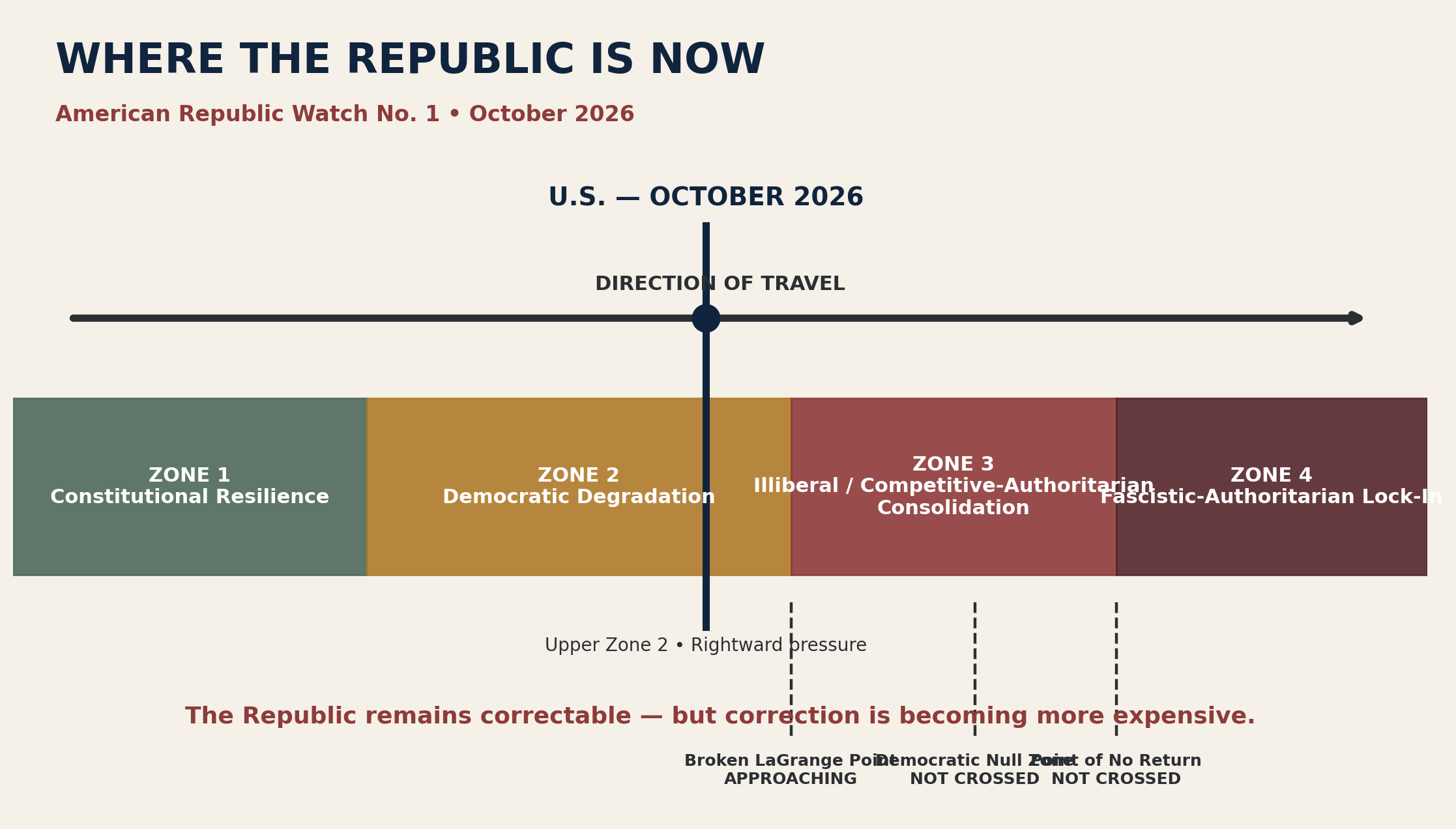
The inaugural American Republic Watch begins with a sober judgment: the United States remains in Zone 2 — democratic degradation — but continues to move rightward toward the boundary of Zone 3, illiberal or competitive-authoritarian consolidation.
That is not a declaration that American democracy is dead. It is not a prediction of inevitable fascism. And it is not a partisan scorecard dressed up as systems analysis. It is a warning that the cost of democratic correction is rising.
Institutions are still resisting. Courts are still issuing adverse rulings against the executive. States retain independent authority. Journalists continue to investigate. Civil-society organizations continue to litigate and organize. Elections remain competitive. Public opposition remains visible. The Republic is still capable of fighting with itself — and that is an essential sign of constitutional life.
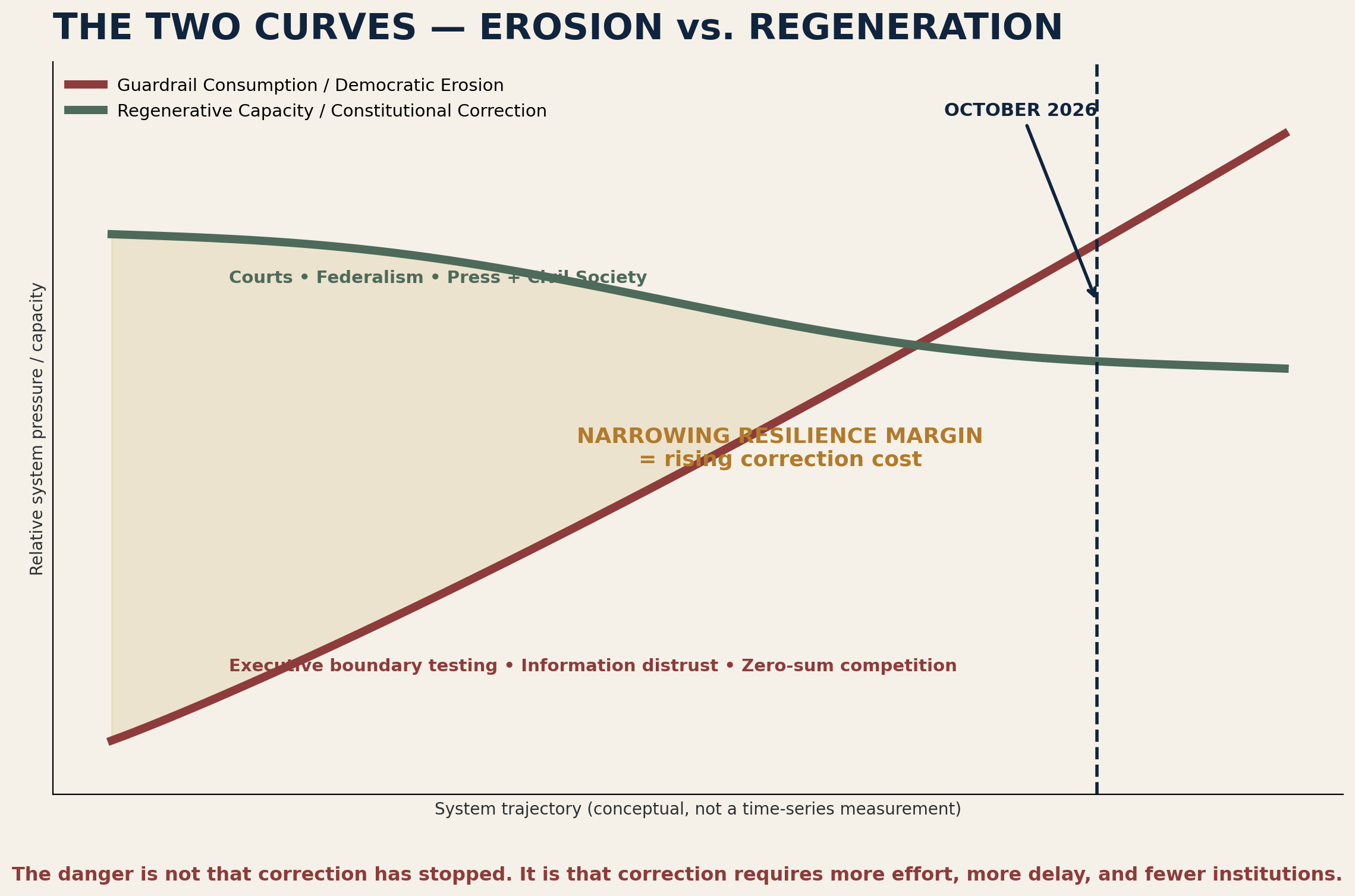
But more of the corrective burden is falling on fewer institutions after the fact. That is the shift worth watching.
The October judgment
International IDEA’s 2026 Global State of Democracy report warns that major indicators of U.S. democracy, including press freedom and judicial independence, have fallen to their lowest levels in roughly fifty years. Freedom House reaches a different but complementary judgment: the United States remains “Free,” but its 2026 score fell from 84 to 81 out of 100.
Those assessments are useful precisely because they do not say the same thing in the same way. One tells us how far major indicators have deteriorated historically. The other reminds us that the constitutional system remains recognizably democratic and free. That combination is consistent with a Zone 2 judgment: the Republic is damaged. It is not gone.
The thing I am watching most closely
The most important October signal is not simply executive ambition. America has had forceful presidents before. The more consequential signal is a growing imbalance between executive velocity and constitutional friction.
The pattern is increasingly familiar: an executive action occurs; another institution must mobilize; litigation follows; a judge intervenes; an appeal follows. The constitutional system still produces friction — but increasingly through emergency correction after institutional boundaries are tested.
That is not the same thing as institutional equilibrium. A healthy republic does not depend exclusively on judges repeatedly telling political actors where the guardrails are. Courts are a safeguard of last resort. They cannot become the Republic’s entire immune system.
The 10 Illnesses — and the 10 Cures
The American Republic Watch is organized around the architecture developed in Letters to the Republic and Blueprints from the Ashes: 10 Illnesses matched to 10 Cures. The method matters because democratic decline is not a single-variable problem.
A republic can preserve elections while losing institutional neutrality. It can preserve courts while destroying shared factual reality. It can preserve formal rights while making their practical exercise increasingly unequal. It can preserve constitutional language while hollowing out the civic habits necessary to sustain constitutional government.
So the Watch tracks both sides of the system: what is being consumed and what is being regenerated.
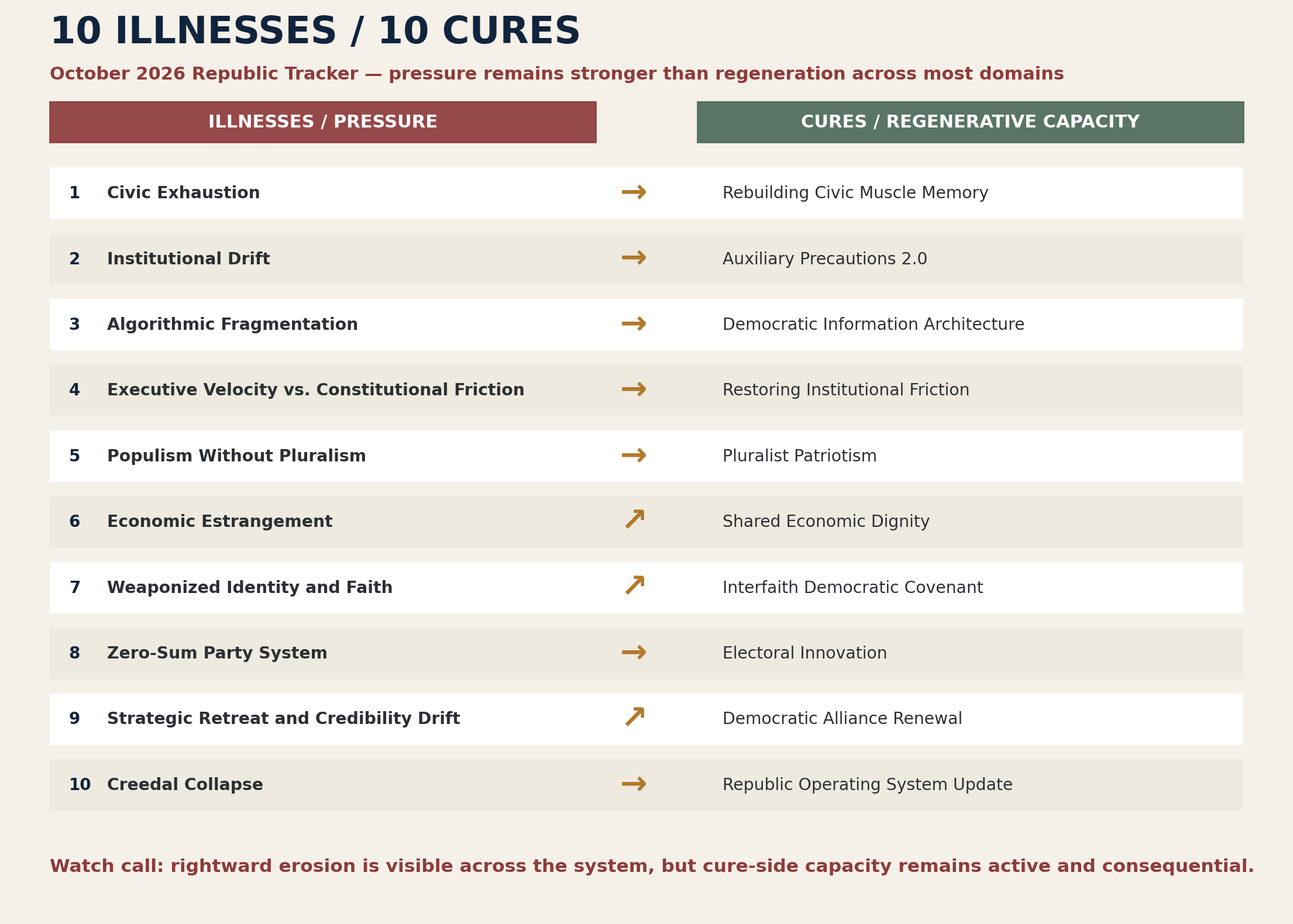
1. Civic Exhaustion → Rebuilding Civic Muscle Memory
The 2026 Annenberg Constitution Day Civics Survey found that 35 percent of U.S. adults could not name all three branches of the federal government. This is not evidence of authoritarianism. It is, however, evidence of civic vulnerability.
A republic whose citizens cannot reliably identify its architecture becomes easier to distort because constitutional violations become harder for the public to recognize as violations. The cure is civic muscle memory: constitutional literacy, democratic participation, service, tolerance of defeat, and the habit of distinguishing political opposition from national betrayal.
2. Institutional Drift → Auxiliary Precautions 2.0
The Founders understood that constitutional text alone would not restrain ambition. Ambition had to counter ambition. The modern problem is that many institutions designed to check power have become weaker, more partisan, more deferential, or more dependent on individual courage. The cure is a modernized system of auxiliary precautions: protected inspectors general, professional public administration, strong congressional oversight, enforceable statutory boundaries, transparent emergency powers, and institutions designed to remain functional when partisan incentives reward submission.
3. Algorithmic Fragmentation → Democratic Information Architecture
AP-NORC’s 2026 State of the Facts survey found that trust in federal information about elections and politics fell from 22 percent in 2024 to 13 percent in 2026. Forty-three percent reported difficulty figuring out whether candidate claims were true. This is the approach to what I call a “Democratic Null Zone:” not the disappearance of information, but the failure of feedback. Every unfavorable fact becomes propaganda; every institution becomes partisan; every correction becomes further evidence of conspiracy. A democracy can survive disagreement. It cannot indefinitely survive the collapse of feedback integrity.
4. Executive Velocity vs. Constitutional Friction → Restoring Institutional Friction
This is the central Watch domain for October. The Republic remains capable of resisting executive overreach — but too much of the burden now falls on judicial intervention after disputed actions occur. The cure is not weak executive leadership. It is balanced executive power embedded within durable constitutional friction: Congress legislating and overseeing, courts adjudicating, professional administrators enforcing law rather than personal loyalty, and states preserving federal redundancy.
5. Populism Without Pluralism → Pluralist Patriotism
Democracy requires more than majority rule. It requires acceptance that citizens who lose elections remain full members of the political community. Pluralist patriotism means something simple: constitutional membership cannot depend upon political loyalty.
6. Economic Estrangement → Shared Economic Dignity
Economic frustration does not automatically produce authoritarian politics. But persistent economic estrangement weakens democratic legitimacy when citizens conclude that institutions operate for someone else. The cure is not merely growth. It is shared economic dignity: a political economy in which citizens can plausibly believe democratic institutions remain capable of improving ordinary life.
7. Weaponized Identity and Faith → Interfaith Democratic Covenant
Pew Research Center’s 2026 data provide an important counter-signal. The share of Americans saying government should stop enforcing separation of church and state fell from 19 percent in 2021 to 13 percent in 2026. At the same time, 17 percent now say the federal government should declare Christianity the official religion, up from 13 percent in 2024. Both facts belong in the Watch. One warns against complacency. The other warns against exaggeration.
8. The Zero-Sum Party System → Electoral Innovation
A constitutional republic depends upon the idea of tolerable defeat: I can lose today because I believe I may compete tomorrow. Once political actors believe electoral loss is existential, restraints disappear. The key test is whether electoral competition remains genuinely meaningful, administration remains lawful, and winners and losers retain a plausible path back to power.
9. Strategic Retreat and Credibility Drift → Democratic Alliance Renewal
The American Republic is not a closed domestic system. Its democratic identity and its international alliances reinforce one another. Domestic institutional erosion changes how allies calculate American reliability; external accommodation of authoritarian practices can feed back into domestic expectations about legitimate power. The cure is democratic alliance renewal appropriate to the Compound Age: resilient, reciprocal, and rooted in common institutional interests rather than personality.
10. Creedal Collapse → Republic Operating System Update
The deepest illness is creedal. Does the office belong to the officeholder? Does law bind the winner? Does opposition remain legitimate? Does the oath run to the Constitution or to a person? The constitutional creed does not require agreement on policy. It requires agreement on the rules that make peaceful disagreement possible. That operating system is under pressure. But it has not crashed.
The two curves: erosion and regeneration
An early-warning system that records only decay will eventually mistake pessimism for rigor. The Watch therefore follows two curves at once: the consumption of democratic guardrails and the regeneration of democratic capacity. The central October insight is not that correction has stopped. It is that correction increasingly requires more effort, more delay, and a narrower set of institutions.
Where we are on the four-zone curve
Zone 1 — Constitutional Resilience: Institutions absorb shocks. Political losses remain tolerable. Rules are broadly accepted. Abuse is corrected faster than it accumulates.
Zone 2 — Democratic Degradation: Norm-breaking becomes recurrent. Institutional independence weakens. Equal application of law becomes contested. Correction remains possible — but slower, costlier, and increasingly dependent on extraordinary intervention.
Zone 3 — Illiberal or Competitive-Authoritarian Consolidation: Elections continue, but incumbents systematically tilt the field, weaken institutional referees, punish opposition, politicize enforcement, and reduce the practical possibility of alternation in power.
Zone 4 — Fascistic-Authoritarian Lock-In: Leader-state fusion, exclusionary ultranationalism, normalized political violence, coercive conformity, and destruction of meaningful pluralist competition converge into a self-protecting regime.
Threshold call
The Broken LaGrange Point
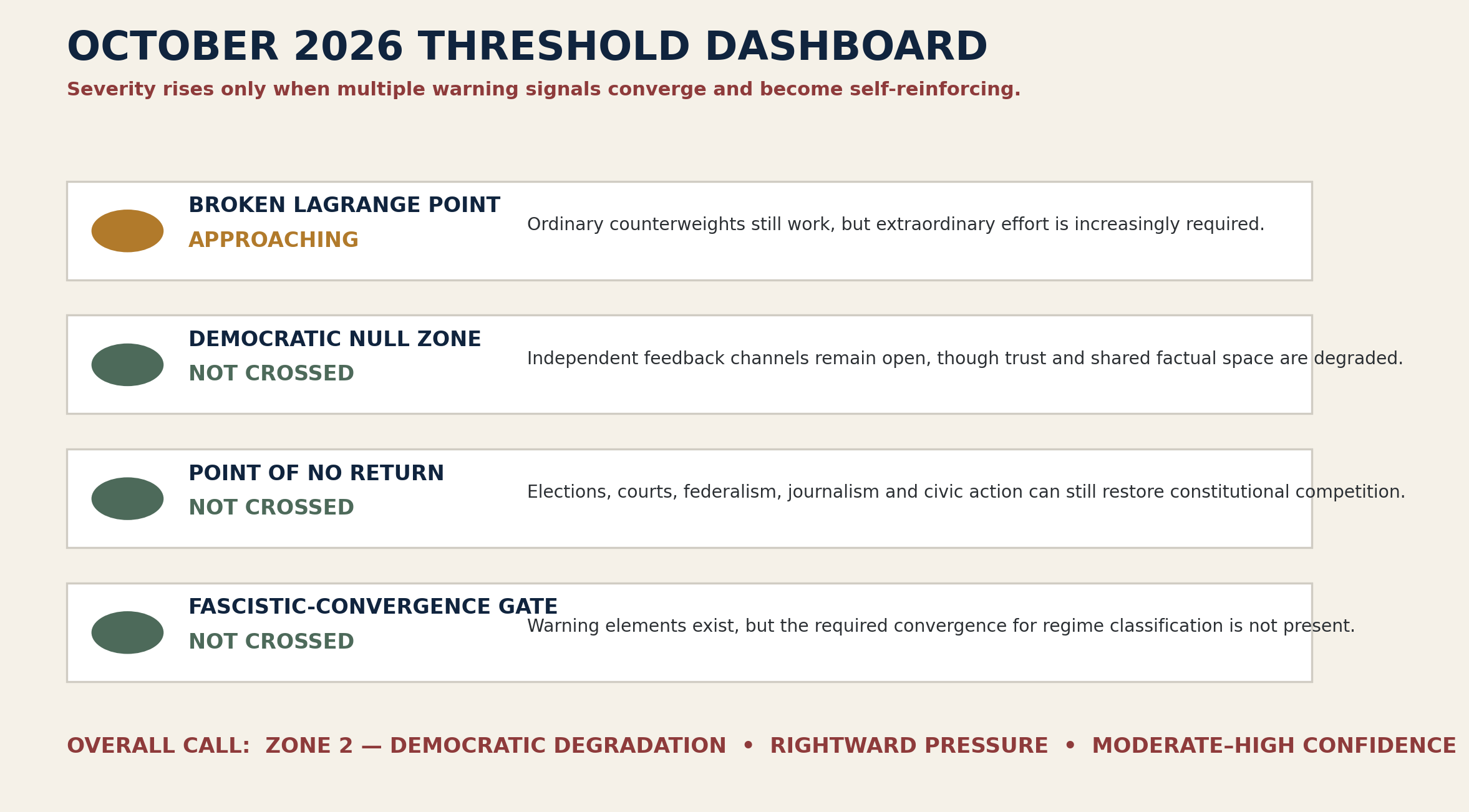
Borrowing from orbital mechanics, think of a constitutional system as a dynamic equilibrium among competing centers of power. No institution is stationary. Congress, courts, executive agencies, states, parties, media, civil society, and citizens constantly exert force on one another. The Broken LaGrange Point is reached when those countervailing forces no longer reliably return the system toward lawful equilibrium. My October judgment is: we are approaching that point. We have not crossed it.
The Democratic Null Zone
The Democratic Null Zone begins when the feedback loops necessary for democratic adaptation become too degraded to function. The danger is not simply lying; democracies have always contained lies. The deeper danger is systemic inability to distinguish truth from loyalty. We have not crossed the Null Zone. Independent information still exists. The feedback channels remain open. But they are noisier, more partisan, and less trusted.
Have we crossed the Point of No Return?
No. A meaningful Point of No Return would require evidence that ordinary constitutional mechanisms could no longer plausibly restore equal political competition. We are not there. Opposition parties govern major jurisdictions. Elections remain consequential. Courts issue rulings against the executive. News organizations challenge restrictions. Citizens organize. Federalism provides redundant centers of power.
And what about fascism?
The word should remain available. But it should be expensive. A finding of fascistic convergence would require multiple features to become mutually reinforcing: leader-state fusion, exclusionary ultranationalism, systematic political coercion, normalized or state-tolerated political violence, destruction of pluralist competition, subordination of law to personal authority, and organized mass mobilization against designated internal enemies. There are warning signals within that constellation. There is not yet sufficient convergence to classify the American regime as fascist.
The Republic is still correctable. But correction is becoming more expensive.
What would move the Watch left?
· Consistent executive compliance with final judicial orders.
· Bipartisan congressional reassertion of oversight and appropriations authority.
· Protection of professional civil service and inspectors general.
· Clear legal and operational protections around voting and election administration.
· Measurable reductions in threats against election workers and public officials.
· Improved civic knowledge and reduced tolerance for political violence.
· Stronger shared confidence in independently verifiable information.
· Successful electoral transitions accepted by winners and losers.
· Visible implementation of the 10 Cures — as institutional behavior, not rhetoric.
What would move the Watch Rightward, into Zone 3?
· Systematic use of public power to alter electoral competition for partisan advantage.
· Routine punishment or removal of public officials for personal political disloyalty.
· Regulatory, contracting, or licensing power used to reward friendly media and punish hostile media.
· Repeated executive refusal to comply with final judicial orders.
· Large-scale politicization of federal law enforcement.
· State or federal coercion that materially deters opposition voting, organizing, or campaigning.
· A durable merger of governing authority, party organization, and loyalist private actors directed against lawful political opposition.
Bottom line
The Republic is still correctable. That is the most important conclusion of this inaugural Watch. But correction is becoming more expensive. More democratic energy is being spent defending previously settled boundaries instead of adapting the Republic to the problems of the future. That is democratic degradation. It is serious. But it is not destiny.
The United States still possesses extraordinary democratic redundancy: fifty states, thousands of local governments, independent courts, universities, journalists, professional associations, civic organizations, businesses, churches, veterans, public servants, and citizens capable of saying no. The central strategic question is whether those sources of resilience can regenerate constitutional capacity faster than compound stress consumes it.
That is what this Watch will measure: not whether one party wins, not whether another party loses, and not whether the politics are ugly — but whether the system retains its ability to see error, absorb correction, constrain power, preserve pluralism, and peacefully change course. That is the real test of a republic.
Sources & Notes
Selected public sources supporting the inaugural October 2026 baseline. The Watch’s zone and threshold calls are Wilson W.i.S.E. analytical judgments, not classifications issued by these organizations.
1. International IDEA. Global Democracy Report: Rule of Law Weakens as the United States Hits 50-Year Lows. https://www.idea.int/news/global-democracy-report-rule-law-weakens-united-states-hits-50-year-lows
2. International IDEA. The Global State of Democracy 2026: Democracy in an Age of Conflict. https://www.idea.int/publications/catalogue/html/global-state-democracy-2026-democracy-age-conflict
3. Freedom House. United States: Freedom in the World 2026 Country Report. https://freedomhouse.org/country/united-states/freedom-world/2026
4. Annenberg Public Policy Center. A Third of Americans Cannot Name the Three Branches of Government. https://www.annenbergpublicpolicycenter.org/a-third-of-americans-cannot-name-the-three-branches-of-government/
5. AP-NORC Center for Public Affairs Research. State of the Facts 2026. https://apnorc.org/projects/state-of-the-facts-2026/
6. Pew Research Center. How Americans Feel About Religion’s Influence in Government and Public Life. https://www.pewresearch.org/religion/2026/05/14/how-americans-feel-about-religions-influence-in-government-and-public-life/

If you value this work, here are three ways you can step into the story with us:
📰 Subscriber (Free)
Stay informed. Receive every new essay, briefing, and analysis straight to your inbox. Join a growing community committed to civic resilience and national security.
🎧 Supporter (Paid Pledge)
Strengthen the signal. Your support sustains both Compound Security, Unlocked and our companion podcast The Civic Brief. Supporters ensure these conversations remain accessible to the wider public while elevating the quality, depth, and reach of the work.
🛡️ Sustainer (Patron Level)
Invest in the mission. Sustainers fuel new research, convenings, and storytelling that enlarge the civic frame of security. This is more than content — it’s a civic project. Your sponsorship helps preserve an independent voice committed to equipping citizens, leaders, and institutions for the compound challenges ahead.
The White House press pool is like watching pro wrestling. Staged and rehearsed softballs to a fake lawyer whose only real qualifications are being porn star trophy wife to some MAGA shill…….This is making a mockery of the office of the POTUS.
Actions against the ICC should knock the meter even lower near the bottom category.