
After the “Post-”
Notes of a Fatalistic-Optimist in an Age That Can’t Name Its Future.

I have a memory of standing in a lecture hall at West Point in the early 2000s, a few years after September 11th, facing a room full of cadets who were about to graduate into war.
They were attentive in the particular way young officers are attentive—not merely polite but alert, as if scanning for what might matter later.
Outside, the Hudson moved as it always has, indifferent to strategy and sentiment. Inside, the vocabulary of the moment was heavy: transformation, counterterrorism, regime change, democracy promotion.
We were already in Afghanistan. Iraq was imminent.
The mood was not reckless. It was certain.
History, we thought, had returned with clarity. The post–Cold War ambiguity of the 1990s—Somalia, Bosnia, the Balkans—had resolved into something stark. There were enemies. There were missions. There were objectives.
Looking back, I don’t remember triumphalism.
I remember velocity.
The sense that events were accelerating and that our institutions, homefront and international, were struggling to keep up.
We were, though we didn’t yet have the word for it, entering a permanent emergency.
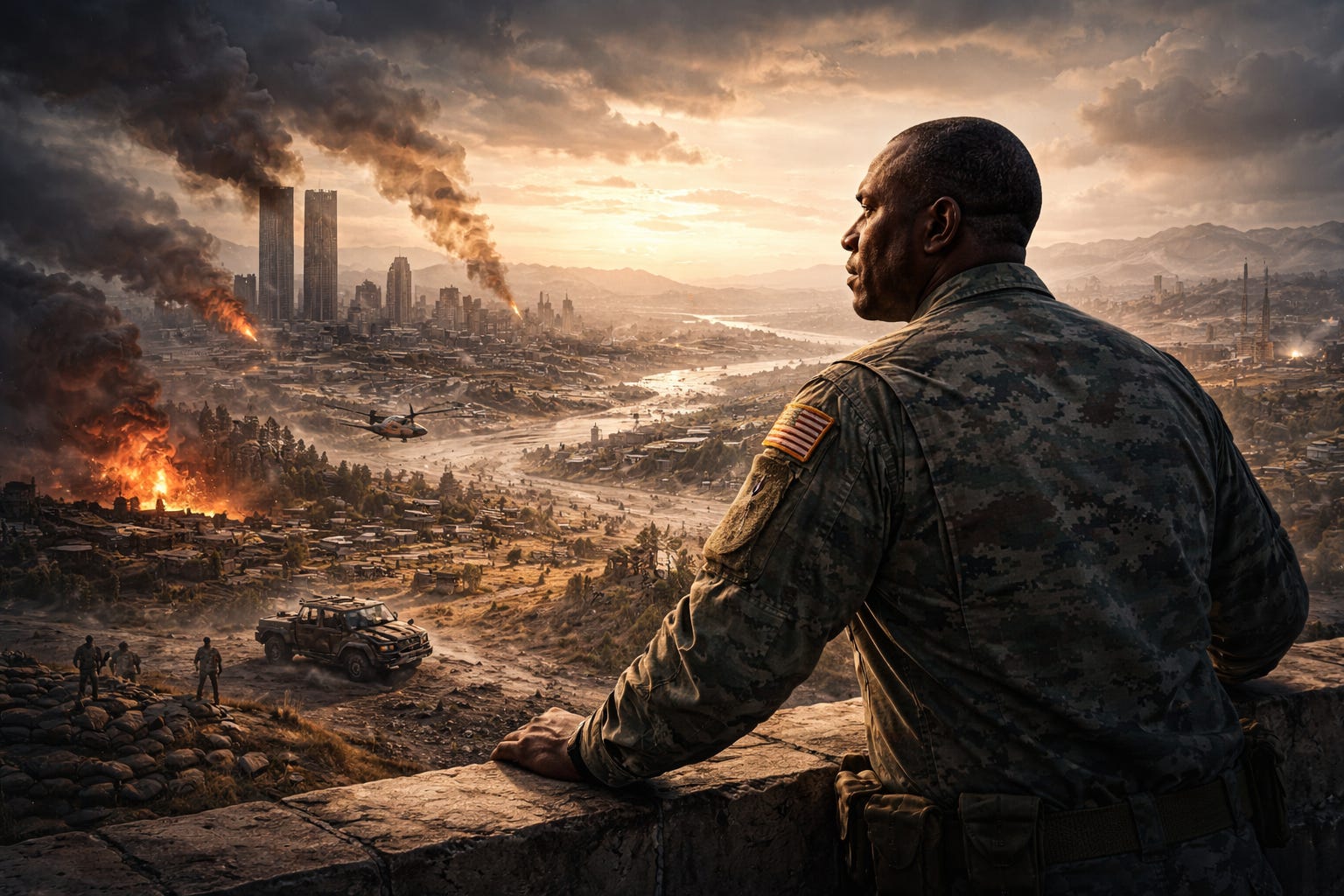
I grew up in a country that was always “post-” something.
“Post-Vietnam,” though the war lingered in family stories and in the wary eyes of veterans who avoided parades. “Post-Watergate,” though the distrust never quite drained from the civic bloodstream. “Post–Cold War,” when it seemed briefly as though history had relaxed and the map had flattened.
Then came 9/11, and with it a new prefix.
“Post-9/11.”
The phrase did not mean what earlier “post-” phrases had meant. It did not imply recovery. It implied rupture.
I was in Manhattan not long after the towers fell. The air still held the faint metallic scent that clung to Lower Manhattan for weeks. People moved quietly, as if indoors. Posters of the missing lined the walls.
In that moment, the word “post” felt obscene.
Nothing was over.
Everything was raw.
The wars that followed were born not only of anger but of fear—the fear that vulnerability had been exposed, that complacency had invited catastrophe.
Afghanistan began as necessity. Iraq became argument.
Years later, in Baghdad, I remember driving through neighborhoods where blast walls divided streets into narrow corridors. Children played soccer beside concrete barriers spray-painted with unit insignias. The city pulsed with life, but it was a life rearranged around fortification.
Iraq taught me something that no briefing ever could: removing a regime is not the same as constructing a political order.
Toppling is kinetic.
Building is political.
The former can be scheduled; the latter cannot.
One evening, in a room lit by a single buzzing fluorescent fixture, an Iraqi civil servant—exhausted, polite, unillusioned—said to me, “You Americans are very good at removing things.”
He did not need to finish the sentence.
The war did not collapse in a single dramatic failure. It frayed. It metastasized. It hardened into insurgency and sectarianism. Tactical brilliance coexisted with strategic ambiguity.
When people say “post-Iraq,” they often mean disillusionment. For me, it means humility.
Afghanistan was different.
I first “visited” Kabul in the early years of the war, when the mood was still tentative but hopeful. Girls returned to school. Markets reopened. International aid workers moved briskly through the streets, maps folded under their arms.
Two decades later, as the final American aircraft lifted off from Hamid Karzai International Airport, I watched footage of people running alongside the planes. The images were chaotic, desperate, intimate.
Afghanistan did not end with a bang. It ended with a slow accumulation of fatigue.
There is a particular kind of exhaustion that sets in when strategy drifts. Not defeat, not surrender—drift. A mismatch between stated objectives and lived reality.
The longest war in American history concluded not because the mission was achieved but because the ‘political will’ dissolved.
“Post-Afghanistan” is less a statement about terrain than about time.
It is a reminder that endurance, untethered from alignment between ends and means, becomes inertia.
The Global War on Terror was never declared formally, and it was never declared finished….
… It expanded and contracted, shifted theaters, renamed itself. It created new legal authorities and normalized old ones.
At some point, war became ambient.
In Washington, briefings would begin with updates from places most Americans couldn’t locate on a map. In airport terminals, announcements about unattended luggage felt like echoes from another era. Surveillance programs, once controversial, settled into bureaucratic routine.
The emergency hardened into infrastructure.
This is what “post-GWOT” actually means: not that the war is over, but that its habits persist.
Speed.
Executive discretion.
A bias toward action.
A tolerance for permanent mobilization.
Those habits have now been redirected toward a different contest—one with peer competitors rather than insurgent networks—but they remain habits.
Last winter, I attended a gathering in Europe where defense officials and industrial executives spoke with urgency about production capacity.
The language was industrial, not ideological: output, surge, integration.
Russia’s war in Ukraine had forced a reckoning. Munitions stockpiles were depleted. Supply chains strained. European states that had long underinvested in defense were scrambling to rebuild.
There was something bracing about the seriousness of it. No one spoke of “the end of history.” No one assumed friction would disappear.
But I felt a faint echo of earlier moments—the confidence that acceleration could compensate for ambiguity.
Production, of course, matters. Deterrence without capacity is rhetoric.
Yet I found myself wondering whether we were mistaking throughput for architecture.
During the Cold War, arms exports were instruments of strategy. They were debated in diplomatic terms. They were constrained by formal oversight.
Today, they are also instruments of industrial stabilization. Production lines in the United States depend on foreign orders. Alliances are woven through supply chains.
Security is co-produced.
This evolution is not sinister. It reflects economic reality. But it carries consequences.
When a production line depends on global demand, policy flexibility narrows. When alliances depend on shared factories, political disagreement acquires economic cost. When arms exports become a measure of seriousness, speed crowds out deliberation.
We have entered what I think of as a compound security dilemma.
Not the classic version, in which one state’s defensive measures threaten another.
This one is subtler.
It operates within the system itself. Efforts to reinforce strength in one domain generate rigidity in others.
Accelerate exports to deter adversaries. In doing so, compress escalation timelines. Integrate industries to fortify alliances. In doing so, reduce strategic distance. Sustain production through foreign recapitalization. In doing so, narrow room for recalibration.
Security exported. Constraint imported.
There and back again.
On a visit to Athens years ago, I stood on the Pnyx, where citizens once gathered to debate expeditions and expenditures. The city’s ruins do not speak, but they do ‘suggest’.
Ancient Athens did not fall because it lacked capacity. It fell, in part, because it mistook momentum for prudence.
The “Expedition to Sicily” was conceived at the height of confidence. The city had resources, ships, ambition.
It also had blind spots.
History does not repeat in clean lines. The United States is not ancient Athens. But the temptation of momentum is perennial.
After Iraq, many Americans recoiled from intervention. After Afghanistan, some recoiled from endurance. After the GWOT, others recoiled from emergency.
Recoil is understandable. But it is not strategy.
The alternative is not retreat. It is design.
We would do well to reflect on all this as we enter our next “expedition,” in and with Iran.
I return often to that lecture hall at West Point ….
The cadets I taught have since served multiple tours. Some have left the service. Some remain. They entered a world defined by “post-”—post-9/11, post-Iraq, post-Afghanistan—and they now inhabit one defined by renewed competition.
When I speak with them, what I hear is not cynicism. It is complexity. They know power has limits. They know drift is dangerous. They also know disengagement has costs.
Perhaps this is what ‘fatalistic-optimism’ looks like in practice: a generation that expects friction but refuses fatalism.
We cannot undo Vietnam, Watergate, Iraq, Afghanistan, or the GWOT. They are sedimented in our institutions and in our civic psyche.
But we can decide what we are for.
A resilience-democracy would not pretend that shocks disappear.
It would design institutions to absorb them.
It would measure security policy not only by deterrent effect but by its impact on constitutional elasticity.
It would treat industrial capacity as necessary but insufficient.
It would insist that strength and restraint are not opposites but partners.
The temptation of the “post-” is to define ourselves by what we have survived. The challenge is to define ourselves by what we aim toward.
Strong without hubris.
Engaged without overreach.
Secure without surrendering the legal and civic architecture that makes security worth having.
History compounds. So do institutions. So do habits.
The question is whether we allow compounding to harden into rigidity—or whether we (re)design for resilience.
In an age that cannot stop naming its endings, perhaps the most radical act is to name our beginning.
Not post-something.
“For” something. …. perhaps, dare I say, “For Nation, Not Self?!”
And to build accordingly.
If you value this work, here are three ways you can step into the story with us:
📰 Subscriber (Free)
Stay informed. Receive every new essay, briefing, and analysis straight to your inbox. Join a growing community committed to civic resilience and national security.
🎧 Supporter (Paid Pledge)
Strengthen the signal. Your support sustains both Compound Security, Unlocked and our companion podcast The Civic Brief. Supporters ensure these conversations remain accessible to the wider public while elevating the quality, depth, and reach of the work.
🛡️ Sustainer (Patron Level)
Invest in the mission. Sustainers fuel new research, convenings, and storytelling that enlarge the civic frame of security. This is more than content — it’s a civic project. Your sponsorship helps preserve an independent voice committed to equipping citizens, leaders, and institutions for the compound challenges ahead.
A 3rd stupid useless war doesn't make the first two any more valuable or dignified.