
AFFORDABILITY, GOVERNANCE, AND THE SOCIAL CONTRACT ...
Why American Renewal Begins With the Cost of Living.

Author’s Note
This essay grew out of a long-running civic dialogue about the rising cost of living, the erosion of institutional trust, and the growing sense—here and around the world—that the systems meant to protect and empower ordinary people are no longer doing either.
What follows is an attempt to weave those threads together: the economics of affordability, the architecture of governance, the failures that brought us to this point, and the possibilities that still exist for renewal.
The argument is simple.
The future of democratic-republican self-government will not turn on slogans or partisan cycles, but on whether societies can restore the basic conditions of stability, dignity, and shared opportunity.
Affordability is not a niche concern; it is the structural hinge on which legitimacy now turns.
Address it seriously, and renewal is possible. Ignore it, and the foundations of liberal democracy will continue to crack.
This essay is offered in that spirit—neither as a partisan brief nor a policy manual, but as a contribution to the wider work of rebuilding a political order worthy of the people it exists to serve.
Introduction.
American politics is full of abstractions—ideology, messaging, narratives, slogans—but the country itself runs on something far simpler: whether ordinary people can afford to live dignified, stable, predictable lives.
Affordability is often dismissed as a pocketbook issue, a matter of wages and prices.
In reality, it is the front line of democratic legitimacy.
When working Americans have to choose between groceries and rent, between medicine and utilities, between childcare and transportation, the issue is not merely economic.
It is civic.
It is constitutional.
It defines whether people feel they are part of the political community or merely surviving within it.
For the wealthy, inflation is an annoyance.
For most Americans, it is a decision tree of sacrifices.
That gap—between those who experience inflation as inconvenience and those who experience it as threat—is the measure of a Republic drifting away from itself.
I. The Hidden Balance Sheet of Poverty
American public debate rarely confronts the true cost of poverty. A low-wage economy is often described as flexible, efficient, or business-friendly.
But any comprehensive accounting reveals the opposite:
Poverty is extraordinarily expensive.
Its costs show up everywhere:
emergency measures in law enforcement
overcrowded jails and court backlogs
expanded budget lines for SNAP, WIC, LIHEAP, Head Start, and housing aid
school security costs and learning deficits tied to household instability
mental and public health burdens
generational wage depression
long-term tax base erosion
homelessness and the municipal infrastructure required to manage it
higher insurance rates, higher policing budgets, higher litigation costs
reduced consumer demand — and therefore reduced economic growth
A single enforcement surge in a major city, such as the recent crackdowns that flooded local jails, illustrates the point.
The downstream effects—overflow incarceration contracts, legal delays, emergency appropriations, disrupted families, lost wages, and future unemployability—represent millions of dollars in public spending and even larger losses in long-term economic potential.
A low-wage economy does not save money; it simply moves costs from private payrolls to public balance sheets, where they accumulate and compound.
And yet, the United States continues to treat low wages as normal and the resulting social consequences as unfortunate but unrelated policy domains.
They are not unrelated.
They are causal.
II. The Poverty–Greed–National Debt Triangle
The dynamics at play can be understood as a triangle:
Poverty drives the demand for public spending
Greed (in the economic sense—deregulated labor markets, wages decoupled from productivity, anti-union strategies) suppresses wages
National Debt absorbs the downstream costs
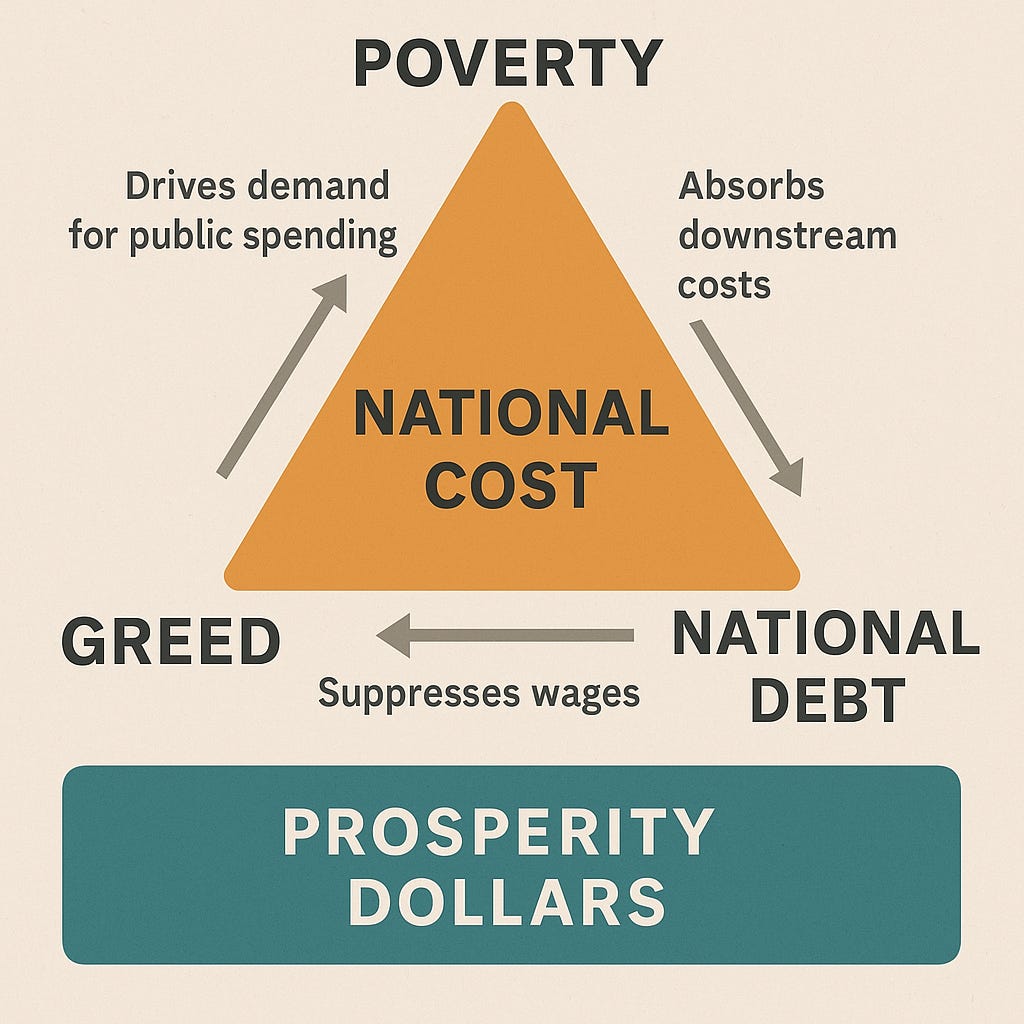
Inside that triangle sits the real variable: national cost.
Outside the triangle sits what remains: prosperity dollars—money available for education, infrastructure, research, climate resilience, defense, and future-building.
As poverty expands, prosperity contracts.
As wages fall, public costs rise.
As greed concentrates, the national debt grows.
A country that pushes its labor base below subsistence eventually pays for it—through crime, instability, political extremism, failed schools, overstressed courts, overstretched police, and shrinking economic mobility.
History is clear:
Societies that tolerate endemic poverty eventually face civic fracture or political upheaval.
III. Why a Living Wage is a Security Policy
A living wage—indexed to real local costs, not abstract national averages—is not charity and not redistribution. It is the cheapest and most direct stabilizer a complex society can deploy.
It:
reduces crime
strengthens families
increases educational outcomes
expands lifetime earnings and tax revenue
lowers downstream public expenditures
increases consumer demand
stabilizes neighborhoods
improves civic trust
reduces political extremism
It is a bipartisan solution hiding in plain sight.
The question is not whether the country can “afford” a living wage.
The real question is why it continues to finance the far larger costs of not having one.
Collective bargaining fits into this logic.
When renters or workers negotiate together, they reduce externalities—stabilizing markets, improving maintenance and productivity, and lowering public burdens associated with housing insecurity and churn.
Collective action, supported rather than undermined by policy, strengthens the economic floor on which communities stand.
IV. Affordability as the New Political Battleground
The national conversation has entered a strange phase. Some political actors now dismiss affordability as a “manufactured issue,” even as millions face declining purchasing power month after month.
This misalignment between elite perception and lived reality creates a democratic vacuum.
Affordability is not messaging.
It is not a talking point.
It is the governing reality of most American households.
When citizens perceive that the political class fails to understand their economic position, they lose trust in institutions.
They turn to alternatives—sometimes democratic, …. sometimes not.
This widening trust gap explains much of the volatility in American political behavior in recent years.
V. The Architecture Problem: A Government Built by Accretion
Economic insecurity is not the only structural issue. The federal government’s organizational logic is also misaligned with 21st-century reality.
For 240 years, the Executive Branch grew through improvisation rather than design. Agencies were created during crises, reorganized by political compromise, or placed according to convenience rather than function.
The result is a government with:
“do-it” agencies mixed with “regulate-it” agencies
enforcement bodies scattered across departments
duplicative cyber, intelligence, and legal units
policy offices embedded in agencies that also implement
service-delivery offices that grade their own performance
A system built this way is hard to navigate even for insiders—and nearly impossible for citizens.
The misplacement of agencies such as the Secret Service, Coast Guard, USAID, or HUD illustrates how historical legacies now obstruct functional coherence.
A modern republic requires a modern structure:
clear functions, clean lines of authority, and separation of operational and regulatory powers.
VI. The Case for a ‘Federal Help Desk’
One practical idea emerging from this broader critique is the creation of a Federal “Front Door”—a centralized help desk that guides citizens to the correct agency, staffed by humans, not chatbots, with tiered support (Level 1 → Level 2 → Specialist).
This does more than assist citizens.
It forces the government to clarify its own internal architecture.
A front door requires a coherent house.
Reorganizing around function—service, regulation, enforcement—makes that possible.
VII. The AI Frontier: Governance Before Crisis
The AI debate, often presented as partisan spectacle, reflects the same governance problem.
The real issue is not whether AI will “take over,” but whether the country builds an institutional framework that can:
separate learning systems from doing systems
require human-in-the-loop approval
enforce RICO-like liability for misuse
define AI as “pseudo-human” for legal accountability
regulate high-risk applications without stifling innovation
prevent consolidation of AI power into monopolistic chokepoints
protect biological, chemical, and cyber domains from automated exploitation
AI is not an existential threat in the science-fiction sense.
But it is an infrastructural threat in the civic sense—if not governed with the same care applied to aviation, nuclear power, medicine, or biological research.
Once again, architecture matters.
Oversight must be designed into the system.
VIII. The Path Forward: A Republic Worthy of Its Citizens
All of these threads—wages, affordability, government architecture, campaign finance, media distortion, AI—point to the same underlying reality:
The United States faces a ‘system problem’, not a series of isolated crises.
The solution is neither ideological nor technocratic.
It is architectural.
A healthier Republic will require:
A living wage policy tied to real costs.
Upstream investment to reduce downstream enforcement and social spending.
Functional reorganization of the Executive Branch.
Separation of service delivery, regulation, and enforcement inside the government itself.
Campaign finance reform and media transparency, reducing dependency on billion-dollar cycles.
A Federal Help Desk, democratizing access to government.
AI governance frameworks designed for responsibility, not fear.
A restored social contract grounded in opportunity, dignity, and civic reciprocity.
None of these ideas are radical.
They are “common-sense” reforms for a complex country confronting 21st-century realities with 19th-century systems.
The central truth is simple:
A republic that wants stability must invest in the stability of its people.
Affordability is not a niche issue; it is the scaffolding on which democracy stands.
When policy returns to lived experience—and when governance is aligned with function rather than tradition—renewal becomes possible.
And that is the work ahead.
IX. When Systems Fail, Faith Fades: The Global Turn Against Capitalism and “Democracy”
The affordability crisis and the hidden costs of poverty are not merely domestic policy failures. They are the main drivers of a broader crisis of faith in the political–economic models that defined the last century.
Across much of the world, majorities now say that capitalism “as it exists today” does more harm than good.
A global survey conducted just before the pandemic found that 56 percent of respondents across 28 countries agreed with that statement, with especially high skepticism in countries like Thailand and India.
In the United States, the share of people with a positive view of capitalism has fallen markedly in recent years, with younger adults particularly skeptical.
At the same time, surveys across Western democracies reveal deep dissatisfaction with how democracy is actually working.
An Ipsos poll in late 2025 found satisfaction with the state of democracy below 50 percent in almost every country surveyed—including the United States, where only about one in five respondents expressed satisfaction and many feared democratic decline in the near future.
The pattern is clear:
People still like the idea of democracy.
They increasingly distrust the practice of their democracies.
They see economic systems as rigged and political systems as captured.
Recent trust-barometer data underscores this: large majorities across countries believe government and business favor the wealthy, and a significant share—especially among younger cohorts—now view hostile actions, including violence and online attacks, as potentially necessary to force change.
This is what happens when the affordability crisis, the poverty-cost triangle, and the architecture problem collide:
Capitalism is experienced not as opportunity, but as extraction.
Democracy is experienced not as representation, but as theater.
Institutions are experienced not as stewards, but as self-protecting guilds.
The result is a grievance-based society—fertile terrain for strongmen, demagogues, and “solutions” that promise order while quietly dismantling liberty.
The paradox is that both capitalism and democracy are still fully capable of serving the public good.
They simply cannot do so when economic insecurity is normalized, and governance systems are misaligned with the lived realities of citizens.
X. ‘The Great Society’: America’s Last Big Try at Structural Affordability
The United States has confronted something like this before.
In the 1960s, the “Great Society” programs—Medicare, Medicaid, major education, and anti-poverty initiatives, along with landmark civil rights legislation—represented the last serious effort to attack structural insecurity at scale.
It was, in many ways, a bold attempt to build affordability into the architecture of American life:
health care for the elderly and poor
investments in education
efforts to reduce poverty and racial inequality
major investments in housing and urban development
But this experiment collided with another strategic choice: the escalating war in Vietnam.
The classic “guns vs. butter” dilemma—whether to invest national resources in military power (“guns”) or domestic programs (“butter”)—was not merely theoretical in this period.
It was brutally concrete.
As U.S. commitments in Vietnam grew, defense spending surged even while Great Society spending expanded.
Instead of choosing, leaders tried to do both—war and welfare—without fully paying for either.
The result was:
rising inflation,
mounting deficits,
political backlash,
and ultimately, the political and fiscal strangling of the Great Society itself.
The lesson is stark:
The last time the United States made a serious, large-scale attempt to address structural affordability and social insecurity, it “lost the plot” in a guns-versus-butter world.
The country chose short-term geopolitical escalation over long-term domestic resilience—and the social project suffered.
What was framed at the time as “butter” was, in fact, the real security investment:
…. healthier citizens, less poverty, stronger communities, greater educational opportunity, and a more legitimate democracy.
The “guns” won the budget battle.
The Republic has been paying the price ever since.
XI. From ‘Guns vs. Butter’ to ‘Compound Security’
The old guns-versus-butter model was a simplification: more tanks or more textbooks.
Today’s environment is more complex—but the underlying tradeoff remains.
The compound-security lens clarifies what is at stake.
In a world of:
converging geopolitical crises,
climate disruption,
resource and supply-chain insecurity,
pandemics,
AI and cyber vulnerabilities,
and democratic backsliding,
“real security” is not merely the absence of external attack. It is the presence of:
economic stability,
social cohesion,
functional institutions,
trusted information systems,
and a population that believes it has a stake in the system.
Under this lens:
Military power is one component of security.
Affordability, opportunity, and dignity are foundations of security.
The guns-versus-butter model was right to identify tradeoffs, but wrong in its implicit hierarchy.
What was historically labeled “butter”—social spending, education, health, housing, anti-poverty programs—turns out to be the core of compound, sustainable security.
If affordability collapses, governance becomes brittle.
If governance becomes brittle, deterrence becomes unreliable.
If deterrence becomes unreliable, crises proliferate.
The “butter” is not optional. It is the operating system.
XII. Affordability as the Core Platform for 2026, 2028, and a Liberal-Democratic Renaissance
All of this points toward an unavoidable conclusion:
If liberal democracies—starting with the United States—want to survive and thrive in the 21st century, affordability must become the core platform, not a side plank.
Not “inflation” in the abstract, but the concrete ratio between income and the cost of staying afloat:
housing
food
health
childcare
transportation
education
digital access
The 2026 midterms and the 2028 national elections in the United States will unfold against a backdrop of:
global economic anxiety,
declining trust in capitalism and democracy,
grievance-based politics,
accelerating technological disruption,
and rising geopolitical risk.
Any political project that pretends this is just a messaging war will fail.
A serious democratic restoration effort—call it a Project 2028 for the Republic—would:
Put living wage + affordability at the center of its agenda, as security policy, not charity.
Treat structural poverty and precarity as national-security vulnerabilities.
Advance executive-branch reorganization that aligns government functions with citizen needs.
Reform campaign finance and media practices that currently reward spectacle over substance.
Build AI and digital governance frameworks that protect people while enabling innovation.
Recast “butter” as hard security—the investment that keeps the Republic intact.
Offer a credible, tangible path back to a fair, functional, liberal-democratic republicanism.
And the stakes are not just national.
Around the world, liberal democracies are under pressure from both within and without.
Citizens are questioning whether these systems still deliver. Autocrats and illiberal movements are eager to answer that question for them.
A worldwide renaissance of liberal democratic republicanism will not be won by rhetoric about “values” alone.
It will be won by systems that deliver affordability, dignity, and credible futures.
If democracy cannot make life livable, people will look elsewhere.
If capitalism cannot share its gains, people will look for other models.
Affordability—understood as the compound condition where wages, prices, services, and governance align to support a dignified life—is the hinge on which this century’s political history will turn.
Which brings us back to the core claim:
A republic that wants stability must invest in the stability of its people.
The real “butter” is not softness. It is the hardened infrastructure of a just society.
And in a world of compound threats, that is the only security that lasts.
If you value this work, here are three ways you can step into the story with us:
📰 Subscriber (Free)
Stay informed. Receive every new essay, briefing, and analysis straight to your inbox. Join a growing community committed to civic resilience and national security.
🎧 Supporter (Paid Pledge)
Strengthen the signal. Your support sustains both Compound Security, Unlocked and our companion podcast The Civic Brief. Supporters ensure these conversations remain accessible to the wider public while elevating the quality, depth, and reach of the work.
🛡️ Sustainer (Patron Level)
Invest in the mission. Sustainers fuel new research, convenings, and storytelling that enlarge the civic frame of security. This is more than content — it’s a civic project. Your sponsorship helps preserve an independent voice committed to equipping citizens, leaders, and institutions for the compound challenges ahead.