
A Strategy Reframed
What America’s “New” Counterterrorism Doctrine Really Signals.

by Dr. Ike Wilson
Introduction
The release of the 2026 United States Counterterrorism Strategy has been framed as a decisive break from the past—a “return to common sense,” a restoration of clarity, and a recalibration of priorities.
Yet beneath the rhetoric of renewal lies a more complex reality.
The strategy does not so much reinvent American counterterrorism as it reframes it—narrowing its conceptual boundaries in some areas while expanding them in others, and in the process revealing a deeper shift in how the United States understands the nature of security itself.
At stake is not simply how the United States fights terrorism, but how it defines the problem.
For more than two decades after September 11, U.S. counterterrorism evolved—unevenly but meaningfully—toward a recognition that terrorist threats are embedded in broader political, social, and transnational systems.
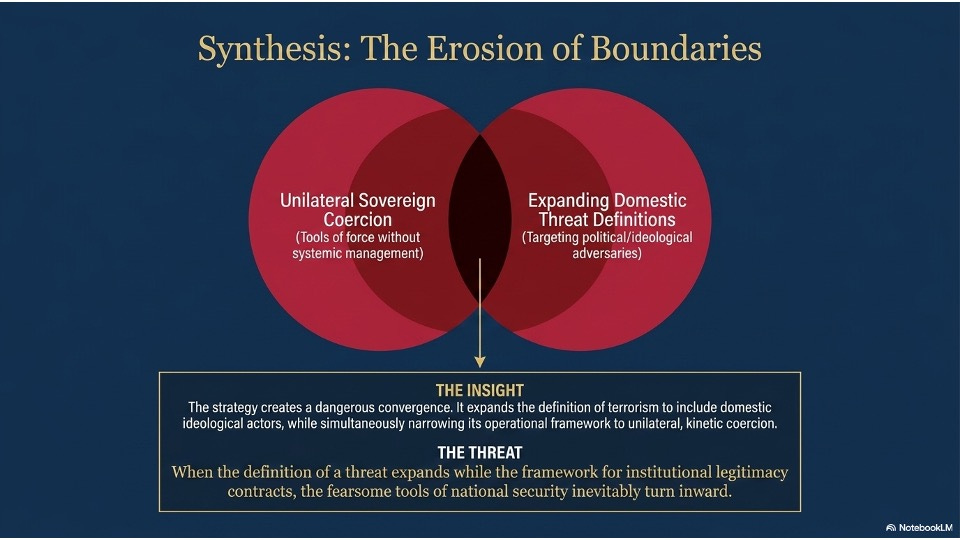
The 2026 strategy signals a departure from that worldview. In its place emerges a more compressed and sovereignty-centered conception of counterterrorism—one that privileges coercion, prioritization, and domestic alignment over network management and systemic engagement.
An Expanded Threat, A Narrowed Frame
At first glance, the strategy appears expansive.
It broadens the category of terrorist threats to include not only legacy Islamist organizations such as al Qaeda and ISIS but also narcoterrorists, transnational gangs, and certain categories of domestic ideological actors. It elevates the Western Hemisphere as a primary theater of concern, placing cartels and cross-border networks at the center of national security planning. And it emphasizes the integration of military, intelligence, financial, and law enforcement tools in a unified campaign to “identify,” “disrupt,” and ultimately “destroy” threat actors.
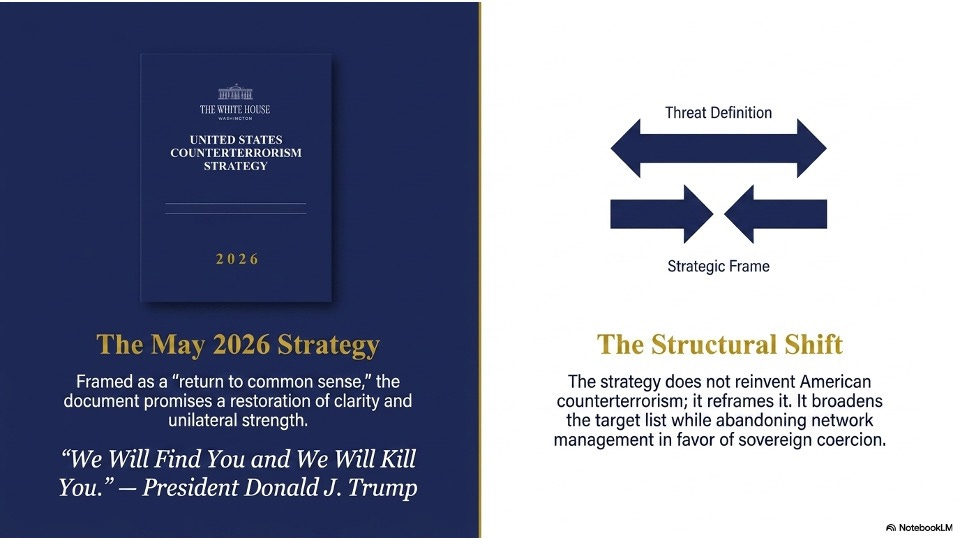
Yet this expansion of the threat landscape is paired with a narrowing of the strategic frame. The strategy places less emphasis on the environments in which terrorism takes root—weak governance, political exclusion, ideological contestation—and more on the direct elimination of actors and their enabling networks. It reflects a return to a model of counterterrorism as targeted disruption, rather than systemic management.
More “anti-terrorism” than counter-terrorism.
This shift carries both strengths and limitations. It restores clarity and prioritization to a mission set that has often been criticized for diffusion and overreach. But it also risks overlooking the conditions that allow threats to regenerate, adapt, and persist.
From Networks to Sovereignty
Perhaps the most significant departure lies in the strategy’s underlying worldview. The post-9/11 counterterrorism paradigm—particularly as it matured—was built on the recognition that terrorism operates across borders, within networks, and through relationships that no single state can fully control. This understanding drove an emphasis on alliances, partner capacity, and multilateral cooperation.
The 2026 strategy shifts the center of gravity. It frames counterterrorism primarily as a function of sovereignty—the defense of the homeland against external and internal threats. The emphasis on “America First,” the prioritization of the Western Hemisphere, and the willingness to act independently of partner alignment all point toward a more unilateral orientation.
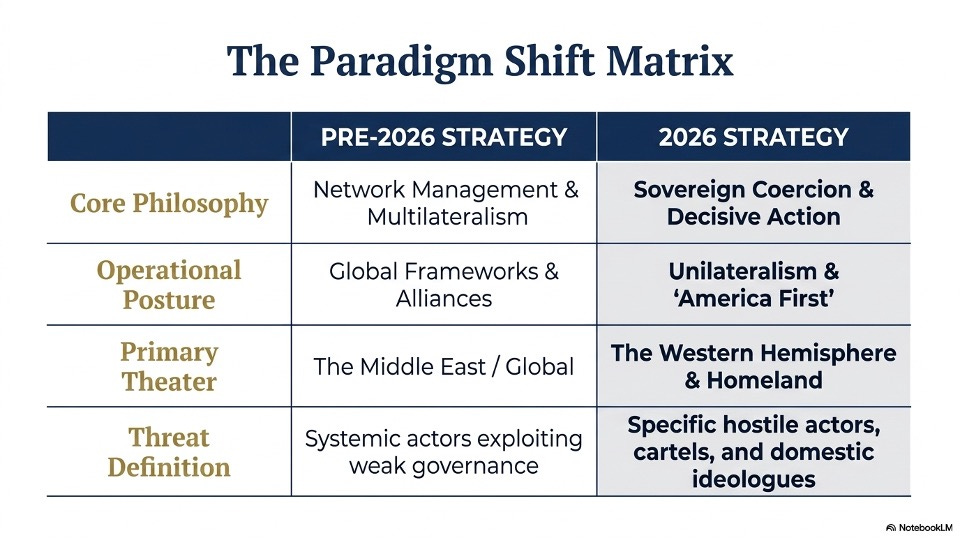
This does not mean alliances disappear. The strategy still acknowledges the role of partners and burden-sharing. But the tone and structure suggest a reordering: cooperation becomes conditional rather than foundational. The United States is prepared to act with others—but no longer necessarily through them.
The Politicization Problem
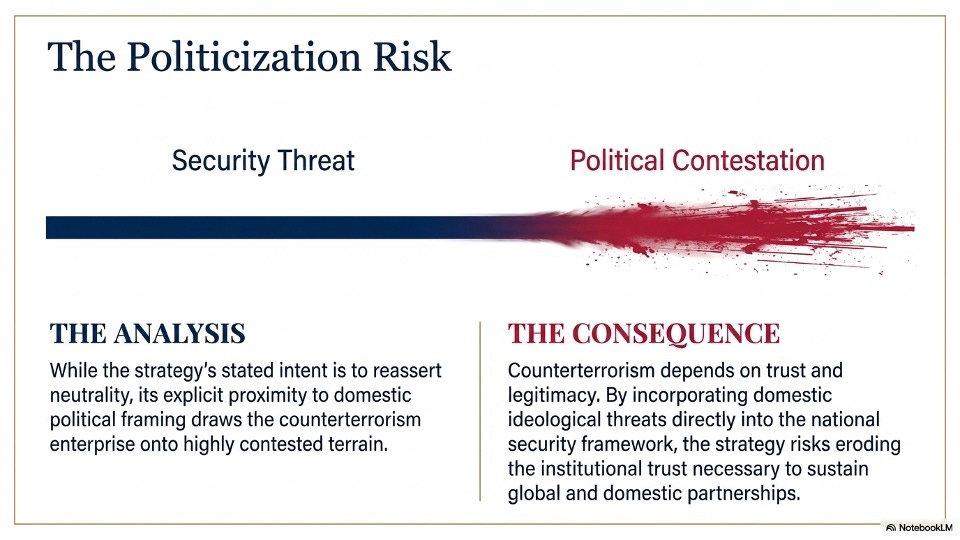
Another notable feature of the strategy is the proximity of domestic political framing to its core logic. The document explicitly addresses the perceived misuse of counterterrorism authorities “by prior administrations” and incorporates certain domestic ideological threats into its framework.
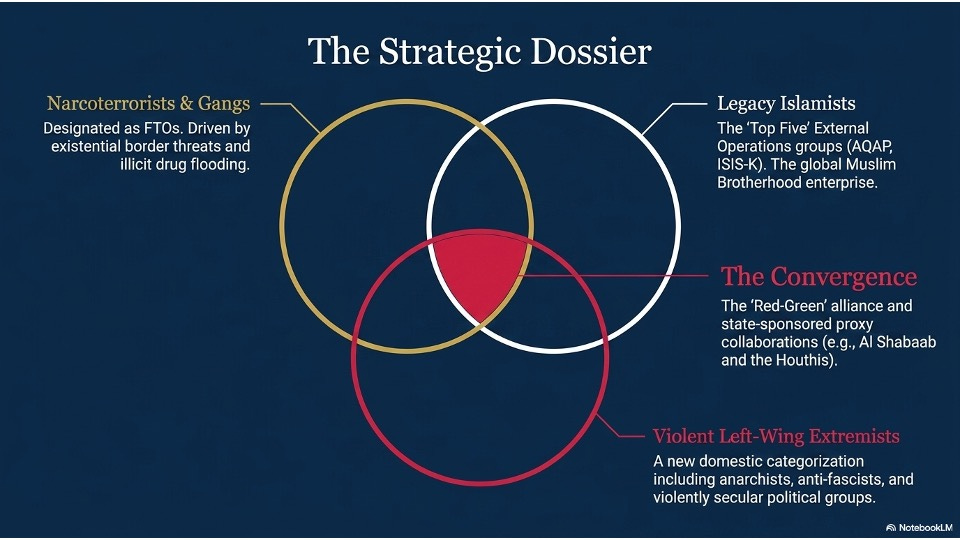
While the intent is to reassert neutrality and accountability, the effect is to draw counterterrorism closer to contested political terrain.
This introduces a risk that has long haunted the CT enterprise: the erosion of legitimacy. Counterterrorism depends not only on capability but on trust—within the intelligence community, among domestic audiences, and across international partnerships. When the boundaries between security and politics blur, that trust becomes harder to sustain.
Continuity Beneath Change
Despite its claims of transformation, the strategy retains substantial continuity with its predecessors. The core mission remains unchanged: to identify threats before they materialize, disrupt their capabilities, and destroy their networks. The prioritization of external operations–capable groups persist. The prevention of weapons of mass destruction remains a “no-fail” mission. And the operational reliance on intelligence, special operations, and precision targeting continues to define the U.S. approach.
In this sense, the strategy’s novelty lies less in what it does than in how it frames what it does. The machinery of counterterrorism remains intact. The narrative surrounding it has shifted.
A Strategic Inflection Point
The 2026 strategy ultimately reflects a deeper tension within U.S. national security thinking. Is terrorism best understood as a global, networked phenomenon requiring sustained engagement across political and social domains? Or is it primarily a problem of hostile actors to be neutralized through decisive action and sovereign control?
The answer, of course, has always been both. The challenge is balance.
By tilting toward a sovereignty-first, coercion-centered model, the strategy seeks to restore focus and discipline. But in doing so, it risks underweighting the systemic dimensions of the threat. Terrorism is not only a function of actors; it is a function of environments. Eliminating the former without shaping the latter has historically produced only temporary gains.
Conclusion
The 2026 U.S. Counterterrorism Strategy is not a clean break with the past. It is a recalibration—one that sharpens some elements of American counterterrorism while compressing others. It reflects a shift in emphasis from networks to sovereignty, from systemic engagement to targeted disruption, and from global frameworks to domestic priorities.
Whether this shift proves effective will depend less on its internal coherence than on its alignment with the evolving threat environment. And more fundamentally, on how Trump’s America chooses to define “common sense effectiveness.”
If terrorism continues to operate through diffuse networks and enabling conditions, a strategy centered on coercion alone may struggle to keep pace. If, however, the threat landscape becomes more concentrated and state-linked, the strategy’s emphasis on decisive action may find greater purchase.
What is clear is that the United States is at an inflection point—not only in how it conducts counterterrorism, but in how it understands it.
Beyond questions of effectiveness and alignment, the deeper implication of this strategic shift may lie in what Jon Meacham has described as the enduring struggle over the “soul of America.”
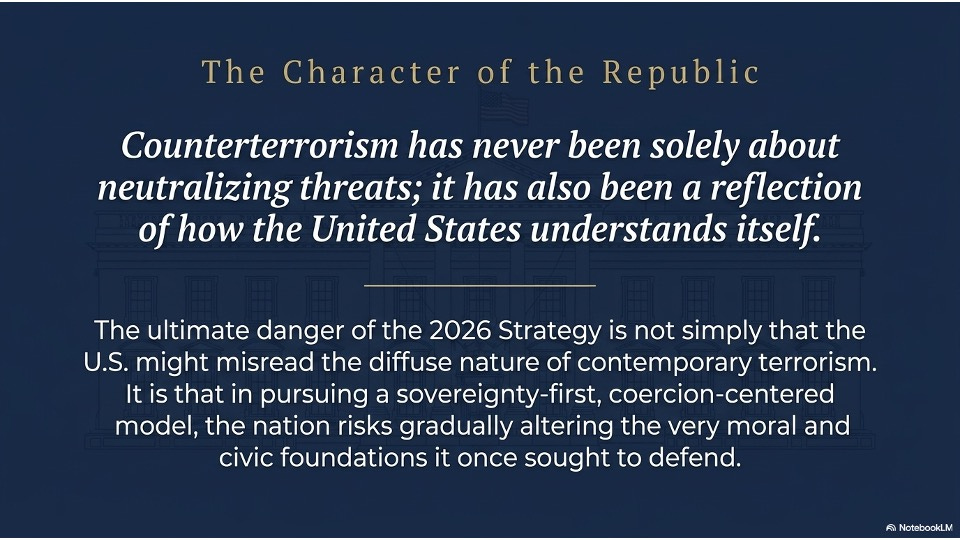
Counterterrorism has never been solely about neutralizing threats; it has also been a reflection of how the United States understands itself—its values, its limits, and its obligations at home and abroad.
When the definition of threat expands while the framework for legitimacy contracts, there is a risk that the instruments of security begin to reshape the character of the republic itself.
A strategy that leans too heavily on coercion, that blurs the boundary between political contestation and security threat, or that narrows its conception of partnership and pluralism may secure short-run tactical advantage while eroding the moral and civic foundations that have long underwritten American power.
The ultimate danger, then, is not only that the United States misreads the nature of contemporary terrorism, but that in responding to it, it gradually alters the very principles it seeks – once sought – to defend.
If you value this work, here are three ways you can step into the story with us:
📰 Subscriber (Free)
Stay informed. Receive every new essay, briefing, and analysis straight to your inbox. Join a growing community committed to civic resilience and national security.
🎧 Supporter (Paid Pledge)
Strengthen the signal. Your support sustains both Compound Security, Unlocked and our companion podcast The Civic Brief. Supporters ensure these conversations remain accessible to the wider public while elevating the quality, depth, and reach of the work.
🛡️ Sustainer (Patron Level)
Invest in the mission. Sustainers fuel new research, convenings, and storytelling that enlarge the civic frame of security. This is more than content — it’s a civic project. Your sponsorship helps preserve an independent voice committed to equipping citizens, leaders, and institutions for the compound challenges ahead.
A couple things stand out to me on this.
1.) The highlighting of left wing domestic extremist groups but not right wing. This identification in itself shows that there is not an honest intellectual approach to defining terrorism. It is as you state, politicized. This should be a glaring red flag for everyone in the Intel and Security space.
2.) What we have seen from the administration in terms of positioning towards Boko Haram, other sub Saharan terrorist organizations, and the Nations they thrive in falls epically short of what it will actually take to destroy these organizations. The administration fails to understand that the basic economic security and the corruption fueled by every other nation that operates on the continent AND not on the continent continue to keep that part of world a safe haven for these organizations.
This could also be said about the cartels as well.
Ultimately, the shift will prove not to be effective because of the political priorities of using a hammer and the ideological America First.